
BJJ Blue Belt Time Explained for Zetland Beginners
Most adults in Australia reach blue belt in about 18 to 36 months of regular training, and a practical Zetland-style average is around 2 years. If you train 3 times per week, blue often lands in about 1.5 to 2 years, while 1 to 2 sessions per week usually pushes the timeline beyond 2 years.
If you're new on the mats, that's probably both reassuring and a little confronting. You might be a few weeks into class at Zetland, learning how to shrimp, getting stuck under side control, and wondering whether everyone else understands more than you do. They usually don't. Most beginners feel clumsy early on because BJJ has its own movement language, and your body hasn't learned it yet.
The part that confuses people is this. BJJ blue belt time isn't really about waiting for months to pass. It's about building enough reliable skill that you can stay calm, defend yourself, escape bad spots, and make decent choices against resistance. In other words, blue belt is less about flashy submissions and more about whether your fundamentals still work when someone is trying to stop you.
At Locals Zetland and Locals Maroubra, that's the lens that makes the journey easier to understand. A student who turns up consistently, gets lots of live reps, and pays attention to defence often progresses more smoothly than someone who only thinks about techniques they want to attack with. The blue belt isn't a reward for surviving. It's a sign that your basics are starting to hold together.
Blue belt is where your Jiu Jitsu stops feeling random and starts feeling organised.
That matters because the biggest bottleneck usually isn't getting to blue. It's what happens after. Plenty of people chase the belt, earn it, then realise the development phase has just begun. If you understand that early, your training gets steadier, less emotional, and much more productive.
Introduction What BJJ Blue Belt Time Really Means in Zetland
A lot of adult beginners ask the same question after the first month. "How long until blue belt?" Usually that question shows up right after a class where mount escape finally made sense, or right after a round where nothing worked and you felt like you were back at day one.
Both experiences are normal.
In Australian guidance, the most common answer is still 18 to 36 months of regular training, with some Sydney-area guidance placing the practical average at roughly 2.3 years and also noting that students training 3 times per week may reach blue in about 1.5 to 2 years, while 1 to 2 times per week often stretches past 2 years. You can see that benchmark in this Australian guide on how long it takes to get a blue belt.
What beginners often get wrong
New students usually treat blue belt like a finish line. Coaches don't. A blue belt means your game has a shape to it. You don't need to know everything. You do need to show that the core pieces are becoming dependable.
Think about someone learning to swim in the ocean. You wouldn't judge them by one perfect stroke in calm water. You'd judge whether they stay composed when the water gets messy. BJJ works the same way. A student can know an armbar in a calm drill and still not be close to blue belt if they panic under pressure.
What coaches are really looking for
The clearest signs are practical:
Defence first: You can protect yourself in bad positions instead of freezing.
Escapes that repeat: You don't escape once by accident. You can do it again.
Basic choices under pressure: You stop making the same major mistakes every round.
Control before attack: You understand that position comes before submission.
That last point matters a lot. Many white belts think blue belt means a bigger submission collection. It usually means something simpler and harder. Your structure, balance, and timing have started to become trustworthy.
Understanding the BJJ Belt Journey to Blue Belt
Before blue belt makes sense, the belt system has to make sense.
For adults, the belt order is white, blue, purple, brown, then black, and there isn't a fixed promotion calendar because instructors decide when a student is ready rather than following a universal timetable. That's outlined in this Australian overview of BJJ belt ranks.
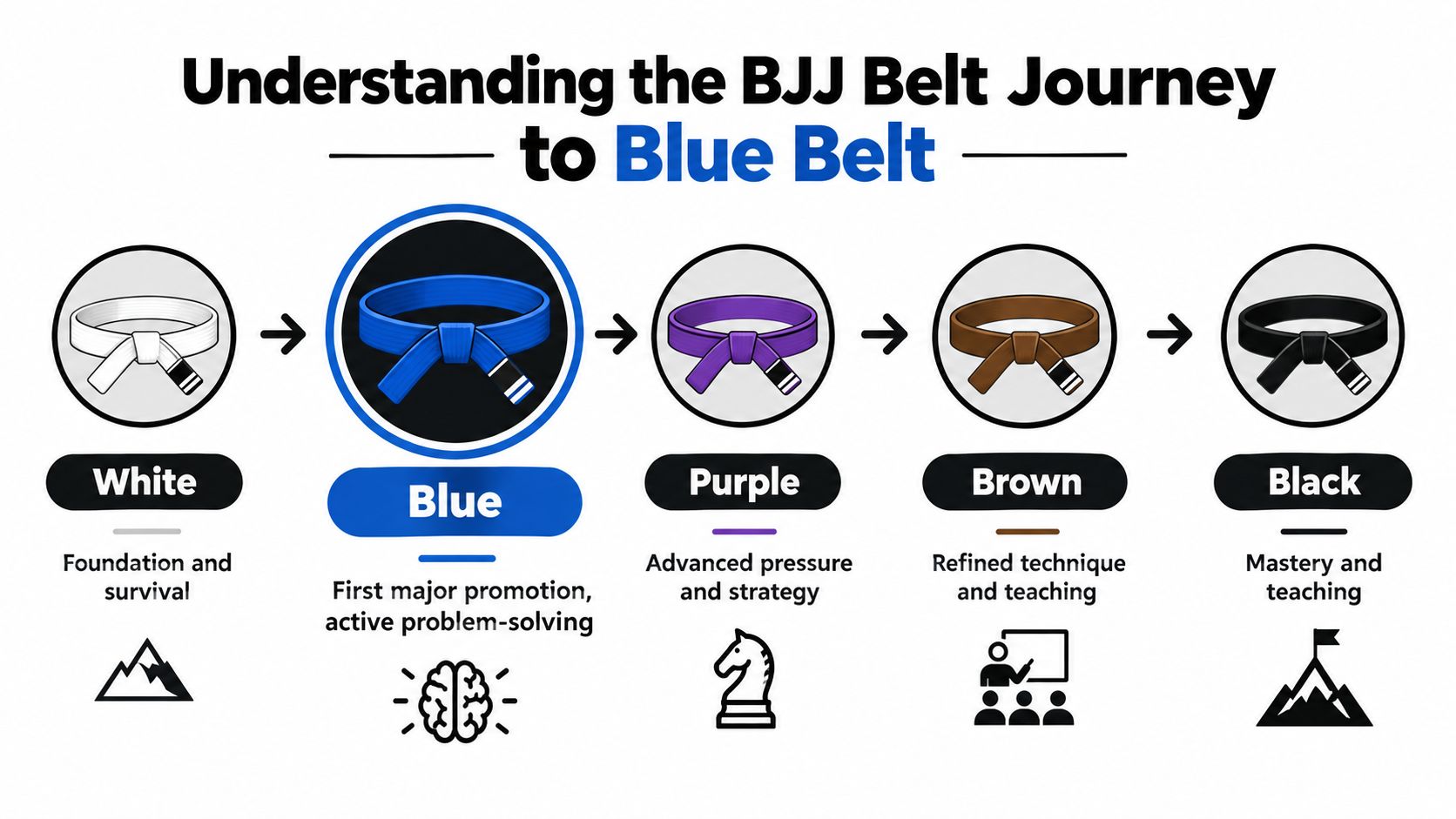
If you want a simple belt-by-belt view, Locals has a useful guide on the Jiu Jitsu belt system.
What blue belt actually represents
The easiest analogy is learning to drive.
White belt is your L-plates stage. You're learning where everything is, how to move safely, and how not to panic when too much happens at once. Blue belt is not race-car driving. It's the point where you can drive with basic control, make reasonable decisions, and handle normal pressure without creating chaos.
That's why blue is the first major promotion. It shows you're no longer guessing all the time.
Practical rule: A blue belt doesn't need a fancy game. A blue belt needs a game that still works when the other person resists.
The age rule and the instructor's call
For adults under the IBJJF graduation system, there's no minimum time at white belt before blue belt, but a student must be at least 16 years old to receive a blue belt. The first mandatory time-in-grade rule begins after blue, where adults must spend 2 years at blue before purple under the IBJJF adult graduation system.
That often surprises people. They assume there must be a formal minimum at white belt. There isn't. So why don't instructors promote everyone quickly? Because BJJ ranks are based on demonstrated ability, not just attendance. A coach watches how you move, how you defend, how you respond when tired, and whether your understanding carries into live rounds.
Why this matters for beginners
If you're an adult beginner in Zetland, this should calm you down. You don't need to chase a hidden checklist. You need to improve in a visible, functional way.
A useful way to think about it is:
White belt asks: Can you survive and learn?
Blue belt asks: Can you apply the basics with consistency?
Later belts ask: Can you build depth, style, and strategy?
Blue sits right at the point where survival turns into problem-solving. That's why people care so much about it.
How Mat Volume Shapes Your Blue Belt Timeline
Two white belts can start in the same month in Zetland and reach very different points by the end of the year. One trains once most weeks and heads home straight after class. The other trains steadily, gets extra rounds in, and starts recognising the same positions over and over. The calendar says they are equal. Their mat time says otherwise.
That is why blue belt timing makes more sense as a volume question than a month-counting exercise.
A Sydney-focused breakdown in this Locals guide to the Brazilian Jiu-Jitsu belt order points to blue belt readiness being shaped by class volume, total hours, and the ability to defend, escape, and make sensible choices under pressure. For adult beginners, that is the useful frame. Your coach is not waiting for a date on the calendar. Your coach is watching for habits that hold up in live rounds.
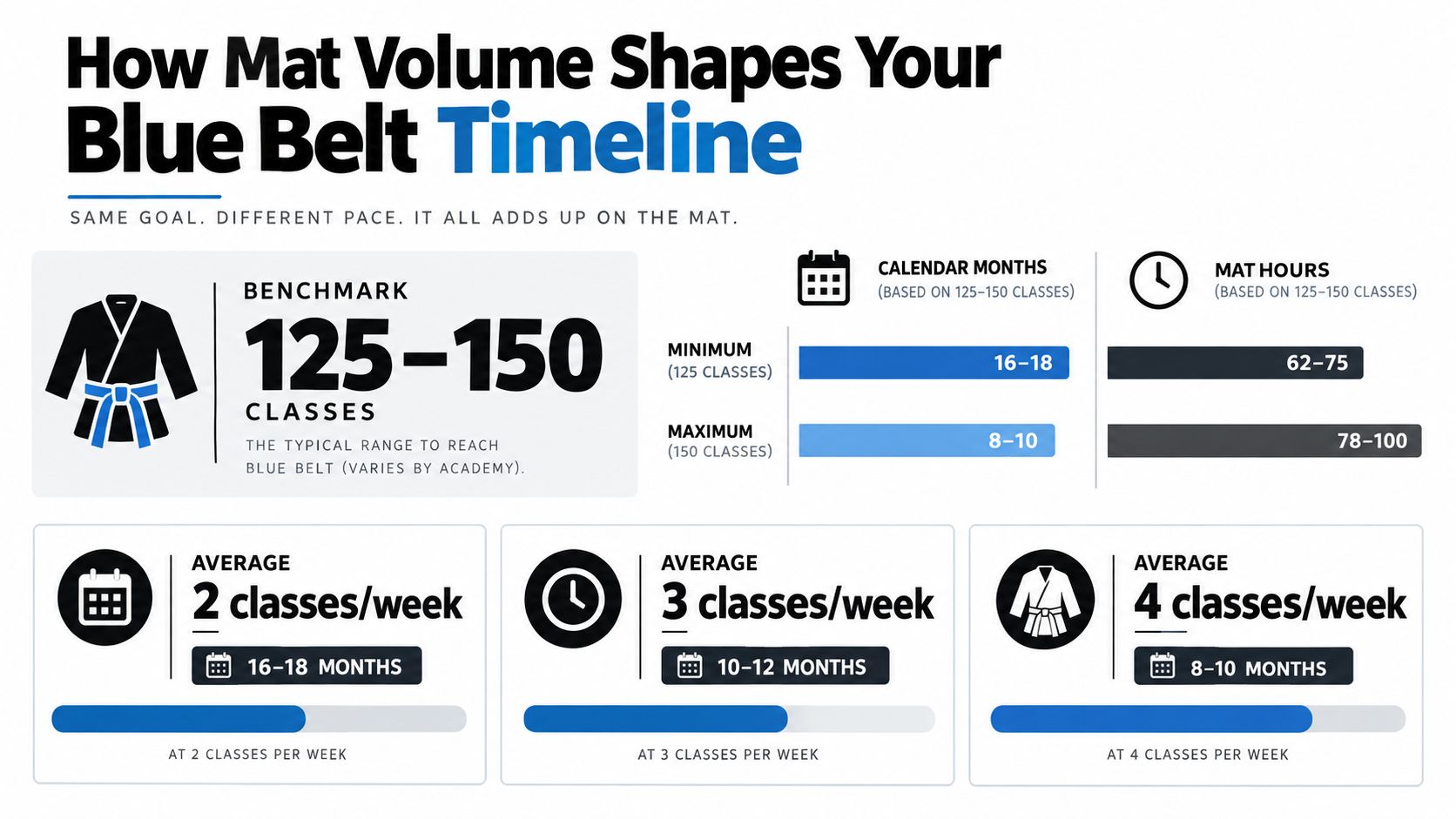
Why mat volume changes the timeline
Mat volume is more than attendance. It is the number of useful reps you collect in the positions that keep showing up. Guard passing. Side control escapes. Mount survival. Back defence. Standing balance. If those situations keep appearing, your reactions get less panicked and more organised.
That matters because blue belt is often less about attacking flair and more about defensive competence. Many guides skip this bottleneck. Beginners picture blue belt as the point where you start catching everyone. In practice, plenty of promotions happen when a coach sees something simpler and more important. You no longer fall apart in bad spots.
At Locals Zetland, this shows up clearly with adult beginners. The students who progress fastest are rarely the ones chasing a new technique every session. They are usually the ones who keep seeing the same core positions, make small corrections, and stay calm long enough to use them.
Language immersion is a better model than calendar time
Learning Jiu Jitsu works a lot like learning a language through regular exposure. A single class can introduce the words. Repeated contact is what helps you understand the conversation.
If you only see mount escape once every few weeks, it stays abstract. If you see it in drilling, then in sparring, then again during open mat Jiu Jitsu sessions, your body starts spotting the pattern earlier. First you notice the problem late. Then you notice it on time. Then you fix it before the position gets worse.
That is the value of mat volume. It turns "I know the move" into "I can use it when someone is resisting."
A beginner usually builds that skill in layers:
Recognition: You know what position you are in.
Structure: You can place frames, elbows, knees, and head in safer spots.
Timing: You stop forcing the move at the wrong moment.
Composure: You make one sensible decision instead of three rushed ones.
Those layers take repetition. No shortcut replaces that.
Here's a good visual explanation to pair with that idea:
What higher mat volume usually improves first
More mat time tends to sharpen the parts of Jiu Jitsu that coaches trust most at blue belt:
Defensive posture: You stop giving away easy grips, underhooks, and head position.
Escape reliability: Your first reaction from bad positions becomes more useful.
Decision-making: You choose between two sensible options instead of moving randomly.
Energy use: You stop treating every round like a sprint.
This is why two adults can spend the same number of months at white belt and still be on different timelines. The bigger difference is often volume with purpose. How many times have you had to solve the same hard problem, against real resistance, until your answer starts working on its own?
Training Frequency and Realistic Timelines for Busy Adults
Most adults aren't building their week around Jiu Jitsu alone. You're working, commuting, parenting, studying, or trying to keep your body feeling decent enough to train again tomorrow. So the useful question isn't "What's the fastest path?" It's "What's a realistic rhythm I can keep?"
Australian-facing guidance commonly places blue belt at about 18 to 24 months for dedicated students, with 1 to 2 sessions per week often taking more than 2 years and 3 sessions per week commonly leading to blue in about 1.5 to 2 years. That's laid out in this Locals article on how long to get a blue belt in BJJ.
A schedule only works if you can repeat it
Beginners often make the same mistake. They train hard for a month, get sore, miss a week, feel guilty, come back flat, then repeat the cycle. A steadier plan beats that every time.
If you're managing aches and trying to stay active without beating yourself up, resources on joint-friendly movement can help. This guide on a low-impact workout for osteoarthritis can be useful for adults thinking about recovery and sustainable weekly training.
Training Frequency vs Expected Time to Blue Belt
Training Frequency | Typical Timeline to Blue | What It Means Practically |
|---|---|---|
1 to 2 times per week | More than 2 years | Progress can still be solid, but you'll need patience because skill retention between sessions is slower |
3 times per week | About 1.5 to 2 years | This is often the sweet spot for busy adults who want steady progress without burning out |
Regular dedicated training | About 18 to 24 months | This suits students who are consistent, coachable, and able to stay involved week after week |
Picking the right pace at Zetland
The best schedule is one you can hold through busy weeks, tired weeks, and average weeks. If three sessions fits your life, that's often a strong pace for adult beginners. If only two sessions fit, that's still enough to build real skill. It just asks for more patience and sharper focus when you're in class.
One simple way to speed up learning without adding extra sessions is to improve the quality of each one. Show up a few minutes early. Ask one clear question. Pick one position to notice during rolling. Use beginner-friendly resources like this Locals guide on how to learn Jiu Jitsu fast to make each class stick better.
The goal isn't to train at hero pace. The goal is to train at a pace your life can support for a long time.
Key Factors That Speed Up or Slow Down Promotion
Two students can attend the same number of classes and progress very differently. That's normal. Attendance gives you exposure. It doesn't guarantee you absorb the right lessons.
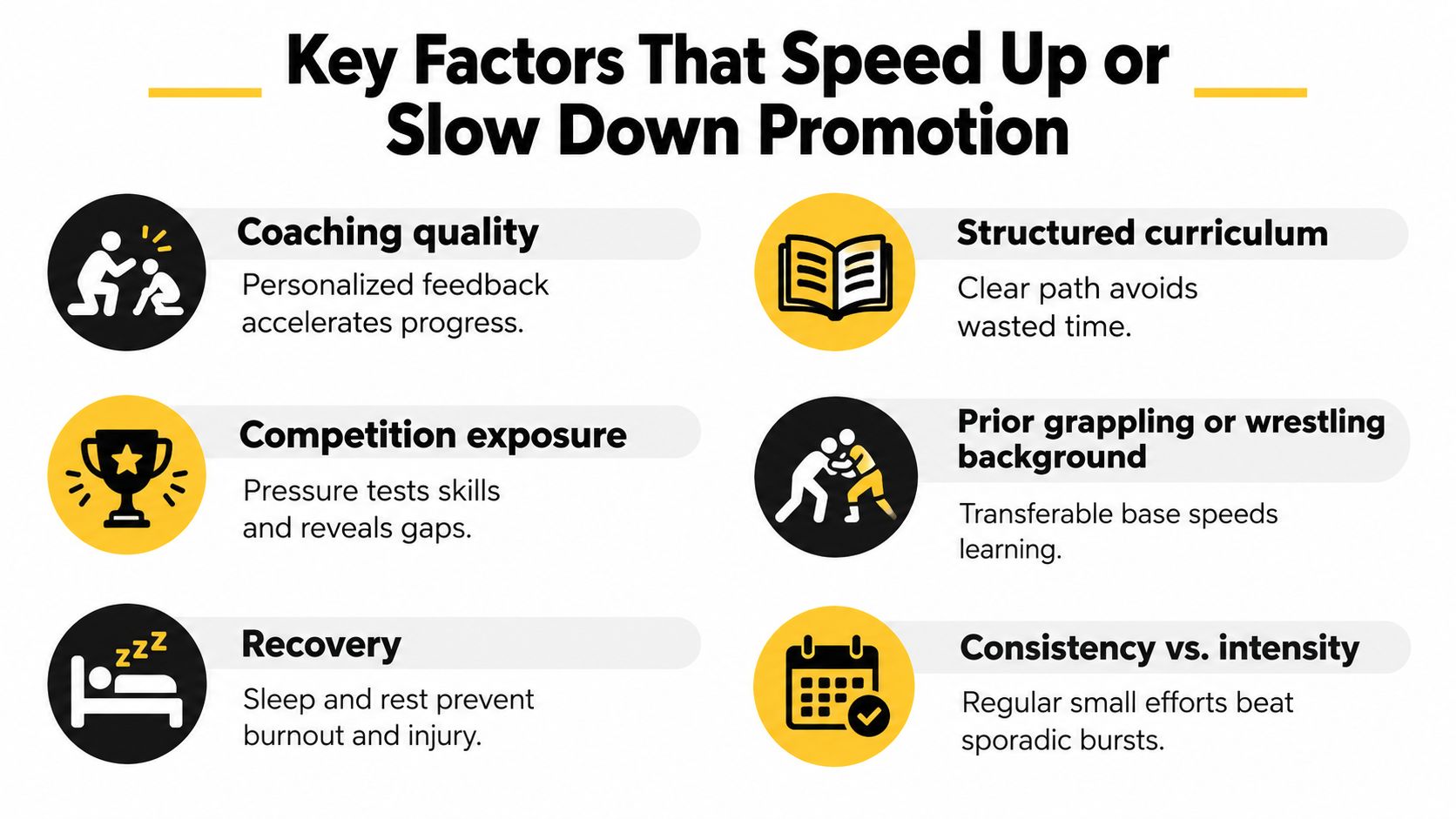
Why one student moves faster than another
A former wrestler usually arrives with balance, pressure awareness, and comfort in scrambles. A complete novice arrives with none of that. That doesn't mean the novice can't become excellent. It means their first phase often includes more basic movement learning before technique starts flowing.
The same thing happens with mindset. One student treats every round as feedback. Another treats every round as a small ego test. The first student tends to improve faster because they notice patterns instead of just outcomes.
The main factors coaches watch
Coaching quality: Clear feedback helps students fix the exact mistake that's holding them back.
Structured curriculum: A logical beginner pathway stops people from collecting random techniques with no connection.
Competition exposure: Some students sharpen quickly when they test their timing under outside pressure.
Prior grappling background: Transferable movement can shorten the early learning curve.
Recovery habits: Sleep, rest, and sensible training decisions keep people on the mats.
Consistency over intensity: A moderate pace repeated often beats occasional all-out weeks.
One practical example. A white belt who trains regularly, asks questions, and revisits the same key positions usually becomes more promotion-ready than a stronger student who chases new moves every class but never settles their defence.
What you can actually control
You can't control your background. You can control your habits.
At this point, a structured beginners programme matters. Locals Jiu Jitsu Zetland offers a beginner pathway built around fundamentals, movement, and positional understanding, which gives new adults a clearer way to organise their training rather than bouncing between disconnected techniques.
Your coach can't give you timing. They can only create the conditions for you to build it.
If you want a simple self-check, ask yourself these questions after a month of training. Am I calmer in bad positions? Am I making fewer repeat mistakes? Am I remembering what happened in rounds well enough to improve next time? Those are better indicators than whether you hit a flashy submission.
Your Zetland Roadmap From White Belt to Blue Belt Ready
A good roadmap keeps beginners from chasing everything at once. If you try to learn all of Jiu Jitsu immediately, you end up with fragments. If you build in layers, your game starts to connect.
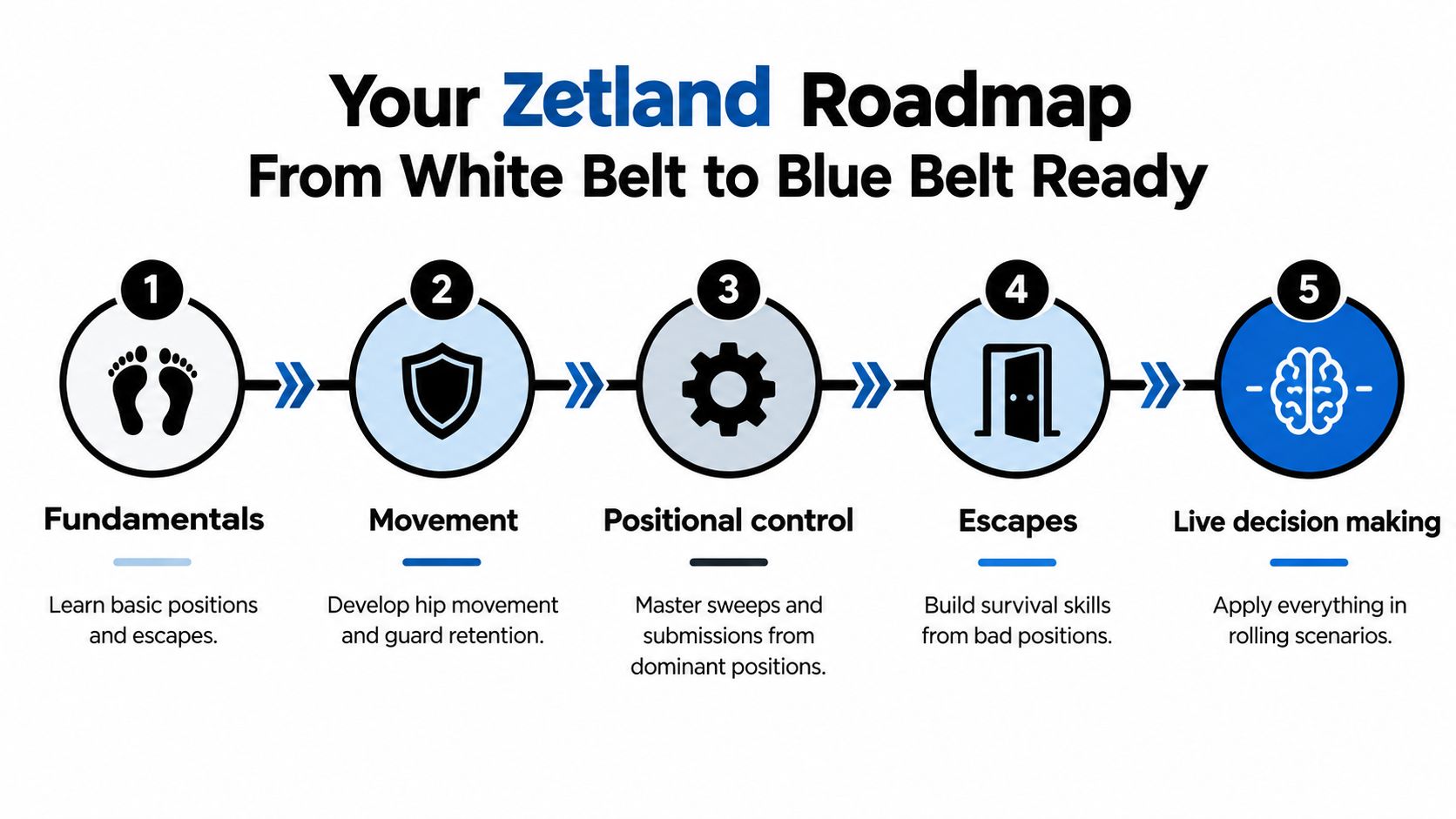
Step one to step three
Start with fundamentals. That means understanding major positions, where you are safe, and where you are in trouble. White belts often improve quickly once they stop seeing BJJ as a blur and start recognising mount, side control, guard, and back control as separate problems with separate solutions.
Then comes movement. Hip escapes, bridging, framing, standing base, and posture don't feel glamorous, but they hold your whole game together. A lot of beginners think they're failing at techniques when the issue is movement quality.
After that, focus on positional control. Learn to stabilise before you attack. If you sweep someone and lose top position instantly, the sweep didn't really solve much.
Step four and step five
Next is escapes. Many future blue belts are made here. If you can survive bad spots, stay patient, and escape without panic, your whole training opens up. You stop feeling hunted every round.
The last stage is live decision-making. This doesn't mean being advanced. It means you can recognise a familiar problem and choose a sensible answer while someone is resisting.
A coach watching for blue-belt readiness often notices practical signs like:
Survival under pressure: You don't collapse immediately in bad positions.
Guard retention: You recover or replace guard with some consistency.
Safe submissions: You apply basic attacks with control instead of recklessness.
Linking actions: Your escape, sweep, and control begin to connect.
"Don't try to look like a blue belt. Train until your reactions make blue belt obvious."
What progression feels like in real life
It rarely feels dramatic. Most students don't wake up one day suddenly "good." They notice smaller shifts. You spend less energy surviving. You recognise setups earlier. You can explain what went wrong in a round instead of just saying, "I got smashed."
That's real progress.
If you're deciding where to start, the simplest next step is to try classes consistently and pay attention to those milestones. Locals Zetland and Locals Maroubra both give adult beginners a setting where those basics can be built in order, not by guesswork.
Beyond Blue Belt How to Keep Progressing After Promotion
A lot of guides stop at the blue belt. That's usually where the more interesting problem begins.
Australian-facing ranking commentary points out that many practitioners spend around 1.5 to 2.5 years at blue before purple, with a minimum of 2 years at blue under IBJJF-style progression, and some commentary also notes that only a small share reach black belt within 10 years. That perspective appears in this Australian piece on BJJ rankings and progression.
Why people stall at blue
At white belt, progress is obvious. Everything is new, so almost any improvement feels big. At blue belt, the errors get smaller and harder to spot. That's where students can drift if they rely on enthusiasm alone.
The fix is simple, but not easy. Keep training with intention. Get feedback. Revisit weak areas. Stop treating promotion as the only proof that you're improving.
A better long-term mindset
Blue belt should feel less like arrival and more like access. You've built enough basics to start developing deeper timing, combinations, and strategy. The habits that got you there still matter:
Stay consistent
Ask better questions
Review your weakest positions
Let defence keep maturing
Measure progress by skill, not only rank
If you understand that early, you avoid the common trap of chasing the next belt too quickly and missing the work sitting right in front of you.
The good news is that this phase can be the most rewarding one. Your Jiu Jitsu starts to feel personal. You stop copying every technique you see and begin noticing what suits your body, your pace, and your decisions under pressure. That's when training becomes less about proving something and more about building something.
If you're trying to make sense of BJJ blue belt time, Locals offers structured beginner classes, clear coaching, and a pathway that helps you build the defensive fundamentals and mat volume that matter. You can visit Locals Jiu Jitsu Zetland to book a trial, see the class options, and start training at a pace that fits real adult life.
Comments