
BJJ Rules for Beginners: Scoring, Tapping and Safety
Most beginner guides teach you the scoreboard and stop there. So here's the question they leave unanswered: if a training partner's head clips the mat during a scramble and they say they're "fine", what's the rule that tells you whether they roll again tonight? BJJ rules for beginners aren't only about points and legal submissions. They're also about tapping, releasing, reporting a knock and behaving in a way that keeps everyone on the mat able to train tomorrow.
Think of the rules in two layers. The competition layer decides who wins a match. The safety layer decides how you train without hurting anyone, and it applies from your very first class, whether you ever compete or not. Both layers are learnable in an afternoon, and neither requires you to be fit, flexible or experienced.
Table of Contents
How a BJJ Match Is Won and Scored - The scoring reference - Reading a score in practice
Legal and Illegal Techniques for Beginners - Why the same move changes status - Fouls that cost you the match
How to Tap Safely and Stop Training - The mechanics behind the rule - Six steps to follow every round
What to Do After a Knock to the Head - The immediate rule - The return timeline
Competition Rules to Check Before You Enter - Your entry checklist
How a BJJ Match Is Won and Scored
A match ends in one of two ways. A submission finishes it immediately, regardless of the score. If nobody taps and regulation time runs out, the athlete with the most points wins, unless the match is stopped because both athletes are injured, as set out in the IBJJF rule book published by the WA Department of Local Government, Sport and Cultural Industries. That rulebook also separates gi and no-gi procedures, so the format you enter shapes how the match is run.
The scoring reference
Points reward control, not effort. Here are the values you'll see on a scoreboard.
Action | Points | What It Means |
|---|---|---|
Takedown | 2 | Taking an opponent from standing to the ground under control |
Sweep | 2 | Reversing from the bottom to finish on top |
Guard pass | 3 | Passing the opponent's legs to reach a dominant top position |
Knee on belly | 2 | A knee placed on the opponent's torso in a control position |
Mount | 4 | Sitting on the opponent's torso with control |
Back control | 4 | Controlling the back with hooks in place |
Submission | Ends match | A tap, or the referee stopping the match |
Advantage | 0 (tie-breaker) | A near-submission or positional edge that only decides tied matches |
Reading a score in practice
Say you take your opponent down and settle on top: 2 points. You then work past their legs and hold a dominant top position: 3 points more, so you're on 5. They recover, reverse you and finish on top, which earns them 2 points for the sweep. The score reads 5 to 2, and the match keeps going.
Notice what didn't happen. You didn't get points for trying an armbar, and they didn't get points for scrambling hard. The referee awards points when a scoring action is completed with control, which is why beginners who chase submissions from unstable positions often end up underneath instead.
Practical rule: stabilise the position first, then attack. Control earns points and makes the submission mechanically available.
Advantages sit in a separate column. They're a near-submission or a nearly completed scoring action, and they only decide the result when points are level. Match length isn't universal either. The Australian Jujitsu Federation competition page lists a standard bout duration of six minutes for its ground-focused Ne-Waza format, while other events run different clocks for different divisions. Learn these few values and you can follow any scoreboard at a tournament.
Legal and Illegal Techniques for Beginners
Legality isn't a single list. It's a rule-set problem. The same technique can be legal for a brown belt in no-gi, restricted for a white belt in gi, and banned outright for a ten-year-old. The Australian Society of Jiu-Jitsu publishes JJIF competition rules covering Brazilian-jujitsu Ne-waza, which shows that Australian events may run a formal international framework rather than the informal habits of your home mat.
Technique | Beginner Status | Notes |
|---|---|---|
Punches and kicks | Not allowed | BJJ is a grappling sport, so strikes are never part of it |
Armbar and other elbow locks | Allowed | Legal submissions; apply slowly and tap early |
Shoulder locks | Allowed | Legal submissions; a common cause of strain if forced |
Chokes | Allowed | Legal submissions; release at the first tap |
Neck cranks | Usually banned | Restricted because of spinal and neck risk |
Heel hooks and other leg locks | Restricted | Often banned below higher belts; check the ruleset |
Slams and spiking | Banned | Dangerous and penalised |
Hair pulling, fish-hooking and eye gouging | Banned | Fouls that can end a match |
Any move not listed | Ask first | Check the ruleset or ask the coach before trying it |
Why the same move changes status
Striking is the easy one. There are no punches, kicks, knees to the head or elbows in BJJ, so a beginner never has to wonder whether a strike is "light enough". The sport is built around joint locks and chokes instead, and those are legal precisely because a partner can concede before damage occurs.
The restrictions follow the same logic. A heel hook attacks a joint that gives very little warning before it's injured, and a neck crank loads the spine rather than a limb a partner can protect. That's why events commonly restrict spinal, neck, leg-lock and high-amplitude techniques for children and novice divisions, while permitting some of them for experienced adults. If you're building your first technical vocabulary, work through the fundamentals in this guide to Brazilian jiu-jitsu techniques before you experiment with anything exotic.
Fouls that cost you the match
Slams are the foul beginners commit by accident. Someone locks a triangle from the bottom, you feel trapped, and you lift them to escape. Lifting to break a submission is dangerous and penalised, so the correct answer is to posture, breathe and defend the technique rather than pick your partner up.
Ask before you try. If a move isn't on the legal list for your belt, age and format, the coach's answer takes ten seconds and saves a disqualification or an injury.
How to Tap Safely and Stop Training
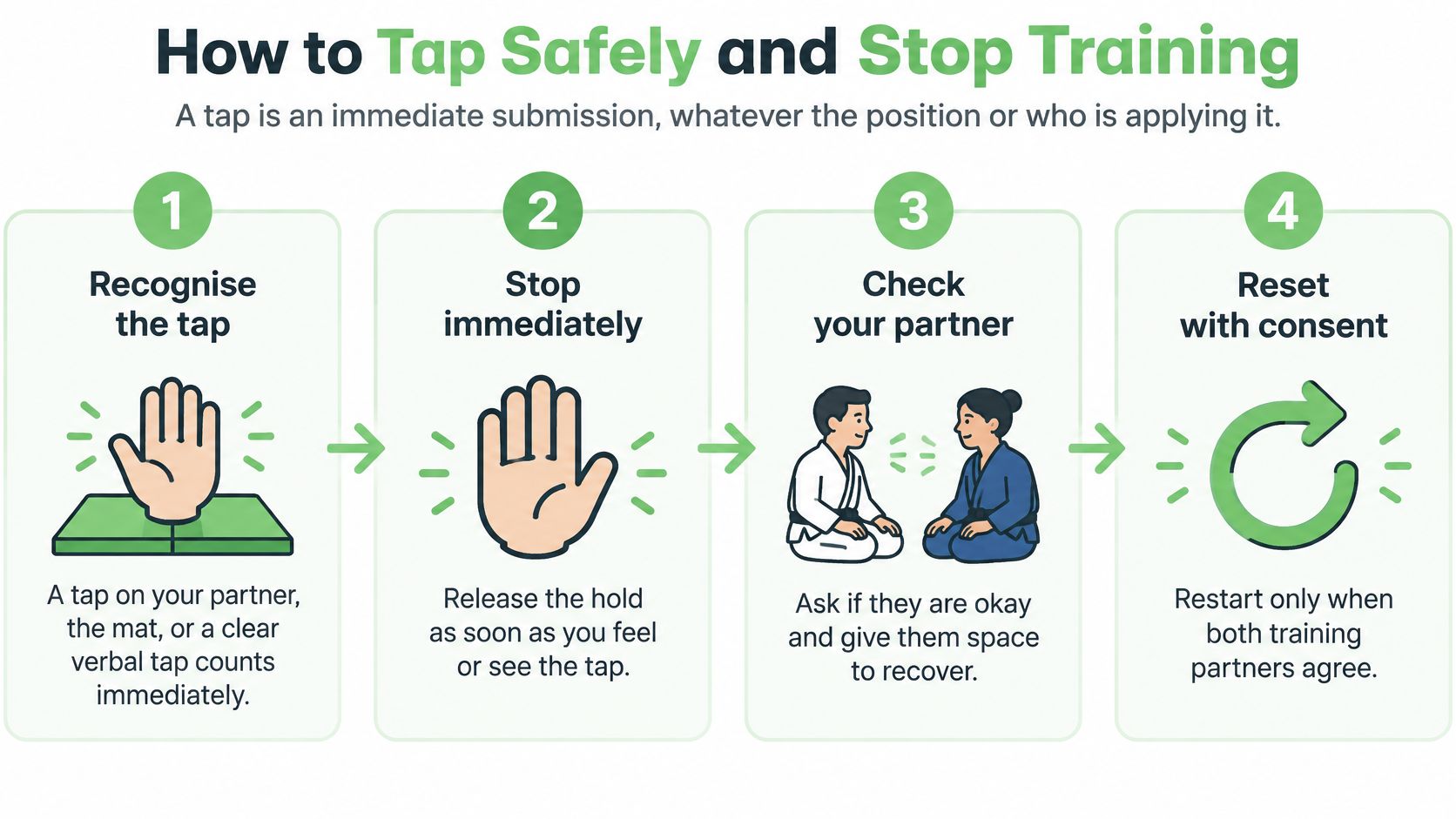
A tap is an immediate submission, whatever the position and whoever is applying it. This four-step sequence is the whole protocol.
The mechanics behind the rule
A joint lock turns positional control into force against a limb. A choke restricts blood flow or breathing. Both work on a curve: the longer pressure continues, the closer a controlled technique moves towards injury or loss of consciousness. Australian combat-sport safety guidance treats a tap as an immediate submission requiring you to release the grip, stop applying pressure and reset without debate, and it also requires immediate removal from contact activity and medical assessment for suspected concussion, as described in the Australian Ju-jitsu Federation submission to the Queensland Parliament. NSW government material notes that combat sports are regulated because of inherent risks, with concussion management following Australian Institute of Sport and Australasian College of Sport and Exercise guidance.
Six steps to follow every round
Recognise the tap. A tap on your body, on the mat, or a clear verbal "stop" all count the same. Don't wait for a second confirmation.
Release straight away. Let go of the grip or the limb before you do anything else, including looking at the coach.
Stop all pressure and reset. Come back to a neutral position, give your partner space and check they're okay.
Never retaliate or argue. Squeezing harder after a tap, or finishing the lock "to see if it worked", is how beginner rolls turn into injuries.
Tap verbally when your hand is trapped. If both arms are pinned, say "tap" loudly. Your voice works when your hands can't.
Report symptoms before the next round. Tell the coach about pain, dizziness, neck symptoms or a hard impact, even if you feel better already.
Watch the release and reset in action here.
Reliable tapping is what lets you train hard. When both partners trust the release, you can practise real submissions at real speed, and a failed technique becomes information rather than a trip to the physio.
What to Do After a Knock to the Head
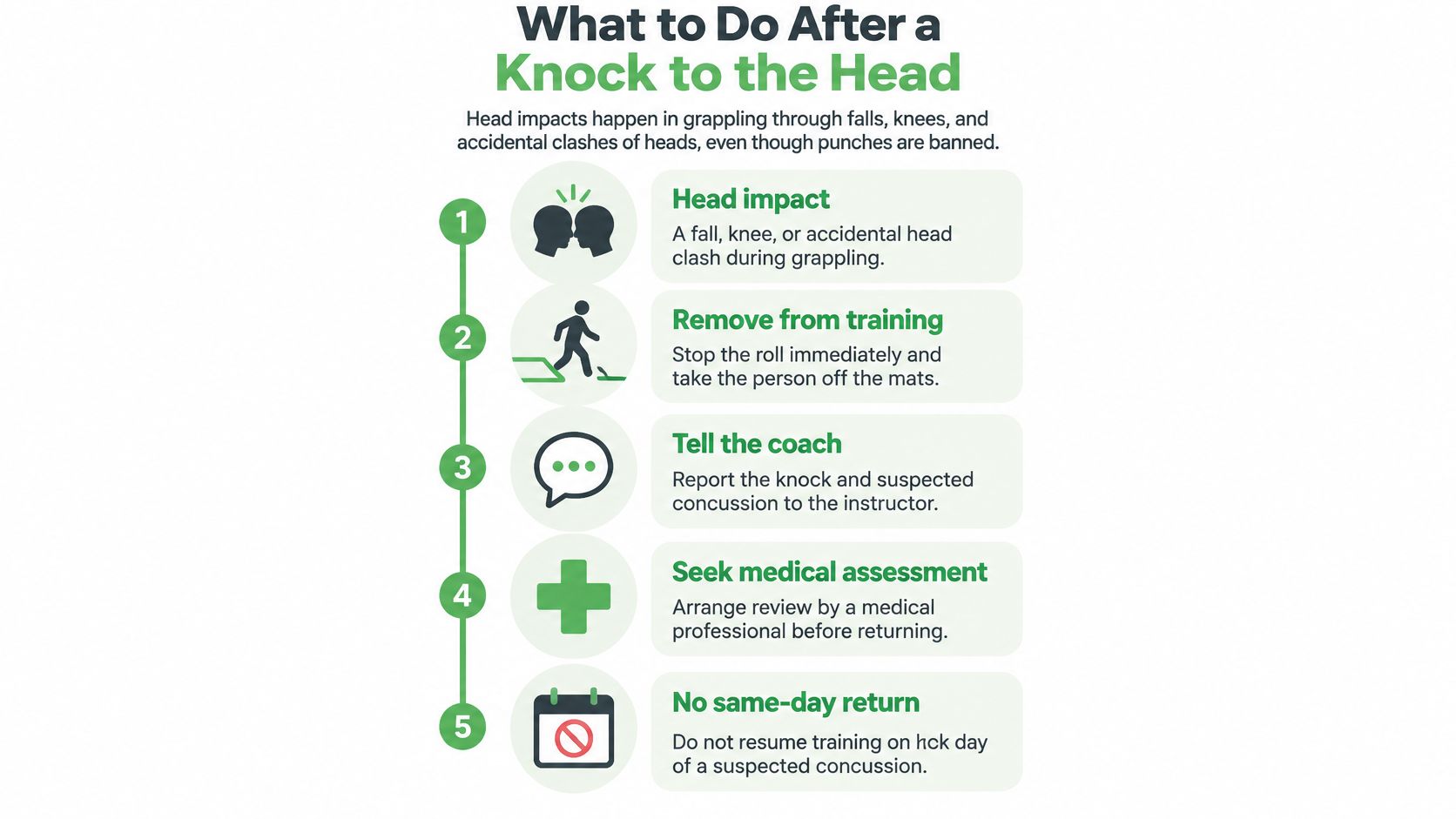
Punches are banned, but heads still meet mats, knees and each other. A clumsy takedown, a scramble where two people rise at once, or a fall from a lifted position can all produce a head impact. Grappling isn't exempt from concussion just because nobody's throwing hands.
The immediate rule
If a concussion is possible, stop the roll, tell the coach and get a medical assessment. Don't train through a headache, dizziness, confusion or sensitivity to light, and don't let a partner "shake it off" and jump back in.
Headgear won't rescue you here. Australian community-sport guidance states there's no current evidence that headgear reduces concussion risk in combat sports, and the Combat Sports Authority annual report records mandatory concussion education for registered participants from 27 June 2025, described as the first such training introduced by an Australian regulatory body.
The return timeline
The Australian Sports Commission concussion guidance sets a clear sequence:
Symptoms present: stop, get assessed, no same-day return.
Symptom-free at rest for 14 days: required before returning to contact-sport training.
At least 21 days: required before returning to competitive contact sport, following the staged approach.
Feeling better for an afternoon isn't clearance. Don't rely on gym folklore either. A Macquarie University review of concussion guidelines in Australian combat sports found that of 11 Australian amateur and professional combat-sport governing bodies, eight provided concussion information, with a median quality score of only 3 out of 9.
Ordinary recovery habits still matter while you're off the mats, and understanding fluid intake is useful for any active person. HYDAWAY's explainer on hydration science for hikers and runners is a sensible read on that general topic, though it's no substitute for medical clearance. For the training habits that prevent most knocks in the first place, work through these ways to prevent injuries in BJJ.
Mat Etiquette Every Beginner Should Know
Etiquette isn't decoration. Each habit protects something specific, and grouping them that way makes them easy to remember.
Habits that protect health
Trim and file your nails before class, on fingers and toes. A ragged nail opens a cut on someone's forearm.
Wear a clean rash guard and shorts, or a clean gi, every session. Kit that sat damp in a bag is how skin infections spread.
Stay home with a cold, a skin infection or vomiting, and tell the coach about any skin condition that could pass to a partner.
Habits that protect teeth and joints
Consider a custom mouthguard. Grappling produces accidental knees and head clashes, and a properly fitted guard is more comfortable than a boil-and-bite. This overview of athletic guard options from a Scottsdale dentist for sports mouthguards explains how fit and coverage differ.
Match your partner's pace. Ask before rolling with someone new, and don't crank a submission on a first-timer who doesn't yet know how to tap.
Habits that protect the learning environment
Arrive on time so you warm up and hear the briefing.
Greet the instructor and partners the way the class does, and listen to a higher belt's correction without arguing.
Drill new techniques slowly with a cooperative partner rather than testing them on someone resisting.
Skip the trash talk and the celebration after a tap. People train generously with someone who's careful and courteous, and that generosity is how you improve fastest.
Competition Rules to Check Before You Enter
Academy sparring and competition are regulated differently. A technique you drill on a Tuesday can be restricted at a Saturday event, and the organiser's published rules are the only ones that count on the day.
Two differences catch beginners out most often. First, gi and no-gi are separate divisions with their own apparel requirements and sometimes their own legal technique lists. The WKA rule sets published for Australian competition administration contain dedicated provisions for gi and no-gi apparel, division rules and scoring, so no-gi isn't gi jiu-jitsu with the jacket off.
Second, age and belt divisions change what's permitted. One Australian tournament rule set lists competitors aged 4 to 15 in Mighty Mite, Pee Wee, Junior and Teen categories, with novice divisions for white and grey-white belts and round-robin formats for those age groups. A submission to the Queensland Parliament from the Australian Ju-jitsu Federation states that competitions should modify rules for lower-skill and younger participants so they can compete without unnecessary fear of injury, alongside suitable facilities, standardised rules, first-aid and resuscitation capability and trained personnel.
Your entry checklist
Confirm the current rules for that specific event, not a ruleset you read last year.
Confirm your division and eligibility by age, belt and weight.
Check permitted and banned techniques for your belt and age group.
Check uniform and weigh-in procedures, including when you weigh in and what you may wear.
Check medical and safeguarding procedures the organiser follows.
Many Australian organisers adopt the IBJJF rules as a baseline, then publish their own variations on the event page. Read those variations before you pay. If you're ready to take the next step, this walkthrough on how to prepare for BJJ tournaments covers the practical build-up. Enter once you can apply the scoring and tapping rules without thinking about them.
Start Your First Class With Confidence
Three rules are enough for day one. You know how a match ends, by submission or by points at the bell. You know which techniques are legal for your belt and age, and that anything unlisted gets asked about first. And you know that a tap means an instant release, every time, no debate.
You don't need prior experience to begin. Our Jiu Jitsu for Beginners program is open to individuals of all ages, genders and fitness levels, and it teaches the essential movements, positions and submissions along with the body mechanics and balance that make them work. Locals Jiu Jitsu Alexandria runs beginner-friendly classes, kids programs and progressive training for all levels, so you're not thrown into a general class and left to keep up.
For beginners in Alexandria, a free trial class is available for all levels. Check the timetable, book a session, and bring your questions with you. Ask the coach how tapping and release work on that mat, how partners are matched, and what the class does after an accidental knock. Those answers tell you more about a training environment than any belt on the wall.
Locals Jiu Jitsu Alexandria teaches the safety rules alongside the techniques, so your first roll comes with a clear tapping protocol, controlled partner work and coaches who explain the scoring as you go. Beginner classes, kids programs and a free trial for all levels mean you can test the mat before committing to anything. Visit Locals Jiu Jitsu Alexandria to check the timetable and book your free trial class.
Comments