
How Long to Get Blue Belt BJJ in Australia
A sustainable weekly training rhythm matters more than a start date. For an adult beginner, about one to three years is a useful planning range for reaching blue belt, though individual progress varies with attendance and time away from training.
Two people can begin in the same month and progress at different rates. Regular sessions give you more chances to practise; shift work, family commitments, illness or injury can interrupt that rhythm. Plan around the sessions you can keep up over time, rather than treating a calendar date as a promise.
Table of Contents
Typical Blue Belt Timelines by Weekly Training - What the weekly bands actually mean - How to read the bands without turning them into a deadline
Why Months on the Calendar Do Not Decide the Belt - The licence test, not the birthday - What a coach can actually see
How Many Sessions and Hours Actually Add Up - What 100 to 150 sessions look like in a real week
Skills Coaches Look For Before Blue Belt - Four abilities that show up under resistance - Why live rounds expose the gap
A Timed Map of Blue Belt Positions - What the clock is testing - Where candidates run out of answers
How Adult and Kids Timelines Differ - The transfer question parents ask
Choose a Weekly Rhythm and Book a Trial - Pick the week before you pick the date
Typical Blue Belt Timelines by Weekly Training
The one to three year answer is a planning range, not a promise. An Australian blue-belt guide places the white-to-blue journey at roughly 12 to 24 months, while noting that some practitioners take about 12 months and others take as long as three years. That spread is normal. It reflects attendance, coaching, recovery and how often you test your technique against a partner who isn't helping.
The same guide sets the practical benchmark as competence in fundamental movements, positional control from guard, mount and side control, escapes, transitions and submissions. Those skills need to appear during sparring, not only in cooperative drilling. It also expects candidates to understand how to use their weight, body mechanics, timing, pressure and control, and to apply those ideas against partners with different skill levels. That's a lot more than memorising a syllabus.
What the weekly bands actually mean
The bands below turn the range into weekly plans. They're planning ranges for adult beginners, not a national deadline.
Weekly attendance | Rough sessions over two years | Typical adult range | What that pace usually means |
|---|---|---|---|
About once a week | Around 100 | Often beyond 2 years, sometimes toward 3 | Ordinary baseline, not a fast path |
Twice a week | Around 200 | Often 18 to 30 months | Common consistent adult rhythm when sparring is included |
Three times a week | Around 300 | Often 12 to 18 months, sometimes up to 24 | Faster only if quality and continuity stay high |
Irregular weeks or long breaks | Well under a steady 100 quality sessions | Often past 3 years | Calendar time counts for little without continuity |
A class counts as a session only if it includes technical instruction and live rounds, not just a warm-up and a chat. Two nights a week where one is always missed isn't really the twice-a-week row. It's the irregular row wearing a better label.
How to read the bands without turning them into a deadline
Use the row that matches the week you can keep. If you're a parent with school pick-up, a shift worker or someone who travels for work, one honest session a week may be the sustainable start. It belongs in the longer band, and that's fine. Progress still happens, just more slowly.
Three sessions a week can support a faster result, but only when attendance barely drops and the extra classes include real resistance. Showing up for three easy drills and avoiding rolling doesn't buy the same progress as two classes with controlled sparring. Quality and continuity decide whether the faster band is real.
Planning rule: Pick the row you can hold for six months, not the row that looks best on paper.
A smaller weekly number you keep for a year beats a bigger number you abandon in March. That's the practical answer to how long to get blue belt BJJ: the calendar follows the weekly rhythm, not the other way around.
Why Months on the Calendar Do Not Decide the Belt
Blue belt is the first adult rank after white. Purple, brown and black sit beyond it, so this promotion is a genuine step, not a participation badge. Australian grading follows international standards for rank order, but those standards don't set one number of months every white belt must serve. The decision belongs to the coach who watches you train.
The difference between time served and skill shown is easier to see as a map.
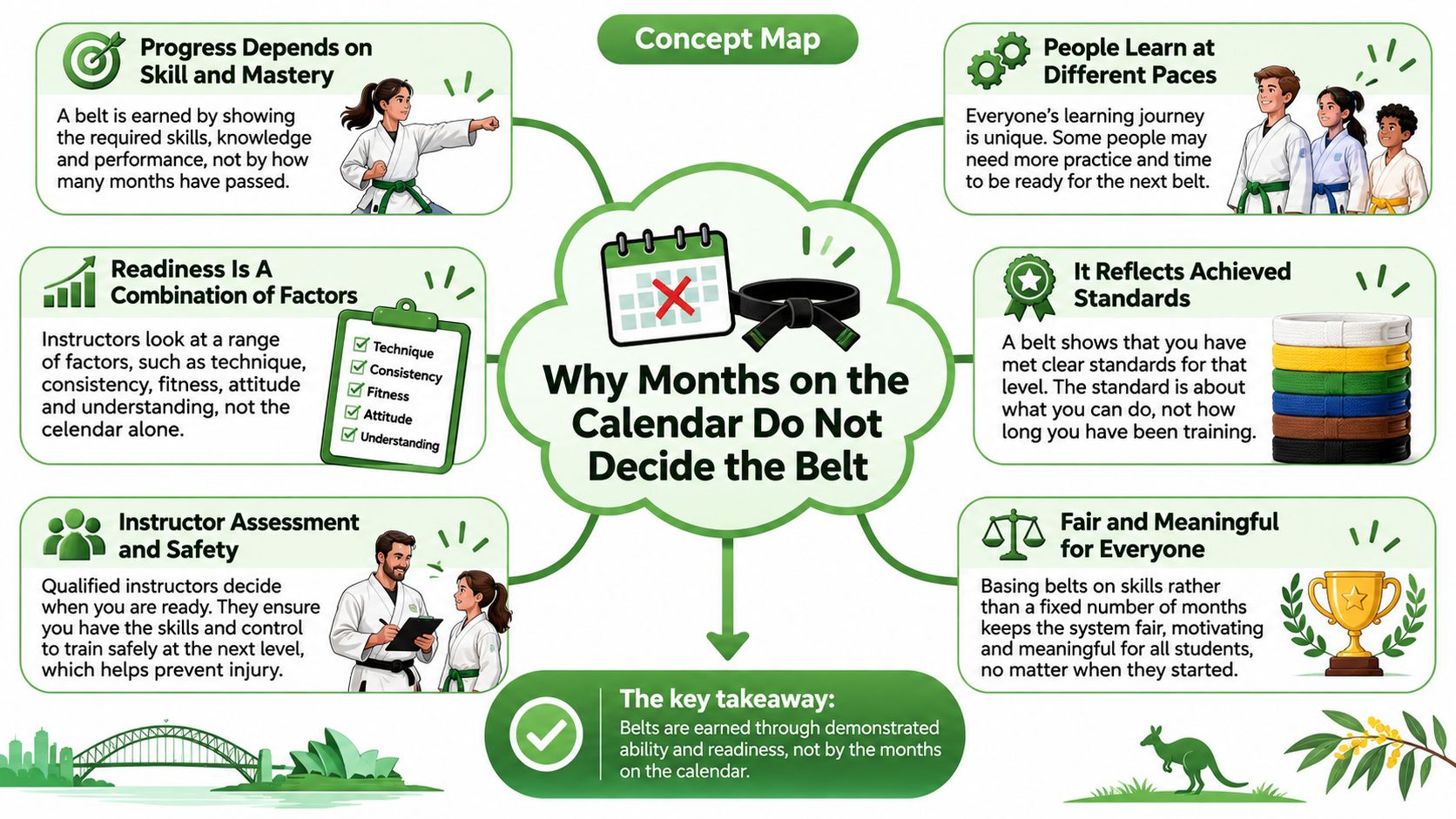
A membership record shows that classes were available. It doesn't show what you did with them. The coach is judging whether you can use white-belt material while a partner resists, whether you keep yourself safe, and whether your answers hold up against different body types. Those things don't appear automatically on a anniversary.
The licence test, not the birthday
A driver licence isn't awarded because you've owned a car for two years. It's awarded because you can handle the road without someone talking you through every turn. Blue belt works the same way. The day you started training doesn't prove you can handle pressure.
Watching a technique and remembering its name is familiarity. Keeping posture, frames, distance and a path back to guard against a heavier partner is skill. Escaping a pin when you're tired is skill. Connecting a takedown to real control instead of landing in a scramble is skill. Coaches promote on those signals.
Two years of quiet drilling is not an automatic promotion. Extra classes are not an automatic early belt either.
Promotion policies vary, but the good ones can be explained. If you want to understand the criteria before you start counting months, this explanation of how BJJ belt promotions work is a useful place to start.
What a coach can actually see
Coaches watch control, escapes, safe behaviour and performance against different partners. They notice who panics when a roll gets hard and who slows down and works through the position. They also notice who avoids certain partners or certain positions. Avoiding the hard round keeps you comfortable, but it doesn't build the evidence a promotion needs.
The belt usually arrives when the student stops needing the coach to narrate every solution. That's the point where the white-belt syllabus has become usable under resistance.
How Many Sessions and Hours Actually Add Up
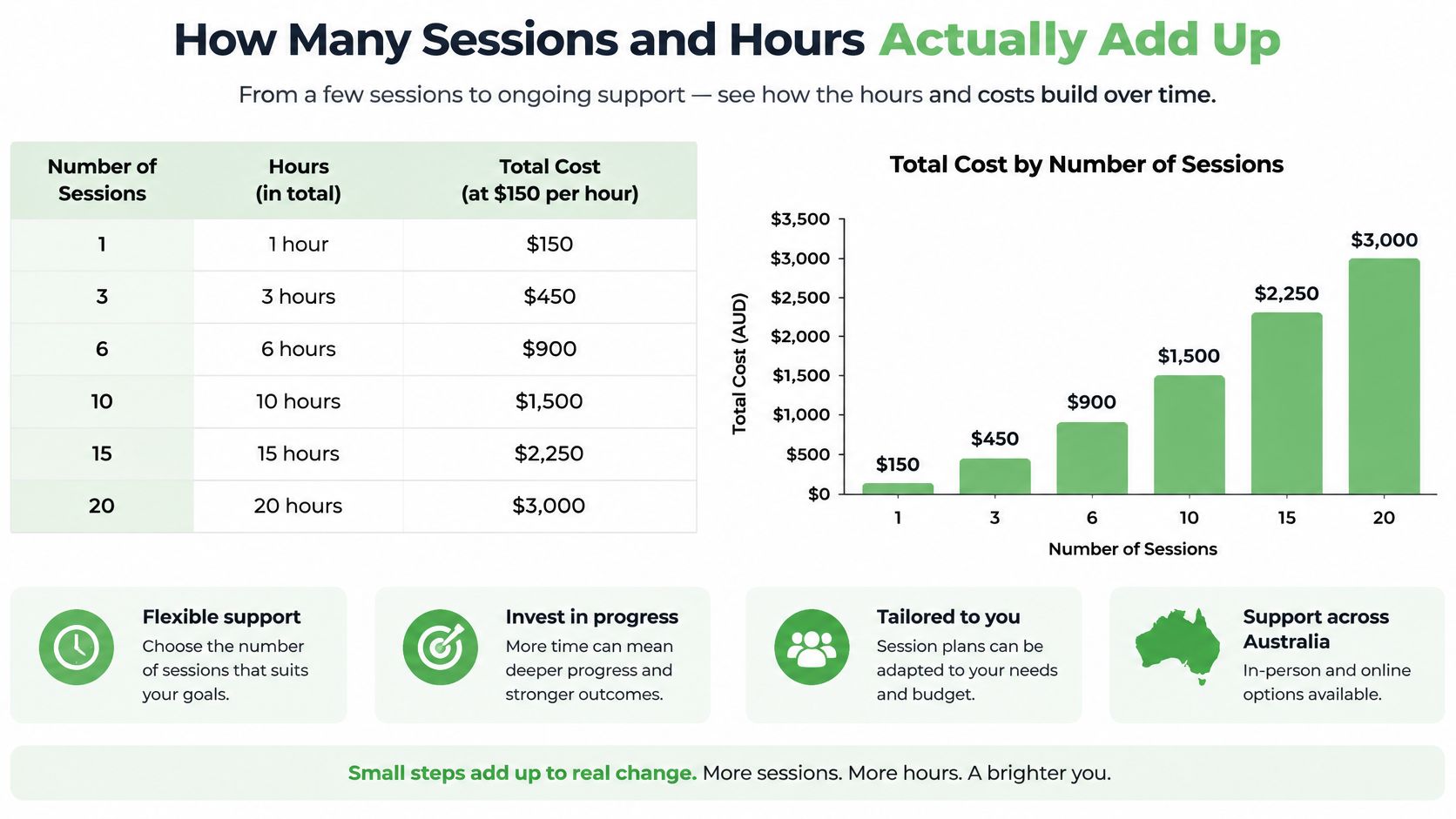
An Australian benchmark puts a typical martial-arts participant at about 65 sessions a year, with each session lasting around 60 minutes. Sport Australia's AusPlay martial-arts report, based on data collected from January 2016 through December 2018, found that median. At that pace, two years adds up to roughly 130 hours of training. It is a useful reference point, not a blue-belt rule: the report covers martial arts broadly, not BJJ promotion standards.
For an adult beginner, a practical planning range is roughly 100 to 150 sessions. At about an hour per class, that represents around 100 to 150 hours on the mat. The number helps you plan consistent training; it cannot predict the date a coach will award a belt.
What 100 to 150 sessions look like in a real week
Two sessions a week adds up to about 100 sessions in a year. At three sessions a week, the same count takes around eight months. Those are simple attendance calculations, not promotion timelines. Choose a pace you can sustain: an extra class has little value if fatigue or soreness means missing the next week.
Weekly sessions | Approximate sessions in a year | Approximate hours in a year |
|---|---|---|
1 | 52 | 52 |
2 | 104 | 104 |
3 | 156 | 156 |
These estimates assume classes last about an hour and attendance stays steady. Holidays, illness, shift work and family commitments can interrupt the rhythm, so the calendar may stretch even when your plan is sound. Sport Australia reported that 85% of martial-arts participation took place in an organised setting, a reminder that regular classes provide a structured routine.
A monthly check can keep your training plan realistic:
Count sessions: Compare your attendance with the weekly pace you chose.
Record live rounds: Note how many rounds you completed, as well as classes attended.
Choose one sticking point: Write down the position or escape that keeps causing trouble.
Review across partners: Notice whether a technique works against partners with different sizes and styles.
The Australian Sports Commission's life course evidence summary reported that 29% of adults aged 25 to 54 took part in sport-related activities at least once a week in 2025, compared with 19% of adults aged 55 and over. Work, commuting and caring responsibilities can shape how often an adult trains, so a repeatable weekly rhythm matters more than an ambitious plan that quickly falls apart.
Locals Jiu Jitsu Alexandria runs classes from morning until night, giving adults options for fitting training around work and family.
Skills Coaches Look For Before Blue Belt
Promotion readiness is a competency line, not an anniversary. Australian guidance describes blue-belt promotion as dependent on applying the white-belt syllabus during live rolling, while vocational martial-arts training standards emphasise structured drills, evaluation and high-performance skills, as set out in Australian guidance on blue-belt promotion. The syllabus matters, but it has to survive contact with a resisting partner.
The skills themselves are easier to check when they're laid out as a list.
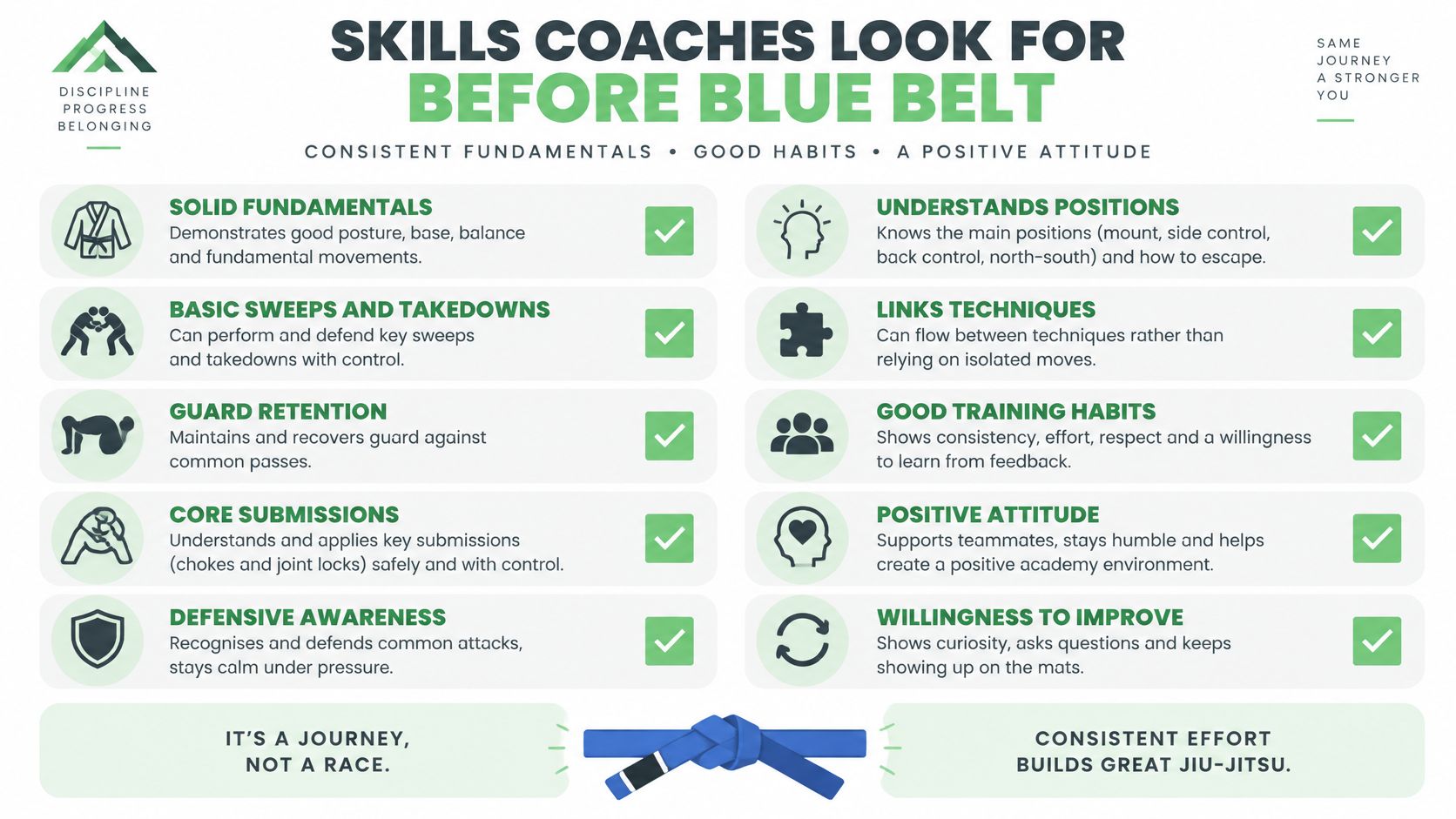
Four abilities that show up under resistance
Defensive priorities: posture, frames, distance and guard recovery against varied partners.
Repeatable escapes: common pins escaped with mechanics that still work when you're tired.
Connected entries: a takedown or guard entry that leads to real control, not a scramble.
Attacks without leaks: submissions or advances that don't abandon your defensive structure.
Attendance increases familiarity. Constrained sparring exposes decision-making under resistance, which is what converts a remembered move into usable skill. That's the cause and effect beginners often miss. You don't get good at jiu-jitsu by watching the solution. You get good by finding the solution while someone tries to stop you.
Why live rounds expose the gap
Cooperative drilling can hide a gap that appears in the first hard minute. A partner who is bigger, faster or more defensive will show whether the technique is yours or just the drill's. If your guard pass only works when your partner stays flat, you don't have a guard pass yet. You have a drill.
Coach's test: Can you hold posture, recover guard and escape a pin against someone who is genuinely trying to stop you?
Here's a practical look at the kind of positional work that builds these skills.
Our coaches at Locals Jiu Jitsu Alexandria prioritise safety and progression, so resistance in class should match what you've been taught. If you want the technical list behind these checks, the jiu-jitsu fundamentals curriculum explains the order we teach.
A Timed Map of Blue Belt Positions
One published adult blue-belt grading shows why a short list of favourite submissions isn't enough. The published adult blue-belt grading document allocates 10 minutes to standing work, split into five minutes of self-defence and five minutes of grappling, then runs timed assessments from guard, side control, mount and back control.
Position | Self-defence block | Grappling block |
|---|---|---|
Standing | 5 minutes | 5 minutes |
Guard | 2 minutes from the bottom | 4 minutes on top and 4 minutes on the bottom |
Side control | 2 minutes from the bottom | 4 minutes on top and 4 minutes on the bottom |
Mount | 2 minutes from the bottom | 4 minutes on top and 4 minutes on the bottom |
Back | 2 minutes | 4 minutes of escapes and attacks |
What the clock is testing
The clock visits standing, guard, side control, mount and back. It mixes defence with grappling in every area. Bottom defence is short but repeated across positions. Top and bottom grappling get the longer blocks, which means you need answers on both sides of each position, not just the one you like.
Standing gets equal halves. A candidate needs a self-defence answer and a grappling answer, not just one takedown. From guard, the bottom player needs to survive and attack. The top player needs to pass and control. Side control repeats that shape. Mount and back add escape pressure and attack pressure in the same assessment.
Read the clock as a map of gaps. If one row collapses every round, that position is next month's priority.
Where candidates run out of answers
A candidate who only looks comfortable in one favourite position will run out of answers. Picture each block as a problem to solve while a partner resists, not as a speech about technique names. The candidate who can recover guard, escape side control and stay safe from the back has a broader base than the candidate with three fancy submissions from one position.
That's why positional breadth belongs in the preparation, not just the submission list. Blue belt isn't a display of your best move. It's evidence that you can handle the positions your best move comes from.
How Adult and Kids Timelines Differ
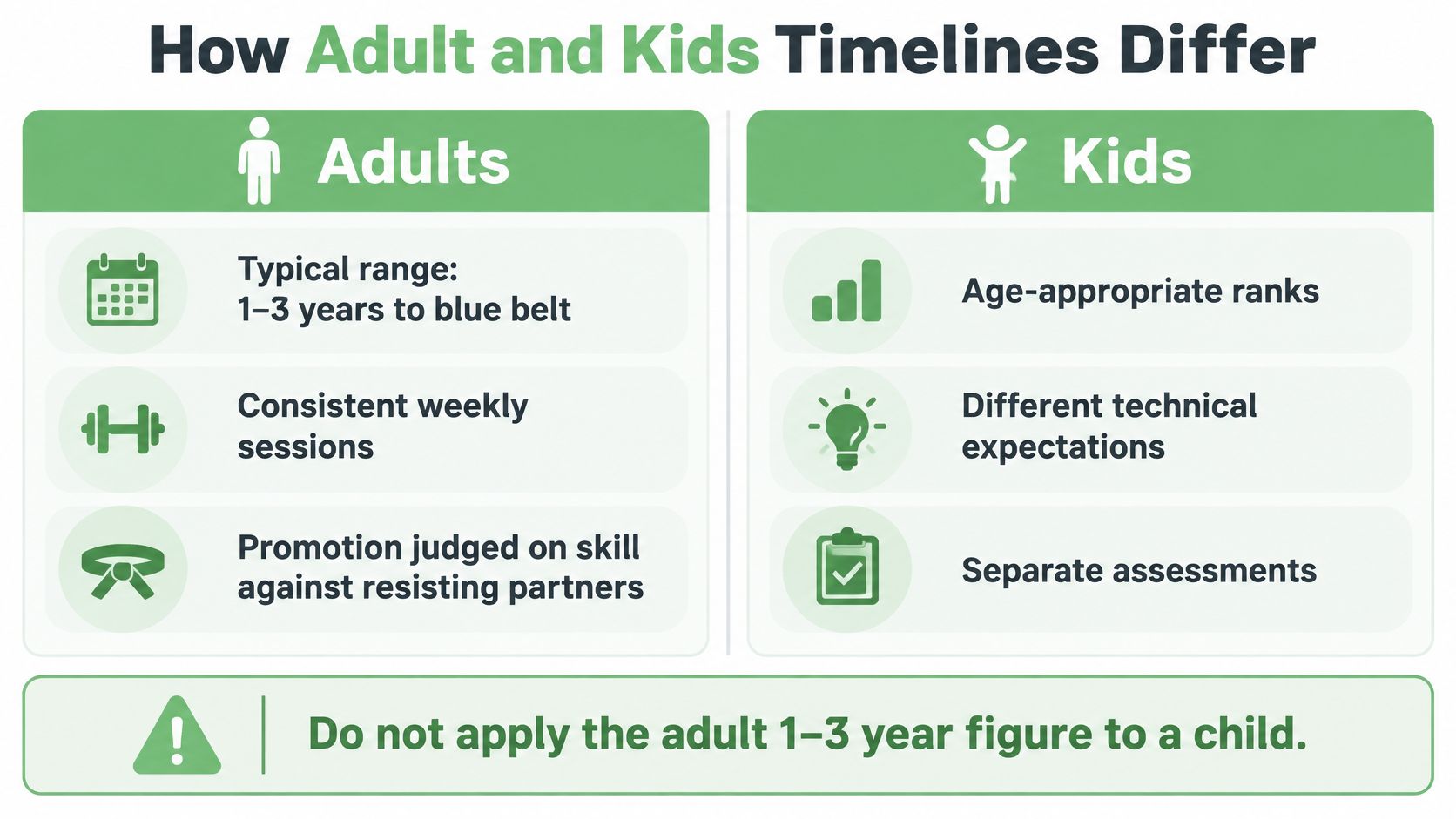
Parents shouldn't paste the adult one to three year figure onto a child. Youth programs commonly use age-appropriate ranks, different technical expectations and separate assessments. Jiu-jitsu is also a small organised activity for Australian children: an AusPlay-based summary of children's participation reports approximately 0.7% of Australian children aged 0 to 14 participating in jiu-jitsu in 2025, equivalent to about 32,000 children. That number sets no belt date, but it shows why families need clearer guidance than an adult estimate transplanted onto a child.
The two standards sit side by side like this.
Question | Adults | Children |
|---|---|---|
Useful time guide | About 1 to 3 years with steady training | No shared adult deadline |
Main evidence | Live defence, escapes, control and submissions | Growth, confidence, attention, safety, attendance and positions |
Rank structure | White, then blue, purple, brown and black | Age-appropriate ranks and separate assessments |
After a change of group or format | Skill is reassessed in live training | A previous promotion does not transfer automatically |
The transfer question parents ask
If a child changes age group, academy or format, the previous promotion doesn't transfer automatically. Belt standards and youth-to-adult transition policies vary by academy, so ask how assessments are documented and who makes the rank decision. A parent who knows the process is harder to mislead than a parent who's only been given a date.
A child's progress can move with growth, confidence, attention, safe participation, attendance and the ability to apply positions. Submission knowledge alone is a weak signal. A quiet child who keeps posture and recovers guard may be further along than a child who can name many moves but panics when someone applies pressure.
Our Jiu Jitsu for Kids program introduces children to Jiu Jitsu in a fun, safe and engaging environment, with discipline, focus, coordination and self-defence built into the sessions. For more on how youth ranks are structured, see kids jiu-jitsu belts.
Choose a Weekly Rhythm and Book a Trial
Pick the weekly number you can keep for months, then train until the earlier skills show up against a resisting partner. Chasing a date on the calendar creates frustration when work, illness or injury breaks a streak. Two or three sessions a week suit someone aiming at the shorter adult band. One honest session a week can still build skill, but it belongs in the longer band.
Pick the week before you pick the date
A realistic week includes travel, sleep, family and recovery. If a class starts at a time you can only make by skipping dinner, it won't survive a busy month. If your schedule is the hard part, planning your week realistically is a practical place to start, because a timetable you can't keep is worse than a smaller one you can.
Treat the first month as a test of consistency rather than a grading countdown. Check the timetable, book a trial, and see whether the class times fit the week you chose. The belt comes from repeatable skill, not from the day the trial was booked.
Locals Jiu Jitsu Alexandria runs a beginners program for all ages, genders and fitness levels, an advanced program for blue belts working toward black belt, and a free trial class so you can test the timetable before you commit. The academy is minutes from Alexandria, Waterloo, Zetland, Rosebery and Green Square, and the coaching team focuses on technique, fitness, self-defence and personal growth. Visit Locals Jiu Jitsu Alexandria to check the timetable and book your first session.
Comments