
8 Jiu Jitsu for Kids Benefits to Know
If a children's activity promises confidence and discipline, what does your child do to practise them? Parents searching for jiu jitsu for kids benefits deserve more than slogans. The useful question is whether a class gives children clear, repeatable ways to move well, listen, cooperate and handle manageable challenges.
In structured training, children follow guided drills, learn partner rules and work towards rank progress. A movement sequence asks them to coordinate their body. A partner exercise asks them to control their pressure. Learning a technique that didn't work last week gives them something concrete to feel proud of.
At Locals Jiu Jitsu Academy in Alexandria, our coaches prioritise safety and steady progression in a fun, engaging setting. Our approach brings coordination, discipline, focus and self-defence together, without treating every child as equally confident, physically ready or comfortable with contact.
The most useful gains are observable: steadier movement, greater fitness, better attention, confidence, strategic thinking, respect, connection and calmer personal safety awareness. They're opportunities to practise, not guaranteed personality changes.
Watch how your child responds to the actual teaching. Can they explain a movement? Do they feel comfortable asking for help? Are they learning to stop when a partner signals? Those details tell you more than a promise that martial arts will transform schoolwork or solve bullying.
Table of Contents
1. Improved Coordination, Balance and Body Control - Look for control before speed
2. Full-Body Fitness, Strength and Flexibility - Count active movement, not just attendance
3. Focus, Discipline and Attention Span - Make attention visible
4. Confidence and Emotional Self-Regulation - Keep the challenge manageable
5. Problem-Solving and Strategic Thinking - Ask why, not just what
6. Respect, Teamwork and Sportsmanship - Respect includes stopping
7. Inclusive Community and Peer Connection - Look at how beginners are included
8. Resilience, Personal Safety Awareness and Social Confidence - Practise decisions alongside movement
Choose the Benefit You Want to See First - Give progress a fair definition - Try the setting before committing
1. Improved Coordination, Balance and Body Control
Coordination starts with knowing where your body is. Children practise this when they shift their weight, crawl, turn their hips and move between positions without falling into their partner.
Individual guidance helps children slow down and notice their posture.
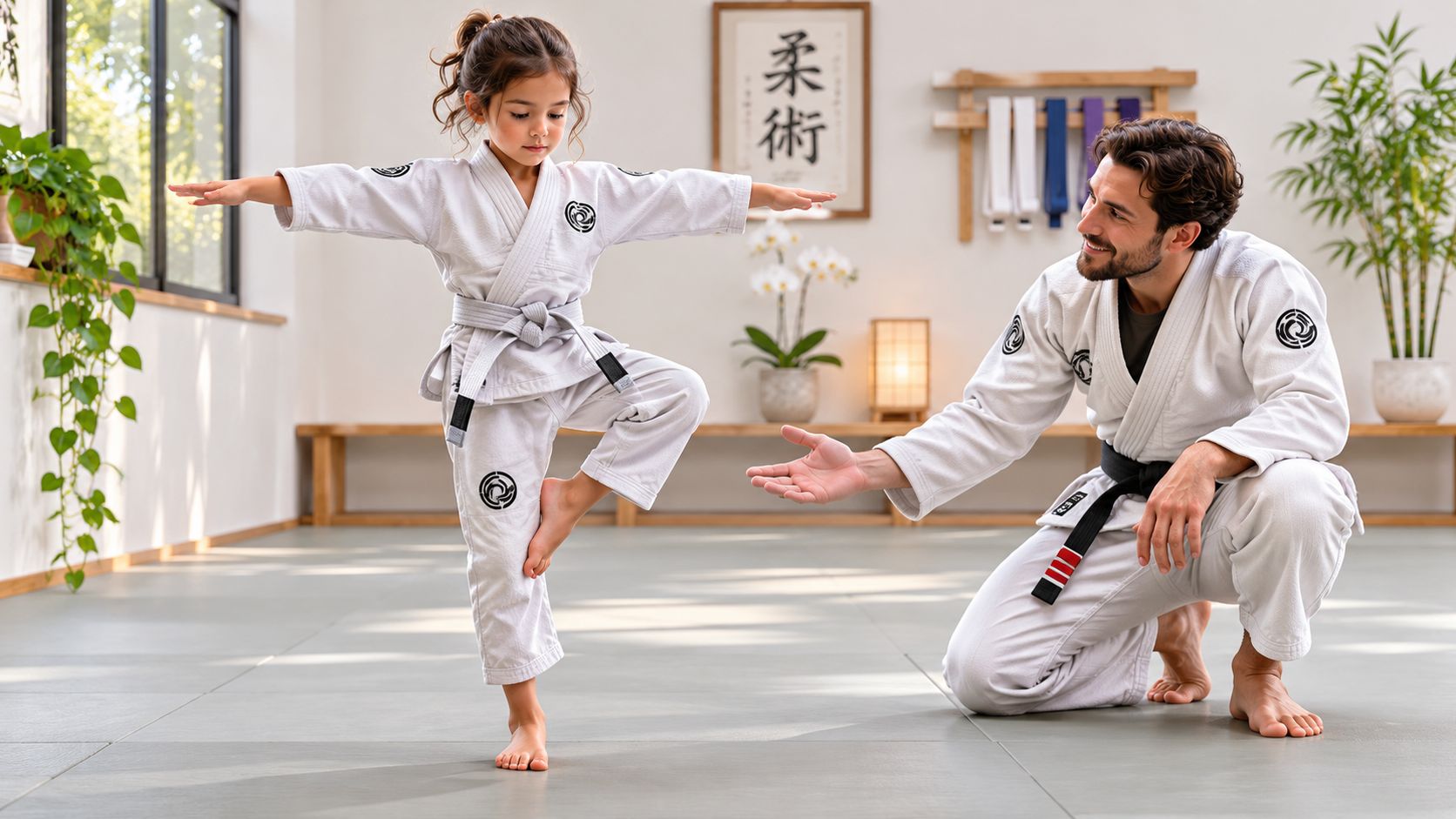
A guided drill might ask a child to move from sitting to kneeling while keeping a stable base. Rather than rushing to finish, they learn where to place their knees, how to distribute their weight and when to change direction. Using position efficiently is not about discovering a trick that makes strength irrelevant.
Say your child loses balance whenever they turn. A coach can simplify the movement, demonstrate it again and let them practise without resistance before adding a partner. Our guide to kids' jiu jitsu drills explains how movement practice fits into learning.
Look for control before speed
Useful signs of progress include smoother transitions, fewer rushed movements and better awareness of nearby children. These are more meaningful than whether your child looks fast or athletic.
Parent check: Watch whether your child can repeat a movement slowly without needing constant correction.
Home practice: Use gentle crawling or balance games on a clear, suitable surface. Leave partner techniques, falls and submissions to supervised training.
Real limit: Improvement on the mat doesn't automatically produce better handwriting, sporting performance or every other motor skill.
This video offers another view of movement practice.
Keep your attention on the quality of movement, not how quickly your child reaches the next technique.
2. Full-Body Fitness, Strength and Flexibility
Bridging, crawling and changing positions ask children to use their legs, trunk, arms and back together. Full-body fitness develops through active practice, with coaches adjusting the pace and difficulty to the child.
A bridge illustrates how a simple movement can involve several muscle groups.
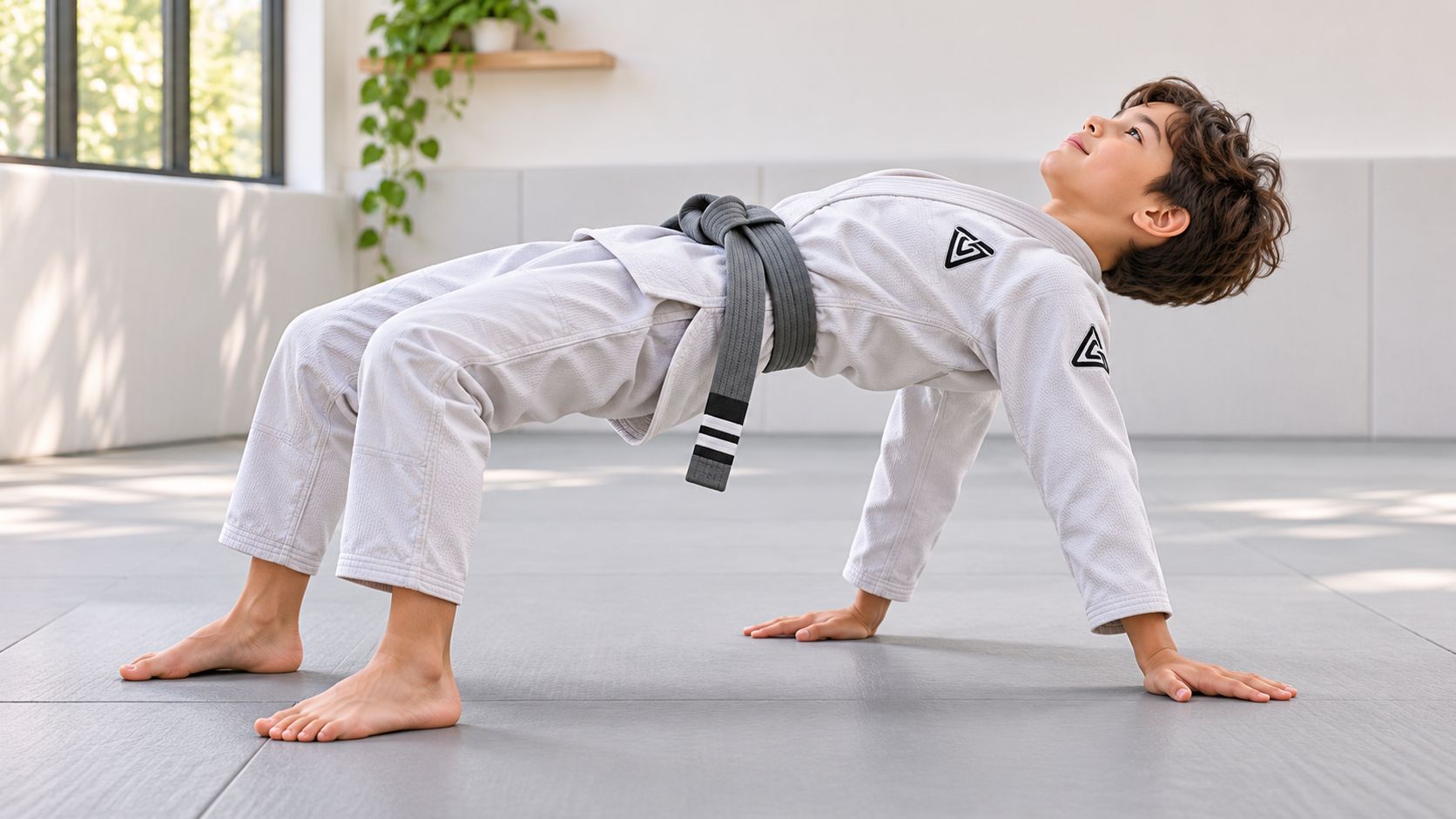
During a positional drill, a child might move their hips, push through their feet and hold their balance while a partner offers light resistance. Repeated efforts can challenge muscular endurance and breathing without making every exercise a race. Controlled movement through comfortable ranges also gives children opportunities to work on mobility.
The broader need for consistent activity is clear: in 2023, only 18.3% of Australian children aged 5–17 met the recommendation of at least 60 minutes of moderate-to-vigorous activity every day, according to the Australian Bureau of Statistics.
Count active movement, not just attendance
A class includes instruction, demonstrations and pauses, so time at training isn't all exercise time. The Australian Government's activity guidelines also recommend vigorous activity and muscle- and bone-strengthening activities on at least three days each week.
For a child who tires quickly, success might mean completing a movement sequence comfortably before needing a break. It shouldn't mean pushing through pain or comparing their stamina with an experienced classmate.
Practical rule: A useful fitness challenge leaves room for good technique, recovery and enjoyment.
Watch your child's energy after training, protect sleep and rest days, and keep walking, outdoor play and other movement in their routine. Jiu jitsu contributes to an active lifestyle. It doesn't replace one.
3. Focus, Discipline and Attention Span
A child watches a demonstration, waits for the signal and then tries the movement with a partner. That sequence creates a practical opportunity to rehearse attention and self-control.
The task is more specific than behaving well. Children need to notice where a hand goes, remember the order of movements and stop when instructed. Clear routines reduce uncertainty, while a manageable technical challenge gives them something definite to concentrate on.
Our coaching approach values discipline and respect alongside technique. Separate instruction by development stage and experience also helps keep expectations appropriate, rather than expecting a newcomer to process the same information as an experienced student.
Make attention visible
Say your child usually begins moving before hearing the full instruction. A useful milestone is waiting, watching and then starting correctly, even if the technique remains imperfect. Praise that behaviour directly rather than saying only that they were good.
Keep routines predictable: Make attendance fit a manageable family schedule rather than treating every session as optional.
Praise the process: Notice listening, careful repetition and a calm reset after a mistake.
Practise elsewhere: Turn-taking games from the Very Special Games family picks offer another setting for waiting and following rules, without making home feel like extra training.
Our explanation of building confidence and discipline through BJJ connects these habits with structured practice.
The limit is transfer. Following instructions during an engaging physical activity doesn't guarantee a longer attention span during homework. Use the same simple cues at home, and don't treat martial arts as a substitute for educational or clinical support when your child needs it.
4. Confidence and Emotional Self-Regulation
Confidence is more useful when a child can name what they've learned. Moving safely out of a position, remembering a sequence or asking for another demonstration gives them evidence of progress.
Rank milestones can recognise that effort, but the learning between promotions matters just as much. A child who once avoided a drill may become willing to try it with a trusted partner. Another may learn to pause rather than become angry when their first attempt fails.
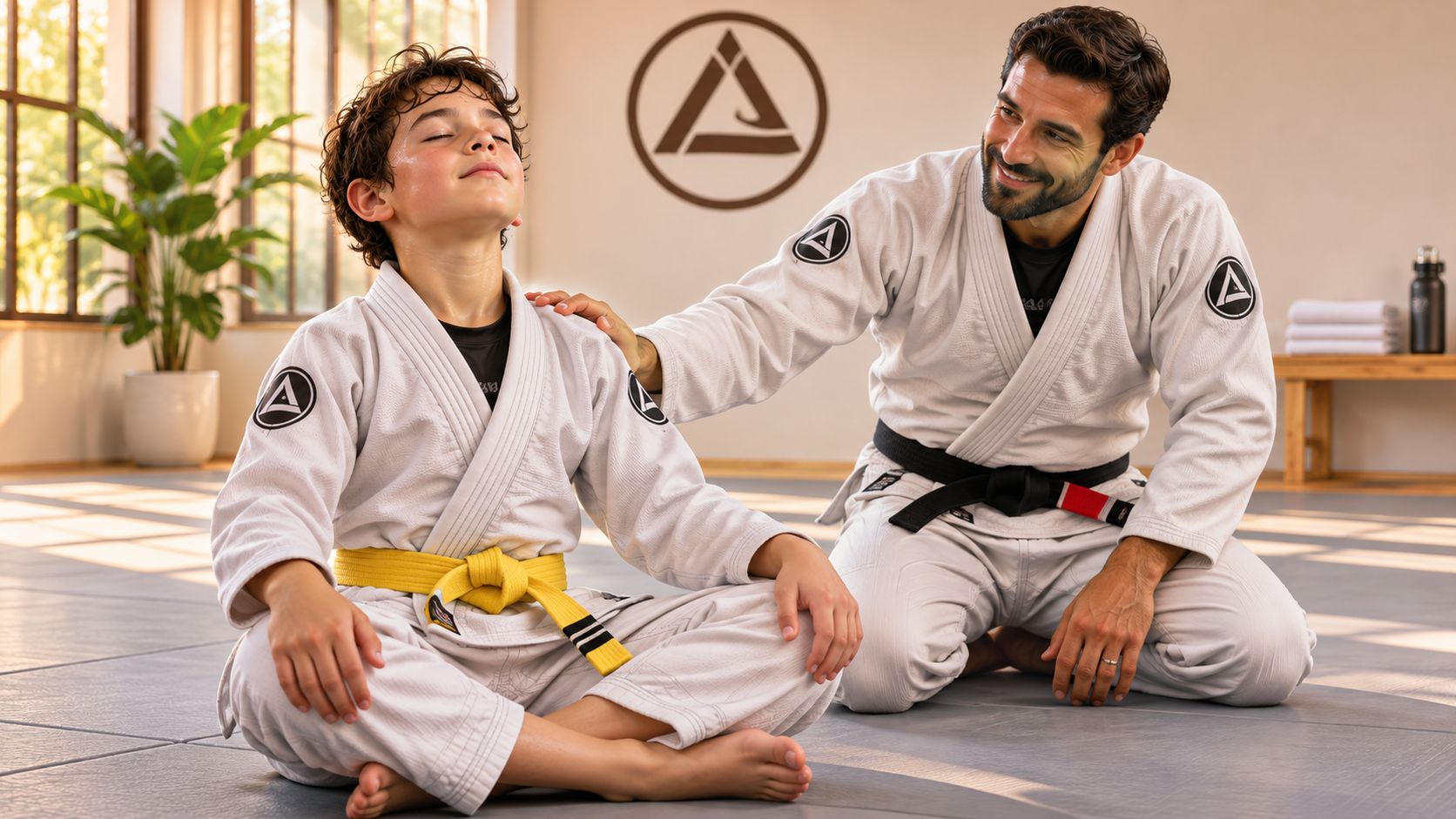
Supportive coaching makes those smaller achievements easier to recognise.
Broader sport evidence supports cautious optimism: an eight-year Australian study found beneficial associations between sport participation and psychosocial wellbeing, according to the Journal of Adolescent Health study00376-2/fulltext). It was observational and didn't establish that children's jiu jitsu specifically causes confidence or emotional regulation.
Keep the challenge manageable
Say your child becomes frustrated when they can't complete an escape. A constructive response is to stop, identify the difficult movement and try a simpler version, rather than insisting they endure increasing pressure.
Progress can mean asking for a break calmly, not staying in an uncomfortable situation for longer.
After class, ask what felt difficult and what helped. Celebrate belt progress alongside quieter achievements such as trying again or communicating discomfort; ideas from these self-esteem activities for dance students can also prompt conversations about effort beyond results.
Watch the emotional cost. Persistent dread, distress or fear of disappointing adults isn't proof that a child needs more toughness. Reduce the pressure and discuss what needs to change.
5. Problem-Solving and Strategic Thinking
A child tries to move a partner directly backwards, but the partner's weight is firmly planted. Instead of pushing harder, they learn to change the angle.
That's problem-solving through positioning and technique. The child notices what's happening, selects a response and checks whether it works. If it doesn't, they adjust rather than repeat the same unsuccessful effort.
Our technical approach emphasises fundamentals such as balance, positioning and strategy. Children need those simple ideas before complex sequences, because knowing a movement isn't the same as understanding when to use it.
Ask why, not just what
A positional game can give a child a clear problem: maintain balance while a partner tries gently to disrupt it. The useful question afterwards isn't who won, but what changed when the child moved their knees, shifted their hips or widened their base.
Try prompts that encourage explanation:
Notice the position: Ask where their weight was when they felt stable.
Compare approaches: Ask what happened when they changed direction instead of pushing harder.
Choose an adjustment: Ask what they'd try next time and why.
This approach also makes room for children who need time to think. A slower response can still be thoughtful and technically sound; speed alone isn't a good measure of understanding.
The main limit is specificity. Solving a grappling problem doesn't prove that a child will become better at mathematics or every everyday decision. The transferable habit is smaller: noticing a problem, trying an approach and being willing to revise it.
At home, you can reinforce that habit during a puzzle or a difficult school task. Help your child identify what they've already tried before suggesting the next step.
6. Respect, Teamwork and Sportsmanship
Your training partner isn't equipment. They're another child whose comfort and safety matter throughout the exercise.
Partner etiquette makes respect concrete. Children learn to wait until both partners are ready, use controlled pressure and stop immediately when someone taps or says to stop. Where bowing or other class etiquette is used, the gesture matters less than the behaviour it represents.
Small moments of acknowledgement help children practise cooperation.
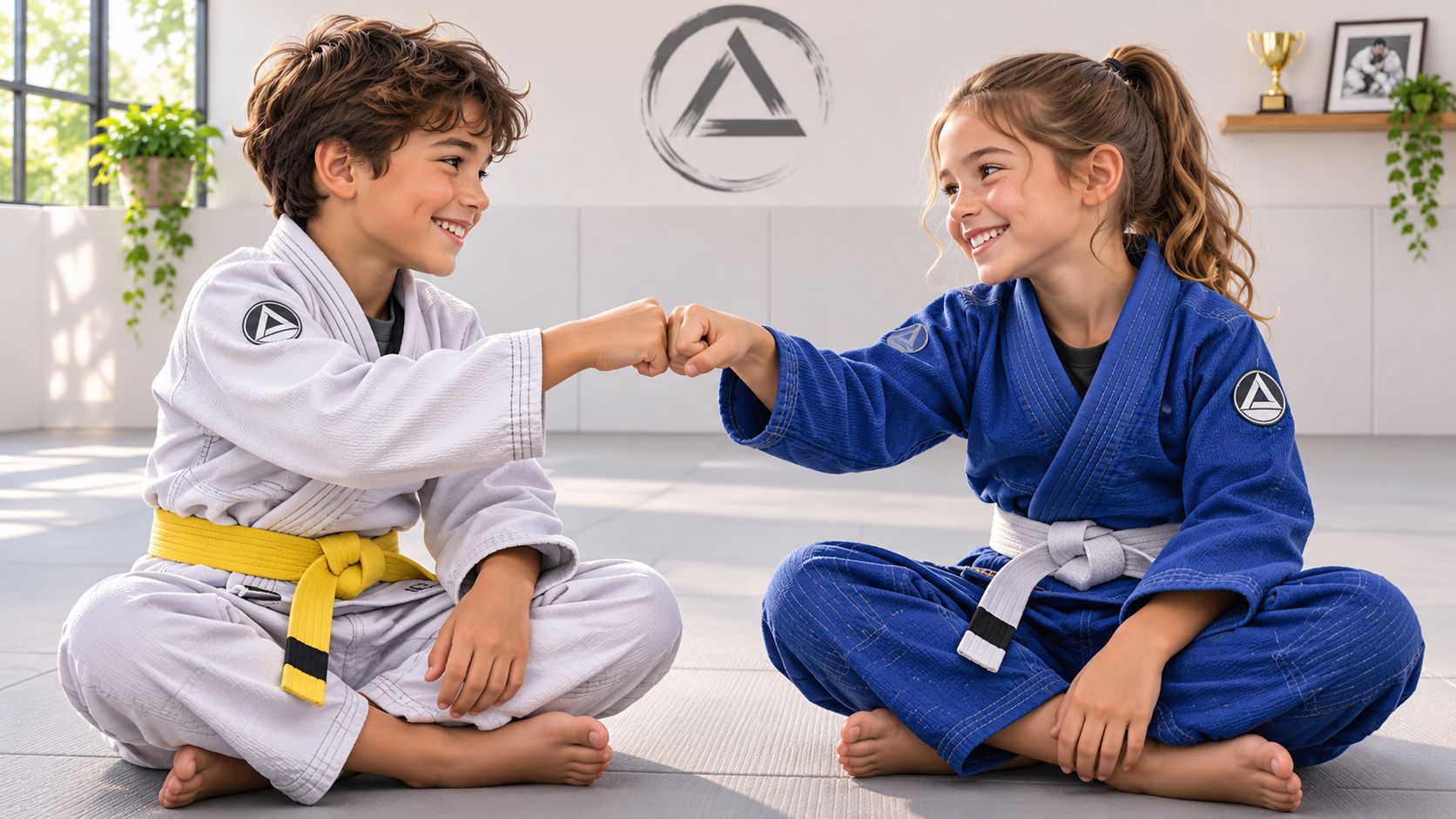
Say a more experienced child is paired with a beginner for a controlled drill. Good teamwork means giving the beginner an appropriate opportunity to practise, not using every advantage to dominate. Our respectful, controlled coaching environment puts that responsibility alongside technical learning.
Respect includes stopping
Contact practice still involves risk. Australian emergency-department research on sport and active recreation identified fractures, strains and sprains among common injuries, but it doesn't establish a children's jiu jitsu injury rate or quantify risk at our academy.
Parents should therefore watch the practical controls: suitable partner matching, close supervision, immediate release after a tap and clear responses to unsafe behaviour. Clean mats, appropriate hygiene and staying off the mat with a potentially contagious skin condition matter too.
Non-negotiable: A child never owes a partner continued contact after signalling that they want to stop.
After a difficult class, praise a safe release or a considerate reset as specifically as a successful technique. Encourage your child to thank their partner and tell a coach if someone ignores a boundary.
Sportsmanship isn't passive obedience. Children can respect adults and teammates while speaking up about pain, discomfort or behaviour that feels unsafe.
7. Inclusive Community and Peer Connection
Some children enjoy learning beside others but dislike the pressure of a conventional team sport. Partnered training can offer shared participation without requiring immediate competition.
A repeated class routine gives children familiar faces and a reason to interact. They learn names, take turns and help each other complete drills. Friendship isn't guaranteed, but cooperation gives a new child a practical starting point beyond having to introduce themselves in an unstructured group.
Our community welcomes people across age, gender, race, religion and social background. Families come from Alexandria and nearby areas including Erskineville and Rosebery, creating opportunities to build local connections through shared effort.
Look at how beginners are included
Say your child watches before joining. A useful response is a clear explanation, a manageable task and patient encouragement, rather than public pressure to participate immediately.
Exercise & Sports Science Australia's children's exercise guide recognises that competitive sport can increase distress for some children and that activities such as martial arts may be a better fit. That doesn't make every martial arts setting non-competitive, so pay attention to how grading, partner practice and competition are discussed.
Parent check: Notice whether established students make room for newcomers and whether coaches intervene when someone is excluded.
Small next step: Encourage your child to learn a classmate's name and acknowledge their effort during a drill.
Real limit: Inclusion requires ongoing behaviour, not a welcoming statement alone.
A child who dislikes loud spaces, close contact or rapid transitions may need additional support. Talk openly about those needs and judge the fit by your child's comfort and participation, not by whether they appear outgoing.
8. Resilience, Personal Safety Awareness and Social Confidence
Personal safety begins before physical technique. Children need to recognise discomfort, use clear words, move towards safety and involve a trusted adult.
Mechanical advantage and positioning can offer practical options during supervised learning. They don't remove differences in size, strength or circumstances, and they don't make every confrontation controllable. The aim is to help a child respond thoughtfully, not encourage them to test techniques on peers.
Say another child repeatedly grabs their clothing at school. A useful response includes speaking clearly, creating distance where possible and reporting what happened. Physical skills shouldn't replace that reporting process or become a reason adults expect the child to manage bullying alone.
Practise decisions alongside movement
Our emphasis on self-defence, respect and personal growth supports discussing when a technique belongs in training and when a child should seek help. Our parent's guide to self-defence classes for kids provides a starting point for that conversation.
Resilience can also mean returning to a manageable task after disappointment. Complementary resilience activities for kids offer ways to discuss coping and persistence away from contact practice.
Practise a clear response: Rehearse saying stop, moving away and naming the adult your child can approach.
Praise reporting: Make sure asking for help counts as a successful safety decision.
Keep physical practice supervised: Don't recreate threatening scenarios or practise submissions at home.
Jiu jitsu isn't a substitute for adult supervision or school anti-bullying programs. A child can become more confident about boundaries while still needing adults to intervene promptly and consistently.
How the Eight Kids Benefits Compare
Item | Growth area | Class habit | Shows up off the mat | Main caution |
|---|---|---|---|---|
Improved Coordination, Balance and Body Control | Coordination, balance and body awareness | Practises controlled movement, weight shifts and footwork | Supports motor skills for sports and daily activities | Progress may be gradual; some drills need adjusted pacing |
Full-Body Fitness, Strength and Flexibility | Fitness, strength, endurance and flexibility | Combines movement drills with conditioning | Encourages regular activity and healthy habits | Minor injuries can occur; check with a doctor about medical concerns |
Focus, Discipline and Attention Span | Concentration, listening and self-control | Follows routines, instructions and class etiquette | Supports consistent habits and attention at home or school | May need extra guidance; regular attendance can be difficult |
Confidence and Emotional Self-Regulation | Self-belief and emotional control | Persists through challenges and resets after mistakes | Helps children manage frustration and recover from setbacks | Early competition may increase anxiety; confidence may not transfer everywhere |
Problem-Solving and Strategic Thinking | Decision-making, adaptability and analysis | Reads movement and chooses technical responses | Can support flexible thinking and academic habits | Concepts may be abstract for young children; instruction quality matters |
Respect, Teamwork and Sportsmanship | Cooperation, respect and fair play | Works with partners and follows safety rules | Helps build healthy relationships and respect for others | Partner work may feel uncomfortable at first; rules need consistent enforcement |
Inclusive Community and Peer Connection | Belonging, friendship and connection | Trains with peers across ages and abilities | Can help children form friendships and feel included | Class culture varies; solo-oriented children may need time to settle in |
Resilience, Personal Safety Awareness and Social Confidence | Resilience, awareness and assertiveness | Practises controlled self-defence and calm responses | Supports composure and respectful self-advocacy | Skills need ongoing practice and do not replace adult supervision or school safety programs |
Choose the Benefit You Want to See First
Choose a priority you can observe: steadier movement, better listening, calmer reactions or stronger peer connections. A clear priority helps you notice meaningful changes without expecting your child to improve in every area at once.
For movement, watch whether they can complete a familiar drill with more control. For focus, notice whether they wait for the full instruction. For confidence, look for willingness to ask a question or attempt something that previously felt difficult.
Give progress a fair definition
Compare your child with their own starting point, not with the most experienced student in the room. Children arrive with different comfort levels, physical abilities and experience of organised activities. Some become comfortable with the routine before they show much technical progress.
The Australian Institute of Health and Welfare's guidance on children's physical activity supports placing organised activity within a broader active lifestyle. For parents, that means valuing regular participation while keeping room for outdoor play, other interests and recovery.
Useful observations include:
Participation: Your child joins suitable activities willingly and understands what happens next.
Control: They move carefully and respond to a partner's stop signal.
Communication: They can describe a difficulty or ask a coach for help.
Recovery: They leave with enough energy for normal family life and adequate rest.
Don't turn these observations into another performance test. A brief conversation after class is usually more useful than a detailed review of everything your child did wrong.
Try the setting before committing
A free trial at Locals Jiu Jitsu Academy lets your child experience the pace, rules and coaching before your family commits. Watch how instructions are explained, how partners treat each other and whether your child feels comfortable communicating uncertainty.
Check the timetable, book a session and follow up by phone on 0414752412 or email at team@localsalexandria.com.au. Share anything relevant to your child's participation, including injuries, worries about contact or difficulty following busy group instructions.
Keep rest days, protect sleep and praise effort rather than comparing belts or results. If enthusiasm drops, find out whether the issue is tiredness, discomfort, social pressure or a poor fit with the activity.
The strongest benefit isn't necessarily the most dramatic one. It may be a child who moves more confidently, treats a partner carefully or knows they're allowed to ask for help. Keep adult supervision and school safety programs in place while those skills develop.
Locals Jiu Jitsu Alexandria offers structured children's training that brings together movement, focus, partner respect and age-appropriate self-defence. Visit Locals Jiu Jitsu Alexandria to check the timetable and book a free trial, then choose a practical goal to discuss with the coaching team.
Comments