
8 Basic Jiu Jitsu Moves for Beginners
You arrive at your first Brazilian Jiu-Jitsu class expecting to learn a few impressive techniques. Instead, you start standing, lose your balance, land on the mat, and find yourself defending a pin while trying to remember what your hands and feet should do. A few minutes later, you create space, improve your position, and recognise an opportunity to apply a controlled submission. That sequence can feel confusing at first, but it reflects how jiu jitsu works.
Basic jiu jitsu moves are connected skills, not isolated tricks. You establish a position, create movement, regain or improve control, and only then look for a safe finish. The eight fundamentals below follow that pathway, from guard and mount to escapes, takedowns, passing, and carefully managed submissions. Practise them slowly, tap early, release immediately, and follow qualified coaching. Beginners in Sydney can develop these habits at Locals Jiu Jitsu Zetland or Locals Jiu Jitsu Maroubra, where structured guidance helps turn unfamiliar movements into reliable class skills.
1. The Fundamental Guard Position
The guard is a defensive position from your back, with your legs controlling your partner's hips or torso. In closed guard, your legs wrap around their body and your feet connect behind them. You aren't helpless underneath. Your legs manage distance, your hips create angles, and your grips help control posture.
Start by lying comfortably on your back and bringing your partner between your legs. Wrap your legs around their waist, cross your ankles behind them, and keep your knees drawing inward. Place your hands across their chest, biceps, or collar area rather than reaching wildly for the head. Your feet should stay active, and your hips should be ready to move.
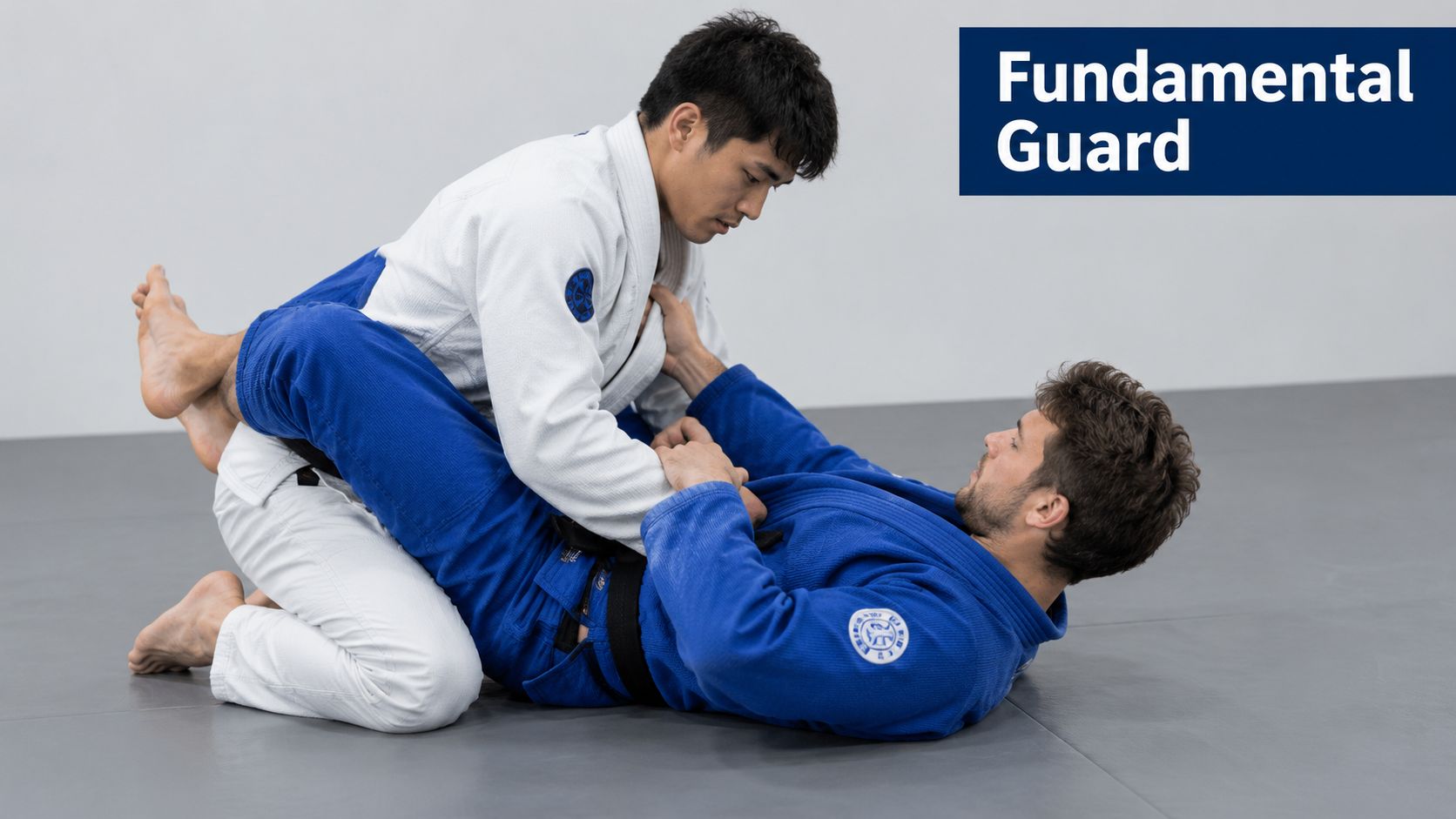
Build control before attacking
The first task is to stop your partner from standing tall or flattening your posture. Use your legs to keep their hips close, then use your grips to influence their shoulders. Once their posture changes, you can begin creating angles for a sweep, opening the guard safely, or isolating an arm.
Coaching cue: Keep your heels close to your body and think, “knees in, hips active, posture controlled.”
A common mistake is squeezing with the legs while leaving the upper body passive. Another is opening the guard without a plan, allowing your partner to pass. Practise holding closed guard against a static partner, then add gentle posture changes and movement. At Locals Jiu Jitsu Zetland or Locals Maroubra, you can connect this position with the jiu jitsu guard fundamentals, hip escapes, and controlled sweep entries.
2. The Mount Position and Control
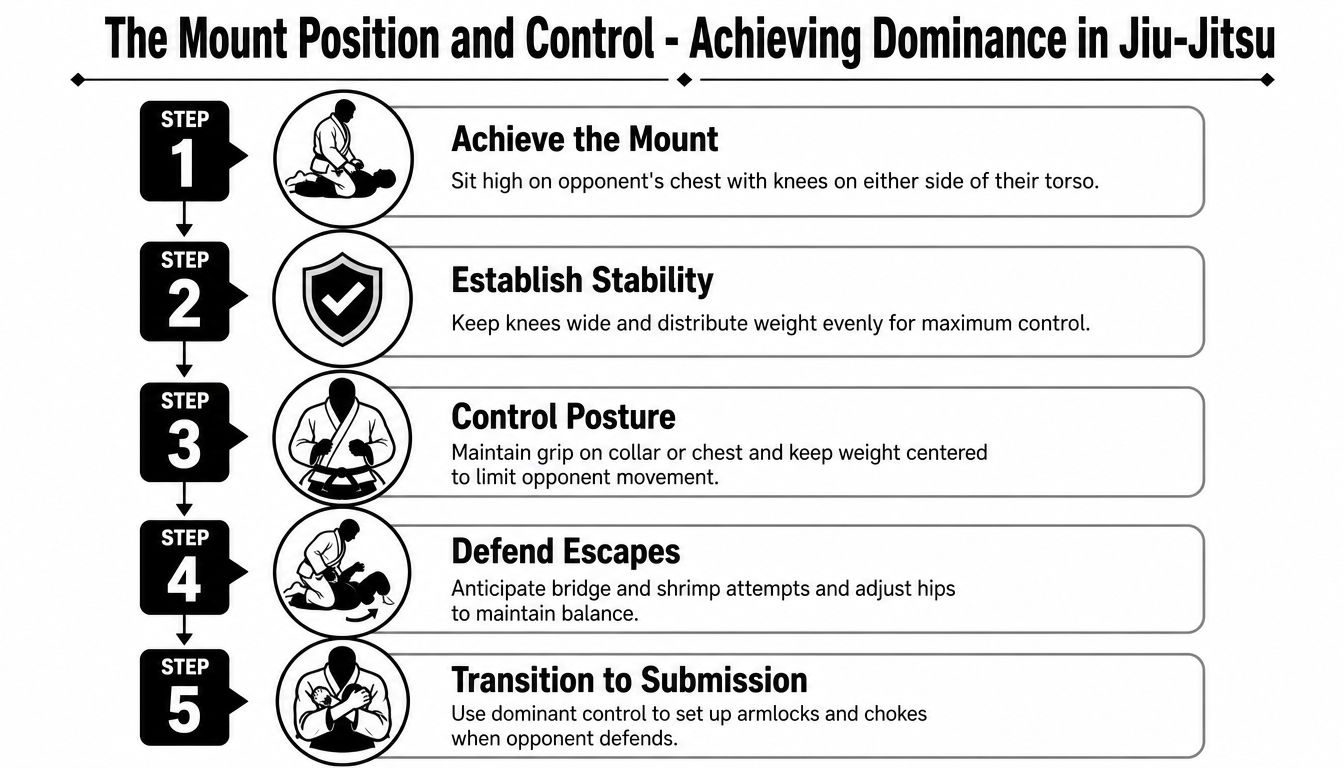
Mount puts you on top, seated over your partner's torso with a knee on each side. It's a dominant position because your weight is above their hips and shoulders, while they have to move you before creating an escape. For a beginner, mount teaches an important lesson: control comes from balance and weight distribution, not from gripping as hard as possible.
To establish mount, move your knees around your partner's hips and settle your weight through your hips and chest. Stay high enough to avoid being easily pushed over, but don't sit on the stomach with your hands posted carelessly. Keep your knees wide enough to form a stable base and adjust your hands when your partner bridges or turns.
Make stability the first objective
If your partner bridges, widen your base and follow their movement rather than fighting it with straight arms. If they turn onto their side, keep your weight connected and consider moving your knee closer to their shoulder. Your hands can control the chest, collar, or arms, depending on the drill.
High position: Keep your hips closer to the chest than the stomach.
Balanced base: Distribute your weight across both sides instead of leaning forward.
Escape awareness: Expect bridging and hip movement, and adjust before your partner creates space.
Controlled progression: Stabilise before considering an arm lock or collar choke.
Mount isn't a seat. It's a balanced platform that moves with the person underneath you.
A common mistake is chasing a submission before securing the position. If your partner protects an arm, maintain your base and follow their reaction. Drill the position first with no submission, then let the bottom partner use gentle bridges and turns. Coaches at Locals Jiu Jitsu Zetland can help you recognise when to hold mount, move higher, or transition safely.
3. The Hip Escape
The hip escape, commonly called the shrimp, is the movement that helps you create space from the bottom. You'll use it when your partner has mount, side control, or has started passing your guard. Rather than pushing their entire body away, you move your hips to an angle and bring your legs back into the space between you.
Begin with your back on the mat and your knees bent. Place one foot firmly on the floor. Keep your shoulders as stable as possible, then drive through that foot and move your hips sideways. Turn slightly onto your side as your hips travel away, return your feet to the mat, and repeat on the other side.
Turn movement into an escape
In a positional drill, place your forearm across your partner's hip and your other forearm near their shoulder or neck. Bridge slightly to make room, shrimp away, and bring one knee inside. That knee becomes a frame. Continue until both legs recover a guard position or you can turn to your knees under coaching.
A common mistake is lifting the shoulders and trying to scoot the whole body. Keep your upper back connected to the mat while your hips do the work. You also don't want to move directly backward, because your partner can follow without losing control.
Movement rule: Create space with your hips, protect yourself with frames, then recover your legs.
The best progression is gradual. Start solo, then work against a partner who remains still, then add light positional resistance. The evidence supplied for Australian combat-sports reporting identifies the knees, shoulders, fingers, and neck as frequent injury areas, so your partner should never force a joint or neck position while you're learning the movement. Coaches at Locals Jiu Jitsu Zetland and Locals Maroubra can adapt the drill for stiffness, limited mobility, or previous joint concerns.
4. The Armlock
Your partner reaches from guard or mount, leaving one arm extended. Before thinking about the finish, secure the arm and place your body where the shoulder cannot follow. The straight armlock attacks the elbow by extending the arm across your hips, so control and alignment come before pressure.
From guard or mount, isolate one arm with both hands or the grips your coach assigns. Keep the wrist close to your chest as you angle your hips to the side. Bring one leg over your partner's head, pinch both knees around the shoulder, and keep your other leg positioned so your hips face the elbow. Pause here. Your partner's elbow should sit near your hips, like a hinge aligned with the fulcrum of the movement.
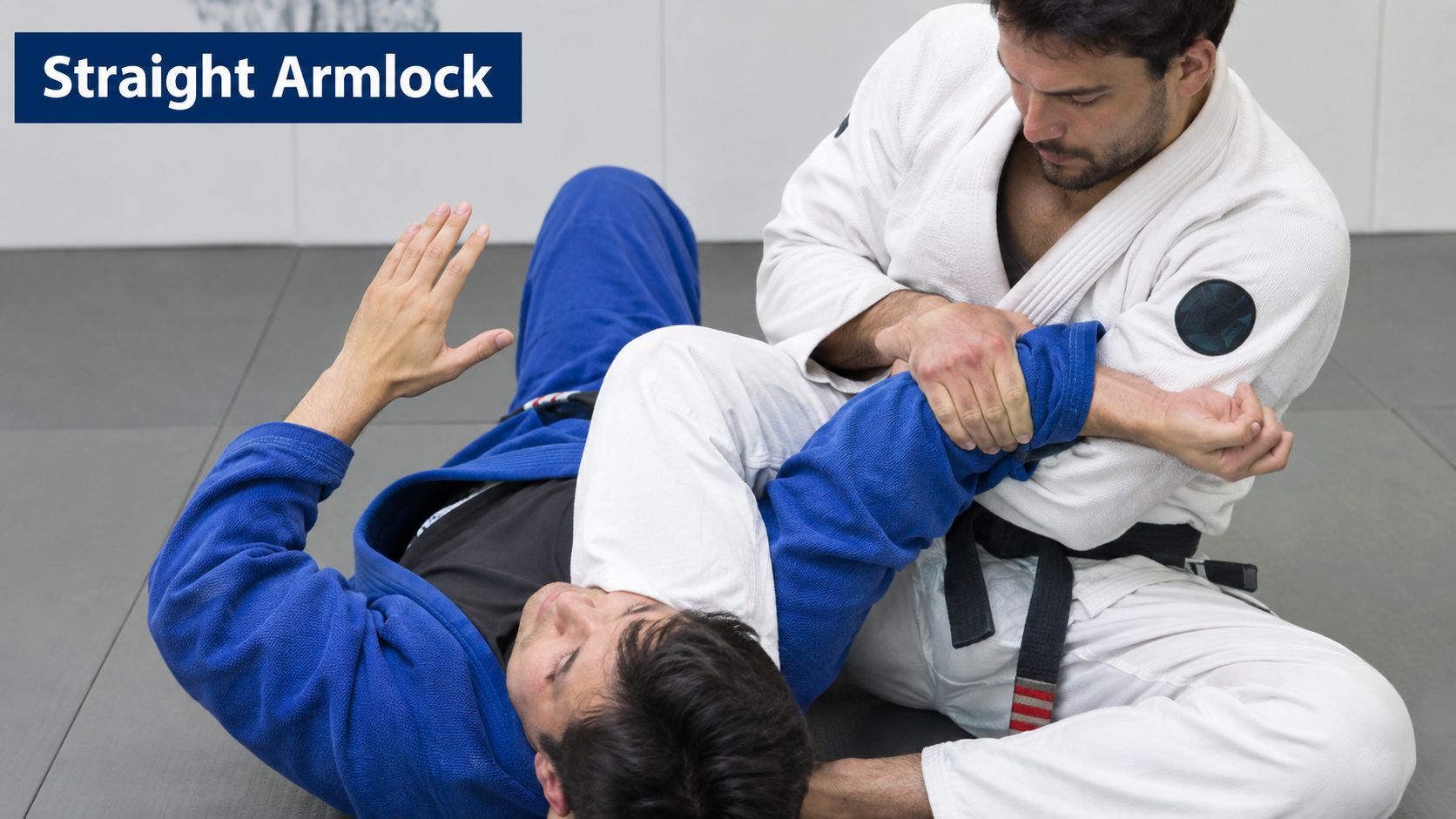
Build the position before the finish
Use this sequence during a cooperative drill:
Isolate the limb: prevent your partner from retracting the arm.
Set the angle: turn your hips so your legs surround the shoulder.
Control the head and wrist: keep the leg heavy over the head and the wrist close.
Finish carefully: raise your hips gradually, then release immediately when your partner taps or says stop.
Your coaching cue is simple: knees tight, wrist close, hips under the elbow. If your knees spread, your partner gains room to rotate. If the elbow slides beyond your hips, the structure weakens and the arm can escape. Avoid pulling suddenly or trying to finish through strength.
Start by entering the position, pausing while your partner checks your alignment, and returning to the entry. Next, add a slow extension with no resistance. At Locals Jiu Jitsu Zetland or Locals Maroubra, progress to light resistance only after both partners can recognise the tap and release promptly. For a technical reference, see the straight arm lock techniques guide.
5. The Side Control Position
Side control places you perpendicular to your partner, chest across their torso rather than sitting over their hips. It's a useful top position because it teaches you how to distribute weight while preventing your partner from turning freely or rebuilding guard.
Start with your chest connected to theirs and your hips close to their body. One arm can control near the head and shoulder, while the other manages the hips or far side. Keep your head low enough to avoid being easily pushed away, but maintain a posture that lets you move. Your legs should be wide enough to respond to bridges and turns.
Stay connected as your partner moves
If your partner frames against your neck, move your head and shoulder into a safer position rather than allowing their forearm to create a strong barrier. If they turn toward you, follow with your chest and adjust your hips. If they turn away, maintain control and look for a transition, such as taking the back or returning to a stronger top position.
A common mistake is lying flat and relying on arm pressure. That makes it easier for the bottom player to create a frame, shrimp, and recover guard. Keep your hips low, remain perpendicular, and move before the escape is complete.
Try this progression with a partner. Hold side control while they make slow framing and hip movements. Your task is not to submit them. Your task is to keep your weight connected, protect your base, and transition when they create a genuine opening. This approach fits the structured fundamentals pathway at Locals Jiu Jitsu and helps beginners understand why positional control comes before finishing.
6. The Rear Naked Choke
Your partner gives up their back during a scramble. The safe response is to secure the position first, then build the submission in stages. Back control gives you the alignment and balance needed to apply a rear naked choke without rushing the neck.
Begin chest to back. Place your legs to control the hips, using hooks or another coach-approved form of back control. Wrap one arm over the shoulder and the other underneath the arm to form a seat-belt grip. Keep your head close to their shoulder so they cannot easily turn into you.
Pause here and check three points: your chest stays connected, your hips follow their movement, and your choking arm is protected. When the position remains stable, bring the arm around the neck with the elbow close to your body. Use the other hand to support the choking arm, following your coach's instruction for hand placement. Pressure should build gradually, with no cranking or sudden pull on the head.
A useful coaching cue is, “Control the back before you chase the neck.” Beginners often squeeze with the biceps while allowing their chest to separate from their partner. Keep your shoulders relaxed, legs active, and elbows close. If your partner turns toward the choking-arm side, adjust your angle and recover back control instead of forcing the arm across the face.
Safety governs every repetition. Drill the entry slowly, pause before finishing, and have both partners confirm the position. The bottom partner should tap early or give a clear verbal signal. The top partner releases immediately, then checks that their partner is comfortable.
At Locals Jiu Jitsu Zetland, practise first by holding back control while your partner makes slow turning attempts. At Locals Maroubra, progress to placing the arm around the neck, pausing, resetting, and only then adding controlled finishing pressure under your coach's supervision. This pathway links positional control to a carefully managed submission, where alignment matters more than squeezing harder.
7. The Takedown and Guard Pass Fundamentals
A round often begins on the feet, then moves through the guard before either partner establishes control. Takedowns develop balance, distance, and safe landing habits. Guard passes teach you to manage legs, grips, and angles until you reach side control or mount. Review these takedown fundamentals before practising entries with a partner.
Begin with stance. Keep your feet under your hips, knees soft, spine upright, and hands ready to manage grips. First, guide your partner's upper body while stepping to shift their balance. Then follow the controlled entry shown by your coach, keeping the direction predictable and prioritising a safe landing over speed.
Coaching cue: Move their weight before you move their feet.
A common error is bending at the waist or reaching so far that your own balance disappears. Practise grip placement, small footwork adjustments, and the entry without completing the takedown. At Locals Jiu Jitsu Zetland, your coach can adjust the entry and landing to match your experience.
Once grounded, treat the guard pass as a route with checkpoints:
Establish approved grips or control the legs.
Keep your head, hips, and feet aligned as you approach.
Clear the knees before trying to settle your chest.
Move around the legs with your feet, rather than pulling only with your arms.
Hold side control briefly before resetting.
Start with a partner who stays still. Next, let the bottom partner make slow hip movements, then add light resistance. The goal is consistent posture and connection, not racing around the guard. If the knees return between you and your partner, pause, recover your stance, and begin the sequence again.
Fast throws and hurried passes create avoidable risk. The Western Australian Combat Sports Commission report recorded 1,200 contestants across 600 contests, with 126 reportable injuries and 91 mandatory suspensions in 2024/25. Drill slowly, communicate clearly, and increase resistance only when the movement remains controlled. At Locals Maroubra, progress from the standing entry to the landing, then from a cooperative guard pass to measured positional sparring under coach supervision.
8. Collar Choke
The collar choke uses the gi collar to create a controlled strangle from positions such as mount, side control, or guard. It teaches you how a grip changes posture and how small adjustments to your wrists, elbows, shoulders, and hips can create pressure without relying on a hard pull.
From mount or guard, establish a deep grip inside the collar, close to your partner's neck, using the hand position shown by your coach. Your second hand takes the opposite collar. Keep both elbows close, control your partner's head and posture, and turn your upper body slightly to create the correct angle.
Apply pressure gradually
Don't rush the finish. Deep grips should be established before you try to tighten them, and your partner must have a clear tap signal. Keep your hands controlled, avoid twisting the head, and release immediately at the tap.
A common mistake is using shallow grips that slide out. Another is opening the elbows and pulling with the arms, which weakens your structure and can give your partner room to defend. Practise gripping from mount while your partner offers no resistance. Then allow light hand fighting and posture changes.
Safety cue: A submission drill ends at the tap, not after it.
The progression at Locals Jiu Jitsu Zetland or Locals Maroubra should move from grip placement, to posture control, to gradual pressure. Partners should communicate clearly throughout. If the collar feels tight or uncomfortable before the intended finish, stop and reset. Gi techniques are valuable because they develop grip awareness, but they still demand the same discipline as joint locks and other neck-control techniques.
8 Fundamental Jiu-Jitsu Moves Comparison
Technique | 🔄 Implementation complexity | ⚡ Resource / Efficiency | ⭐ Expected outcomes | 📊 Key advantages | 💡 Ideal use cases & tips |
|---|---|---|---|---|---|
The Fundamental Guard Position | Low–Medium, basic mechanics but requires consistent drilling | Moderate, needs flexibility and core/leg conditioning; no special equipment | High ⭐, equalizes size, creates submissions and sweeps | Reliable bottom control; strong transition potential | Beginners / self-defence, keep hips elevated, active feet, drill hip escapes |
The Mount Position and Control | Medium, achieving and maintaining requires balance and pressure control | Variable, can be tiring if technique poor; efficient with proper weight distribution ⚡ | Very High ⭐, dominant control with many submission options | Maximum top dominance; excellent for applying pressure and strikes | Self-defence & positional dominance, sit high on chest, knees wide, defend bridges |
The Hip Escape (Shrimp) | Low, fundamental movement pattern but timing matters | High efficiency, quick space creation with minimal equipment ⚡ | High ⭐, enables escapes and positional recovery | Foundational escape; builds hip power and mobility | Universal drill, plant foot, drive hips explosively, repeat daily for muscle memory |
The Armlock (Straight Arm Lock) | Low–Medium, straightforward mechanics but requires precise isolation | Efficient to drill and apply; safe with taps ⚡ | High ⭐, clear submission endpoint across positions | Intuitive submission; transferable across guard/mount/side control | Submission training, isolate arm, position perpendicular, control wrist and elbow |
Side Control Position | Medium, demands hip placement and pressure awareness | Efficient, less tiring than mount with stable control ⚡ | High ⭐, strong control and platform for transitions | Stable dominant position; gateway to mount and submissions | Positional control, keep hips low/tight, shoulder over shoulder, use underhooks |
The Rear Naked Choke | Medium–High, requires secure back control setup | Highly efficient, fast finish once back control is established ⚡ | Very High ⭐, one of the highest-percentage submissions | Extremely effective and safe when applied correctly; teaches back control | Back-control scenarios, secure hooks/seatbelt, chin to shoulder, cross-grip wrist |
Takedown and Guard Pass Fundamentals | High, involves many concepts, timing and partner variety | Resource intensive, needs mat time, varied partners and controlled drilling ⚡ (slow to master) | Very High ⭐, completes standing-to-ground transitions and positional control | Builds full-range grappling ability; essential for competition and self-defence | Progressive training, master balance disruption, practice controlled entries and passes |
Collar Choke (Basic Gi Strangle) | Medium, grip depth and angle are key technical elements | Gi-dependent, requires proper uniform; efficient once grips secured ⚡ | High ⭐ (Gi), quick and effective in gi contexts | Teaches grip fighting and gi management; strong finishing option in gi | Gi training, grip deep in collar, cross-grip over shoulder, control head; not applicable no-gi |
Turn Techniques Into Reliable Skills
The eight moves work best as a chain. From guard, you manage distance and posture rather than immediately chasing a submission. If your partner begins passing, you use frames and the hip escape to create space, recover your legs, and return to guard. From there, you can improve your position, off-balance your partner, or create an opening for the armlock.
On top, the same logic applies. A takedown or guard pass gives you access to side control or mount, but reaching the position isn't the finish. Stabilise your weight, protect your base, and respond to your partner's escape attempts. Side control may lead to mount or back control. Mount may create an arm-lock or collar-choke opportunity. Back control may create the rear naked choke, but only after your position is secure.
The supplied Australian participation data shows why structured teaching matters. The Australian Sports Commission tracks jujitsu in its sport reporting, while the broader martial-arts category includes 248,351 adults aged 15 and over, representing 1.2% of adults, with 85% participating in organised or venue-based settings in the cited AusPlay reporting. You can review the Australian Sports Commission sport reports for that context. Beginners generally need a coached pathway, not a random collection of online techniques.
Women are also a significant part of the participation picture. A Judo NSW summary reports 136,998 women among 248,351 adult martial-arts participants, meaning women represented 55% in that snapshot, as detailed in this Sydney women's jiu jitsu reference. That supports welcoming beginner and self-defence pathways for women, alongside mixed classes where everyone learns respectful training habits.
Practise one connection at a time
Choose one movement pattern for a session. For example, start in mount, frame, bridge, shrimp, recover guard, and pause. Once the mechanics are consistent, let your partner add light resistance. Later, connect guard control to a sweep or armlock entry, then connect a pass to side-control stabilisation.
Safety needs to remain part of the technique. The supplied evidence cites one study in which 59.2% of practitioners experienced at least one injury in six months, and another in which 9 in 10 athletes experienced at least one injury overall, with knees, shoulders, fingers, and neck identified as common problem areas. The Combat Sports Commission annual report+e25151554++combat+sports+commission+2024-25+annual+report+-+final+-+16+09+25+(electronic+version).pdf) summarises that evidence. These findings don't mean beginners should avoid training. They mean you should learn tap timing, controlled drilling, sensible resistance, and modifications for your own body.
A separate injury summary reports 784 of 1,140 athletes, or 68.8%, experienced an injury requiring a two-week absence over three years, with 1,052 injuries recorded, equal to 308 injuries per 1,000 athletes per year. The Brazilian jiu jitsu injury reference from Locals Zetland explains why gradual progression and safe sparring belong in any beginner curriculum.
Chokes and joint locks require qualified coaching, clear tapping, and immediate release. Don't test a technique by holding it after the signal, and don't treat discomfort in a partner's joint or neck as a challenge to continue. Sydney beginners can practise these fundamentals through a structured pathway at Locals Jiu Jitsu Zetland or Locals Maroubra, building control and confidence one repeatable movement at a time.
Visit Locals Jiu Jitsu Zetland to learn the fundamentals through a structured beginners program covering movement, positional control, escapes, and safe submissions. Book a session, speak with a coach about your goals, and start practising these basic jiu jitsu moves with qualified guidance.
Comments