
What Is No Gi BJJ? a Plain Guide for Beginners
No-Gi BJJ is Brazilian jiu-jitsu practised without the traditional gi (kimono), so grips come from the body rather than fabric. In Australia it sits inside an established competition scene, with organised results recorded since 2017.
So why does almost every beginner explanation stop at "BJJ without the uniform" and call it done?
That line is accurate and nearly useless. Take the jacket away and more changes than the wardrobe: how you hold a partner, how fast an exchange moves, what scores in competition and where injuries turn up. In the gi, fabric does a share of the controlling. Cloth grips stall movement, break posture and slow a round to a pace you can think at. Remove them and you have to hold the person rather than the uniform, which is a different skill and a faster one. The risks shift too, because slippery rounds and fewer places to grab reward scrambling over stalling.
Table of Contents
What No-Gi BJJ Means and Where It Started
A gi works like handles sewn into clothing. Collar, sleeve, pant leg: four points of attachment that let a grappler steer, stall and drag an opponent around the mat. No-gi removes the handles. You hold the person instead, with your arms, hips, head position and balance, so the whole style leans on body control, underhooks, wrist control, positional pressure, takedowns, wrestling transitions and submissions such as rear-naked chokes, guillotines and leg locks.
That shift is easiest to see in a single exchange. A gi grappler defending a pass grabs a trouser cuff and freezes the passer's foot. The no-gi grappler has no cuff, so they fight for an underhook, block the hip with a forearm and keep moving. Same pass, same defence, completely different mechanics.
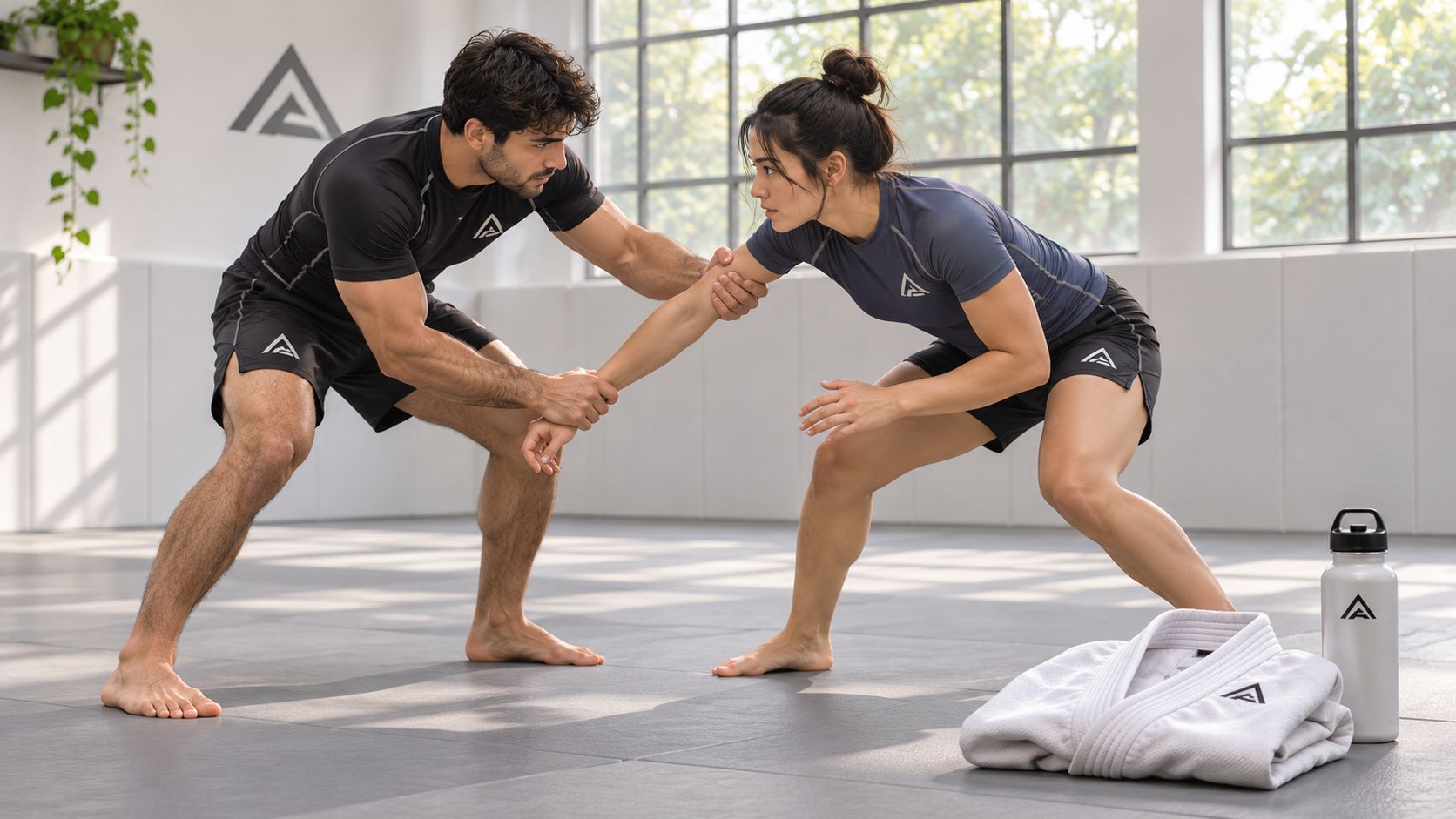
The Australian timeline runs longer than often assumed. Historical accounts of Brazilian jiu-jitsu in Australia place no-gi within the wider expansion of the art during the late 1980s and early 1990s, with two names doing much of the early work. John Will was among the first 12 non-Brazilians to receive a BJJ black belt, and Peter de Been established an early Australian academy in the early 1990s. That is more than three decades of local technical development, not a fitness trend that appeared with social media.
Internationally, the Abu Dhabi Combat Club Submission Wrestling World Championship, known everywhere as ADCC, turned submission grappling into a distinct no-gi competition pathway. The local scene has depth to match: the independent AUS BJJ Rankings database counts 64,147 competitors across 1,677 ranked gyms, with results logged since 2017, so a beginner here can build a competition record without booking an international flight.
For someone with no martial-arts background, the practical point is simple. No-gi keeps jiu-jitsu's positional and submission framework, adds wrestling-style movement and grip fighting, and can carry self-defence, conditioning and competition goals at the same time.
The Differences That Change Training
Put two grapplers on the mat, one in a gi and one in a rash guard, and the first minute looks similar. By the third minute the difference is obvious. The gi grappler is holding cloth and slowing the exchange; the no-gi grappler is chasing an underhook and moving through positions.
Gi and No-Gi training compared
Training feature | Gi | No-Gi |
|---|---|---|
Grip source | Jacket and trouser fabric | Underhooks, overhooks, wrist control and body locks |
Control points | Sleeves, collar and lapels | Hips, shoulders, head position and centre of mass |
Standing pauses | More time stalled while grips are set and broken | Less standing pause, positions cycle faster |
Takedowns | Tends toward fewer completed takedowns per round | Tends toward more completed takedowns per round |
Physical demand | Hard work that concentrates in the forearms and grip endurance | Hard work that concentrates in the hips, pummelling and scrambles |
Typical pace of play | Slower, grip-led | Faster, scramble-led |
Beginner focus | Grip fighting and guard retention | Wrestling stance, hand fighting and protecting your hips |
Where control comes from without fabric
Strip the cloth away and connection has to be built from the body itself: underhooks, overhooks, wrist control, body locks, head position and leg entanglements. In the gi you can anchor to a sleeve and stall; without fabric, nothing on your partner's body holds still for you. Positional stability then depends on controlling their centre of mass and denying them inside access to your hips and shoulders.
That dependence is why no-gi rewards posture and hip position so heavily, and why a beginner who understands frames tends to survive longer than one who only knows attacks. The NSW Brazilian Jiu-Jitsu Federation makes the same point in technical terms, and its uniform standard for competition is a useful reminder that fitted gear is part of the format rather than an afterthought.
Why no-gi rounds feel faster
With no lapel to hang onto, a fleeing partner slips away sooner, so no-gi rounds tend to run faster, produce more completed takedowns and spend less time paused in standing grip battles. Both formats are demanding. The fatigue shows up in different places: gi drains your forearms through endless grip exchanges, while no-gi taxes your hips and lungs through constant movement.
That changes how a class should be programmed. Standing entries, grip fighting and transitions all behave differently once there is nothing to grab, so no-gi works best as its own technical sessions rather than gi class in a t-shirt.
The test that settles it: if you want fast scrambles and wrestling-style entries, no-gi shows more of them. If you prefer slower, grip-led positional play where you can build a plan and grind it out, the gi will suit you better.
Coaching still shapes everything. A no-gi class run with heavy positional drilling feels controlled and technical, while the same format run as open sparring feels frantic. Partner matching does as much to set the pace as the uniform does.
Core Techniques Beginners Learn First
Beginners don't start with submissions. They start with standing up properly, because a bad stance hands your partner a free body lock before you've decided anything.
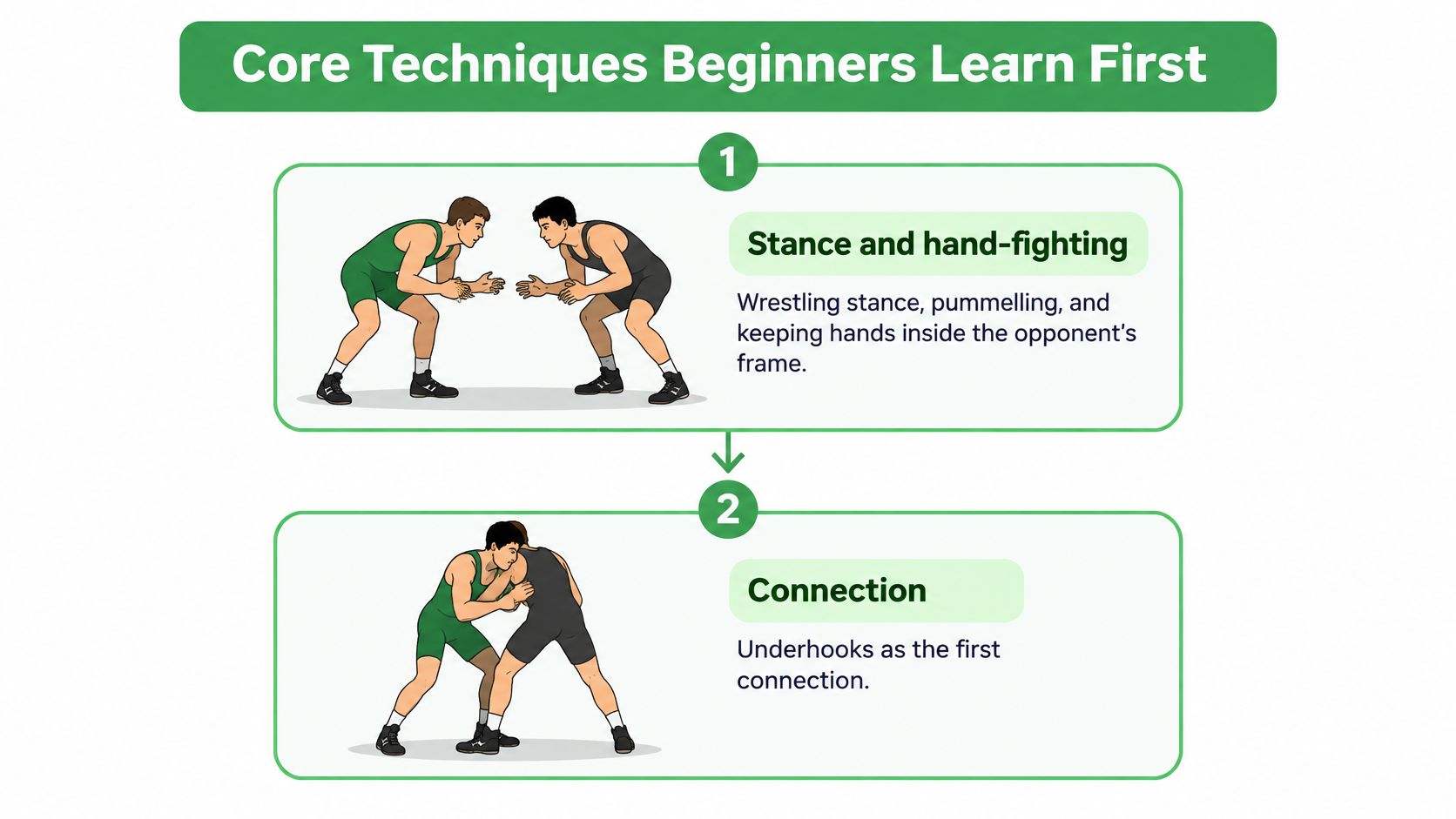
Here's the order a new student meets the material, and the mistake that shows up most often at each stage.
Stance and hand-fighting. Wrestling stance, pummelling and keeping your hands inside your partner's frame. The common error is standing tall with the hips high and the hands low, which is an open invitation to a body lock.
Connection. Underhooks, overhooks, wrist control, body locks and head position. The error here is grabbing and holding instead of moving your feet, so the grip goes stale and your partner steps around it.
Takedowns. Single legs, double legs and trips, drilled under supervision with a safe landing and a partner who knows how to fall. Shooting with your head down and your hips low is the mistake that gets people caught in guillotines.
Positional control and escapes. Side control, mount, back control, and a reliable way out of each. Squeezing without control burns your arms in a minute and teaches nothing.
Submissions. Rear-naked chokes, guillotines and leg locks, introduced only once control and early tapping are established habits. Cranking a neck to finish a choke that isn't there is the fastest way to lose a training partner.
Positional competence comes first for a reason. A beginner who can hold a position and escape from one is safer to train with and learns faster than one who only attacks, because they can stay in a round long enough to feel what's happening. Neck and leg attacks have clear boundaries in beginner classes, and the deeper work on them belongs later, once you can recognise danger and tap before it becomes an injury.
The video above is a useful reference for how those first two stages look in motion.
A three-drill starter set
Underhook exchanges: pummel for the same underhook with a partner for two-minute rounds, no submissions, just hands and footwork.
Wrist control rounds: one person tries to hold a wrist and control distance, the other breaks free.
Hip escapes: from side control, shrimp and recover guard twenty times per side, slowly enough for your hips to move.
At Locals Jiu Jitsu Alexandria, our Beginners program is built around exactly this foundation of fundamental techniques and concepts, and it's open to all ages, genders and fitness levels. For a closer look at how the positions fit together, read our guide to core no-gi techniques.
Clothing and Grip Rules for No-Gi Training
No-gi removes the kimono, not the rulebook. Competition in Australia commonly runs on IBJJF-based uniform standards delivered through Australian Brazilian Jiu-Jitsu Association events, and the ABJJA's published uniform requirements are specific enough to settle most first-day questions.
No-Gi clothing requirements
Item | Rule | Why it matters |
|---|---|---|
Rash guard fabric | Tight elastic material | Loose fabric becomes an extra grip |
Rash guard length | Covers the torso down to the shorts waistband | Prevents exposed skin and sudden grabs at the waist |
Rash guard colour | Black, white, rank colour, or at least 10% rank colour | Keeps uniforms consistent across competitors |
Shorts length | Covers at least half the thigh, not beyond the knee | Limits leg grips and skin contact |
Shorts hardware | No open pockets, buttons, exposed drawstrings, zippers, plastic or metal | Prevents scratches and snagging |
Session hygiene | Clean skin and trimmed nails | Protects training partners |
The logic behind each line is the same. Anything loose or hard becomes either a handle the format was meant to remove or a hazard close to someone's eye. A baggy t-shirt gets stretched into a de facto collar grip; a zipper leaves a scratch across a partner's cheek during a scramble.
For training rather than competition, the standard is simpler but not slack. A fitted rash guard, shorts with no pockets or hardware, clean skin, trimmed nails and no jewellery covers it. Wash the rash guard after every session and don't leave it sweating in a closed bag overnight.
Pre-class check: snug rash guard, shorts without pockets, buttons or zips, nails trimmed, nothing sharp or dangling. If a piece of gear is questionable, ask before you step on the mat.
Our own guide to no-gi jiu-jitsu clothing covers fit and fabric in more detail if you're choosing a first kit.
How No-Gi Competition Is Scored
Standard ADCC competition doesn't run as one continuous points match. The first half of regulation is submission-only, meaning nothing scores during that opening period; points activate in the second half. According to the ADCC match structure and phase breakdown, a 10-minute regulation match runs as two five-minute phases, while finals use two 10-minute phases.
The other rule that shapes matches is timing. Under the ADCC ruleset, points are awarded only after a position has been established for at least three seconds and the athlete is not under an active submission threat. Passing through a position on the way somewhere else doesn't score.
ADCC scoring values
Action | Points | Note |
|---|---|---|
Takedown ending in guard or half guard | 2 | Opponent ends in your guard or half guard |
Clean takedown that passes the guard | 4 | Takedown that goes straight into a pass |
Sweep | 2 | Reversal to the top position |
Guard pass | 3 | Passing the guard and holding the position |
Mount | 2 | Position held for three seconds |
Back mount with hooks | 3 | Hooks in place and position held |
Knee-on-belly | 2 | Position held for three seconds |
Read it as a ladder rather than a list. A sweep gets you level; a guard pass puts you ahead; mount or back mount with hooks builds a lead that forces your opponent to take risks.
Here's a worked example. You hit a clean takedown that lands you directly past the legs: 4 points. You settle, hold the pass for the required three seconds: 3 more. That's 7 points from one sequence, and your opponent now has to open up to close the gap, which is exactly when submissions appear.
The training implication is blunt. Preparing for no-gi competition means drilling timed positional control, not just aggressive attacks. Set a timer, hold mount for three full seconds before you move, and you'll be practising the rule that decides matches. Our no-gi jiu-jitsu rules explain how these standards apply in practice.
Safety, Injury Risk and Starting Safely
No-gi gets marketed as the safer option and as the rougher, more realistic one, sometimes by the same coach in the same week. Neither label survives contact with a training room. What changes is where the risk sits, and that's a coaching question rather than a clothing one.
The injury picture is worth knowing before your first sparring round. An international survey of 1,140 BJJ athletes reported that 68.8% experienced at least one injury requiring two weeks away from training over a three-year period, with the knee at 27.1% and shoulder at 14.6% the most frequent sites. 77.6% of those injuries occurred during sparring, submissions accounted for 29.7% of reported mechanisms and takedowns for 26.4%, according to the published survey of BJJ injuries.
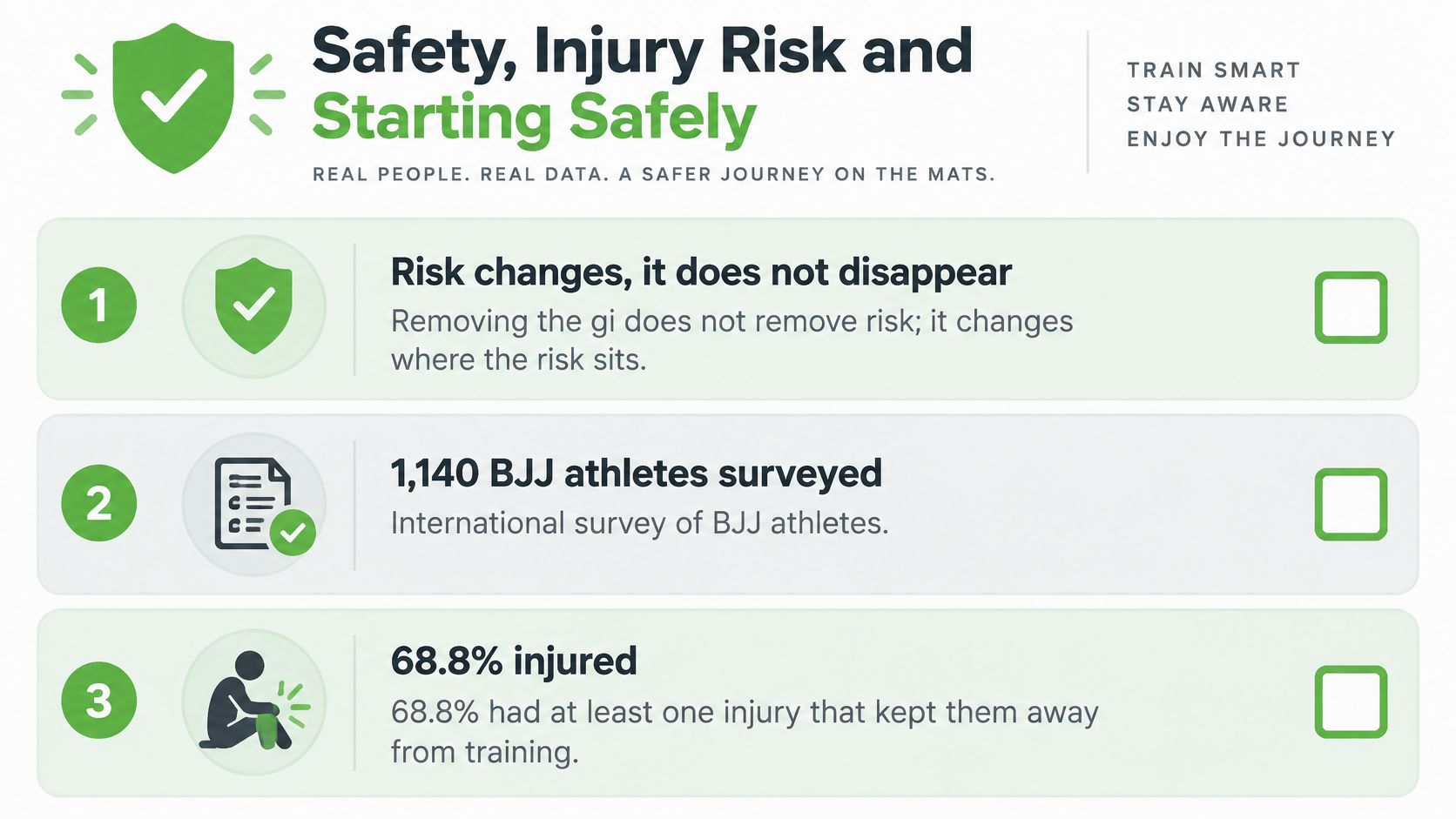
Read those numbers as a list of moments to manage rather than reasons to stay home. Three situations do most of the damage: live takedown exchanges where nobody has agreed on a landing, submissions applied fast enough that the tap arrives late, and fatigue that drops your defensive posture just as a round speeds up. Without cloth to grab, safe release mechanics matter more, not less.
A sensible class controls all three.
Progressive resistance: positional rounds before free sparring, so you aren't defending at full speed in week one.
Explicit tap and release rules: agreed before the round, including how to signal with a hand trapped.
Supervised takedown drilling: a coach watching landings, not just entries.
Partner matching by size and experience: a first-week student doesn't need a competition brown belt on top of them.
Knee-line and shoulder awareness: drilled as technique, not mentioned once as a warning.
Head knocks need their own line. Stop training, get medical advice, and ask the academy what its protocol is rather than assuming one exists. A review of Australian combat-sport concussion guidance rated the material across governing bodies at a median of 3 out of 9, which is low enough that you should ask the question directly.
Our coaches prioritise safety and progression, and we've built the room as a family-friendly environment where people at very different starting points train together. First session: arrive early, bring a fitted rash guard and compliant shorts, tell the coach about any existing injury, and tap early. Nobody remembers who tapped in a beginner class.
Decide Whether No-Gi Suits You and Book a Trial
Judge the format against your own goals, not against someone else's highlight reel.
Fitness and conditioning. Scrambles come thick and fast, so No-Gi rounds feel harder aerobically than gi rounds of the same length. The gi slows exchanges down through grip-led control. Both build fitness if you show up consistently, so pick the pace you'll enjoy.
Self-defence. Training without cloth handles translates well to a clinch with someone wearing a t-shirt, because there is no collar or sleeve to grab. That does not make No-Gi automatically harder, more realistic or safer. Coaching, partner behaviour and the rules of the room decide the risk, not the uniform.
A first class with no background. None is required. Positions and grips feel strange for the first few sessions, then start to make sense once your body learns the patterns.
Children. Jiu-jitsu classes for kids are widely taught through guided drills, games and age-appropriate intensity, building coordination, focus and discipline alongside self-defence skills. Small classes with close supervision matter more than how popular the sport is nationally, so ask about class size and how the coach introduces new children to contact.
Older adults, women and lower fitness. The format fits when resistance stays progressive and partners are matched by size and experience. Ask how beginner rounds are paced before you sign up.
Competition. Choose No-Gi, gi or both once you know whether you prefer scramble entries and body-based grips or grip-led positional play. You do not have to decide in your first month.
At Locals Jiu Jitsu Alexandria, near Beaconsfield, the beginners program welcomes all ages, genders and fitness levels with no previous experience required, and a free trial class is open to all levels. Check the timetable and book a session, then ask three questions while you are there: what the rash guard and shorts rules are, how beginner sparring is paced, and how tapping and injuries get handled.
The quickest way to test all of this is on a mat. The No-Gi and grappling program at Locals Jiu Jitsu Alexandria covers wrestling entries, body-based grips and the submissions that work without a jacket, and the trial class is free. Bring a fitted rash guard and shorts without pockets, and tap early.
Comments