
No Gi Jiu Jitsu Explained: Rules, Grips and Gear
If taking off the gi were the only difference, why would a grappler need to change how they control someone? The missing jacket removes the handles, not the need for control. Understanding what replaces those handles makes no gi jiu jitsu much easier to follow, whether you're watching a class, choosing your first session or adapting an established Gi game.
Table of Contents
What No-Gi Jiu Jitsu Is and How It Differs from Gi - Different handles, familiar goals
Clothing, Hygiene and Safety for No-Gi - Set your stop rules before rolling - Keep contact training clean
Core Grips and Techniques Without a Gi - Build space before chasing a grip - Connect your head, hips and legs
How No-Gi Competition Works in Australia - Follow the match from standing to ground
Who Should Train No-Gi and Who Should Start With Gi - Choosing for a child
Your First No-Gi Class and How to Book - An example session from start to finish - Make the first visit straightforward
What No-Gi Jiu Jitsu Is and How It Differs from Gi
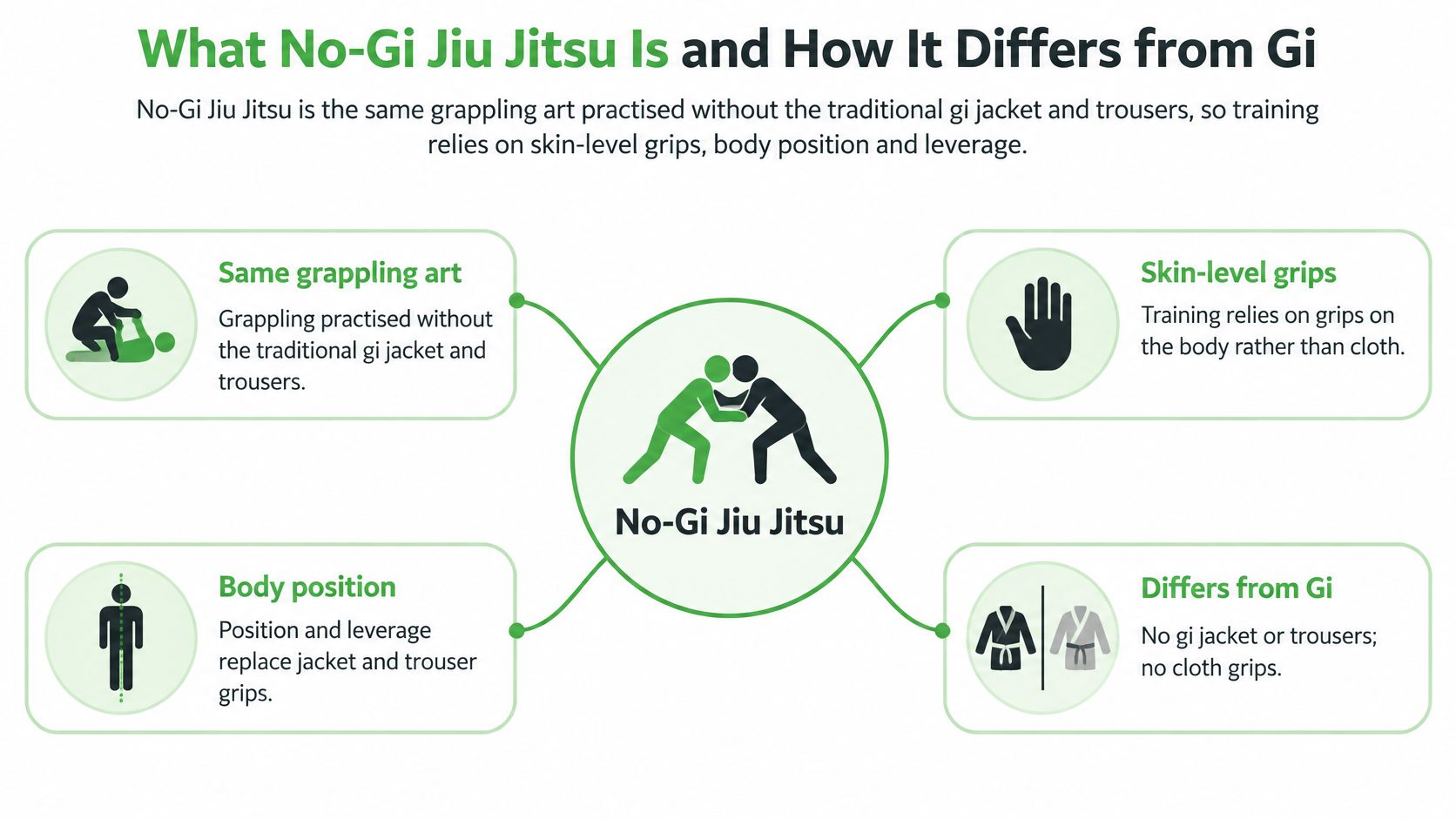
No-Gi Jiu Jitsu is the same grappling art practised without the traditional gi jacket and trousers, so training relies on grips on the body, body position and wrestling-style entries.
Gi and No-Gi side by side
Feature | Gi | No-Gi |
|---|---|---|
Uniform | Kimono jacket and trousers with a belt | Rash guard or fitted top with grappling shorts or compression shorts |
Control points | Collar, sleeves and trouser legs act as grips | Wrists, arms, torso, hips and legs create the connection |
Pace | Slower, with more time spent gripping and posturing | Faster, with more scrambling and transitions |
Main skills emphasised | Grip fighting, collar chokes, sleeve-based sweeps | Underhooks, positional pressure, wrestling entries and leg entanglements |
Competition | Gi divisions under IBJJF rules | Separate No-Gi divisions for adults and juniors under IBJJF rules |
The pace comparison describes a general tendency, not a requirement to move quickly. A beginner can practise No-Gi slowly, and an experienced practitioner can make a Gi exchange very dynamic.
Different handles, familiar goals
Think of pulling a rope with a handle compared with holding a smooth pole. With the handle, your fingers provide a secure attachment. Without it, you need to wrap, position your body and manage the direction of pressure.
A gi collar or sleeve provides that convenient handle. In No-Gi, you build connections using your forearms, arms, torso and legs. You're not squeezing harder to compensate for missing fabric.
The concept map below shows how those connections fit together.
The Australian Federation of Brazilian Jiu-Jitsu rules follow the International Brazilian Jiu-Jitsu Federation framework, including separate No-Gi weight classes for adults and juniors. That framework addresses scoring, positions, advantages, penalties, match duration and referee procedures, so No-Gi competition is a defined format rather than an informal version of grappling.
Both formats still include sweeps, which reverse top and bottom positions, and passes, which move beyond an opponent's defensive legs. Both also include positional control and submissions.
The techniques are related, but the handles are different. Good control comes from understanding the connection, not collecting more grips.
Clothing, Hygiene and Safety for No-Gi
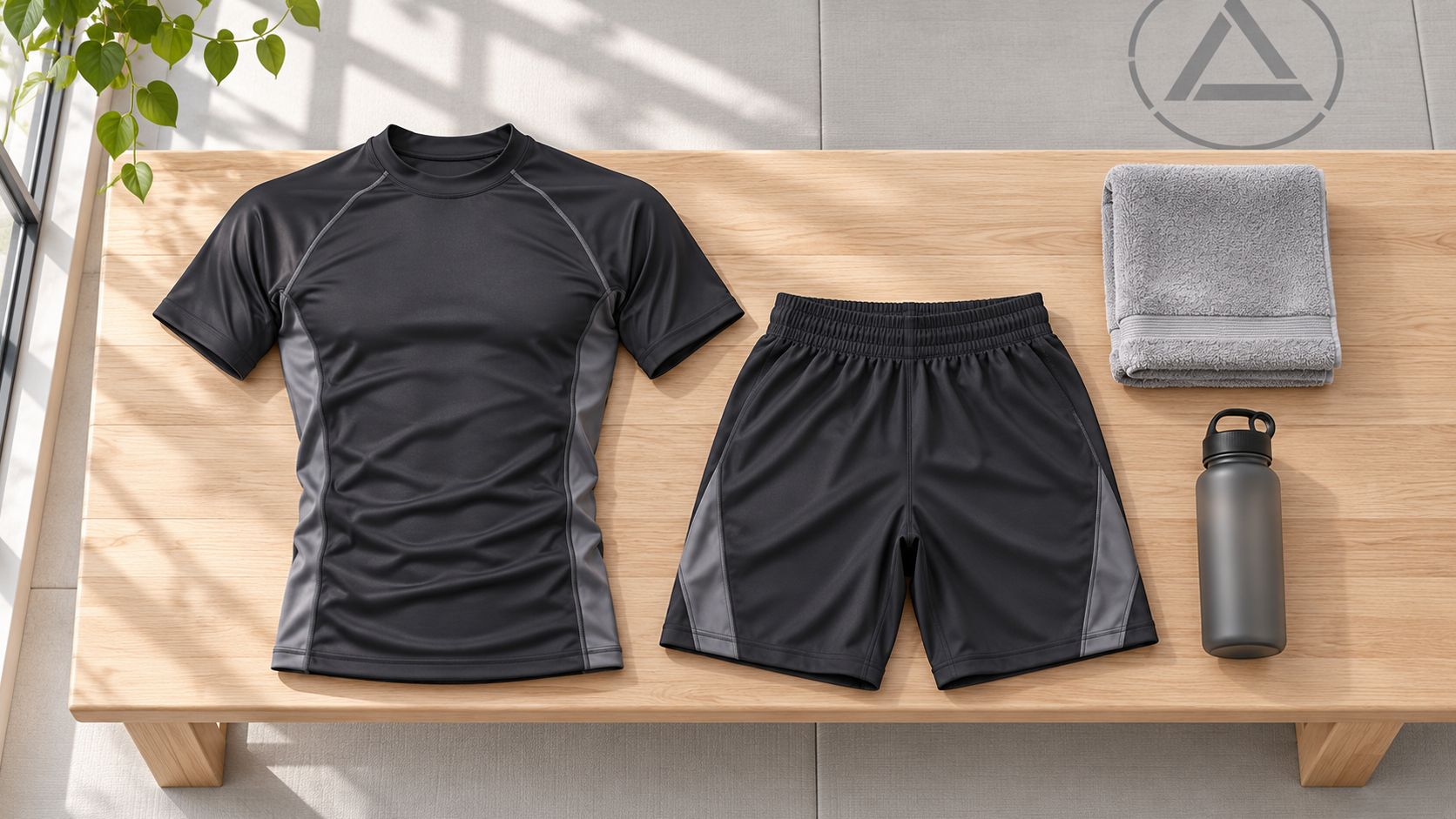
Start with a fitted rash guard or compression top, with short or long sleeves, and grappling or compression shorts. Pockets, metal rivets, zips and hard buttons can catch fingers or scrape a partner, so leave them out of the kit.
Fit matters because No-Gi control depends on body contact. Loose fabric can snag a limb during a scramble or create an accidental handle where you intended none. A close fit keeps excess material out of the way, so both partners feel position rather than cloth. No belt is worn.
Use this simple kit layout as a starting point.
Our No-Gi clothing guide explains fabric and fit choices in more detail. An optional mouthguard and a spare set of kit are useful additions, particularly when you need dry clothing for another session.
Set your stop rules before rolling
Tell the coach about injuries, medical conditions and any restrictions before joining contact work. Learn how to tap with your hand and how to signal verbally when your hands are trapped. Your partner must release immediately.
Never crank a neck or force a joint beyond its comfortable range. Suspected concussion, neck injury or numbness means stopping, then seeking medical advice before returning to contact training.
Australian combat-sport injury-monitoring research supports tracking new and recurring problems rather than treating pain as something athletes should tolerate. For beginners, the practical habit is straightforward: report the problem and adjust training before it becomes your normal way of moving.
Keep contact training clean
Fresh clothing: Wash kit after every session and dry it completely.
Hands and accessories: Trim nails and remove jewellery before stepping onto the mat.
Personal hygiene: Shower before class where possible, especially after physical work, and shower after training.
Sweat management: Bring a clean towel and alert the coach to wet patches so they can be cleaned appropriately.
Skin concerns: Cover minor clean cuts securely. Don't train with a suspected contagious skin condition, even beneath a dressing.
Illness: Stay home when unwell rather than exposing training partners.
Drying principles from these hockey equipment tips from CleanOnline make a useful comparison for any sports kit, though the care label for each No-Gi garment still decides the method. Rash guards, compression shorts and other sports fabrics do not all tolerate the same washing and drying methods.
Children, older adults and returning students can use lighter resistance, more drilling and carefully matched partners. Before each round: warm up, agree on intensity, tap early, communicate and report recurring pain.
Core Grips and Techniques Without a Gi
Gi grips and their No-Gi substitutes
Gi control point | No-Gi substitute | Why it works |
|---|---|---|
Collar grip | Head and neck control with posture and head position | Disrupts upright posture while a supporting frame maintains distance |
Sleeve grip | Wrist control and elbow frame | Limits the arm while the body keeps the opponent in front |
Lapel grip for guard | Underhooks and inside position | Creates connection through skeletal frames and torso pressure |
Trouser grip for passing | Hip control and leg pressure | Directs weight onto the opponent and blocks their legs |
Sleeve tie for sweeps | Overhook and leg entanglement | Provides levers to lift or turn the opponent without cloth |
These are functional comparisons, not exact replacements for every technique. A useful question is: what movement am I trying to stop?
Build space before chasing a grip
A frame uses aligned forearms, elbows and shoulders to preserve space. Instead of pushing continuously with tired muscles, place your forearm against an appropriate contact point and keep your elbow supported near your body.
An underhook threads your arm beneath your partner's upper arm. An overhook wraps over it. Together with torso position, these connections help you turn, stay attached or stop your partner establishing a stronger angle.
Wrist control limits an opponent's ability to post, meaning place a hand on the mat for balance. Keep your elbow connected to your own movement rather than stretching your arm out and trying to hold them still.
Connect your head, hips and legs
Head position helps close routes around your body and can make it harder for someone to reach your back. Keep your neck aligned rather than using your head as a lever against pressure. Our guide to wrestling grips explores related hand-fighting connections.
A leg entanglement uses your legs to connect around an opponent's leg. It can support guard control and sweeps; it isn't automatically a leg-lock attempt. Beginners should learn positioning and safe exits before adding submissions.
Brazilian jiu-jitsu competition research found a substantial post-bout reduction in maximal isometric handgrip strength, while blood lactate rose from approximately 4.4 mmol/L before fighting to 10.1 mmol/L afterwards. The study wasn't a direct comparison of Gi and No-Gi, but it gives a practical reason to practise efficient control under fatigue.
Try this drill: From a coach-selected position, one partner maintains a frame and seeks an underhook while the other works to escape. Keep resistance light, reset when the connection breaks and leave submissions out.
How No-Gi Competition Works in Australia
A No-Gi contest starts with an important distinction: grappling isn't striking. Competitors work to establish control without punches or kicks.
The Australian Jujitsu Federation's competition description explains that Brazilian jiu-jitsu contests begin standing, normally develop on the ground and can be won through a joint lock, strangulation or points for throws, takedowns and controlling scoring positions. Its general description cites a six-minute competition period, but that shouldn't be treated as the duration of every No-Gi division.
Follow the match from standing to ground
Standing exchanges: Competitors seek an entry, a takedown or another permitted route to ground engagement.
Ground exchanges: The athlete underneath may defend with their legs, escape or attempt a reversal. The athlete above may pass and establish control.
The finish: A submission can end the contest. Without one, scoring and the applicable decision procedures determine the result.
AFBJJ competitions use the IBJJF framework, with separate adult and junior No-Gi divisions. Before entering, confirm the event's weight categories, permitted techniques and match requirements through our No-Gi tournament guide and the organiser's current rules.
Say a competitor scores a takedown, passes the legs and maintains a scoring position. They can win on points without forcing a submission, provided they protect their lead and avoid penalties.
Competition preparation should include escaping bad positions, not just practising your favourite finish.
Australian athletes have reached elite submission-grappling levels, including ADCC silver medals in 2019 in the under-88-kilogram division and 2022 in the under-99-kilogram division, as documented in Kingz Australia's account of Australian BJJ milestones.
Who Should Train No-Gi and Who Should Start With Gi
Choose No-Gi if you're drawn to body-control grappling, wrestling exchanges and transitions. Choose Gi if you enjoy cloth-grip problem-solving or prefer training in the traditional uniform. You don't need to earn the right to start No-Gi by training Gi first.
Which format suits which grappler
Grappler type | Start with | Why |
|---|---|---|
Complete beginner, adult | Either format | Fundamentals of position and leverage transfer to both |
Child in a junior program | Structured junior class in either format | Coordination, focus and discipline are the goals, with age-appropriate rounds |
Wrestler or former wrestler | No-Gi | Takedowns, scrambling and body control match the format |
Blue belt preparing for competition | No-Gi or both | Separate No-Gi divisions reward body control and submission transitions |
Adult focused on fitness and self-defence | No-Gi | Full-body movement and body-based control without cloth grips |
Gi-only practitioner broadening skills | No-Gi | Develops grip-independent control that can also support Gi training |
A faster format doesn't mean beginners must be explosive or already fit. Start with manageable resistance and learn to recognise positions before trying to win every exchange.
For self-defence, grappling practice is only part of preparation. Avoiding conflict, finding an exit and recognising the risks of strikes or additional people remain important.
Choosing for a child
A 2025 AusPlay-based report on Australian children's martial arts estimates that approximately 32,000 children aged 0–14 participated in jiu-jitsu, representing 0.7% of that age group, with participation reported at 0.9% of boys and 0.4% of girls. These are jiu-jitsu figures, not separate No-Gi enrolments.
For families, the practical test is more personal than the participation figures. Will your child enjoy guided partner work, and are the rounds suitable for their age and development?
Watch the structure: Look for clear instructions, manageable tasks and supervision during contact.
Listen to your child: Enjoyment and willingness to return matter more than choosing a supposedly superior format.
The best starting point is the class you can attend consistently and approach with curiosity.
Your First No-Gi Class and How to Book
Your first visit doesn't need to feel like an audition. Arrive early, introduce yourself to the coach and explain any injuries or concerns before the warm-up. A useful first-session goal is to understand the task and communicate with your partner, not to prove your toughness.
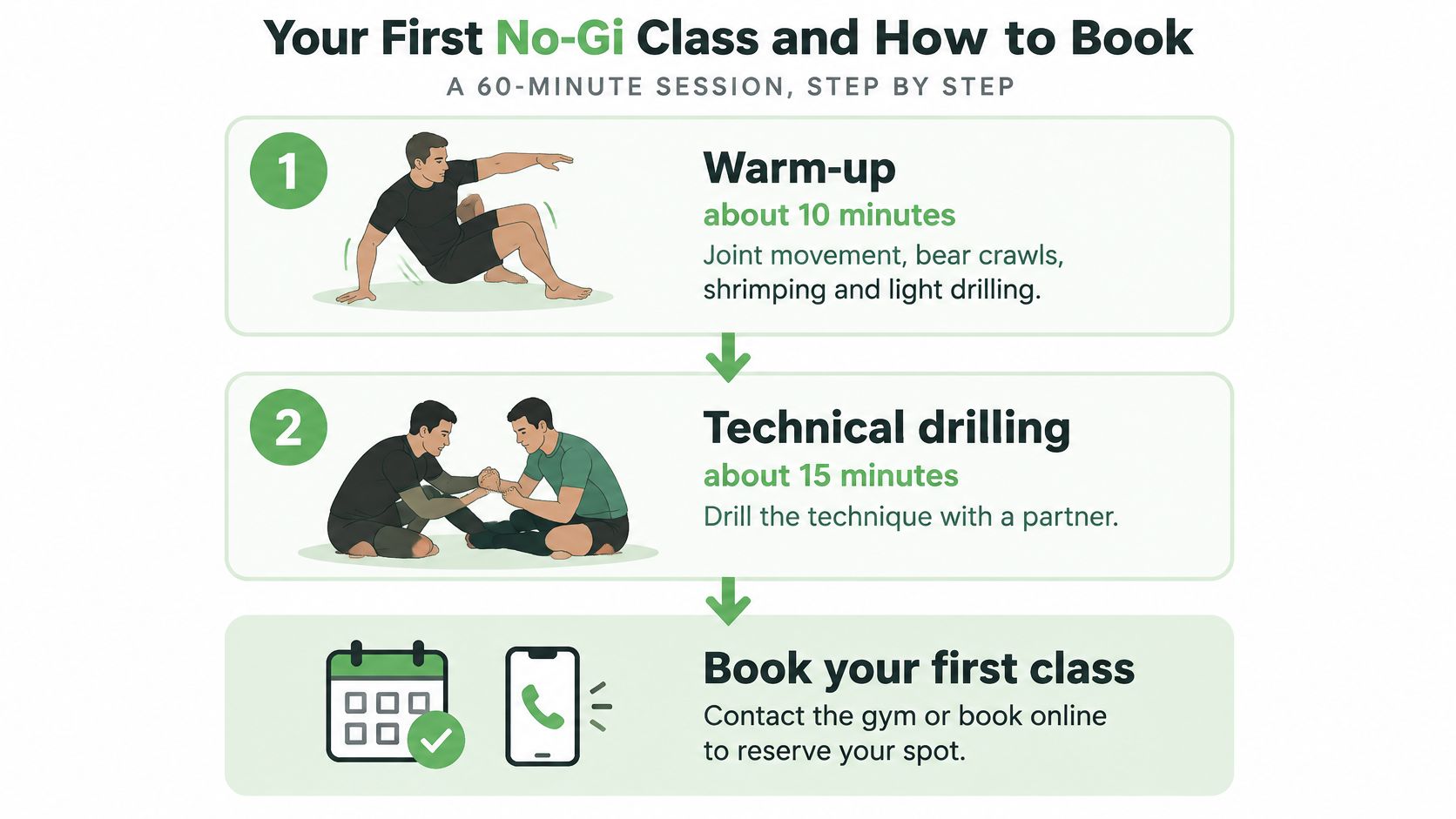
The visual below introduces the progression from preparation to partner practice.
An example session from start to finish
The following is an illustrative 60-minute session, not a fixed timetable or a promise about the exact structure of your booked class.
Stage | Example time | What you practise |
|---|---|---|
Warm-up | About 10 minutes | Joint movement, bear crawls, shrimping and light drilling |
Technical drilling | About 15 minutes | Repeating a demonstrated position or takedown with a partner |
Positional rounds | About 15 minutes | Starting from an underhook exchange or side control with a clear goal and time limit |
Takedown and scramble work | About 8 minutes | Controlled entries, safe finishes and movement between positions |
Live rounds | About 8 minutes | Applying techniques against resistance at an agreed pace |
Cool-down and review | About 4 minutes | Settling your breathing and asking questions |
Shrimping means moving your hips away while using your feet and shoulders for support. It may look unfamiliar, but it teaches you to create room without pushing someone away.
During technical drilling, your partner initially cooperates so you can learn the movement. Positional rounds introduce a narrower problem, such as escaping side control, before live rounds allow more choices. For a first visit, aim to join the warm-up and a light positional round at a comfortable pace rather than treating every activity as compulsory.
This video offers another way to familiarise yourself with No-Gi training before attending.
Make the first visit straightforward
Bring the basics: Pack suitable kit, water and a towel.
Prepare your information: Note injuries, movement restrictions and questions for the coach.
Respect your partner: Adjust to their size and experience rather than assuming everyone wants the same intensity.
Speak up: Tap early and ask for a break whenever you need one.
At Locals Jiu Jitsu Alexandria, close to Beaconsfield, we provide professional training in a friendly and supportive environment. Our free trial class is available for all levels, and prospective students can check the timetable and book a session.
If you're comparing introductory offers, Gym Membership Tips on trial conversions provides context for thinking about the move from a trial to regular attendance. Use your visit to assess the coaching, the atmosphere and whether the schedule fits your life, rather than deciding only because an introductory session is free.
Locals Jiu Jitsu Alexandria offers No-Gi training that combines wrestling techniques, body-based grips and submissions, with a free trial class for all levels. Visit Locals Jiu Jitsu Alexandria to check the timetable, book your first class and start training this week.
Comments