
Beginner Martial Arts for Adults: How to Start
Only 28% of Australian adults aged 18–64 met the strength-and-toning guideline, according to Better Health Channel. That reframes beginner martial arts for adults: you don't need to pass a fitness test before joining. A well-paced class can be a coached way to build the strength, movement skills and regular exercise habits you're missing.
Table of Contents
Adults Can Start Without Being Fit Already - Start as a learner, not an athlete - Make the practical decisions first
Which Beginner Martial Arts Suit Adult Bodies - Match the lesson to your aim - Judge the teaching, not the tough label
What Happens in a First Adult Class - Follow the lesson from arrival to finish - Dress for movement and recognise stopping signals
A Weekly Load That Meets Australian Guidelines - Choose a week you can recover from - Count the work, not just the booking
How a First Month on the Mats Unfolds - The early weeks are about recognition - Later weeks add familiarity, not a new identity
When Age or a Long Break Changes the Start - Make the adjustments explicit - Measure progress through useful movement
Try One Beginner Class Before You Commit - Assess the coaching and the welcome - Leave room for a modest beginning
Adults Can Start Without Being Fit Already
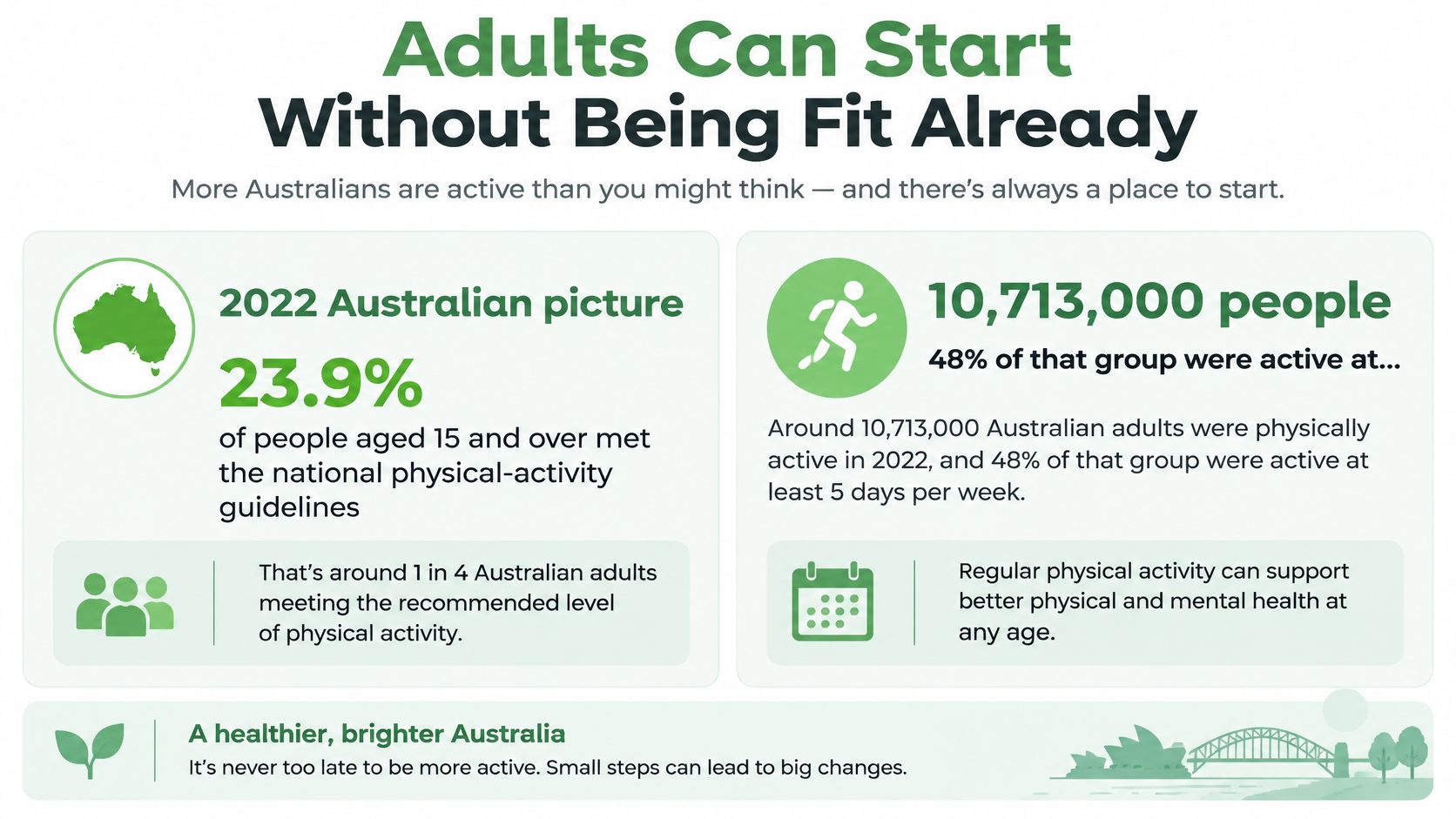
In 2022, 23.9% of Australians aged 15 and over met the national physical-activity guidelines, while an estimated 10,713,000 people, 48% of that group, participated in physical activities at least three times per week, according to the Australian Sports Commission. Being active regularly and meeting the complete guidelines aren't the same thing.
That distinction matters if you walk to work but haven't done strength training, or run occasionally but struggle to keep a routine. You're not starting from nothing. You may need a different kind of structure.
The national picture makes the gap easier to see.
Start as a learner, not an athlete
Say you finish work in Alexandria, change into training clothes and arrive feeling stiff from your desk. Your first useful task isn't proving how many push-ups you can do. It's learning where to put your feet, how to breathe during a drill and when to relax your grip.
You don't need to arrive fit, flexible or experienced. Joining a beginner class is like joining a language class, not sitting an exam you were supposed to have passed already. You attend because there's something to learn.
A coach breaks the movement into manageable pieces. A partner supplies controlled resistance. A technical problem gives you something more interesting to return to than another attempt to exhaust yourself.
Starting rule: Choose a pace that lets you learn and return, rather than a pace that proves you can endure discomfort.
Make the practical decisions first
Walking, gym training and running already have an established place in Australian adult recreation. Martial arts offers another route into that habit, with instruction and a scheduled appointment rather than an entirely self-directed workout.
Before committing, make these decisions:
Choose the format: Match contact, movement and pace to your body and interests.
Understand the class: Know what you'll practise and how partner work progresses.
Protect the time: Pick a weekly load that fits around work, family and recovery.
Consistency matters more than a strong opening performance. You need a workable class and a repeatable week, not a motivational speech.
Which Beginner Martial Arts Suit Adult Bodies
Beginner styles compared for adult starters
Style | First skills | Impact | Fitness to start | Best if you want |
|---|---|---|---|---|
Brazilian jiu-jitsu | Positions, grips, safe falling, basic submissions | Low-impact beginner drills, mostly on the ground | None required | Self-defence, strategy and full-body strength |
Boxing | Stance, guard, footwork, pad work | Higher on hands and shoulders; head contact should wait | Light pads are enough | Fitness and striking confidence |
Karate or taekwondo | Stances, blocks, kicks, forms | Moderate loading on hips and knees | Flexibility grows in class | Structure and distance control |
No-gi grappling | Grips, takedown entries, submissions without a uniform | Moderate, with more scrambling | Some athleticism helps | A faster pace later on |
Muay Thai | Stance, teeps, knees, clinch basics | Higher in contact-focused training | A little cardio helps | Conditioning plus striking |
These are practical starting points, not injury ratings. A slow boxing pad session can be gentler than an uncontrolled grappling round. The coach's choices matter as much as the style's name.
Brazilian jiu-jitsu lets beginners practise without punches or kicks, but low impact doesn't mean no joint loading. Grips challenge the hands, positions put pressure through shoulders and hips, and submissions require careful stopping rules. A calm ground-based lesson is different from competitive wrestling or hard takedown practice.
Boxing gives you a narrower starting task: move your feet, protect your face and deliver a controlled punch. Light pads let you learn without head contact. Hands and shoulders still need sensible loading, suitable equipment and instruction rather than repeated heavy punching from the outset.
Match the lesson to your aim
Karate and taekwondo can appeal if you like a clear sequence and time to practise movements individually. Kicks don't need to start high. A coach can keep them within a comfortable range while you learn balance and control.
No-gi grappling removes the traditional uniform and uses more direct body grips. Faster exchanges can involve scrambling, so a technical beginner lesson needs clear boundaries. Muay Thai adds kicks, knees and clinch work, with a teep being a straight pushing kick used to manage distance.
Your goal can narrow the choice:
Practical self-defence: Grappling can teach control, escapes and getting back up, but personal safety also requires awareness and avoiding confrontation.
Fitness with striking: Pad work offers an active lesson without requiring sparring.
A calm technical start: Gi jiu-jitsu gives you grips and positions to examine slowly, with pauses to reset.
For a closer look at exercise goals, our guide to the best martial arts for fitness compares what different training formats involve.
Judge the teaching, not the tough label
A demanding class isn't automatically a useful beginner class. You should be able to learn a piece, try it and receive a correction before the pace increases.
Use this check when assessing a first visit:
Separate beginners group: New students learn apart from advanced and no-gi sessions.
Visible coaching: The instructor watches newcomers rather than only demonstrating from the front.
Optional early sparring: You can decline live rounds while learning the basics.
A clear learning result: You leave the trial understanding a technique, not just feeling tired.
What Happens in a First Adult Class
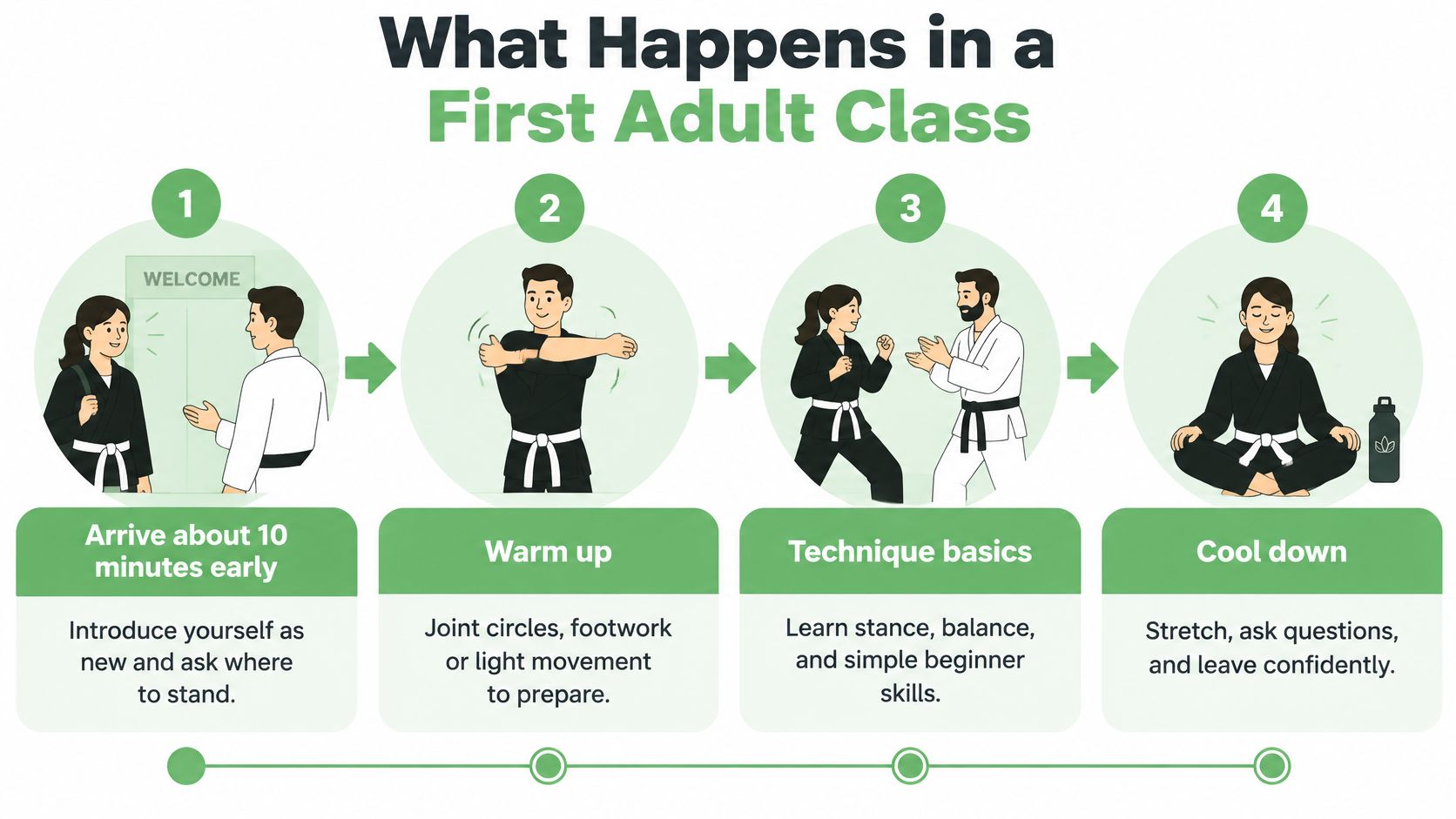
Think of a 60 to 90-minute beginner class as a practical lesson with movement, rather than continuous exercise. The exact timetable changes between sessions, but the order should help you settle in before anyone adds pressure.
This overview shows the basic flow before partner work becomes more involved.
Follow the lesson from arrival to finish
Arrive about 10 minutes early. Introduce yourself as new and ask where to stand. Mention injuries or movement restrictions before the warm-up, so the coach doesn't have to discover them halfway through a drill.
Warm up without racing. Joint circles, footwork and simple ground movements prepare you for the lesson. In grappling, you might practise shrimping, moving your hips away while lying on your side. The aim is preparation, not exhaustion.
Watch a short demonstration. Look for the starting position, the main movement and the finishing position. If you can't remember the whole sequence, ask the coach to show the beginning again.
Drill with a partner. Work at a pace where you can still talk and reset often. A cooperative partner gives you time to place your hands and feet before adding resistance.
Try light positional work only when invited. This means starting from a defined position with a limited task, such as maintaining balance or making space. Learn how to tap physically and say stop. Your partner must release immediately.
Cool down and ask a useful question. Ask what to focus on next time, rather than requesting a collection of extra techniques. A clear cue, such as keeping your elbows close, is easier to remember.
For a visual introduction alongside the lesson sequence, watch the following video.
Dress for movement and recognise stopping signals
Wear a clean T-shirt and long shorts without exposed zips, or a borrowed or hired uniform if that's available and required. Confirm the clothing arrangement before arriving rather than buying a full kit. On the mats, use bare feet, trim your nails and remove jewellery.
Clean clothing and a water bottle matter more than branded gear. Keep footwear off the training surface and cover any cuts appropriately. Don't train with a potentially contagious skin condition.
Grip, hip and shoulder soreness for a day or two can follow unfamiliar work. Sharp joint pain, dizziness or pain that changes how you walk isn't something to push through. Stop, tell the coach and seek medical advice when needed.
A clean repetition teaches you more than a tired scramble. Winning your first drill proves nothing.
A Weekly Load That Meets Australian Guidelines
For a returning adult, two classes with a recovery day between them is a sensible starting schedule. It gives you repeated practice without asking your body to handle unfamiliar partner resistance every day.
For adults aged 18–64, the Australian Government's movement guidelines recommend 150–300 minutes of moderate activity or 75–150 minutes of vigorous activity weekly, muscle strengthening on at least two days, and mobility, balance and coordination activities on at least three days. Treat those as a weekly framework, not a demand to train hard in every class.
Choose a week you can recover from
Beginner weekly loads for adults 18 to 64
Starting point | Classes | Extra movement | Recovery rule | Guideline fit |
|---|---|---|---|---|
Returning from inactivity | 2 × 60 minutes | Easy walks only | At least one rest day between classes | Builds consistency before chasing minutes |
Steady beginner | 2 or 3 × 60 minutes | 10-minute mobility on other days, plus walking | Keep one easier day | Moves towards the moderate target when sufficient walking is included |
Already active | 3 × 60 minutes | Short walks or mobility | Don't stack hard sparring on back-to-back days | Can contribute to the vigorous target when active rounds are genuinely vigorous |
These are example schedules, not a guarantee of guideline compliance. A class includes demonstrations, pauses and partner changes. An hour at the academy isn't necessarily an hour of moderate or vigorous activity.
Walking also needs the appropriate intensity to count towards the moderate target. An easy recovery stroll serves a different purpose from a brisk walk that noticeably increases your breathing.
Count the work, not just the booking
Stance and footwork practise coordination. Bridges, technical stand-ups, sprawls and controlled grappling load the body through different positions. Gradually increasing resistance makes those movements more challenging without requiring a beginner to rush.
Still, a class isn't automatically a complete strength session. The stimulus comes from the resistance, duration and intensity, including whether major muscle groups work sufficiently close to fatigue. Technical drilling may be valuable while providing only a light strength challenge.
Don't make fatigue your scorecard. Prioritise positional control, safe falling and joint alignment before hard sparring. If you're too tired to place a foot safely or respond promptly when a partner taps, reduce the pace.
Regular activity supports muscle and bone strength and can improve blood pressure, cholesterol, blood-sugar control and heart health, according to the NSW Government's adult physical-activity guidance. That makes your schedule part of a health plan, not just a hobby.
If you've been inactive, choose the returning-adult row. Add workload when you're recovering comfortably and attending reliably, not because someone else trains more often.
How a First Month on the Mats Unfolds
Consider a hypothetical 38-year-old office worker in inner Sydney who hasn't trained since school sport. Their first month doesn't need a transformation story. It needs room for awkward movements, ordinary soreness and a schedule that survives a busy working week.
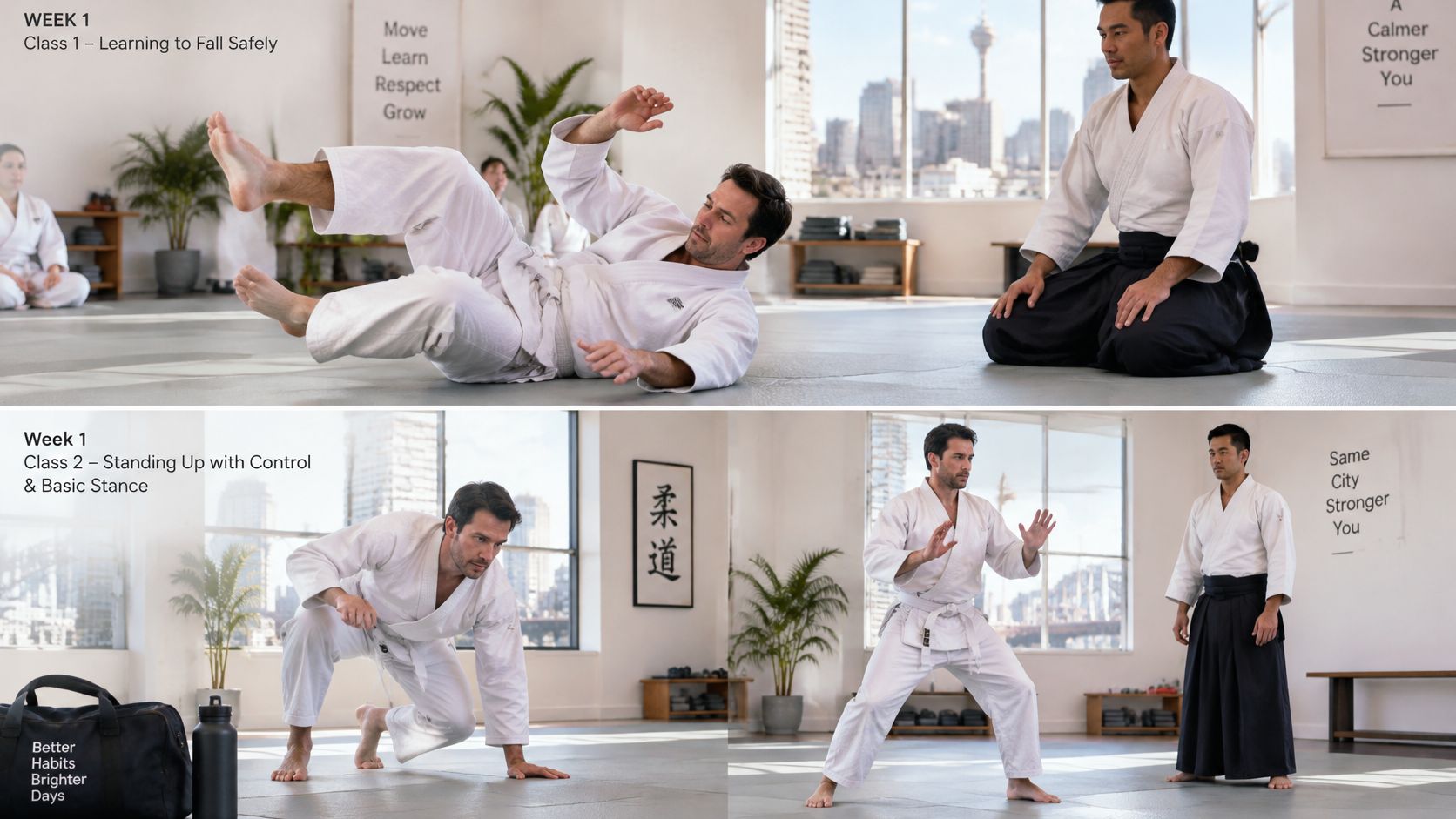
Learning to fall and stand back up gives the month a practical starting point.
The early weeks are about recognition
Week 1: They attend two classes and practise falling, standing up and holding a basic position without holding their breath. Their hands and hips feel unfamiliar work afterwards. Sleep and a rest day matter more than adding extra drills at home.
For help distinguishing ordinary post-exercise discomfort from a reason to reduce training, Thermo Recovery Wear's guide to when to rest aching muscles offers useful recovery context. It doesn't replace assessment of sharp, persistent or worsening pain.
Week 2: The same positions return. A calm partner waits while the newcomer finds the correct grip, and the coach corrects where they're placing their weight. The lesson feels less foreign even though they're still slow.
Later weeks add familiarity, not a new identity
Week 3: In this example, they add an easy walk on two non-class days and a ten-minute mobility slot. They don't organise home sparring. Their extra movement supports the routine without turning every evening into training.
Week 4: A partner's weight feels more manageable, and a simple escape works once without a reminder. Confidence appears as asking a question and staying after the timer to clarify a detail, not as beating a partner.
There's no belt test, hard-sparring requirement or promised visible body transformation in this example. A useful scorecard is simpler:
Attendance: Did they keep the sessions they planned?
Safe decisions: Can they tap early instead of resisting a trapped joint?
Recall: Can they explain a concept such as base or mechanical advantage?
Readiness: Do they feel able to return next week?
AusPlay reporting for July 2023–December 2024 found that more than 11 million Australian adults took part in a sport-related activity, while nearly 6 million participated in organised sport, according to the Australian Sports Commission. A booked class gives this hypothetical beginner a practical alternative to waiting for motivation.
The habit is deliberately ordinary: the same two nights, the same bag by the door.
When Age or a Long Break Changes the Start
For adults aged 65 and over, the NSW Government's older-adult activity guidance recommends at least 30 minutes of moderate activity on most, preferably all, days, with fitness, strength, balance and flexibility included, plus strength exercises two to three times weekly. It also identifies balance-focused activity as useful for preventing falls and injuries.
That calls for individual adjustments, not a single intensity for everyone in the room. A suitable lesson might use low-impact movement, supervised partner drills, controlled positions and supported balance practice. Hard takedowns and fast scrambling can wait.
Make the adjustments explicit
Our coaching approach prioritises safety and progression, with beginners learning separately from advanced and no-gi groups. Before participating, discuss the details that affect your movement:
Round participation: Establish how you'll sit out or stop a round when you need to.
Joint restrictions: Identify alternatives for kneeling, weight-bearing through the shoulders or getting off the floor.
Balance needs: Agree on stable starting positions and the level of partner resistance.
A younger adult returning after injury, pregnancy or a long break may need similar changes. Seek individual medical guidance for ongoing symptoms, relevant health conditions or recovery concerns before attempting demanding partner work.
For gentle movement ideas outside class, Bayside Osteopathic Health can help you find exercises for stiff joints. Choose movements suited to your circumstances rather than forcing a painful range.
Measure progress through useful movement
Standing up more comfortably, remembering a protective frame and feeling ready to train again are worthwhile outcomes. Our article on starting jiu-jitsu at any age offers another perspective on an age-adjusted start.
The art should fit the person, not the other way around.
Chest pain, sudden unexplained breathlessness, a joint giving way or dizziness means stopping, not negotiating another round. Seek prompt medical assessment, with urgent help for severe or potentially serious symptoms.
If the adjusted lesson still feels welcoming, your next decision can be a supervised trial. You don't need to settle a long-term membership before discovering how the movements feel.
Try One Beginner Class Before You Commit
Decide by attending, not by buying equipment. At Locals Jiu Jitsu Alexandria, our Beginners program builds fundamental techniques and concepts for all ages, genders and fitness levels, with no previous jiu-jitsu required. You can check the timetable and book a free trial class before making a longer commitment.
We run classes from morning till night, giving working adults different opportunities to fit a visit around their day. Choose a session you could realistically attend again. A convenient time matters more than an ideal training plan that clashes with every late meeting.
Assess the coaching and the welcome
Our coaching team includes black belt co-owners Troy Pitman and Frank Damasco, head coach Gian Baratela, black belt Lee Aguilera Martinez and no-gi specialist Moe Elkheir. Our coaches prioritise safety and progression, with separate beginners, advanced and no-gi groups.
We're based in Alexandria and serve nearby Waterloo, Zetland, Kensington, Beaconsfield, Rosebery, Green Square and Erskineville. Account for the journey as well as the session when deciding whether training fits your week.
Bring a water bottle, wear clean clothes you can move in, arrive a little early and tell the coach you're new. Then judge the visit by these signs:
You understood a technique: You can explain its purpose, even if you still need help performing it.
You could go slowly: The pace allowed questions, resets and a manageable effort.
You'd return: The environment felt respectful enough to learn in again.
Leave room for a modest beginning
You don't need to decide about advanced training or faster grappling formats during your first visit. They can remain later options while you establish the basics.
If the trial feels right, keep your initial schedule modest and repeatable. Let fitness develop alongside the skill of showing up, rather than treating it as permission you must earn beforehand.
Locals Jiu Jitsu Alexandria offers foundational beginner training and a free trial so you can explore martial arts without arriving fit or experienced. Visit Locals Jiu Jitsu Alexandria, choose a suitable session and take your first lesson at a pace you can build on.
Comments