
Adults Jiu Jitsu: A Beginner's Guide to Getting Started
You've had the timetable page open in a browser tab for three weeks. You're 38, you sit at a desk most of the day, and the last proper exercise you did was a social netball season that ended with a sore knee. You're not sure whether you'd be the oldest person in the room, whether you need to get fit before you start, or whether two evenings a week can survive work, the commute and school pickups.
Here's the short answer. Adults jiu jitsu is built for that person. It's a grappling art where technique and timing beat size and speed, and beginner classes assume no martial arts background at all. What stops most adults isn't the training itself. It's not knowing what the first hour feels like, how often to go, and what to do when a week falls apart.
The honest version: the first month is awkward for nearly everyone, and two sessions a week, not five, is what keeps busy adults in the sport long enough to get good at it. Start with what the training is.
Table of Contents
What Adult Jiu Jitsu Involves and Who It Suits
In a beginner Jiu Jitsu class, you might spend part of the session learning how to move from your back or escape a hold. Jiu Jitsu is a grappling art: students work on their feet and on the ground to control positions using movement, balance and technique. There are no punches or kicks.
The aim is to use technique and timing rather than rely on strength alone. That gives people of different sizes a way to practise together, with control and attention to their partner.
You do not need martial arts experience to begin. Beginner training introduces fundamental movements, positions and submissions step by step. At first, the names and movements can feel unfamiliar. Like learning a new language, they become easier to follow with practice.
Training is partner-based. One person practises a movement while the other provides a controlled response, then they switch roles. This makes class a mix of physical practice and problem-solving, rather than a workout where you move through exercises alone.
Format | Suits | Experience needed | What you practise |
|---|---|---|---|
Beginner class | Adults new to martial arts, across ages, genders and fitness levels | None | Fundamental movements, positions and submissions |
Advanced class | Students exploring Jiu Jitsu in greater depth and working towards black belt | Blue belt level | More advanced techniques and concepts |
No-Gi class | Students interested in grappling without the traditional Gi | No-Gi experience is not specified | Wrestling techniques, grips and submissions used in No-Gi training |
Free trial class | Anyone who wants to try a class before committing | None | An introduction to training |
Choosing a starting point: If you are new to Jiu Jitsu, begin with a beginner class. If you have trained before, tell the coach about your experience so they can help you choose a suitable class. Locals Jiu Jitsu Alexandria offers beginner-friendly classes, progressive training for all levels, and a free trial class.
Fitting Training Into a Busy Adult Week
Two sessions a week is a realistic baseline for most busy adults. It's enough repetition to remember what you drilled, enough loading to build genuine strength, and small enough that a bad week doesn't erase it. Four and five session schedules exist online because they suit people who compete. They're not the entry point.
Time is the barrier adults name most often. AIHW's report on physical activity across the life stages records that 37% of adults aged 18 to 64 cite insufficient time or competing commitments as a barrier to sport and recreational physical activity. That's rarely a motivation problem. It's a scheduling problem, and scheduling problems get solved with fewer, fixed commitments rather than more.
Weekly sessions | Who it suits | What to expect |
|---|---|---|
1 session | Busy weeks, shift work or adults returning to exercise | Familiarity with positions and tapping; slower technical gains |
2 sessions | Most busy adults; the recommended baseline for steady skill and strength exposure | Clear progress through beginner fundamentals within a few months |
3 sessions | Committed trainees with flexible schedules and good recovery | Faster technical development and fitness gains; more soreness to manage |
Three real weeks look like this.
Shift worker. Choose one evening slot and keep it on the roster's fixed point. If a rotation swallows that night, move to the same time next week rather than squeezing in a session on a day you'd normally be asleep.
Office worker. A lunchtime class works if the gym is close to the office, but an early evening session that replaces the commute home tends to work better. Bring your kit in the car or the office locker so the decision is already made by 5pm.
Parent. Saturday morning plus one weeknight class once childcare is settled. Two sessions spread across the week beat two back-to-back sessions on a weekend, because your body adapts between them.
When a week collapses, don't double up the following week. Return to the next scheduled class and let the missed session go. Ten minutes on an off day does more for you than a catch-up marathon: hip openers, shoulder circles, slow spinal rotations and a hamstring and calf stretch will keep the range of motion you've built while your schedule settles.
Consistency and intensity are different things. A quieter two-session week still builds skill, because repetition is what encodes movement. Three sessions bring faster gains and more soreness to manage, and skipping recovery days in between produces fatigue, sloppy technique and a higher injury risk.
The twelve-week test: attend two sessions a week, log every attendance, and once a month ask the coach to review one technique with you. Twelve weeks of that beats twelve weeks of good intentions.
What a Typical Adult Class Looks Like
Your first class starts before you reach the mat. You sign in, meet the coach, get shown where to change and where to leave your bag. Then the hour follows a predictable order, and knowing it in advance removes most of the nerves.
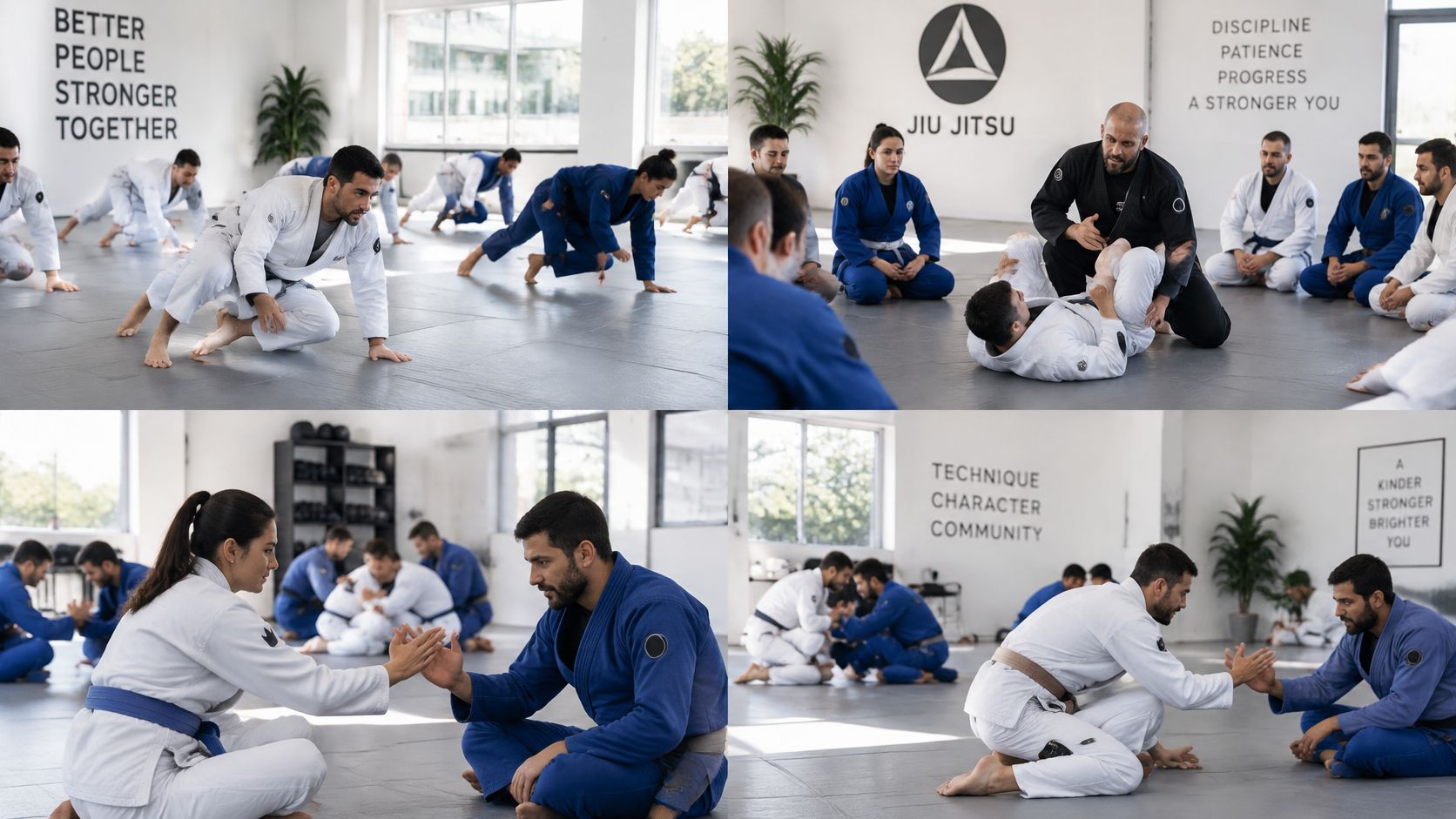
A class runs about an hour, which matches the median session duration of 60 minutes recorded in an analysis of AusPlay martial arts participation.
Warm-up. Ten minutes of movement: light jogging, hip openers, shoulder circles, breakfalls, shrimping and rolling across the mat. Nobody is assessed here, and nobody is watching you.
Technique. The coach demonstrates one position or submission, usually three or four times, then talks through the details that make it work. You'll feel clumsy because the movement is new.
Drilling. You pair up and repeat the technique with a partner, then rotate.
Positional rounds. Sparring from a fixed starting position, at a pace the coach sets.
Cool-down. A few minutes of easy movement and stretching before the room empties.
Take one beginner's first guard drill. The coach shows a hip escape: from sitting guard, you plant a foot, lift your hips and shift them away to create space. You repeat it ten times slowly, no resistance. Then your partner adds light pressure and you try again. By the third round of the drill you're doing it without thinking about the steps, which is exactly how the skill transfers into a live round.
This is what a controlled training exchange looks like when two students know the pace:
Partners get matched by size and experience where the room allows it, and you can always ask for a slower partner. Saying "can we go lighter" or tapping the mat twice carries no judgement. Etiquette is simple: bow when you step on and off the mat, arrive clean with short nails, wash your gi, and treat your training partners the way you'd want to be treated when you're the one underneath.
Intensity grows across weeks, and live sparring usually comes later, once breakfalls and tapping feel reliable. Everyone in the room trains at the same time regardless of fitness level, so nobody gets singled out for a fitness test. At Locals Jiu Jitsu Alexandria the room is deliberately family friendly, and beginners train alongside parents, teenagers and people in their fifties.
Expect week one to bring sore muscles in odd places, short breath during warm-ups, and a slow, steady sense of control arriving around the third or fourth class.
Fitness, Balance and Skills You Build
Standing up from the ground without using your hands takes more than leg strength. You need to keep your balance, control your trunk and move in the right order. Jiu jitsu links those skills together through repeated movements against a partner.
The 24-hour movement guidelines for all Australians recommend at least 30 minutes of moderate to vigorous activity on most days, muscle-strengthening activity on two or more days a week, and functional work for mobility, balance and coordination on three or more days. Many adults find it difficult to meet these targets consistently. Jiu jitsu can contribute to movement and strength, though a class schedule alone may not cover every guideline.
Strength: Grip fighting, bridging, hip extension, technical stand-ups and maintaining a stable base all ask muscles to work. Positional drills add a problem to solve as you build strength.
Mobility, balance and coordination: Guard recovery and hip switching require you to move while a partner changes your balance. Practising slowly helps you find the sequence before adding speed.
Cardiovascular activity: Drills and rounds involve repeated movement. Their intensity varies, so treat class as one part of your activity routine, not a guaranteed substitute for every other form of exercise.
Grip plays a role in holding positions and controlling movement. For ideas to practise outside class, see these forearm training tips from Evermost. For more on the conditioning involved, read how jiu jitsu can support fitness.
A controlled stand-up from guard brings several skills together. The student rises without posting a hand, keeps their posture and finishes balanced. With practice, better control can reduce the need to rely on maximum strength during a scramble.
Progress gradually: begin with stationary movement drills, then practise continuous movement under light resistance, and later try timed positional rounds while keeping your breathing steady and your exits controlled. Progress looks different for each person. Notice whether your movement feels more settled and whether your breathing recovers more comfortably between rounds.
Safety, Injury Risk and Self-Defence Expectations
During an early class, a partner may hold a position while you practise an escape. The safest response is to work at a pace where you can listen, move with control and stop when needed. Injuries can happen in any contact sport, so good habits matter more than a belt.
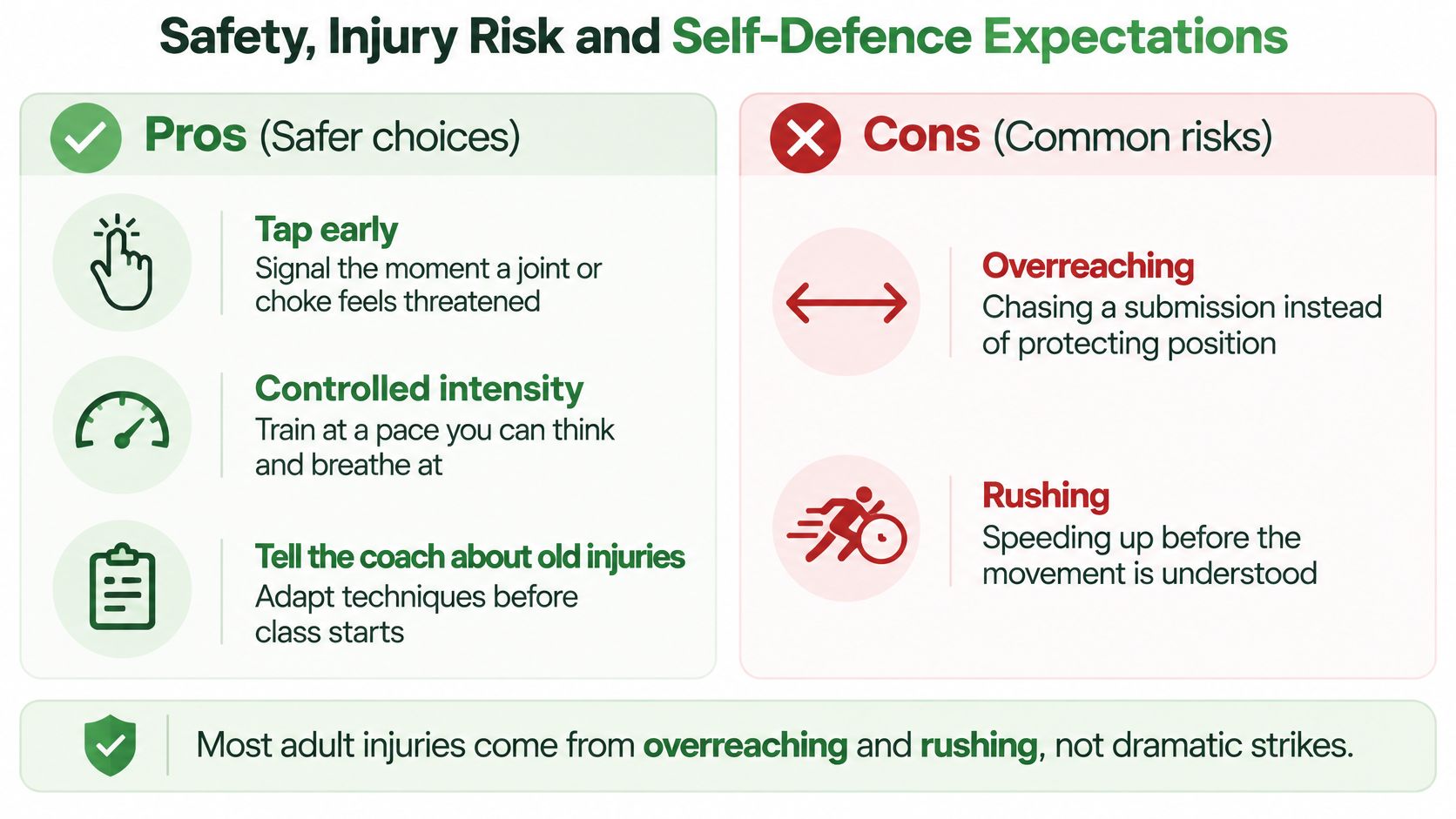
Tap as soon as you feel pain or pressure you cannot manage. Tap the mat or your partner to stop the action. You do not need to wait for a position to become uncomfortable.
Build intensity gradually. First learn the movement, then add resistance and speed as your control improves.
Tell the coach about an injury or limitation before class. They can help you approach drills more safely.
Stop for sharp or worsening pain. Do not try to push through it. Pause and speak with the coach.
Release a submission when your partner taps. In training, control and clear communication matter more than finishing a hold.
Take sparring step by step. Ask how it is introduced and whether you can focus on drills first.
For more practical guidance, read how to reduce the risk of injury in BJJ. If something feels wrong during a drill, stop and tell the coach rather than trying to keep up.
Jiu Jitsu can help you practise staying composed, using position and creating a chance to disengage. It cannot guarantee an outcome in a real confrontation. Self-defence depends on the circumstances, and any response should be proportionate to the threat as you understand it. Avoiding danger and leaving when you can should come before trying to control someone.
Locals Jiu Jitsu Alexandria has experienced coaches who prioritise safety and progression, in a friendly, supportive environment. If you are considering a class, ask how beginners are introduced to sparring, how drills can be adjusted, and what to do if you feel pain.
How to Book and Attend Your First Adult Class
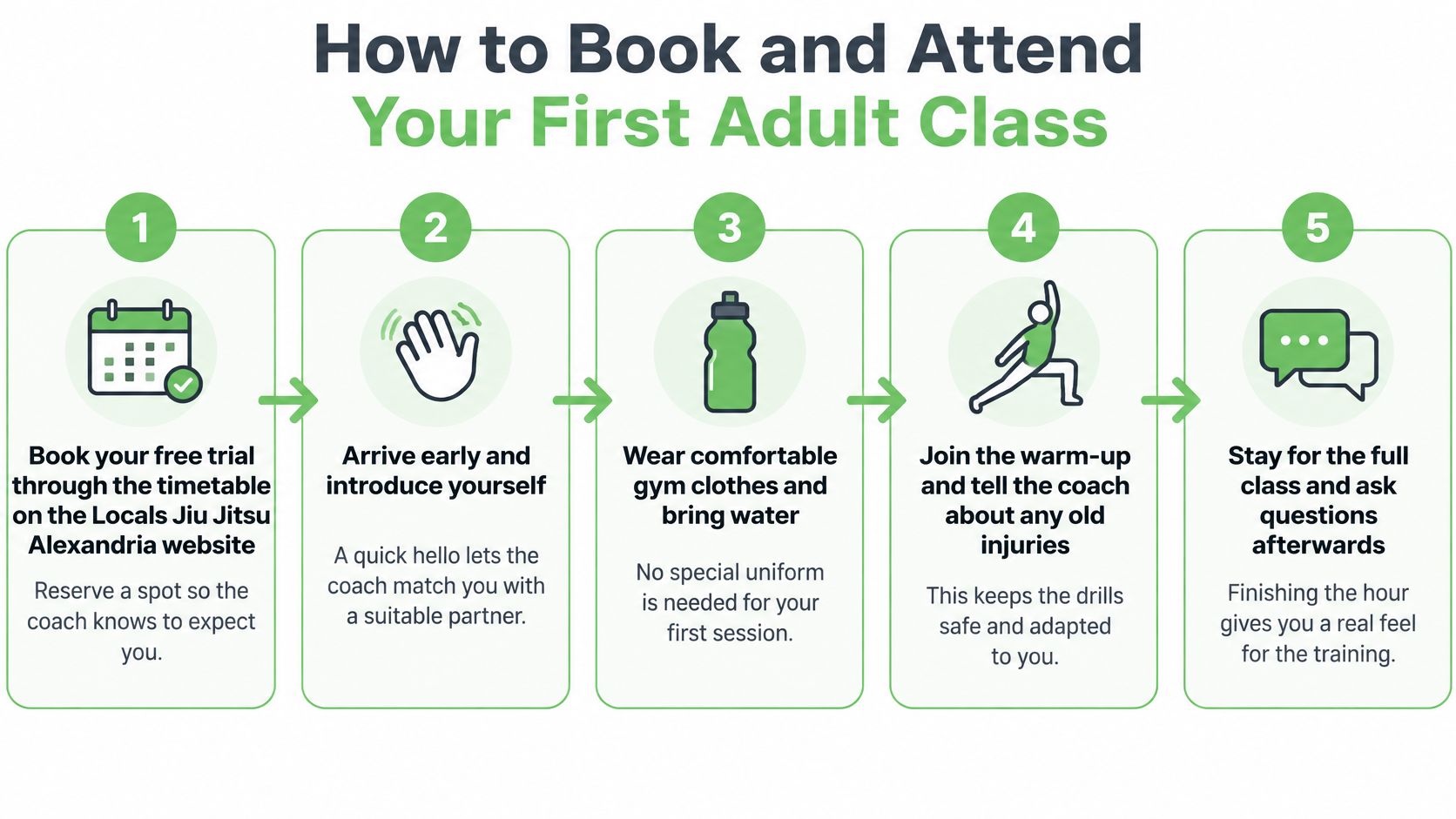
Book your free trial through the timetable on the academy website, or call 0414752412 or email team@localsalexandria.com.au. Booking ahead means the coach knows a beginner is coming and can think about partners before you walk in.
Arrive 10 to 15 minutes early to complete any paperwork and meet the coach. Walking in with five minutes to spare and no idea where to change is the most common first-day mistake.
Bring athletic clothing that allows full movement, a water bottle and a towel. Remove jewellery and keep your nails short, because loose zips scratch and long nails catch skin.
Ask whether you need your own gi for the trial or can borrow one, and ask about membership pricing before you sign anything. Both answers should take a minute and require no pressure.
Tell the coach you're a complete beginner and mention any injuries or medical conditions before the warm-up starts. A group class can adapt a movement, but only if the coach knows it needs adapting.
Follow the warm-up and copy the basic drills, asking your questions in the breaks rather than mid-repetition. Coaches would rather explain a detail twice than watch you guess.
Practise tapping on day one. Tap firmly on the mat or your partner the moment a hold becomes uncomfortable, and tell your partner to tap you early too. It's the first skill taught because it's the one that keeps you training.
After class, write down how you felt. Note which techniques stuck, whether the pace suited you and how your body responded the next morning. That note is more useful than your memory in a week's time.
The slips that cost people the most are small and avoidable: arriving late, missing the warm-up entirely, and training through pain because you don't want to seem difficult. If you're still weighing up whether a venue fits your week, this guide to finding jiu jitsu near me covers what to check before you travel.
Confirm Your Trial Class Before You Commit
Here's the decision rule. If you're curious and you can commit to two sessions a week, book the trial now. If two sessions a week isn't realistic this month, wait until it is, because one class a month teaches you almost nothing and slowly convinces you that you aren't suited to it.
Accept that early sessions feel awkward. You'll forget which side to put your foot on, you'll get stuck under someone lighter than you, and you'll leave with a sore neck from looking the wrong way. None of that is a verdict on whether you'll stay. The people who do well are the ones who came back the following week, not the ones who looked good on day one.
Locals Jiu Jitsu Alexandria offers a free trial class for all levels, so complete beginners and experienced practitioners book the same way: check the timetable and pick a session that fits your week. If nothing on the timetable suits you, call 0414752412 or email team@localsalexandria.com.au.
Book the trial for this week, then start an attendance log on the night you go. Two ticks on a calendar across twelve weeks will tell you more about your future in this sport than any amount of reading.
Locals Jiu Jitsu Alexandria runs beginner, advanced and No-Gi adult classes from its Alexandria academy, with a free trial class so you can experience a full hour before committing to anything. If two sessions a week sounds workable, the timetable is the only thing left between you and your first class. Visit Locals Jiu Jitsu Alexandria to check class times and book your free trial.
Comments