
Kids Jiu Jitsu Belts: Ranks, Ages and What Each One Means
What should your child be able to do before they wear the next belt? Most belt charts answer a different question entirely: which colour follows which. That part is easy, and you can read it off a poster on the wall.
The harder question is what a promotion means. Does it show your child is ready for more contact, more responsibility and harder training, or does it show they've been turning up? Those are different things, and parents deserve to know which one they're looking at.
This guide walks through the junior belt order, the age rules that set the pace, and the skills and safety standards a belt is meant to signal. It's written for Australian families, where the junior pathway follows age bands rather than a single adult sequence.
Table of Contents
Kids Jiu Jitsu Belt Order From White to Green-Black - What the order fixes and what it leaves open - Finding your child's place in three steps
How Age Bands Set the Pace of Promotion - The exit at 16 changes the planning
What Coaches Check Before a Child Is Promoted - Seven things a fair system assesses - The difference between development and retention - When progress pauses
Contact, Concussion and Return to Training - Questions worth asking before you need them
Safe Partner Drills and Child Safeguarding in Class - Belt assessments stand apart from contact - Four questions for the coach
Kids Jiu Jitsu Belt Order From White to Green-Black
Thirteen ranks sit between a child's first class and the top of the junior system, and they run in a fixed order. Five belt families carry the sequence: white, grey, yellow, orange and green. Inside each coloured family sit three steps, a white-stripe version, the solid colour and a black-stripe version, which is why the chart looks longer than the list of colours you'd expect.
Junior belt order with age stages
Order | Belt | Belt family | Age stage |
|---|---|---|---|
1 | White | White | Starting belt |
2 | Grey-white | Grey | From the year the child turns 4 |
3 | Grey | Grey | From the year the child turns 4 |
4 | Grey-black | Grey | From the year the child turns 4 |
5 | Yellow-white | Yellow | From age 7 |
6 | Yellow | Yellow | From age 7 |
7 | Yellow-black | Yellow | From age 7 |
8 | Orange-white | Orange | From age 10 |
9 | Orange | Orange | From age 10 |
10 | Orange-black | Orange | From age 10 |
11 | Green-white | Green | From age 13 |
12 | Green | Green | From age 13 |
13 | Green-black | Green | From age 13, highest junior rank |
The top row is the ceiling of the junior system. Green-black is the highest junior rank a child can hold, and nobody wears it indefinitely. Grey stages open in the year a child turns 4, yellow stages from age 7, orange from age 10 and green from age 13 under the Australian Federation of Brazilian Jiu-Jitsu graduation framework, which follows the IBJJF system. Each family marks a stage of childhood, not another colour to collect.
What the order fixes and what it leaves open
The sequence is fixed. The calendar isn't. Two eight-year-olds can both wear yellow while one has held it for four months and the other for a year. Training frequency, how quickly a child picks up movement patterns and how often the coach runs gradings all shift the pace. What the table guarantees is the direction of travel, not the speed.
Read it as a map, not a timetable. Knowing that grey-black sits before yellow-white tells you where your child is heading. It tells you nothing about when they'll arrive.
The intermediate belts do real work here. A child moving straight from grey to yellow waits a long time for a milestone, while a child passing through grey-black gets a visible step forward while the harder skills settle. That's the point of the two-tone ranks.
Finding your child's place in three steps
Match the belt on your child's waist to a row. Two-tone belts are the easiest to place, because the order number tells you exactly where they sit.
Read the row directly below. That's the next promotion, and the age stage column tells you whether it's open yet or still a year away.
Check the family. If your child is in yellow, the orange rows are the horizon. A move from yellow-black to orange-white is a change of stage, not just a change of colour.
How Age Bands Set the Pace of Promotion
Why can progress look stuck for a year, then jump twice in a season? Age does more than open the next colour. It sets the rhythm of the whole junior pathway.
Under the AFBJJ graduation system, children are eligible for junior coloured belts from the year they turn 4 through the year they turn 15. Yellow stages generally begin from age 7, orange stages from age 10 and green stages from age 13. Those thresholds sit in the belt families, not in one instructor's taste. The bands work like lanes on a track. A faster child can move inside the lane that is open, and a slower child still has room in that same lane.
A belt in this system is a readiness and safety signal. Age makes a stage available. It does not, on its own, show that a child can use those techniques without putting a partner at risk. Before a promotion, the child should show that control. The belt marks readiness for the next set of problems. It does not rank one child against everyone else in the room.
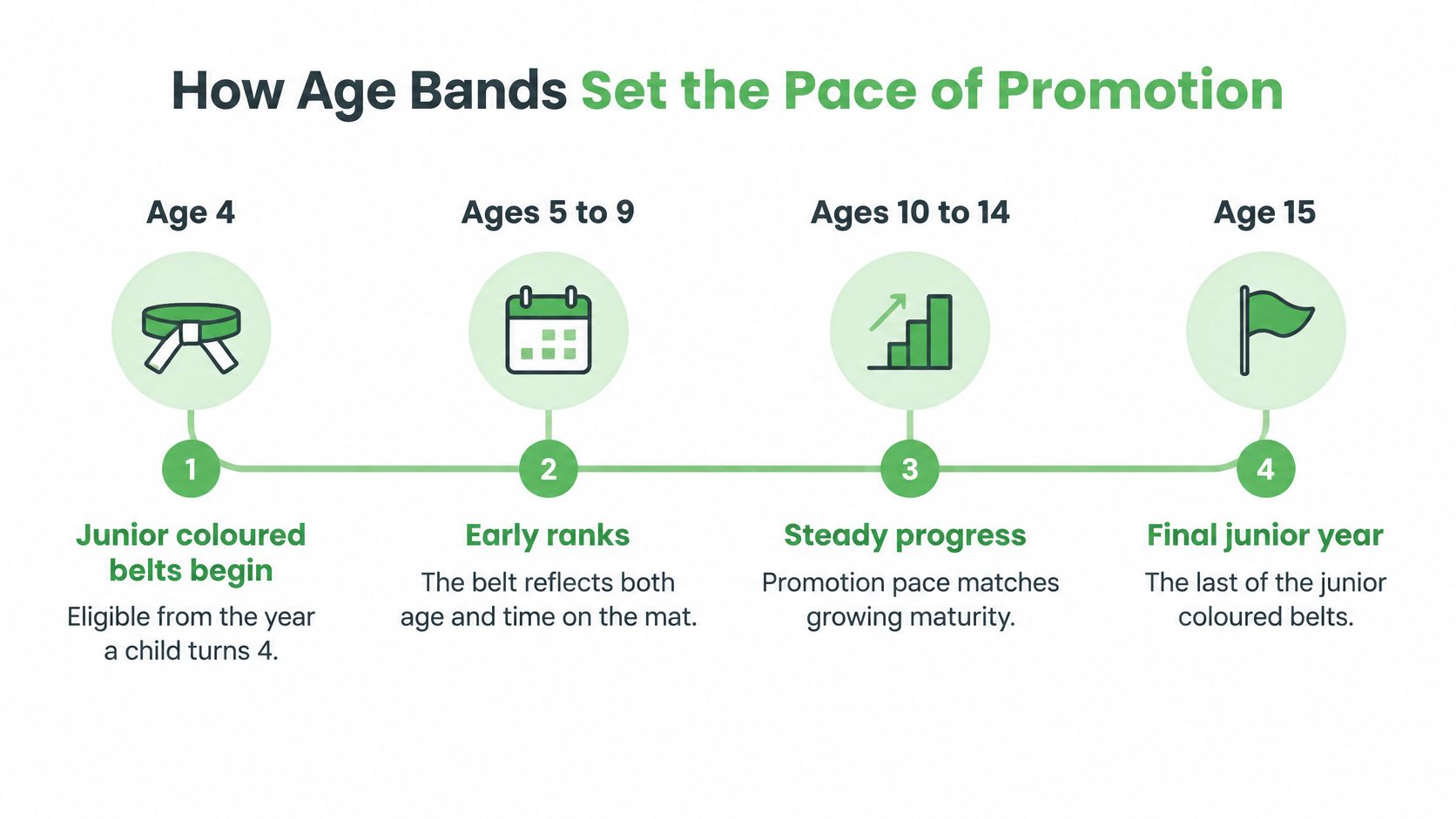
A child who starts at 4 has roughly nine years before the green stages at 13. A child who starts at 11 can meet orange almost at once, if the control is already there. Both paths fit the same framework. The band keeps age and skill in one decision, so neither one cancels the other.
The exit at 16 changes the planning
Junior coloured belts end in the calendar year a child turns 16. That is when the children's pathway closes. Families should confirm the exact changeover with their academy or federation.
Those years are finite. A child who begins at 14 has about two years inside the system, so the sensible aim is skill, confidence and safe training habits, not every colour on the chart. Promotion in that window is age-appropriate development, not a race toward an adult black belt. A junior belt does not predict how soon that adult rank will come.
Work backwards from 16. The exit year is fixed, so one slow season is information, not a failure.
Note the calendar year your child turns 16. See which stage is open now and which opens next, and ask what safe, repeatable skill has to show up first. Count the years left, including breaks for school or other sports, and let that count set the pace.
Skills Children Build as They Move Up the Ranks
A yellow belt mid-throw. The coach is watching control as closely as technique, because a throw that ignores a partner's safety isn't a skill worth ranking.
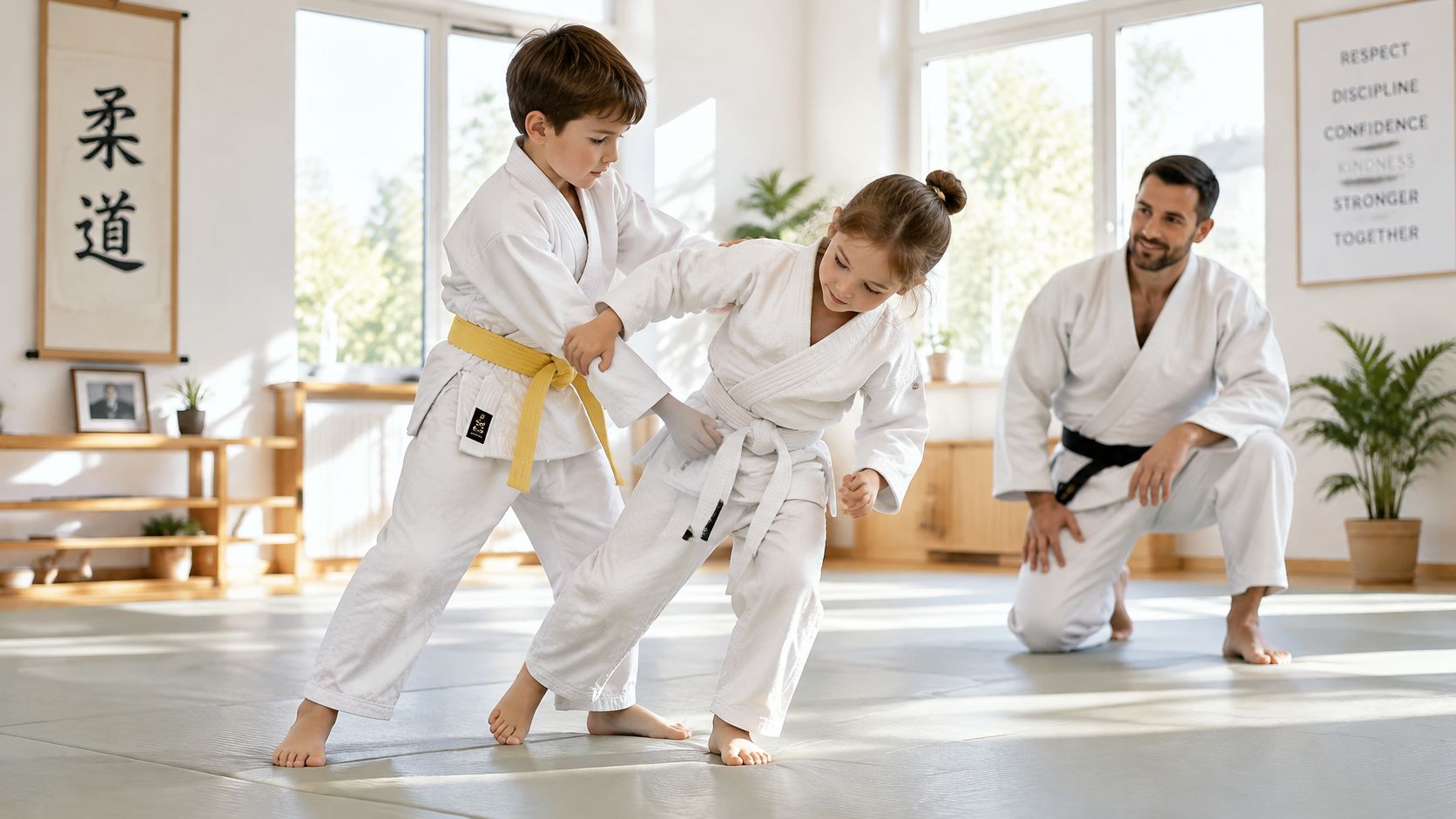
The qualities families notice first are usually coordination, focus, discipline, respect and teamwork. The practical self-defence sits underneath them. At white belt the work is fundamental movement: falling safely, escaping a grip, moving the hips without turning away. Positions and submissions arrive with the ideas that make them work, including mechanical advantage, balance and strategy, which is how a smaller child learns to handle a larger training partner without relying on strength.
The stage examples below are the sort of thing a coach is looking for at each level.
White belt: breakfalls, grip escapes, standing up without giving away the back.
Yellow stages: linking two positions in a single drill, sweeping and then holding the top position instead of scrambling.
Orange stages: working against controlled resistance, chaining a second option when the first attempt fails.
Green stages: adjusting a technique mid-round and explaining to the coach why the change worked.
Class time counts toward a child's weekly movement, and it's worth knowing how it fits. The physical activity guidelines for children and young people aged 5 to 17 recommend at least 60 minutes of moderate-to-vigorous activity every day, plus vigorous and muscle-strengthening activity on at least three days a week. A Jiu Jitsu class that mixes warm-ups, drills, technique and controlled games contributes to that, and the daily target can be gathered in shorter sessions. It's one part of a varied week, not a replacement for it.
The habit matters more as children get older, not less. The Australian Sports Commission reported that in 2022 only 1 in 20 young people aged 15 to 17 met the physical activity guidelines, according to its physical activity evidence summary.
A class looks like this when those skills are being built.
Three things are worth watching for in any session: focus, meaning your child returns to the drill after a mistake rather than drifting; safe effort, meaning they tap early and let go when someone else taps; and listening, meaning they stop the moment the coach says stop. Balance and body control underpin all of it, and these kid-friendly balance exercises are a simple way to build it at home between classes. If you want to see what the drills behind the ranks contain, this breakdown of kids Jiu Jitsu drills walks through a typical class.
What Coaches Check Before a Child Is Promoted
A belt shows a child met the criteria their academy sets. It doesn't prove readiness, maturity or safety on its own, and no colour does.
That distinction matters more when you consider the scale of the picture: about 1.83 million Australian children aged 0 to 14 take part in organised sport-related activity at least weekly, according to the Australian Sports Commission clearinghouse. With that many children being graded somewhere, the criteria behind the colour matter more than the colour chart itself.
Seven things a fair system assesses
Age-appropriate technical competence. Can your child demonstrate the technique when asked, or only follow along in the line?
Positional understanding. Can they tell you where they are and what they're trying to do from there?
Safe tapping. Do they tap early, and do they release a hold the moment their partner taps?
Controlled resistance with different partners. Can they train safely next to a child much heavier or much smaller than them?
Attendance and consistency. Is there a stated expectation, or is it left vague?
Behaviour and respect. Is conduct assessed, or is technique the only measure?
Sparring readiness. Who decides a child is ready for live rounds, and what does that decision rest on?
Competition wins are not the test. A child who takes medals but can't regulate force with a smaller partner hasn't shown the thing that matters.
The difference between development and retention
A developmental promotion shows up in explanation. Ask your child what they had to show for it and listen for a skill, a position, a correction they fixed. If the answer is "I did enough classes", that's worth knowing too, because it tells you the promotion is a reward for attendance rather than a statement about competence.
Children also develop unevenly. A younger child may show excellent movement and safety awareness without being ready for the pressure that comes with a higher rank. An older beginner can pass them technically within months. Neither is a problem.
When progress pauses
Pauses are normal, and they're often where the actual learning happens. Promotion should never be used to push a child back into training they aren't ready for, and a good coach will say so plainly. For a fuller picture of how grading is structured at our academy, this explanation of how BJJ belt promotions work covers the process.
Ask three questions before the next grading. Which criteria apply to my child, who assesses them, and are stripes used between belts?
Contact, Concussion and Return to Training
A knock to the head in class needs a plan, not a decision made in the moment by a child who wants to keep training.
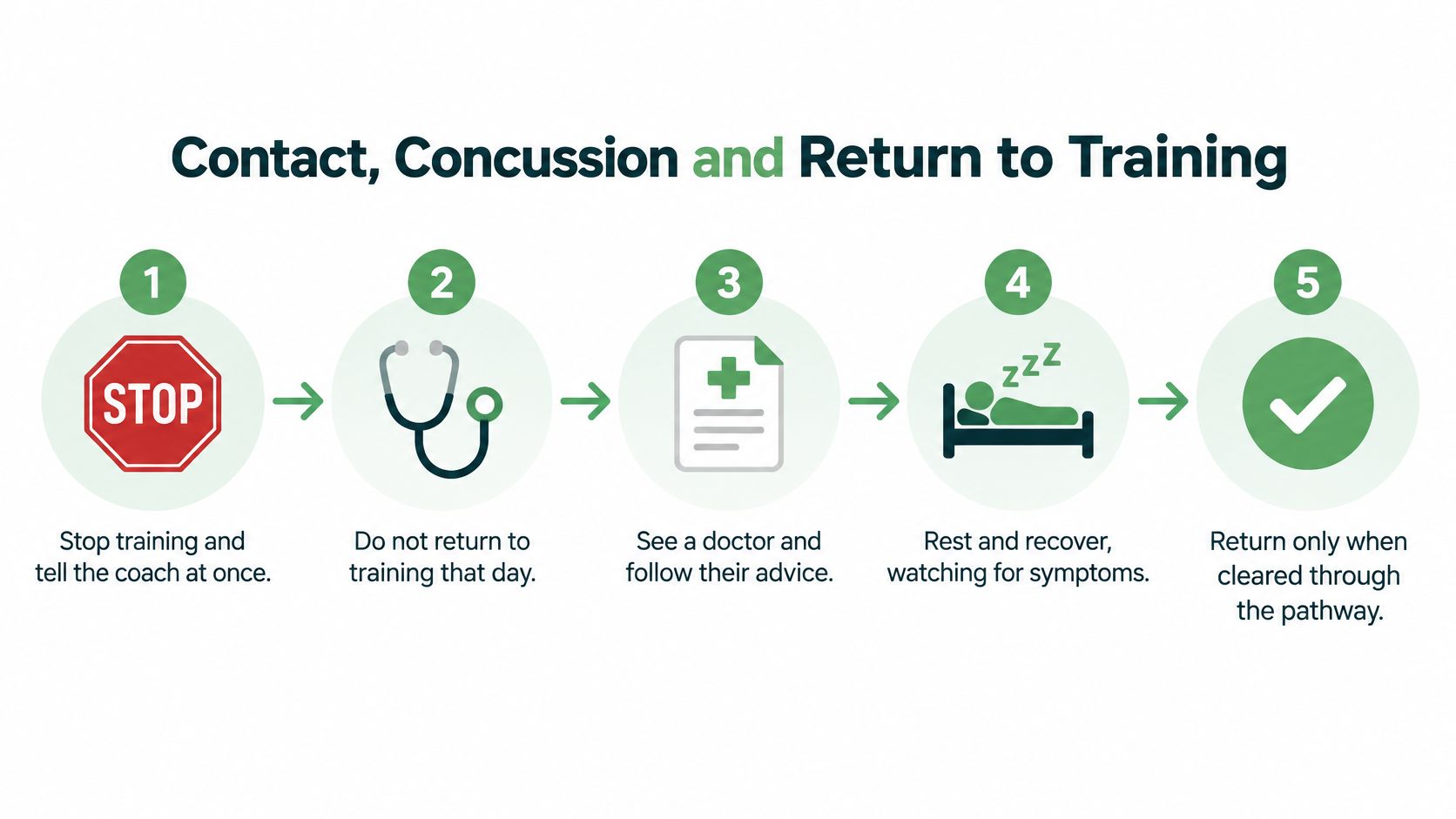
The Australian Concussion Guidelines for Youth and Community Sport set out a deliberately conservative pathway, and it's worth knowing before anything happens:
Stop training and tell the coach immediately. A child with symptoms doesn't finish the round.
Arrange a medical check and follow the advice you're given.
Wait at least 14 days symptom-free before returning to contact or collision training, which includes live grappling.
Wait at least 21 days symptom-free before any competitive contact.
Return to normal school activities first, before returning to sport, and accept that a grading can be postponed.
Grappling carries these risks in ordinary classes, not just at competitions. Training involves falls, body pressure, accidental head contact and live resistance, and a child who is tired or trying to impress a partner is exactly the child who won't report symptoms unless the room makes it safe to speak up.
A belt test can wait. Postponing a grading costs a child nothing. Rushing a return to contact can cost them a season.
If you want to understand what first aid training covers for the adults supervising children, this 2026 childcare first aid compliance guide explains the compliance side for people who work with kids.
Questions worth asking before you need them
Is there a written concussion process you can read, rather than a verbal policy?
Who decides when a child resumes contact, and is that decision separate from grading?
Are pairing, size differences and intensity actively managed by the coach running the mat?
A promotion should never pressure a child back into training before they're cleared, whatever the calendar says.
Safe Partner Drills and Child Safeguarding in Class
A partner drill should have a clear teaching purpose, and children should know how to pause it. Sport Integrity Australia's guidance on physical contact says contact with children must be necessary, appropriate to the activity and responsive to the child's needs. Examples include helping with a technique, using equipment or providing first aid.
The guidance rules out contact with intimate areas, including the genitals, buttocks and breast area, except when medically necessary and protected by appropriate safeguards.
In grappling, a coach may need to show how a position or movement works. The correction should be limited to what the technique requires, while partner drills should be supervised and matched to the children taking part. Written safeguarding rules give coaches, children and parents a shared standard to follow.
Belt assessments stand apart from contact
Promotion should reflect a child's skill and conduct against the program's criteria. It should not depend on tolerating contact that feels uncomfortable. A belt signals progress in training; it does not mean a child must ignore their boundaries.
Parents comparing youth activities may also find a guide to youth kiteboarding in Key Biscayne helpful for considering how supervision and instructor responsibility are discussed in another sport.
Four questions for the coach
How are techniques demonstrated on children? Ask how coaches handle close-contact positions and whether the child's comfort is considered.
Can a parent observe a class? Find out whether viewing is allowed and how to arrange it.
Who handles safeguarding concerns? Ask who is responsible and whether you can read the written policy.
Can a child tap, say stop or ask to change partners? They should be able to communicate discomfort without being judged.
Clear answers help parents understand how partner work is supervised and how children's boundaries are respected.
Choosing and Caring for a Kids Belt
A child's belt is training gear, not just a rank symbol. A belt that comes undone mid-drill or frays against the neck is a distraction at best.
Confirm the requirements before buying. Ask for the required belt width, length, colour and grading system, since academies differ on stripes and colours.
Measure the waist over the uniform and check the size guide against your child's gi size, not their school trousers.
Test the fit in class. The belt should stay tied through drills and sparring and sit comfortably at the waist.
Replace it when the fabric, stitching or label turns abrasive or frays badly, because a rough edge rubs against partners.
Expect to replace it as your child grows or moves into a new uniform size, sometimes more than once in a year.
The coaching side matters too. Children shouldn't pull, swing or use the belt as a handle, because belt play causes collisions and entanglement that have nothing to do with technique. A consistent colour-and-stripe policy across the class also helps children read rank without confusing a belt with maturity or fighting ability, which is a confusion worth correcting early.
These are practical standards rather than a government product specification, so confirm the details with your academy before you buy. If you're also sorting out the uniform, this guide to a children's BJJ gi covers fit and sizing.
Key Belt Terms Parents Hear at Class
Promotion notices and mat-side conversations come with vocabulary. Learn these eight terms and most of what you hear will make sense.
Belt terms and what they mean
Term | What it means |
|---|---|
Grading | A formal assessment where a child is considered for the next belt or stripe |
Stripe | A bar on a belt that marks progress within one belt, if the academy uses stripes |
Belt family | The main colour group, such as grey, yellow, orange or green |
Intermediate belt | A two-tone belt, such as grey-white or yellow-black, between full colours |
Junior | A child in the children's belt system, from the year they turn 4 to the year they turn 15 |
Juvenile/adult framework | The competition framework a young athlete moves into during the calendar year they turn 16 |
Return to play | The staged process for returning to training after a head knock or symptoms |
Safeguarding | The rules that protect children from inappropriate contact and conduct |
The terms connect in a straightforward way. A grading is the formal check for the next belt or stripe; the belt family is the main colour group; the intermediate belt is the two-tone step between colours; and the junior label applies from the year a child turns 4 until the year they turn 15.
One caution. Stripe use depends on the academy's policy, so the same term can mean slightly different things from one club to the next. Treat this table as a starting point and confirm the specifics with the coach.
A term is only useful if it's defined locally. Ask what a stripe means at your academy before you assume it matches what another parent described.
For colours and ages, return to the belt order table. For timing, the age section answers it. For return-to-play rules after a knock, the safety section holds the details.
Confirm Promotion Rules Before the Next Grading
Before the next grading, ask for the academy's written promotion policy. It should state the criteria used for promotion, who assesses them and how behaviour is weighed alongside technique, and it should be a document you can read rather than a talk after class.
While you're asking, confirm the safety points too: the concussion process, who decides when a child can return to contact, and how pairing and intensity are managed. A grading can always be postponed without penalty. Nothing about a belt is worth rushing a recovery or pushing a child through training they're not ready for.
If you're still choosing a class, Locals Jiu Jitsu Alexandria runs a Jiu Jitsu for Kids program that introduces children to Jiu Jitsu in a fun, safe and engaging environment, developing discipline, focus, coordination and self-defence skills. The academy also offers a free trial class for all levels, so you can check the timetable and book a session to see a class before committing.
Your next steps are short. Write down the three questions that matter most to your family, ask the coach at the next class, and book the free trial if the answers are clear.
Junior belts mark progress, but true value sits in what a child can do safely on the mat, and that's what Locals Jiu Jitsu Alexandria builds class by class. Our Jiu Jitsu for Kids program introduces children to the art in a fun, safe and engaging environment, developing discipline, focus, coordination and self-defence skills, with a free trial class for all levels and a timetable you can check before booking. Visit Locals Jiu Jitsu Alexandria to book a session and see how the ranks are earned in practice.
Comments