
BJJ Rules for Beginners: What to Expect at Class
You're standing outside a Sydney BJJ academy with a gym bag over one shoulder, watching people move confidently across the mats. You're wondering whether you should sit down, remove your shoes, bow, or admit that you've never heard of half the positions being called out.
That uncertainty is normal. BJJ rules for beginners aren't designed to make newcomers feel like outsiders. They form a practical harm-reduction system that protects your skin, joints, training partners, and confidence while you learn. The most important early achievement isn't submitting someone. It's learning to communicate, control your movement, follow instructions, and leave with enough energy to come back.
Walking Into Your First BJJ Class Without Feeling Lost
A beginner class usually follows a predictable rhythm. You arrive, check in, change, and speak with the coach before stepping onto the mat. A foundational Australian guide explains that entry-level jiu-jitsu can begin with only a T-shirt and loose-fitting bottoms, while also stressing respect for partners and awareness of personal limits. Australian beginner guidance on starting jiu-jitsu reflects the simple principle that specialised equipment shouldn't be the first barrier.
Arrive early enough to introduce yourself and ask where to wait. Keep your shoes off the training surface, put your phone away, and tell the coach about any injury, medical concern, or complete lack of experience. You won't be expected to know how to bow, tie a belt, or choose a partner perfectly. Ask rather than guess.
What happens after you enter
The coach will normally organise a warm-up, demonstrate a technique, and pair students for drilling. Drilling means practising the movement slowly with a partner while the coach corrects details. Some classes finish with positional sparring or light rolling, while others keep new students working on the lesson.
During positional sparring, you start from a defined position, such as being held underneath side control, instead of trying to solve every part of jiu-jitsu at once. That restriction lowers confusion and gives you a safer learning target.
Your first win is a safe training decision. Telling your partner to slow down, tapping before discomfort becomes pain, or sitting out when something feels wrong are all signs that you're learning properly.
The class ends with a cool-down, questions, and time to clean up. The rules that follow protect this sequence. Hygiene keeps close contact safer, etiquette removes social guesswork, and controlled rolling gives you room to learn without turning every round into a test of toughness. A useful local overview of the BJJ gym experience for new students can also help you understand what to expect before your first visit.
Hygiene and Mat-Entry Rules Every Beginner Must Follow
BJJ involves repeated skin contact, shared mats, grips, sweat, and close pressure. Hygiene rules therefore protect the whole class, not just the person following them.
Start with your hands and feet. Trim your fingernails and toenails so they can't scratch a partner during grip fighting, framing, or scrambling. Remove rings, watches, earrings, necklaces, and other jewellery because they can catch skin, tear fabric, or create sharp pressure points. Zippers and hard clothing hardware create similar problems.
Wear a clean gi or clean no-gi clothing. Wash your uniform after every session, and don't train in a rashguard or shorts that have been sitting damp in your bag. Australian academy rules repeatedly emphasise clean uniforms, short nails, no jewellery, covered cuts, and safe partner conduct. The concern is straightforward: unwashed equipment and uncovered skin damage increase the pathways for skin irritation, laceration, and infection.
Entering the mat properly
Wash or shower before class, especially if you've come directly from work or public transport. Use deodorant, but don't treat fragrance as a substitute for washing. Off the mat, wear thongs or sandals so your bare feet don't collect street grime and carry it onto the training surface.
No food, drinks other than water, or chewing gum belongs on the mat. Food creates contamination, while gum can become a choking hazard during exertion or accidental contact. Cover minor cuts with a clean, breathable dressing, and tell the coach if the dressing comes loose.
A practical cleaning routine should include the training surface and frequently touched equipment. Guidance on choosing disinfectant wipes for fitness equipment can help families understand why suitable products matter outside the mat as well.
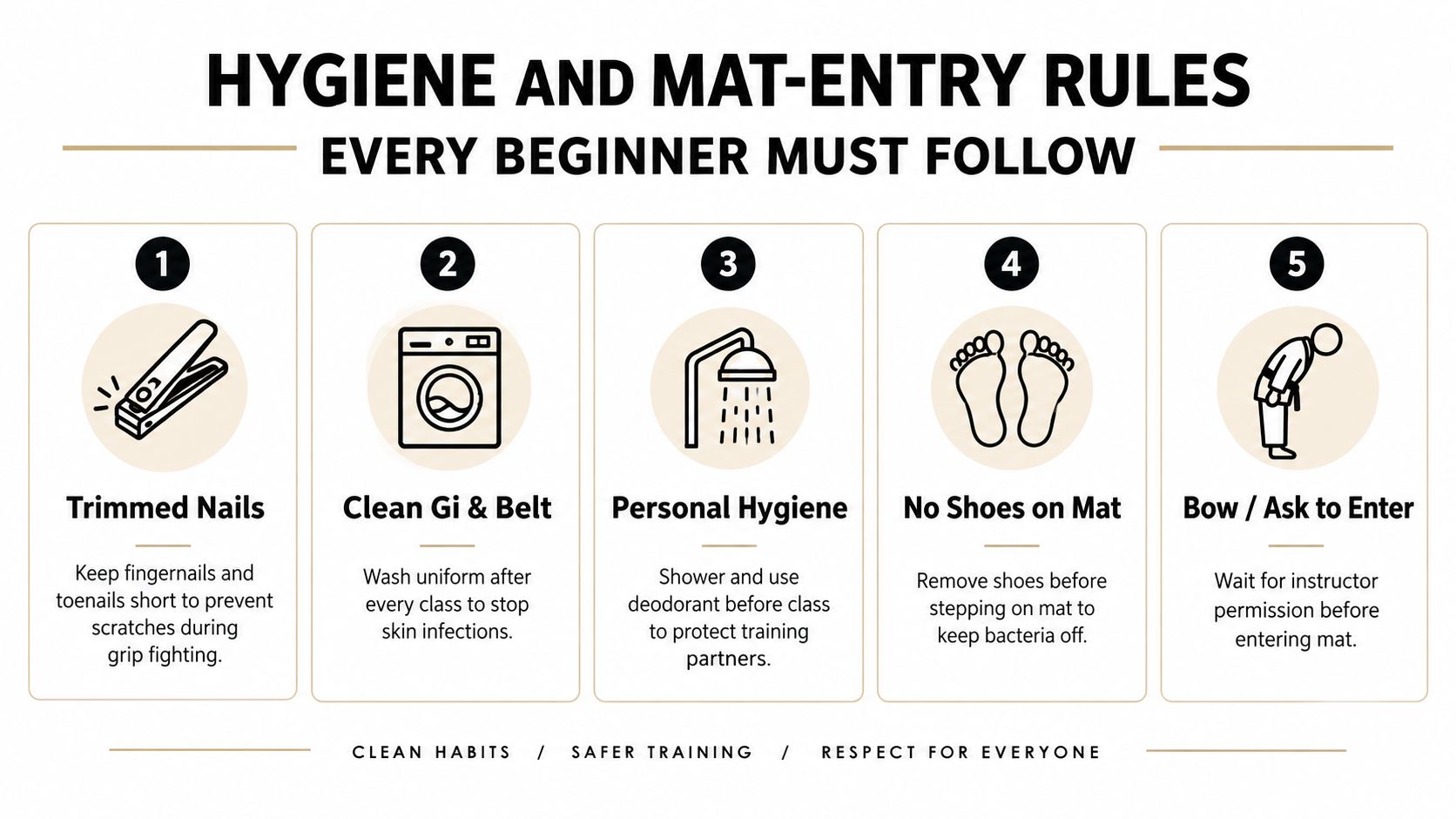
Before buying a uniform, check the academy's clothing expectations in its guide to what to wear to your first jiu-jitsu class. The aim is simple: arrive clean, cover anything that could expose a partner to blood or infection, and keep anything sharp or loose away from the training area.
Dojo Etiquette That Shows Respect From Day One
Etiquette is respect translated into visible behaviour. You don't need to know every tradition on your first night, but you should make a genuine effort to follow the coach's lead.
Wait for permission before entering the mat if the class is already underway. Bow when your academy uses that custom, and bow or acknowledge the space when leaving. The gesture isn't a performance. It reminds you that the mat is a shared training environment where another person is trusting you with their body.
At the beginning and end of class, line up as directed. Many academies organise students by rank, with more experienced belts closer to the coach. If you aren't sure where to stand, ask the nearest student. Address the instructor using the title the academy prefers, such as Coach, Professor, or Sensei.
Listening is a safety skill
When the coach demonstrates, stop moving and face the demonstration. Sit with your legs crossed or in the academy's preferred position rather than leaning across the mat or wall. Don't talk over instructions, take calls near the training area, or keep checking your phone. A missed detail about where a hand goes can become an unsafe grip when you practise it at speed.
Higher-ranked pairs may need the centre of the mat for space. If a more experienced pair approaches while you're rolling, move towards the edge when it's safe. Australian club guidance also states that lower-ranked practitioners should move for higher ranks when space is tight. This isn't a statement that beginners matter less. It keeps experienced students from colliding with less predictable movement while giving you a clear way to contribute to order.
Don't correct another student's technique unless the coach asks you to help. Ask permission before filming, and don't post footage that includes training partners without checking first. The local explanation of respect in martial arts captures the broader principle: humility and consideration make close-contact training possible.
Good etiquette builds trust. Trust makes it easier for experienced partners to slow down, explain a position, and help you learn safely.
Safe Rolling Rules During Beginner Sparring
Rolling is controlled sparring. It should feel like cooperative problem-solving, not a private contest to prove who can impose the most force. Your partner is trying to create useful resistance while also helping you practise safely.
The first safety rail is tap early and often. Tapping means signalling that you want the action to stop, usually by tapping your partner, the mat, or yourself. Tap before pain, not at the point where pain has become sharp or damage may already be developing. If you can't use your hands, say “tap” clearly.
Your partner must release immediately when you tap. Don't hold the position to finish counting, and don't ask whether the tap was serious. The tap is the instruction.
Four controls for a calm round
Match intensity. Start slowly and mirror your partner's pace. Using less force lets you recognise grips, pressure, and unsafe angles before panic causes a sudden movement.
Keep your weight controlled. Don't launch, spike, or explosively lift a partner. A failed lift or stack can load the neck and spine, especially when the person underneath doesn't yet know how to protect their posture.
Protect small joints. Avoid wrenching fingers or gripping with frantic force. Finger jams are common in close hand fighting when a beginner tries to hold every grip.
Communicate continuously. Say when your neck, knee, ribs, or another area feels vulnerable. Reset after a collision, check that your partner is comfortable, and ask the coach for a safer variation.
Positional rounds are especially useful when you're new. Starting from one position limits the number of decisions and helps you learn posture, frames, breathing, and escape routes before adding submissions. Victorian public health guidance recommends accredited instruction, obedience to the style's rules, and stopping immediately after an injury, with no return until fully recovered. Australian guidance on safe martial-arts participation supports treating beginner BJJ as a safety-controlled contact sport.
Cauliflower ear can develop when repeated head pressure or friction goes unchecked, while late taps and uncontrolled movement can contribute to joint, rib, or soft-tissue problems. Tapping isn't surrender. It's the communication system that lets both people keep training.
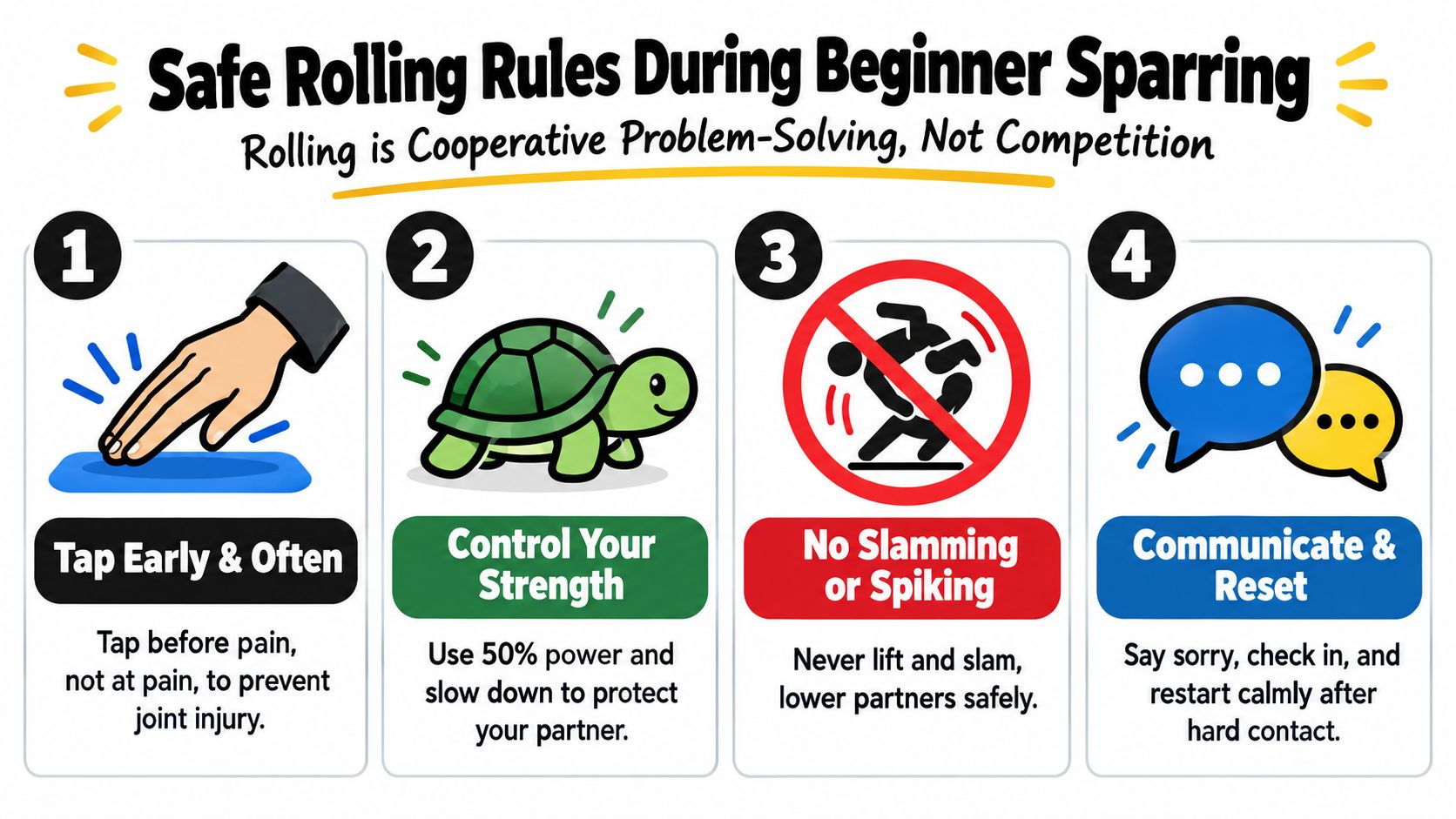
A short visual reminder can reinforce the same habits before your first live round.
What Is Not Allowed on the Mat and Why
The clearest prohibitions exist because certain actions create predictable injury pathways. Striking, eye gouging, slamming, small-joint manipulation, and uncontrolled neck cranks have no place in ordinary beginner rolling. Heel hooks are also commonly restricted in gi classes and should never be attempted unless the coach has specifically taught and authorised them.
Competition guidance in Australia converges around no striking, no slams or suplexes, no spinal locks in relevant beginner settings, trimmed nails, clean clothing, covered cuts, and jewellery removal. These rules respond to mechanics and biology. Hard impacts and explosive lifts increase load through the neck and spine, while sharp nails, loose jewellery, and dirty uniforms can cause cuts or contribute to skin-infection risk.
Not every unsafe action is technically illegal. A beginner might stiff-arm a partner's face to create distance, drive a knee into the hip while applying side control, or grip the face during a guillotine because they're trying to stop an escape. Those choices may happen through inexperience, but they still deserve immediate correction.
Rule Category | Common Beginner Mistake | Risk Reduced |
|---|---|---|
No striking | Pushing or swiping at the face | Eye, nose, and facial injury |
No slams or spikes | Lifting a partner to escape a position | Neck, spinal, and impact injury |
No small-joint attacks | Twisting individual fingers | Finger sprains and ligament damage |
Controlled neck pressure | Pulling the head sharply during a guillotine | Cervical strain and panic |
No jewellery or hard clothing | Rolling in rings, watches, or zips | Cuts, snags, and skin tears |
Safe framing | Posting across the face or throat | Facial pressure and accidental choking |
Stop if you're unsure. Ask the coach to clarify the rule rather than experimenting on a partner. An academy can pause a round, refuse a pairing, or ask a student to sit out if unsafe behaviour continues. That response protects the class and gives the student a clear chance to reset.
Competition Rules and NSW Safety Standards You Should Know
Training rules and competition rules overlap, but they aren't identical. Your academy may use simplified drills, restricted submissions, or positional rounds to make learning safer. A registered tournament adds referees, divisions, time limits, scoring, penalties, uniform checks, and event-specific restrictions.
For a beginner, the point system is easier to understand as a reward for progressing through control positions. A takedown, pass, sweep, mount, or back control may contribute to a score under the federation rules used by that event. Advantages can recognise a near-completed action, while penalties may address stalling, running out of bounds, or prohibited actions. The referee isn't making a personal judgement about your character. They're managing safety, engagement, and fair competition.
NSW compliance is separate from gym etiquette
In New South Wales, combat-sport contests must follow the relevant sport body's rules and comply with the Combat Sports Act 2013, Combat Sports Regulation 2014, and NSW Authority Rules. The NSW Combat Sports Authority requires combatant registration applications at least 10 business days before a contest date and updated medical documents at least 5 business days before that date. NSW combat-sport legislation and registration requirements set out that framework.
NSW's regulation prohibits straps, buckles, metal, or clothing that could cause injury during a contest. Breaching that requirement carries a maximum penalty of 20 penalty units, as stated in the NSW Combat Sports Regulation 2014. Authority Rules also specify hand-wrap limits. Bandages must be crepe or gauze, no longer than 5 metres and no wider than 5 centimetres per hand. Surgical tape must be no more than 2.5 metres long and 2.5 centimetres wide per hand, and it can't extend beyond or cover the knuckles. The NSW Authority Rules provide the exact wording.
All new and renewal applicants in NSW combat sports must complete mandatory concussion training before an application is considered. NSW combat-sport safety information shows why competition preparation involves more than learning points.
Ask the coach about event rules, medical paperwork, supervision, cleaning procedures, and how beginners are matched before entering a tournament. Don't rely on a generic internet explanation for a specific event.
Common Beginner Mistakes and How to Avoid Them
Most first-month mistakes come from nerves, not bad intentions. You're trying to look prepared, avoid embarrassment, and keep up with people who already know the routine. Replace that pressure with a short checklist.
Arriving late: Sneaking onto the mat can interrupt instruction and leave you cold. Arrive 10 minutes early, a punctuality rule stated by Sydney club guidance, so you can change, introduce yourself, and warm up.
Eating heavily before class: A full stomach can make close pressure and movement uncomfortable. Choose timing and food that let you train without nausea, and ask the coach if you're uncertain.
Gripping too hard: Fear makes beginners squeeze collars, wrists, and sleeves as though the grip itself guarantees control. Use enough pressure to maintain contact, then focus on posture, breathing, and position.
Refusing to tap: Toughing out a submission turns a learning moment into unnecessary joint or soft-tissue risk. Tap early, reset, and ask what you missed.
Debating legality mid-roll: If a position feels unsafe, don't pause to conduct a rules seminar. Tap, explain the concern, and ask the coach after the round.
Posting footage without permission: Social media can expose someone's face, injury, or private training moment. Ask the coach and everyone visible before filming or publishing.
Wearing jewellery or zipped clothing: These items can cut, catch, or scratch. Remove them before entering the mat.
Training with a skin infection: Close contact can expose partners. Report the issue, follow medical advice, and return only when cleared and fully recovered.
Treating every round as a final: Maximum effort creates panic and makes partners reluctant to train with you. Keep the session technical, controlled, and repeatable.
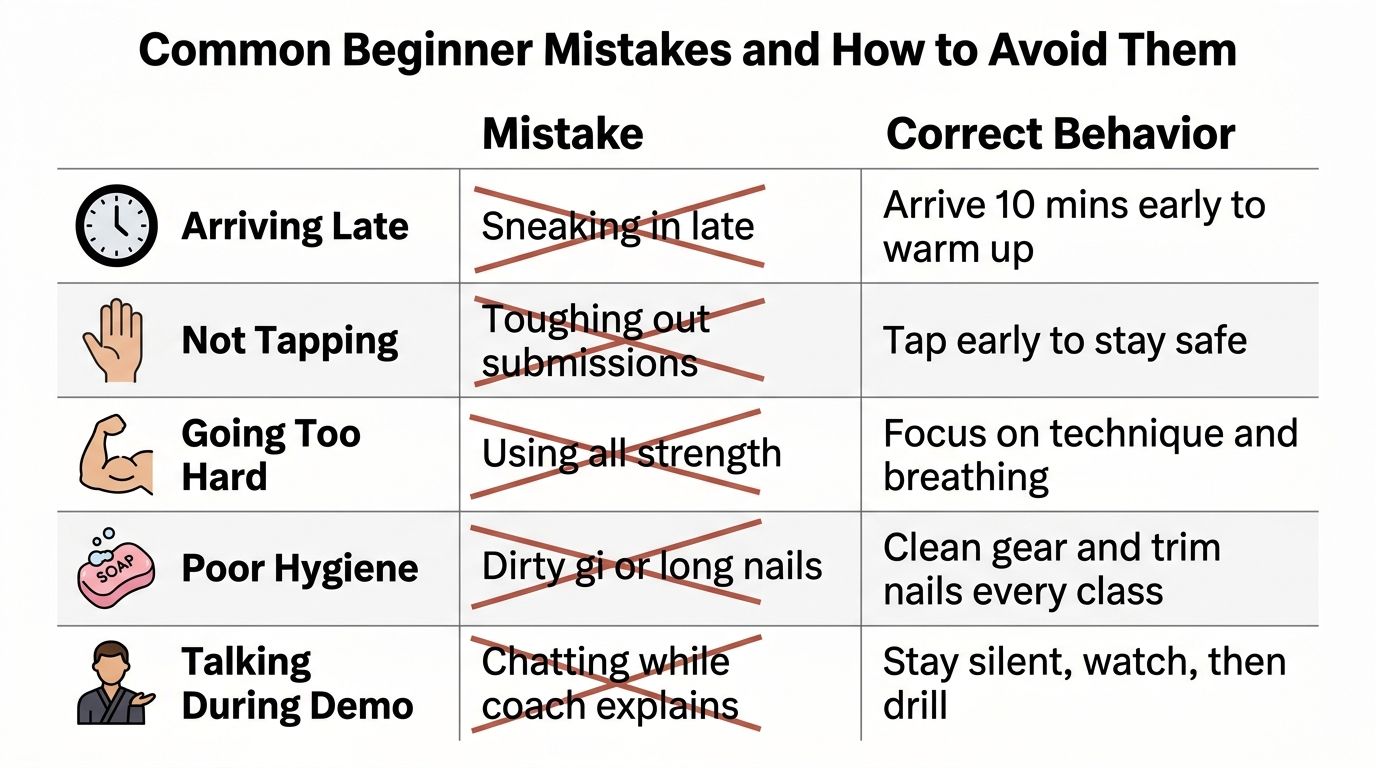
The replacement habit is usually simple: arrive prepared, listen closely, communicate early, and choose consistency over bravado. Rules protect training longevity, not a coach's desire to police beginners.
Building a Long-Term Foundation Through the Rules
The rules matter because they shape the kind of training partner you become. Clean gear, trimmed nails, punctual arrival, and attentive listening tell teammates that you understand the shared responsibility of close-contact practice. Over time, that reputation affects whether experienced students feel comfortable drilling with you, explaining details, or trusting you with harder positional work.
Safe rolling protects more than one class. Controlled grips reduce needless finger strain, early tapping prevents avoidable damage, and sensible intensity gives joints and ligaments a better chance to tolerate regular practice. Recovery also belongs in the system. If soreness or a minor injury changes how you move, use a complete recovery guide for athletes as general background, then follow qualified medical advice for anything persistent or serious.
How coaches see the early months
The first stage is observation. You learn the academy's rhythm, identify unsafe positions, and notice how experienced partners communicate. The next stage is integration, where hygiene, etiquette, breathing, and tapping become habits rather than reminders. Technical progress follows when those behaviours no longer consume your attention.
Competition rules become less intimidating once you understand why referees penalise stalling, boundary running, slams, and equipment violations. You don't need to compete to benefit from that structure. Knowing the difference between a gym drill and an event rule helps you ask better questions and make safer choices.
A reliable training partner is more valuable than a dramatic round.
Treat the rules as part of your jiu-jitsu foundation, alongside escapes, guard work, posture, and control. A nervous first class becomes manageable when you know what to do with your shoes, your hands, your voice, your intensity, and your right to tap.
If you're ready to practise these habits in a structured beginner environment, Locals Jiu Jitsu Zetland offers a Beginners Program with progressive coaching and a safety-first approach. Visit the academy to ask about a suitable introductory class, share any concerns with the coach, and take your first step onto the mat prepared.
Comments