
Brazilian Jiu Jitsu for Kids: A Parent Guide
Children who took part in organised physical activity averaged 69 minutes of moderate-to-vigorous physical activity per day, compared with 53 minutes for children who hadn't, according to the Australian Bureau of Statistics measured physical activity release. That gap doesn't prove any single sport causes the difference. It does explain why a scheduled, coach-led class can matter. Brazilian Jiu Jitsu for kids is one of those structured options, and it's easier to judge once you know what children do on the mat, how hard they should work, and where the boundaries sit.
Table of Contents
Why Kids Classes Matter for Everyday Movement - What a First Class Actually Looks Like
What Each Age Band Should Learn - The Youngest Children Learn Control First - Older Children Add Resistance in Small Doses
How a Kids Class Raises Difficulty Safely - One Session From Start to Finish - What Supervision Should Look Like
Where Classes Fit the Daily Activity Target - One Class Cannot Cover the Whole Week
Self Defence Without Fighting Back at School - A Decision Order Children Can Remember - Progress You Can Actually See at Home
Starting When a Child Is Reluctant or Anxious - Three Gentle Ways In
Why Kids Classes Matter for Everyday Movement
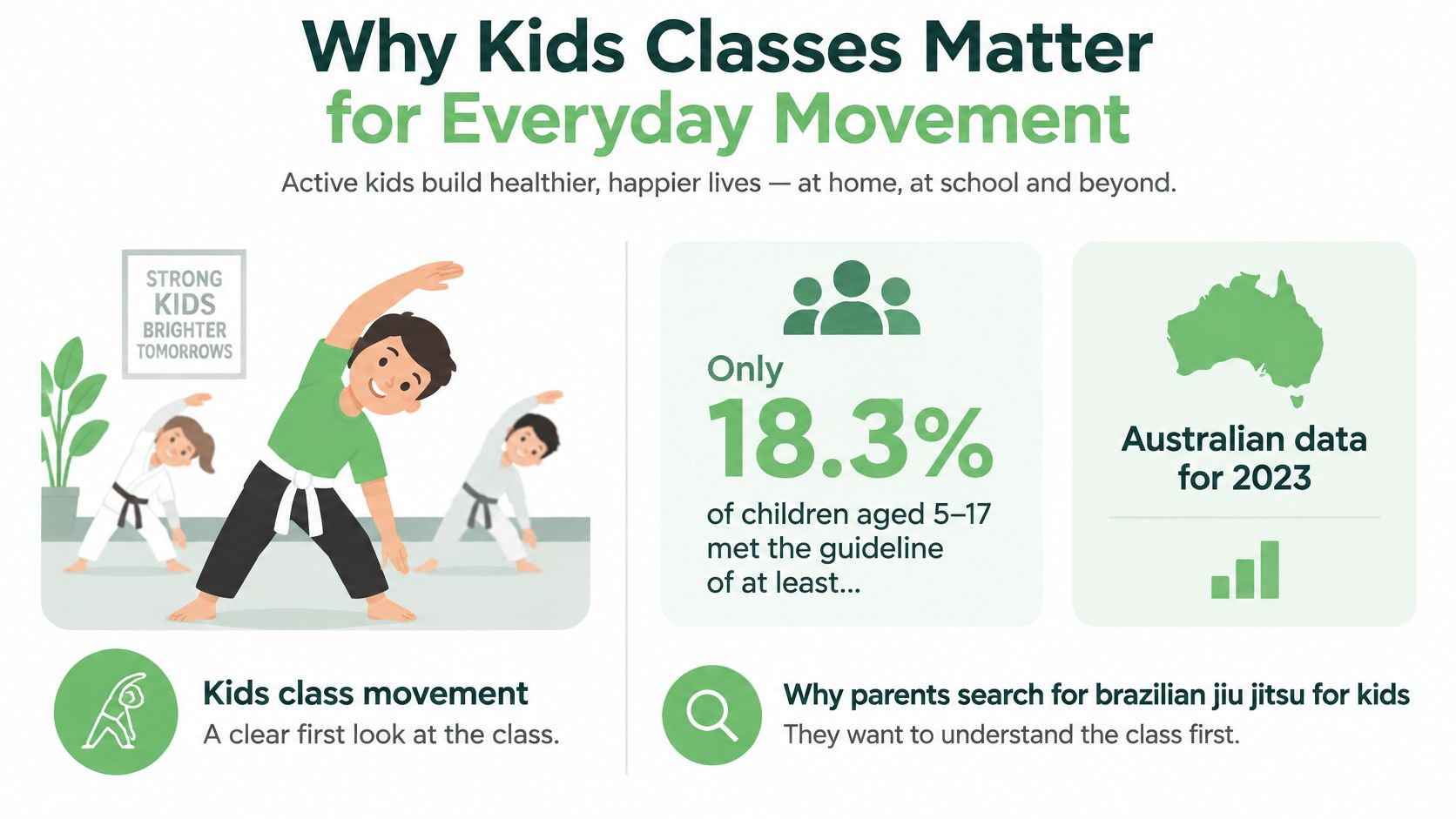
In 2023, only 18.3% of Australian children aged 5 to 17 met the national physical-activity recommendation during the week before their interview, a recommendation generally set at least 60 minutes of moderate-to-vigorous physical activity each day, according to the Australian Bureau of Statistics article on children's physical activity, screen time and sleep. In that same week, 59.1% took part in some organised physical activity. Participation reached 64.0% for ages 5 to 11 and 53.4% for ages 12 to 17, with similar rates for boys at 59.3% and girls at 58.9%.
Those numbers describe organised activity as a whole. They don't show that grappling itself produces a health result. They show something simpler and more useful for parents. Most children already use organised programs, yet far fewer reach the daily target, so the quality and regularity of the program you choose matters.
What a First Class Actually Looks Like
Think of early lessons as learning to steer in an empty car park before busy traffic. Children practise posture, balance, crawling and partner awareness at a speed a coach can stop instantly. A session mixes movement games, repeated drills, positional practice and short problem-solving rounds. It shouldn't look like a smaller version of an adult fight.
That structure is the point. A child isn't left to invent activity for an hour. The coach sets the task, pairs the children, watches the contact and resets the drill when shape or control is lost. Physical effort sits inside technical learning, so a child can work hard while also learning where their body is in space.
A good first question isn't whether your child looks tough. It's whether they can stop, listen and repeat a movement calmly.
Parents comparing activities often think about character as well as movement. If you're weighing how sport can support persistence at home and school, these youth resilience tips from Villarreal Houston Academy offer a useful broader perspective alongside what you observe in a class. On the mat, resilience stays concrete. Your child tries an escape, gets stuck, resets without drama and tries the next step.
That repeated cycle is why classes can support everyday movement. Children bridge, crawl, stand up safely, change direction and learn to fall without panic. They're not just burning energy. They're building a wider movement vocabulary they can use in the playground, in other sports and in ordinary active play.
What Each Age Band Should Learn
Age band | Main skills | Movement emphasis | Self-defence lesson | Intensity ceiling |
|---|---|---|---|---|
4 to 6 years | Games, hip escapes, soft breakfalls, freeze on a stop cue | Balance, coordination, spatial awareness | Stop means stop and bodies are not for grabbing | No submissions or hard sparring |
7 to 9 years | Mount escapes, technical stand-up, guard shapes, instant tap | Bodyweight patterns and agility | Ask for help and hold only long enough to get away | No cranks, slams or size mismatches |
10 to 12 years | Positional rounds, basic controls, kneeling takedown entries | Short harder efforts and mobility | Leave, tell an adult, escape immediate danger | No uncontrolled standing throws |
13 to 15 years | Fundamentals, leverage and simple strategy | Conditioning that still leaves energy for school | Physical skill is for immediate danger only | No adult-class intensity or forced competition |
The Youngest Children Learn Control First
For ages 4 to 6, cooperative games do most of the teaching. Animal walks build coordination, hip escapes become a simple shrimping story, and soft breakfalls teach children how to land without stiff arms. A whistle or a single word should freeze the room. That freeze matters more than any technique, because a child who can't stop on cue isn't ready for partner resistance.
There are no submissions and no hard sparring in this band. Contact stays playful and brief, and the coach keeps tasks short enough that listening doesn't collapse. Success looks like lining up, waiting for a turn, keeping hands to themselves when told, and moving away when a game ends.
Ages 7 to 9 can hold a shape for longer. They learn a mount escape, a technical stand-up so they can rise while facing a partner, basic closed-guard shapes and a clear tap with hand or voice. Partners should be broadly similar in size and maturity. The self-defence idea stays narrow. Hold only long enough to get free, then move toward an adult.
Parents sometimes compare this staged approach with other beginner activities that build coordination through set patterns. If your child is choosing between movement styles, this guide to dance styles for eight-year-old beginners shows a similar age-based logic in a different setting. In Jiu Jitsu, the equivalent logic is position before submission, and control before speed.
Older Children Add Resistance in Small Doses
For ages 10 to 12, short positional rounds make sense. A child might start in mount and try to escape while a partner tries to stay balanced, with both children resetting after a set time or a clear change of position. Basic controls and takedown entries from the knees add effort without the impact of uncontrolled standing throws. Effort comes in intermittent bursts, followed by instruction and recovery.
Ages 13 to 15 can bridge toward fundamental positions, control, and simple strategy. They can link an escape to a guard recovery, or understand why posture breaks down when elbows drift away from the body. Conditioning can be firmer, but it still has to leave energy for school, homework, and sleep. Adult intensity doesn't become appropriate just because a teenager is tall.
Say a family has a nine-year-old and a thirteen-year-old starting together. They shouldn't share the same round or the same success measure. The younger child might succeed by tapping early, standing up in base and asking for help without freezing. The older child might succeed by keeping posture under light resistance and choosing the right escape. Putting them against each other to see who wins teaches the wrong lesson to both.
Some rules don't change with age.
Adult intensity stays out: Children don't need exhausting rounds to learn sound technique.
Dangerous actions stay banned: Neck cranks, slams and explosive standing exchanges have no place in kids classes.
Competition stays optional: A medal pathway shouldn't be the default measure of progress.
Ask which band your child would enter, who they'd be paired with, and what's prohibited in that band. A clear answer tells you more than a long list of techniques.
How a Kids Class Raises Difficulty Safely
A safe class raises difficulty in a visible order. Children earn resistance by showing control at the step before it, not by surviving a hard round. Australian guidance on safe exercise for children from healthdirect supports regular activity with safe exercise practices, and that principle shapes how partner work should be introduced. Young participants are still developing stable posture, force control, spatial awareness, balance recovery and the ability to recognise a safe stopping point.
One Session From Start to Finish
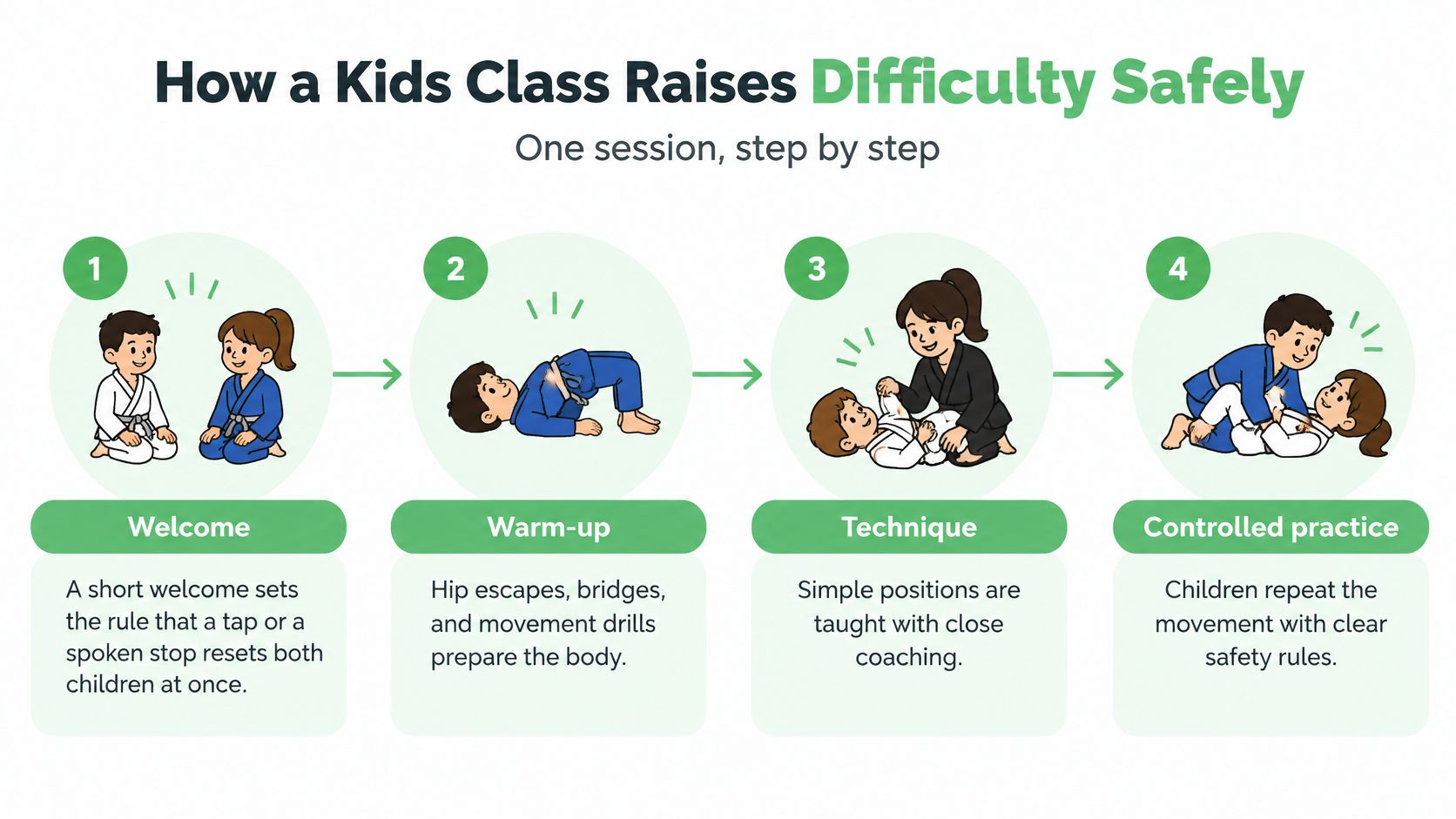
Welcome and stop rule: The coach sets one rule before contact. A tap or a spoken stop resets both children at once, every time.
Movement warm-up: Hip escapes, bridges, technical stand-ups and crawling prepare posture and balance before children touch a partner.
Cooperative games: Children learn the shape of a position with almost no resistance, like tracing a map before driving the road.
One technique, paired drilling: The coach shows a single technique. Children drill it in pairs matched for size, maturity and experience.
Light supervised resistance: Resistance rises only when the group can hold the position and release immediately on cue.
Late, limited submissions: Submissions appear only for children who already control the position, tap early and follow partner-safety rules consistently.
Calm close: The class ends with a reset, a drink and a reminder of the stop cue, not with children leaving the mat overstimulated.
The bans need to be named inside that hour, not buried in a policy document. Uncontrolled slams, neck cranks and explosive standing exchanges are prohibited. A coach-defined intensity ceiling tells children how hard a drill should feel, and an immediate reset follows a tap or verbal safety cue. Controlling mismatch, speed, impact and fatigue reduces avoidable risk far better than praising toughness.
What Supervision Should Look Like
Supervision should be constant, active and able to reach any pair quickly. Parents or carers can watch training, children aren't left alone, and one-to-one time without another adult present is kept for an emergency. That visibility protects children and helps you judge the class with your own eyes.
Practical rule: If you can't tell who is watching each pair, the class is too loose, whatever the technique looks like.
Coaches should stop or modify work when they see technique degrading, heavy breathlessness, pain or emotional distress. A timer running out isn't the only reason a round ends. A child who starts flailing, holds their breath or goes quiet and teary needs a reset, a drink or a different task.
Parents can ask direct questions before enrolling. Ask about first-aid procedures, qualified supervision, hygiene rules for mats and uniforms, and whether there's an age-specific curriculum. Ask how partners are matched and what happens after a tap. The benchmark to listen for is quality of controlled repetitions, not who won rounds or how many submissions were scored. A tidy escape repeated calmly ten times teaches more than one frantic scramble.
Where Classes Fit the Daily Activity Target
For Australian children aged 5 to 17, the guideline is at least 60 minutes of moderate-to-vigorous physical activity daily, with vigorous activity and muscle and bone strengthening activity on at least 3 days per week, according to the Australian Government recommendations for children and young people aged 5 to 17 years. That's the benchmark classes need to fit into. Attendance by itself isn't the test.
A grappling round works like a set of short hills, not one long flat run. Hip escapes, bridging, technical stand-ups, crawling, controlled takedown entries and positional sparring alternate near-hard efforts with quieter technical practice. A child pushes, frames and stands up under load, then slows down to listen and drill. That pattern can build cardiovascular work and bodyweight strength without asking a child to jog continuously for an hour.
One Class Cannot Cover the Whole Week
One or two weekly classes are a piece of the week, not a substitute for daily movement. On class days, look for active drilling intervals, age-appropriate round lengths and very little time standing in a queue. A child who spends long stretches waiting for a turn isn't accumulating much activity, however impressive the demonstration looked.
On other days, walking, cycling, outdoor play or another sport keeps the pattern alive. Variety also spreads the physical load across different movements, which suits growing bodies better than repeating one demanding activity every day. If you're planning the wider week, our guide on keeping kids active with Brazilian Jiu Jitsu sets out how classes can sit alongside school and free play.
Training also has to fit the other hours of the day. Australian guidance recommends several hours of light activity, recreational screen time limited to 2 hours daily, and sleep of 9 to 11 hours for ages 5 to 13 and 8 to 10 hours for ages 14 to 17. A late, exhausting class that wrecks sleep works against the same health goal it claims to serve.
Use a simple next-day check.
Eating and energy: Your child eats normally and has energy for school.
Soreness: Mild tiredness fades, and soreness doesn't stop ordinary play.
Mood: Your child is settled, not wired, tearful or dreading the next session.
If your child is wiped out, unusually sore or struggling at school the next day, the round length or weekly load is too high for that child right now. Tell the coach and reduce the dose. Fitness built gradually, inside a full pattern of movement, sleep and recovery, is the goal. A single heroic class each week isn't.
Self Defence Without Fighting Back at School
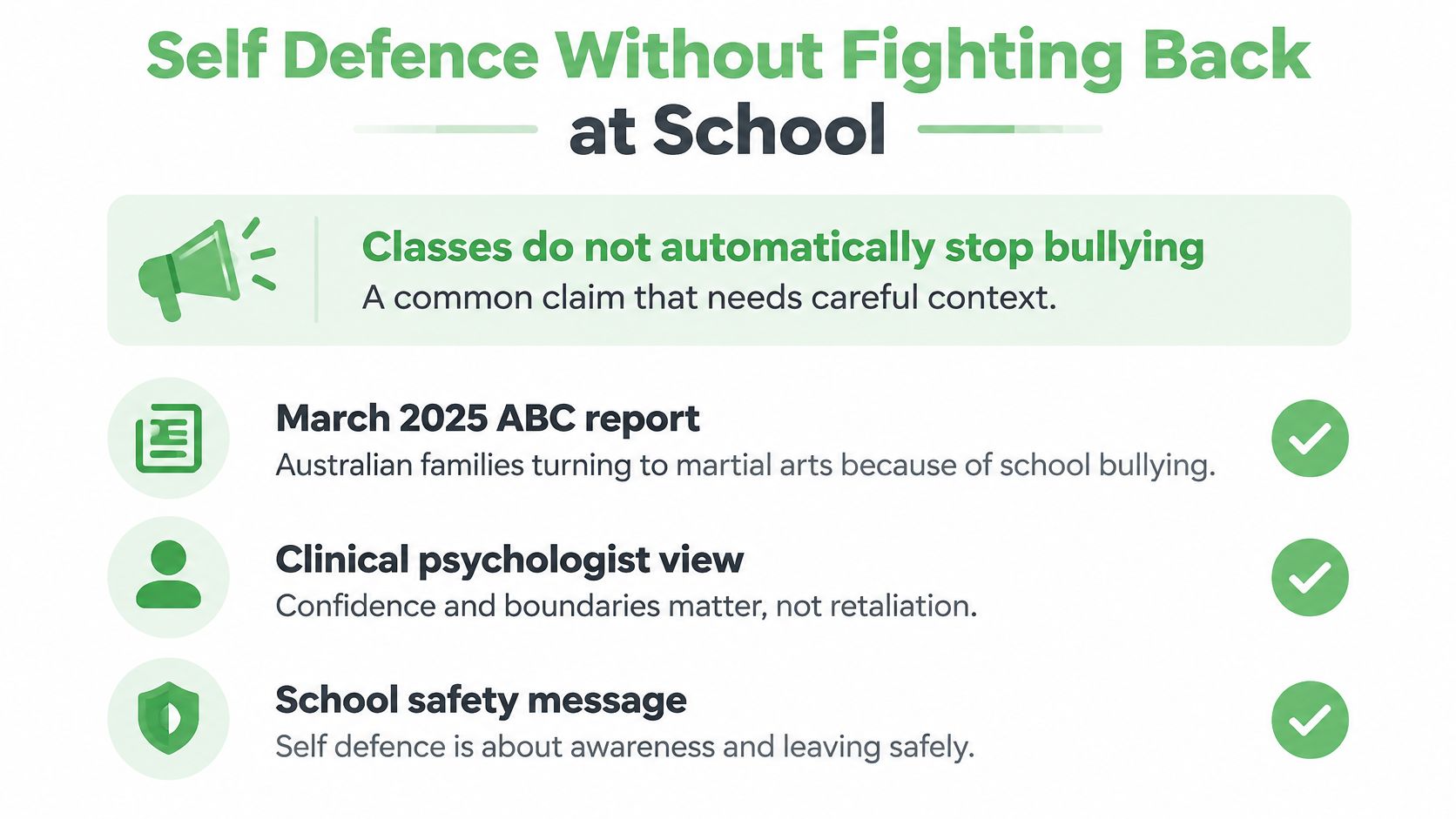
Classes don't automatically stop bullying, and fighting back shouldn't be sold as the goal. The ABC report from March 2025 on families turning to martial arts over school bullying captured why many parents start looking. A clinical psychologist quoted in that report said martial arts may support confidence and help children stay calm under threat, but stressed that violence is not the answer to bullying and that walking away and telling a teacher are usually the appropriate responses.
A Decision Order Children Can Remember
Children need a short order they can use under stress. Notice the problem early. Use words and set a boundary. Leave the area. Find an adult and tell them clearly. Use a physical skill only to create space and exit if someone is already holding or hurting them and they can't get away.
That last step is narrow on purpose. Escaping a grab, protecting the head, standing up and moving toward help is self-defence. Gripping a classmate to prove a point, holding someone down after the danger has passed, or stepping into someone else's fight is a failure of the lesson, even if the grip is technically correct.
The skill is for getting out. It isn't permission to sort out a conflict with your hands.
Mat consent teaches the same boundary in a controlled setting. Partners agree to the drill, contact stays inside the technique the coach showed, and either child can stop the round. A child who learns to respect a partner's tap is also learning that bodies have limits and that stopping is normal, not weak.
Progress You Can Actually See at Home
Look for specific changes, not a submission count. Your child asks for help sooner instead of bottling up a problem. They can name a boundary in plain words. They recover after a frustrating round without lashing out. They can explain when not to use a technique, and they can describe a safe exit from a playground scenario.
Those signs matter because confidence is practised, not automatic. A child may feel steadier because they can move well, fall safely and stay calm while someone is close to them. That steadiness helps them walk away early and speak clearly to a teacher. Presenting the same confidence as permission to intervene in every conflict would make a child less safe, not more.
Parents can ask whether coaches rehearse telling a teacher, safe exits and scenario choices alongside technique. Ask how consent and controlled partner work are taught, and what a child is told to do after creating space. Our overview of self-defence for kids explains that escape and help-seeking approach in more detail. The right answer always ends with an adult being told, not with a child winning a fight.
Starting When a Child Is Reluctant or Anxious
Joining organised sport isn't automatic for many children. In 2025, 47% of children aged 5 to 14 participated in sport-related activities outside school at least weekly, while only 18% of children aged 0 to 4 did so, according to the Australian Sports Commission evidence on the value and benefits of sport across the life course. Nationally, 71% of children aged 0 to 14 took part at least once during the previous year, but only about 26% participated through a sports club or association. Belonging and a manageable start matter as much as the first visit.
Three Gentle Ways In
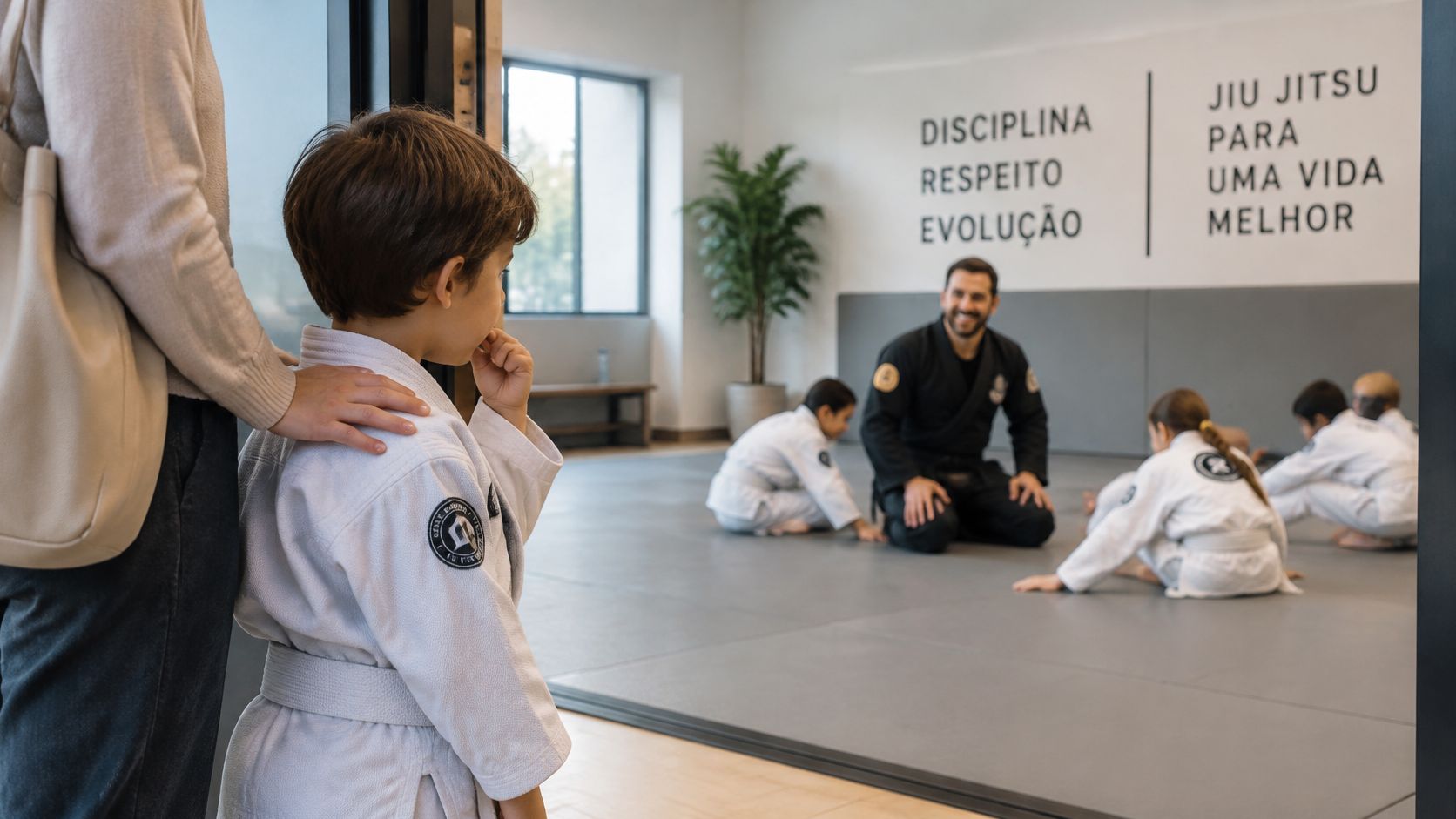
Say your child is inactive and wary of team sport. Let them watch one full session first. They learn where to line up, what the stop word is and when drinks happen. At the next visit they join the warm-up only, then sit out partner work. Watch whether they leave curious rather than overwhelmed. Curiosity is a workable starting point.
An anxious or neurodivergent child may need the contact agreed in advance. The coach can explain exactly where hands will go in a drill, pair them with a familiar, calm partner and agree a planned break spot at the side of the mat. Plain, individual cues work better than a wall of instructions shouted across the room. Watch sleep, appetite and mood after class, not just behaviour during it.
A reluctant teenager often needs a different bargain. No competition, no public testing in the first weeks, and progress measured by remembering one escape and using it calmly. That gives them competence without performance pressure. If you'd like a wider view of gradual confidence building, our article on how to build confidence in kids covers habits that support that slower path.
Keep expectations honest. Better coordination, a familiar routine and growing confidence are plausible results of structured, well-matched classes. Guaranteed personality change, weight loss or the end of anxiety aren't promises any coach should make. A child who hides their gear, can't sleep before class or stays upset long afterwards is telling you the format doesn't fit yet. Pause and adjust rather than insisting that pushing through builds character.
The fit test is simple. Can the children's format slow down, reduce contact and let your child observe before joining? That tells you far more than how demanding the sport looks on video.
Book a Trial Class at Locals Jiu Jitsu Alexandria
Use a yes or not yet test before you book. Choose a trial if your child fits the age band for the class, can cope with watching a session, and your family wants discipline, coordination and self-defence taught as escape and help-seeking rather than fighting. Our Jiu Jitsu for Kids program introduces children to Jiu Jitsu in a fun, safe and engaging environment, developing discipline, focus, coordination and self-defence skills.
Wait, or ask more questions first, in a few situations.
Touch is currently distressing: Ask about watching first and joining movement work only.
Your child is recovering from injury: Get medical clearance and tell us before any partner work.
The only goal is retaliation at school: Reconsider the goal, because classes teach exit and adult help.
Locals Jiu Jitsu Alexandria offers a free trial class, so your child can experience the format before you commit. Details such as current class times, pricing and trial terms aren't covered here, so check the kids program and timetable information before booking, or ask us directly. You can contact us by phone on 0414752412 or by email at team@localsalexandria.com.au.
On the visit, watch three things. Partners should be similar in size. A tap should stop the action at once. The coach should be able to see the whole group and reach any pair quickly. Notice, too, whether children look settled at the close of class rather than scattered and overstimulated.
Afterwards, ask your child one question. Can they name the stop rule? If they can explain it, can show you one movement they practised, and want to return, the trial has done its job. If they felt rushed into contact or can't say how to stop a drill, that's useful information too, and it's worth raising with us before a second visit.
If your child needs a structured class where self-defence means calm exits, clear boundaries and movement they can build on week by week, come and watch a kids session with us and ask every question in this guide. Book a free trial through Locals Jiu Jitsu Alexandria, check the timetable for your child's age band, and let them try the warm-up at their own pace before deciding.
Comments