
Childrens BJJ Gi: Children's BJJ Gi Guide
A children's BJJ gi is a sized, woven cotton jacket and trousers worn with a belt for training, built to be gripped and pulled. Choose it by how your child moves in it, not by the age printed on the label.
You might be looking at a size chart while your child asks whether they can start classes this week. The jackets look similar, the size codes don't mean much yet, and buying something roomy enough to last feels sensible. The useful starting point is simpler: understand the parts, check the class requirements, then test the fit on the child who'll wear it.
Table of Contents
What a Children's BJJ Gi Is and What It Includes - Parts of a children's BJJ gi - A first-session example
Uniform Rules and Fabric Expectations for Young Students - Training gi versus competition gi expectations - Keep the first purchase straightforward
Measure, Size and Test Movement Before the First Class - Measurements for choosing a children's gi size - Test the fit through movement - Choosing between sizes
Comfort, Heat and When to Re-check Fit - Find the source of rubbing - Re-check when the routine changes
Washing and Caring for a Children's Gi - A routine for every training day - When the routine gets missed
What a Children's Gi Costs Over the First Year - Build a practical equipment budget - Let frequency guide the quantity
Choose the Right Gi for Your Child's First Class - Confirm the kit before spending - Make the conversation specific
What a Children's BJJ Gi Is and What It Includes
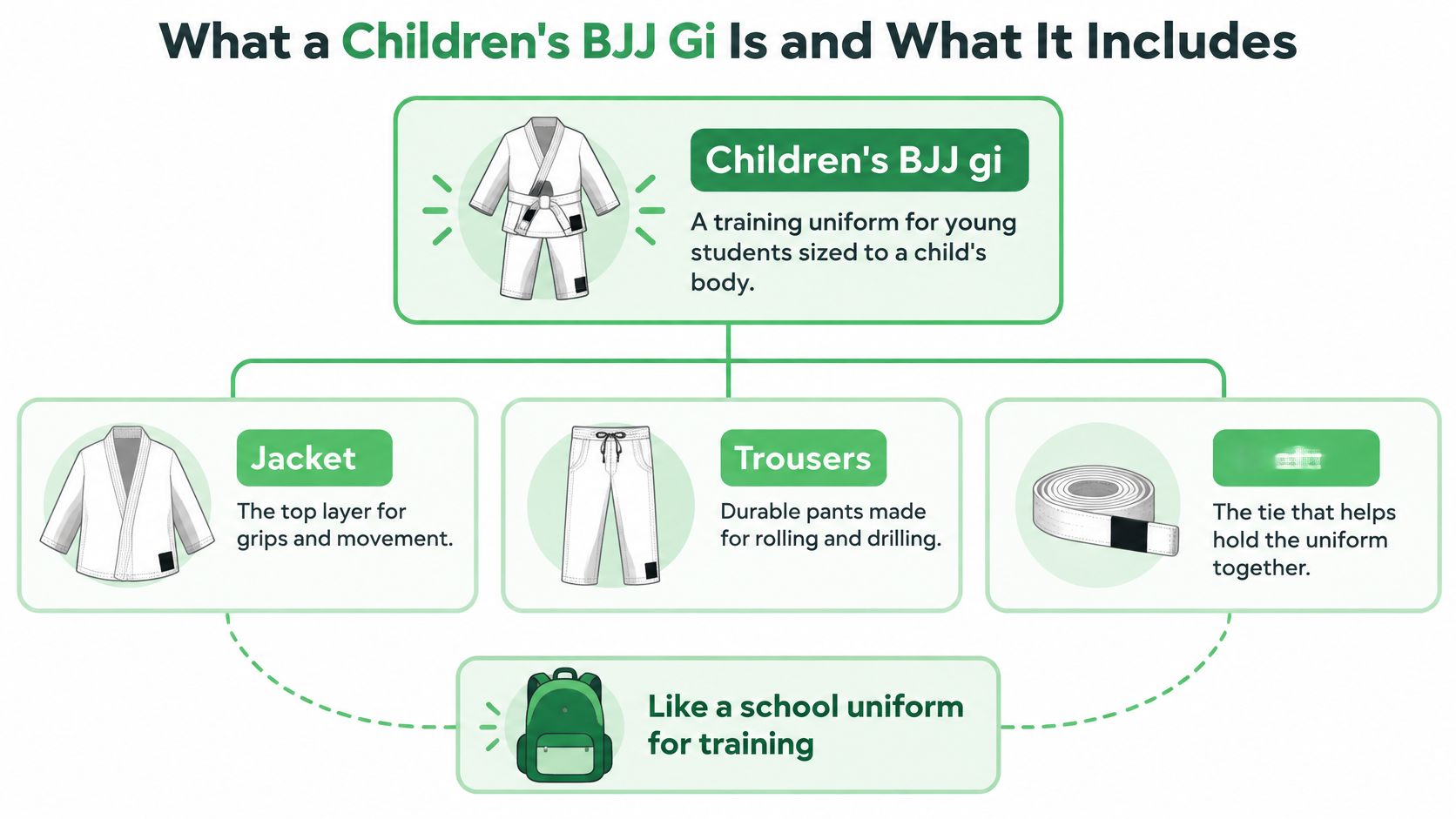
A children's BJJ gi is a training uniform sized for a young student's body. BJJ stands for Brazilian Jiu-Jitsu, a martial art involving controlled grappling, which means working with a partner through grips, positions and movement rather than practising alone.
Think of the gi as a school uniform built to be pulled, gripped and rolled in, not just worn. The jacket's sleeves, collar and lapels, the folded front edges, give training partners places to hold. Those grips are part of learning technique, so the uniform is equipment as well as clothing.
Parts of a children's BJJ gi
Part | What it does | What to check |
|---|---|---|
Jacket (gi top) | Provides the sleeves, collar and lapels used for grips | Sleeve length, stitching at seams and cuffs |
Trousers (pants) | Allow kneeling, squatting and leg movement | Leg length near the ankle, drawstring waist, knee reinforcement |
Belt | Shows rank and is tied at the waist | Matches the child's current rank and fits the waist |
Name patch or logo | Identifies the academy or the student | Optional for training; check rules before any competition |
Check the product description before paying. A jacket-and-trouser set doesn't necessarily include a belt, and a photograph showing the complete outfit isn't confirmation of what's in the package.
The belt isn't a colour choice to match the gi. It reflects the student's rank, which the coach determines. Our guide to kids' BJJ belts explains that part of the uniform in more detail.
The main components are easy to recognise once you see them together.
A first-session example
Say a seven-year-old beginner has a plain white gi and a white belt ready for class. Before packing it, check that the jacket closes comfortably, the waist fastening holds and there aren't loose threads around the cuffs.
Ask the child to put it on rather than holding it against their clothes. A uniform can look suitable on a hanger yet feel awkward once the belt is tied and the child bends their knees.
Uniform Rules and Fabric Expectations for Young Students
Choose woven fabric rather than stretchy sportswear fabric if you want a gi suitable for grip-based training and potential competition. The International Brazilian Jiu-Jitsu Federation uniform rules specify woven cotton or cotton-like material, prohibit fabric that's so thick or rigid it prevents gripping, and generally limit gi colours to uniform white, royal blue or black.
That rule has a practical purpose. When a child holds a sleeve or lapel, the material needs to offer predictable resistance. A stretchy top changes shape under the hand, while an excessively stiff jacket can make an ordinary grip unusually difficult.
Fabric weight isn't a quality score. A heavier jacket isn't automatically better for a beginner, and a lighter one isn't automatically flimsy. Look at the weave, how the material bends, and the stitching around areas that receive repeated pulling.
Training gi versus competition gi expectations
Feature | Everyday training | Competition gi |
|---|---|---|
Fabric | Cotton or cotton-blend, weave chosen for comfort | Woven cotton or cotton-like, not stretch or knitted |
Thickness and stiffness | Academy's choice | Not so thick or rigid that an opponent cannot grip the jacket |
Colour | Set by the academy | Plain white, royal blue or black |
Condition | Clean and in good repair | Not wet, dirty, torn or smelling of odour |
Patches and logos | Optional | Follow the organiser's rules and check before entry |
The distinction matters because acceptable for class doesn't automatically mean approved for a tournament. A coach may accept a training garment that doesn't meet an event's inspection requirements.
Before buying, confirm our class requirements with us. If competition is already planned, also check the actual organiser's uniform rules rather than assuming every event uses identical requirements.
Buying rule: Choose the fabric for training, then check the event rules before treating the gi as competition-ready.
Keep the first purchase straightforward
A plain gi leaves fewer details to check than one covered in decorative patches. Even then, colour alone doesn't establish compliance. Construction, condition, fit and patch placement can all matter.
For example, a nine-year-old entering a local competition should have the colour and patch rules checked before entry. The night before the event, lay out the complete uniform and confirm it's clean, dry and undamaged.
Don't leave that inspection until the child is waiting beside the competition area. Discovering a torn cuff at home gives you options; discovering it at inspection may not.
Measure, Size and Test Movement Before the First Class
Measurements for choosing a children's gi size
Use a flexible tape measure and record the results before comparing products.
Measurement | How to take it | Fit sign |
|---|---|---|
Height | Stand straight without shoes, heel to top of head | Starting point only; check the brand chart |
Shoulder width | Measure across the back, shoulder seam to shoulder seam | Jacket sits square on the shoulders without pulling |
Sleeve length | Shoulder seam to wrist with the arm slightly bent | Sleeve ends near the wrist when the arm is relaxed |
Inside leg | Crotch to ankle | Trousers reach close to the ankle without dragging underfoot |
Waist | Around the natural waist | Drawstring ties securely with room to move |
For shoulder and sleeve measurements, a well-fitting garment can help identify the seam positions. Check whether the seller's chart describes body measurements or garment measurements, because they aren't interchangeable.
A height measurement gives you a starting point for the chart, not a final size decision.
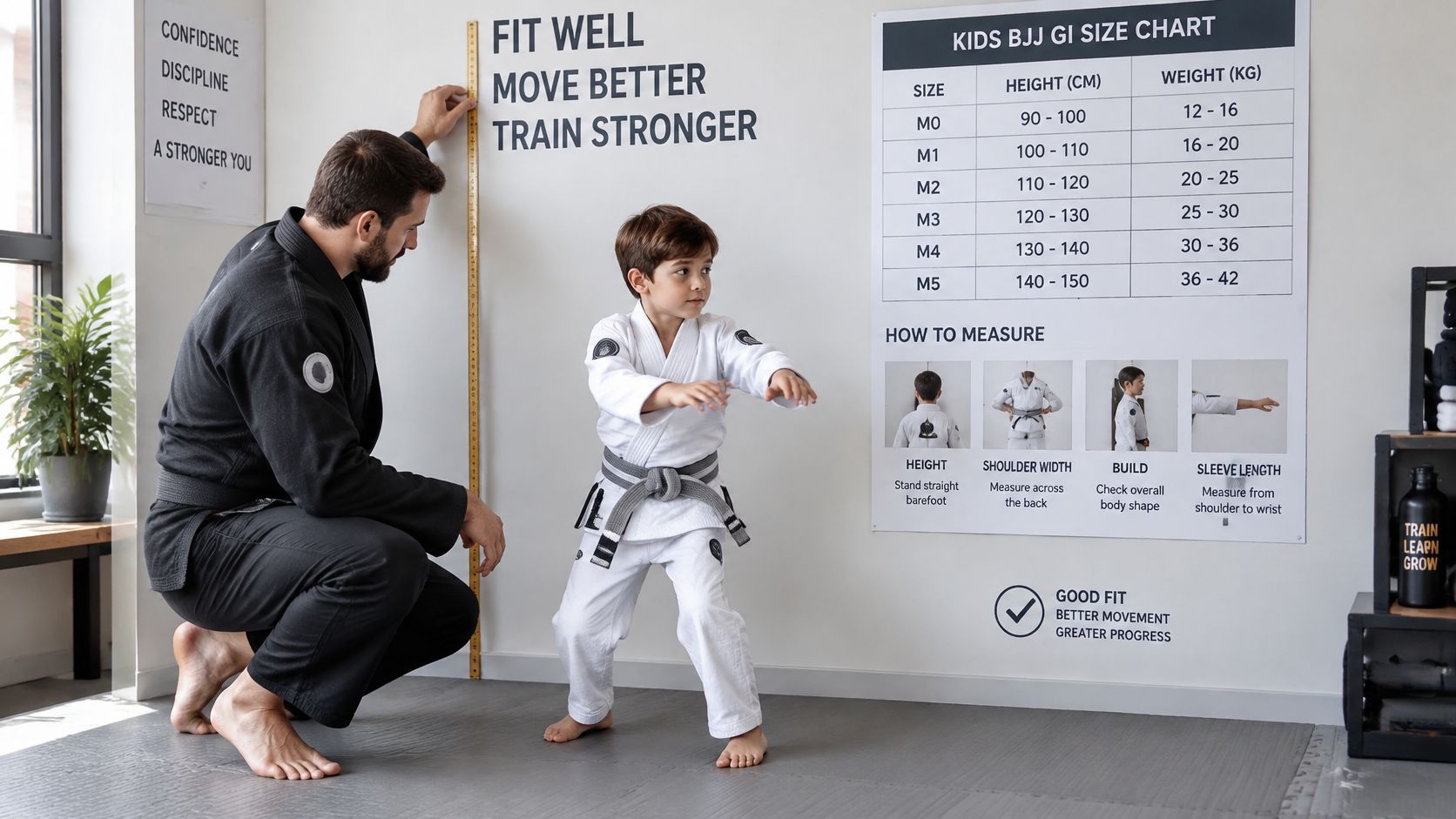
Age alone is a poor sizing tool. Children of the same age can have different shoulder widths, builds and leg lengths. The Australian MMA Fight Store gi guidance highlights model-specific sizing and cotton shrinkage, including the possibility of heat shortening sleeves by several centimetres.
Record the product name alongside the size code. A size that works in one model shouldn't become your automatic choice for every future gi.
Test the fit through movement
Fasten the trousers and tie the belt before testing. Keep the first checks gentle, and leave unfamiliar grappling movements to the coach.
Raise both arms overhead. The jacket should stay reasonably closed and shouldn't ride above the waist. Watch for pulling across the shoulders rather than judging only the sleeve ends.
Squat low. Ask whether the trousers pull at the knees or seat. Your child shouldn't need to lift the waistband or spread their knees awkwardly to get down.
Sit cross-legged. Look for uncomfortable bunching behind the knees and pressure around the hips.
Try a gentle sleeve and lapel grip. With a coach's guidance, check that the jacket sits securely without excessive gaping or strained seams. Don't test durability by yanking.
Roll and bridge under supervision. A bridge means lifting the hips while supported through the feet and shoulders. Check that hems and cuffs don't catch during the movement.
Complete a familiar class drill. Ask the coach to watch for trips, restricted reaching or hands disappearing inside sleeves.
These checks help separate a length problem from a width problem. If the shoulders fit but the trousers drag, buying a larger or smaller complete set may create a different mismatch.
Use the video as a visual reference alongside the hands-on checks.
Choosing between sizes
Choose the option that fits the shoulders and usable sleeve length, not the one with the most spare fabric. Slightly long sleeves may be manageable through an appropriate alteration agreed with the coach, but sleeves that are already too short can't be lengthened by washing.
Brazilian Jiu-Jitsu Academy Finder's sizing guide can help you account for gi shrinkage when comparing a new garment with its expected washed fit. Don't rely on deliberately shrinking an oversized gi, because the jacket and trousers may not change exactly as you hope.
Buy room to move, not loose fabric that your child has to work around.
If a movement check fails, identify whether the cause is length, width or fabric stiffness. Try the adjacent size or another cut before buying again, and check the retailer's return conditions before washing or altering anything.
Comfort, Heat and When to Re-check Fit
A child who keeps tugging at the collar or scratching under an arm may be uncomfortable even when the size chart looks right. Ask where the gi bothers them, then inspect that exact spot.
Comfort comes from the combination of fabric weight, seam placement and waist fastening. A lighter, breathable pearl-weave gi, named for its small raised woven texture, can be a practical option for warm Australian training spaces. A heavier weave may feel more substantial in the hand but hotter and stiffer during movement.
Find the source of rubbing
Run your fingers along the inside of the collar, underarm seams and waistband. Look for a stiff label, rough seam edge or raised embroidery backing. If the child complains only when reaching forward, check whether the jacket pulls across the back rather than assuming the fabric itself is unsuitable.
The drawstring should hold the trousers securely without digging into the waist. Tie it with the child standing normally, then have them sit and bend. A fastening that feels fine while standing can press uncomfortably once the hips fold.
If an underlayer is appropriate for class, our kids' BJJ rash guard guide explains the close-fitting training tops worn beneath a jacket. An extra layer shouldn't be used to hide a fit problem or a damaged seam.
Re-check when the routine changes
Use changes in your child's body and training routine as reminders:
At the start of each school term: Try the gi on before the first class back.
After noticeable growth: Look at reaching and squatting, not just standing sleeve length.
After several hot washes: Compare the garment with your original measurements.
When training frequency increases or the class changes: Check comfort during the movements the child is now practising.
Say a child trains twice a week through summer and, after a month of hot washing, the sleeves look shorter. Measure again and repeat the movement checks rather than waiting for the child to complain.
Season matters because the same garment may feel different during a warm session than during a cool-weather fitting at home. Replace a gi when it no longer fits or fails condition checks, even if the outside still looks tidy.
Washing and Caring for a Children's Gi
Leaving a damp gi in the training bag is the mistake to avoid first. The fabric holds sweat against the skin during close-contact practice, and packing it away damp encourages odour and makes thorough drying harder.
Treat the care label as part of the equipment instructions. Australia's mandatory care-labelling standard for clothing and textiles requires appropriate care information for covered products, so keep those instructions readable and follow the garment's specified washing and drying method.
A routine for every training day
Wash after every session. Don't save a visibly tidy gi for another class. Sweat left in the fibres can produce odour even when there are no obvious marks.
Use the labelled wash temperature and drying method. Read both the jacket and trouser labels if they have separate instructions. Don't assume an ordinary sportswear setting suits the gi.
Check laundry additives. Avoid fabric softener if the manufacturer's instructions warn against it or it affects the fabric's strength or grip texture.
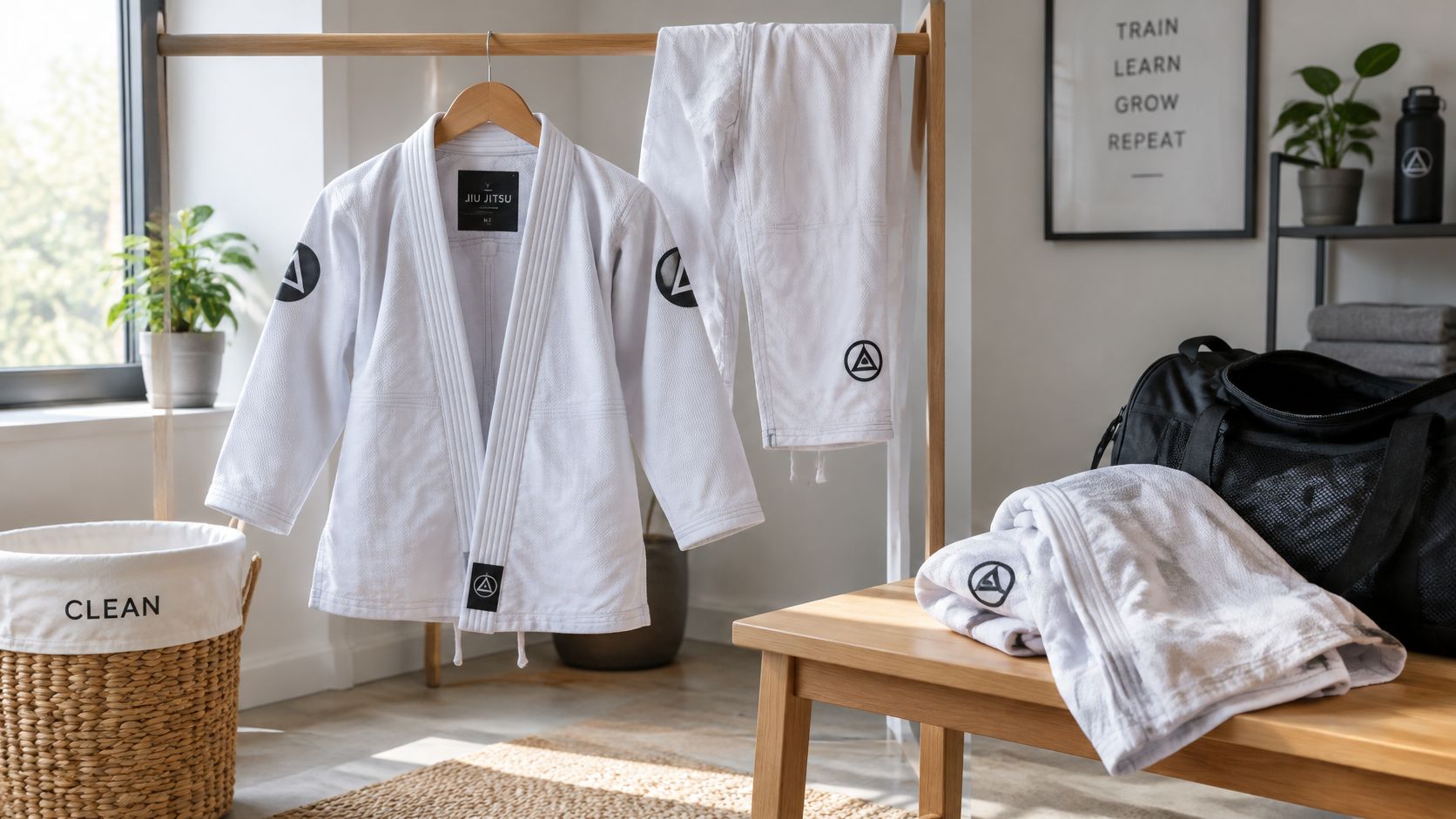
Dry it completely. Where the label permits air-drying, hang it in a shaded, ventilated spot away from direct heat. Open the jacket out and allow air around the waistband and reinforced areas.
Inspect before packing. Check seams, cuffs, exposed fibres and abrasive patches. Put a damaged garment aside for repair or replacement rather than hoping the stitching survives another session.
Store it dry and folded. Smooth the jacket rather than forcing it into a tightly packed bag, and keep it ready for the next class.
A separate hanging spot makes the routine easier to remember.
When the routine gets missed
If a damp gi has been left in the bag overnight, take it out when you discover it and wash it before reuse. Hanging it up may help it air out while you organise the wash, but airing isn't a substitute for washing.
For future sessions, empty the bag as soon as your child gets home. Before repacking, feel the thick collar, cuffs and waistband for remaining dampness, because the lighter fabric may dry before those areas do.
What a Children's Gi Costs Over the First Year
The purchase price isn't the whole equipment budget. Reporting in The Sydney Morning Herald puts the median annual sport cost for Australian children aged 0–14 at $500 and the mean at $1,065, including fees, uniforms, equipment, travel and other expenses, not BJJ alone.
For your family, use actual product prices and the planned training schedule. A cheap gi isn't necessarily economical if it needs early replacement, but paying more doesn't guarantee a better fit.
Build a practical equipment budget
Record the first gi's price. Include delivery and check exactly what's supplied.
Consider a second gi. Base the decision on whether the washed uniform can dry fully before the next session.
Add missing items. Include the belt, any required patch and an underlayer if needed for class.
Allow for resizing. Keep a replacement allowance for growth or an unsuitable washed fit.
Include care costs. Laundry belongs in the family budget, even though it doesn't appear on the product receipt.
A useful calculation is initial kit + additional uniform + care + replacement allowance. Keep class fees and travel separate if you're trying to compare equipment options accurately.
Budget check: Spend first on gear your child needs for ordinary attendance, not on an imagined competition calendar.
Let frequency guide the quantity
As a planning example, a child attending once weekly may manage with one gi if washing and drying happen promptly. For a child attending three times weekly, budgeting for two gis from the start provides a practical rotation.
Those are household planning examples, not fixed uniform rules. Your drying space and the spacing between sessions matter too.
Competition-specific equipment only becomes necessary when competition is planned. A compliant training gi may already serve both purposes, so check before setting aside money for a separate tournament outfit.
Choose the Right Gi for Your Child's First Class
Your first purchase should pass a short, practical checklist:
Suitable material: A plain woven-cotton or cotton-like training gi that meets the class requirements.
A functional fit: Measurements supported by comfortable movement, not an age label alone.
Manageable care: Instructions you can follow with your washing and drying setup.
Complete essentials: Confirmation of whether the belt and any required items are included.
A realistic rotation: Another uniform if the training schedule leaves too little drying time.
You don't need to solve every possible tournament question before your child has tried a class. Prioritise a garment they can move in comfortably and a routine your family can maintain.
Confirm the kit before spending
For families in Alexandria and nearby suburbs, contact us before purchasing so we can confirm the requirements for your child's class. Our guide to what to wear to a first Jiu-Jitsu class is also a useful starting point for preparing without buying unnecessary extras.
Locals Jiu Jitsu Alexandria offers a free trial class, giving your child an opportunity to try training before you commit to a full kit. Ask what to bring for that session rather than assuming a complete gi is required or that ordinary clothes will be suitable.
You can call us on 0414752412 or email team@localsalexandria.com.au. Have the product name, size chart and your child's measurements ready if you're already considering a particular gi.
Make the conversation specific
Bring your measurement sheet and movement-check notes to the call. Explain whether the concern is tight shoulders, dragging trousers, an uncomfortable waistband or uncertainty about washing.
That gives the conversation a useful starting point. Instead of asking only which age size to buy, you can work towards a uniform that suits your child's body, class and likely training routine.
Locals Jiu Jitsu Alexandria offers a Jiu Jitsu for Kids program in a fun, safe and engaging environment, developing discipline, focus, coordination and self-defence skills. Visit Locals Jiu Jitsu Alexandria to arrange a free trial and confirm what your child should wear before buying their first gi.
Comments