
Combat Gyms Near Me: How to Choose Well
You finish work in Alexandria, pull out your phone and search “combat gyms near me”. One map pin is closer than the others, so it looks like the obvious choice. But the nearest option may not have a class that fits your schedule, a beginner-friendly way to manage contact or a weekly price you can keep.
A better choice starts with four practical questions: Who is the class for? How is contact controlled? Can you realistically train twice a week? Does the weekly cost fit your budget? Distance matters, but those answers help you decide whether a gym can become part of your routine.
Table of Contents
Why the Closest Combat Gym Can Still Be the Wrong Fit - Look past the map pin
A Checklist for Choosing Combat Gyms Near Me - Turn the checklist into an actual enquiry
What Jiu Jitsu Training Offers Beyond a Normal Gym Hour - Class design changes the training load
What Parents Should See in a Children's Class - Watch how the class is run - Make the first visit low-pressure
Weekly Cost and a First Month You Can Keep - Published weekly plans - Make the first month a trial of the habit
Match Your Door and Book a Free Trial - Choose the class that matches your experience - Book a trial in four steps
Why the Closest Combat Gym Can Still Be the Wrong Fit
Your phone says the nearest gym is six minutes away. You finish work late, the beginner class starts soon, and the short trip makes the choice feel obvious. Then you arrive to find that the beginner class is really an open mat, the coach pairs new students with experienced grapplers, and the weekly fee is more than you can comfortably keep paying.
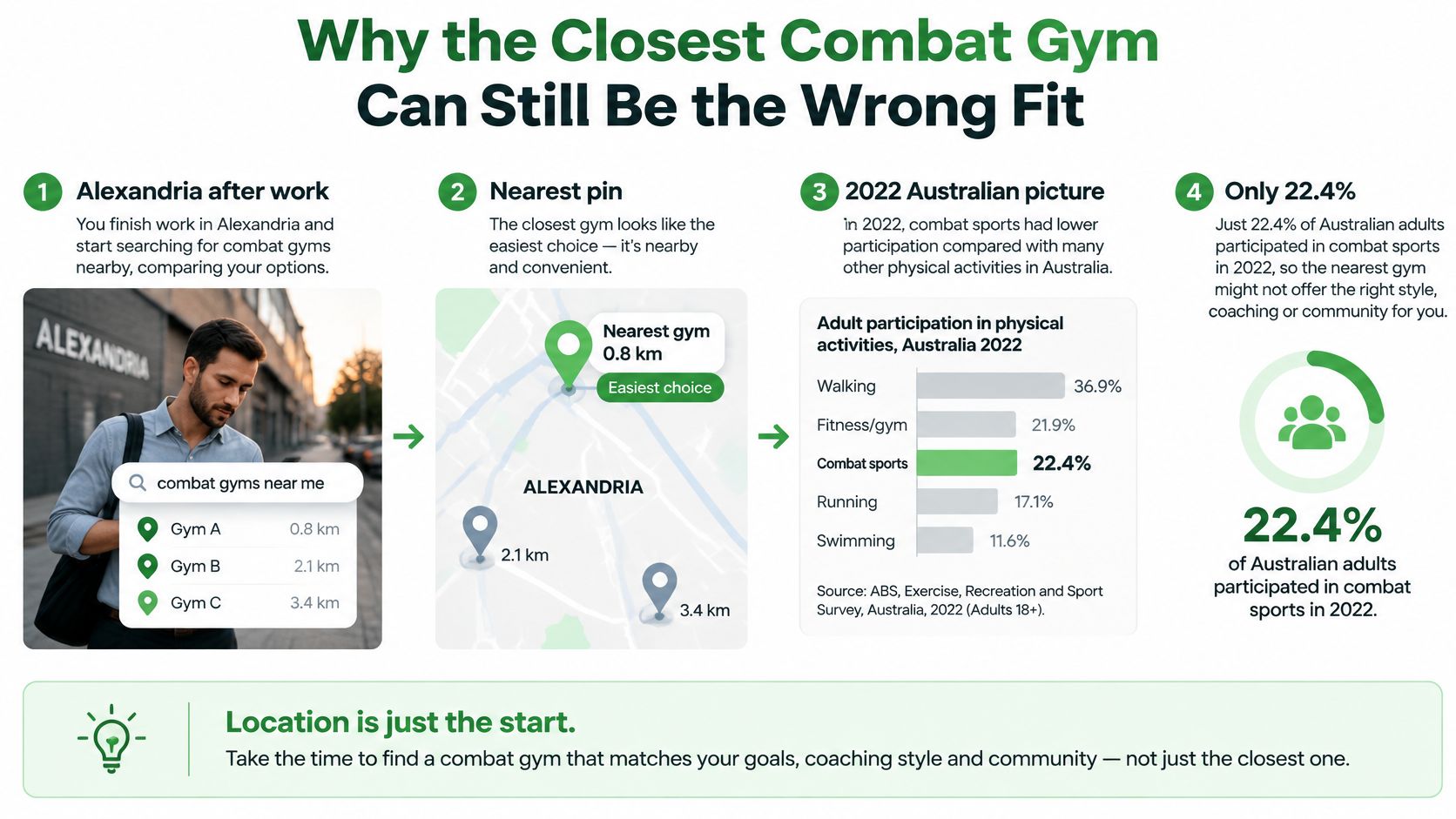
Distance works like the front door of a house. It tells you how easy it is to get inside, not whether the rooms suit the person who will live there. The closest gym becomes the right gym only when its class design, contact level and weekly cost match the person training.
National activity data helps set the scene. In 2022, 22.4% of Australian adults aged 18–64 met the national physical-activity guidelines, while 77.6% did not, according to the Australian Institute of Health and Welfare's physical activity reporting. Strength work showed a similar gap: only 26.6% of adults in this age group had done strength or toning exercises on at least two days in the previous week.
Those figures describe the country, not your suburb. Activity levels vary by area and by week, and a national average cannot tell you whether a 6pm class will fit around school pickup, shift work or the energy you have left by evening.
Look past the map pin
A structured combat class can combine conditioning, technical practice and progressive skill development in a coached session. That is different from a walk or an unplanned gym visit, where you have to build the structure yourself. The useful question is whether a particular class gives you a safe, repeatable way to work toward your goals. Combat training is not automatically the answer.
For someone comparing options around Alexandria, Beaconsfield, Rosebery or Zetland, the practical test is whether the gym supports a routine that can survive an ordinary week. Check the timetable, the way contact is managed, the coaching and the weekly price before you commit. A close gym that fails those checks adds convenience to your commute, not to your training.
A Checklist for Choosing Combat Gyms Near Me
A gym two streets from your door and a gym fifteen minutes further can look identical in photos. The difference shows up in the details: whether a beginner class runs when you're free, whether contact ramps up in stages, and whether the weekly price still looks reasonable in month three. That is why distance belongs on the list, not at the top of it.
Score each gym yes or no on the six rows in this table before you look at photos or reviews. A no on a key row, such as beginner access or timetable fit, outweighs a short drive.
Check | Why it matters | Green flag |
|---|---|---|
Distance and timetable | A close gym still fails if class times clash with work, school or recovery. | Classes across the day and room for at least two sessions a week. |
Class split | One mixed room can put beginners and children in with advanced sparring. | Separate kids, beginners, advanced and No-Gi classes. |
Coaching and safety | Uncontrolled rounds can build fatigue before you've learnt to manage positions. | Coaches scale contact and teach positions before live rounds. |
Trial and contract | A long commitment makes it harder to leave if the fit is wrong. | Free trial, no sign-up fee and no lock-in contract. |
Weekly cost | Price, not distance, can decide whether training lasts past the first month. | A clear weekly price for kids, adults or emergency services. |
Goal fit | Competition isn't necessary for fitness or practical self-defence. | Foundation classes, with advanced or No-Gi only when wanted. |
Turn the checklist into an actual enquiry
Start with timetable fit, because it is the row most likely to undo the others. A gym near home won't help if the only beginner class clashes with work, school pickup or the time you need to recover. Look for a schedule that leaves room to attend regularly, rather than one that only works in a perfect week. Locals Jiu Jitsu Alexandria runs classes for all ages and fitness levels from morning till night.
Then look at how the room is divided. Ask whether new students practise positions and controlled drills before live rounds, and whether coaches adjust contact for experience level. A single mixed class can push a first-timer into sparring intensity before the basics are in place. Locals Jiu Jitsu Alexandria has experienced coaches who prioritise safety and progression, with separate classes for children, beginners, advanced students and No-Gi training.
Price and contract terms tell you whether the plan survives past the first month. A free visit lets you see the room and the coaching, but check the weekly commitment before you decide. Fitness, confidence and practical self-defence don't require a competition entry.
Three questions get you most of the way when you call or message:
Who shares my class? Ask how beginners are matched with training partners.
What happens in the first 20 minutes? You should hear the warm-up, the instruction and the first drills described clearly.
What if I miss a week? Find out how you can return without being pushed into a class beyond your current level.
What Jiu Jitsu Training Offers Beyond a Normal Gym Hour
Jiu Jitsu works like a partner puzzle. You learn to move, hold a position and respond to another person rather than repeating an exercise alone. Moving a heavy couch with a friend is a close comparison: good positioning, balance and timing do more than raw pushing strength.
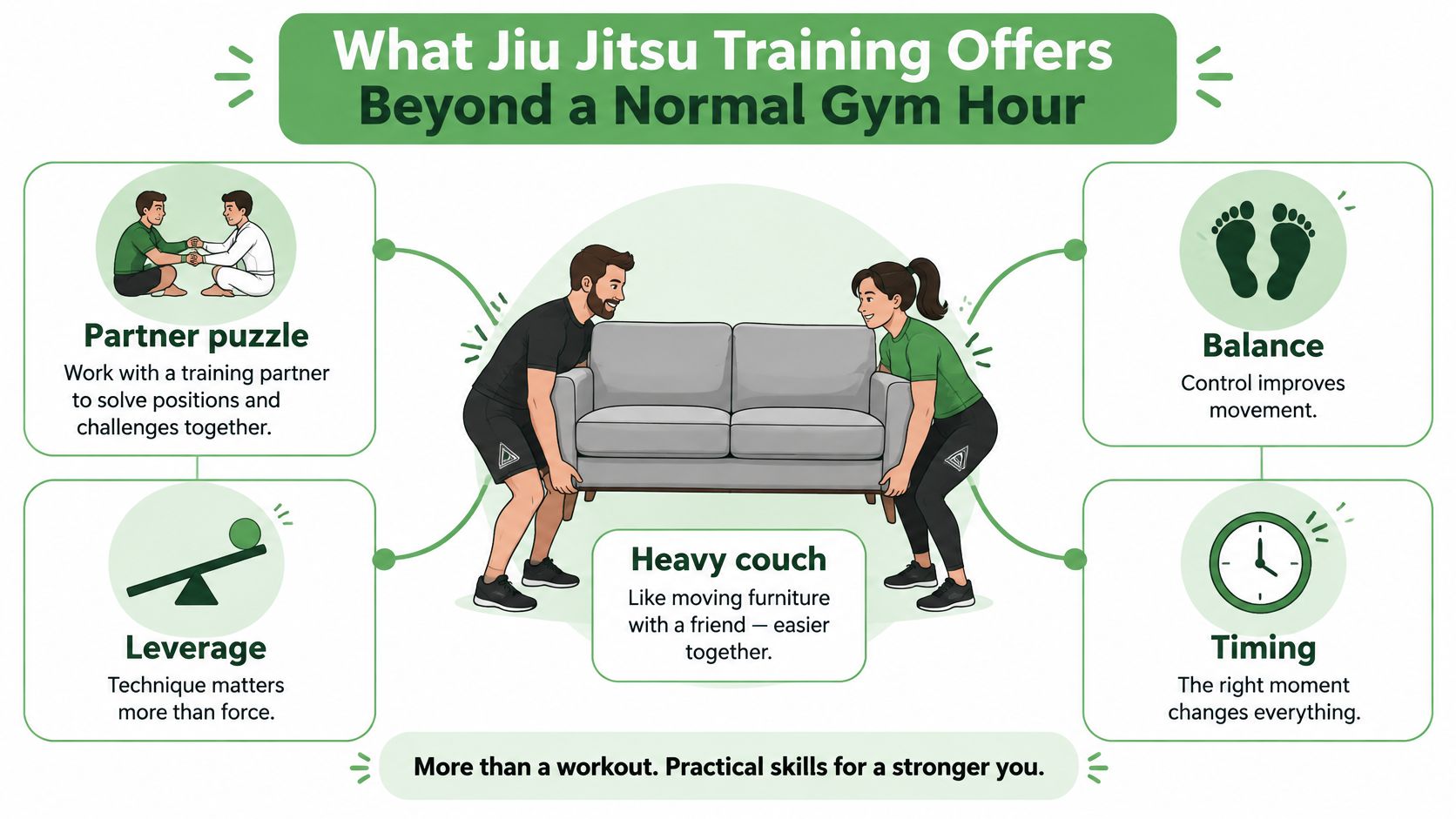
The national recommendations for Australian adults aged 18–64 call for 150–300 minutes of moderate activity or 75–150 minutes of vigorous activity each week, plus muscle-strengthening work on at least two days, according to the Australian Government's 24-hour movement guidelines. Jiu Jitsu doesn't automatically meet those targets. The training effect depends on what happens in class and how often you attend.
Plenty of adults fall short of the weekly targets those guidelines set out. That makes supervised, structured activity in a room with other people relevant to a wide range of bodies and schedules. It doesn't follow that everyone needs the same class, intensity or weekly routine.
Class design changes the training load
A technique block, where you practise a movement at a measured pace, may put less demand on your cardiovascular system than repeated live rounds. Rounds with a partner can raise intensity and create local muscle fatigue. Beginners shouldn't have to start with unrestricted, high-intensity grappling. They need time to learn efficient breathing, posture and movement first.
A well-designed beginner hour moves from a warm-up to a small set of positions, partner drills and, where appropriate, controlled rounds. Positional sparring starts from a specific situation, so students practise solving one problem instead of managing an entire open-ended round. Recovery between efforts matters too. If you're too fatigued to pay attention, you're less likely to practise good movement.
Two sessions a week is a practical starting point for a beginner, provided the timetable and your recovery allow it. Build consistency before you add volume. If you want to know more about the adult experience, this guide to the benefits of Jiu Jitsu for adults covers it.
Health authorities don't prescribe one particular sport. Jiu Jitsu is one structured way to practise movement and strength, not a medical order or a substitute for individual health advice.
After class, training clothes and shared mats need more than a quick shake-out. Kit that stays damp or grimy doesn't do the next person on the mat any favours, and a simple habit of washing your Gi and wiping down shared gear keeps the room pleasant for everyone in it. If you handle that cleaning at home, cleaning cloth advice from WipesBlog.com covers which cloths suit mats and training kit.
What Parents Should See in a Children's Class
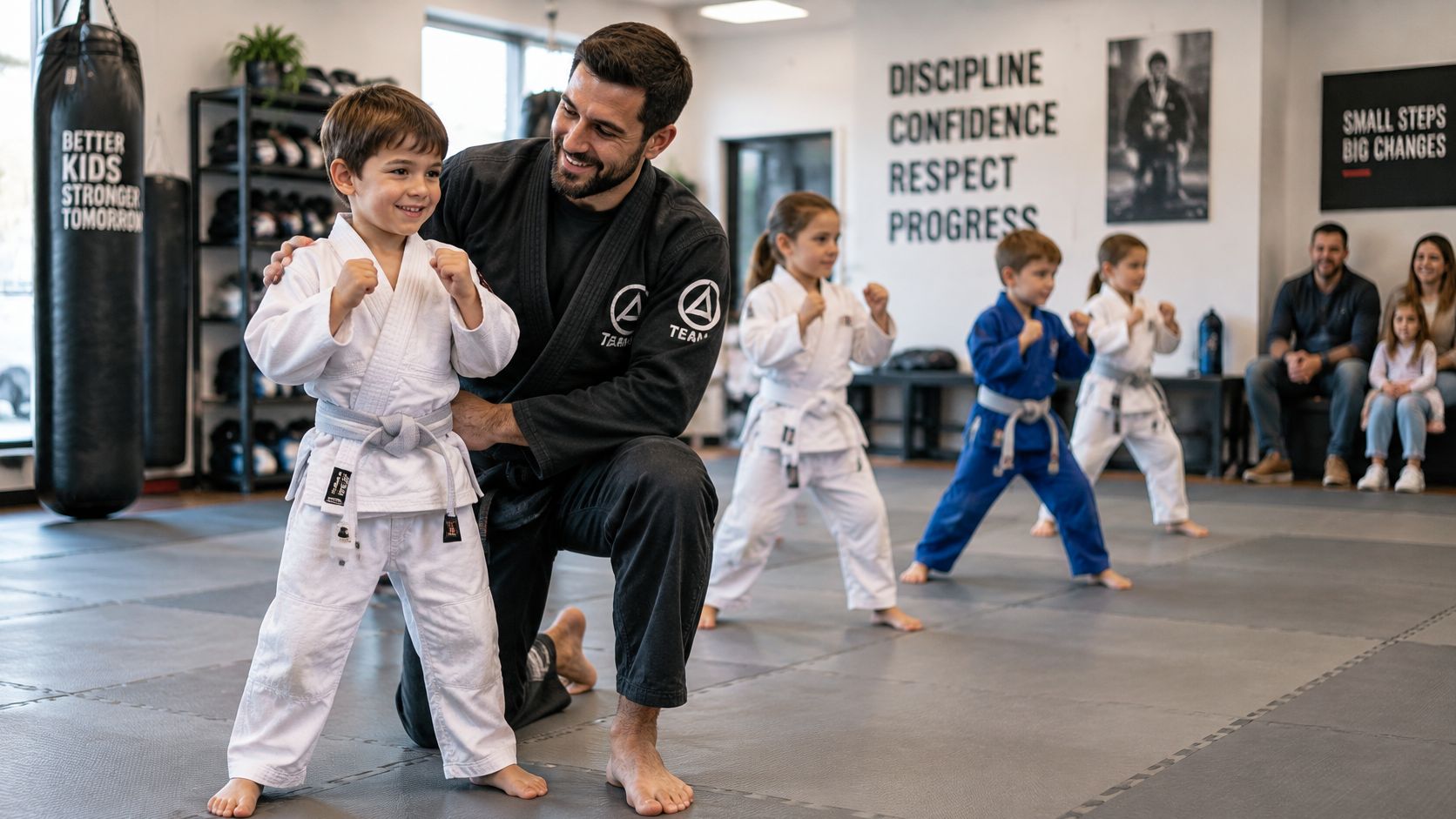
A tougher-looking class isn't automatically better for a child. Enjoyable, consistent participation matters more than maximum exertion in a single session. Parents should judge the room and its coaching, not only promises about confidence or discipline.
In NSW, only about 39% of children aged 5–17 achieved at least seven hours of moderate-to-vigorous physical activity per week in 2024–25, down from 59% in 2015–16, according to the NSW Health survey's 2025 key findings. A class that children want to return to can be more useful than one that looks intense but overwhelms them.
Watch how the class is run
Parents looking around Alexandria, Waterloo, Zetland, Rosebery or Erskineville can check a few concrete details during a visit:
Grouping: Are children arranged by age or developmental stage, and are beginners separated from more experienced students?
Contact: Is sparring compulsory? How do coaches manage contact, partner choice and differences in size or experience?
Support: What does the coach do when a child is nervous, less coordinated or unsure of a movement?
Rules: Do children learn clear rules for gripping, falling and stopping? Do coaches step in when behaviour becomes unsafe?
A sound class keeps instruction short and gives children frequent chances to move. A takedown entry drill, crawl, bridge or controlled ground movement is not the same as live grappling. Coaches can build resistance gradually while helping children practise balance, coordination and decision-making.
A separate children's curriculum lets coaches use age-appropriate cues, partner choices and drill complexity. That's different from placing children into an adult session, where the pace and expectations may not suit their development. Locals Jiu Jitsu Alexandria's children's program introduces Jiu Jitsu in a fun, safe and engaging environment, with attention to discipline, focus, coordination and self-defence skills.
Make the first visit low-pressure
A first class can include a welcome, a simple warm-up and a few guided movements. You can watch how the coach explains the activity, responds to questions and helps children take turns. Your child doesn't need to master a technique to have a useful first experience.
Afterwards, ask what rule they remember and which movement they tried. If they can name one of each and want to return, that's a helpful sign that they felt involved. Discipline and confidence can grow from a well-run class, but they shouldn't be used as substitutes for clear supervision and safe, progressive teaching. Parents can find more detail in this guide to Jiu Jitsu for kids.
Weekly Cost and a First Month You Can Keep
A nearby gym isn't necessarily a sustainable choice if the price, timetable or expected training frequency doesn't fit your life. In Australia, gym and fitness participation in 2024–25 was reported as 15.6% lower than in 2022–23, and affordability was cited as the leading barrier by 72% of non-members, according to Ausleisure's fitness industry report. That's why weekly cost belongs in your decision, rather than being left until after you've tried a class.
Published weekly plans
Plan | Weekly price | What it includes | Trial and contract |
|---|---|---|---|
Kids | $35 | Kids program; family discounts apply | One-day free trial, no sign-up fee, no lock-in |
Adults | $55 | Adult training; family discounts apply | One-day free trial, no sign-up fee, no lock-in |
Emergency services | $50 | Unlimited Gi and unlimited No-Gi | One-day free trial, no sign-up fee, no lock-in |
These are subscription-based plans. The kids and adult plans have family discounts, while the emergency services plan includes unlimited Gi and unlimited No-Gi training. You can use the free trial to see how the class feels before deciding whether the weekly commitment suits you.
For more detail on the fees, see the guide to how much Jiu Jitsu costs. If you're also thinking about how your activity changes your energy needs, this overview of calorie needs by activity level can help you explore the topic. It isn't a personalised nutrition plan.
Make the first month a trial of the habit
Week one is for trying a class. Arrive early enough to get settled and tell the coach you're new. Wear a rash shirt and shorts, or a borrowed Gi if the academy advises it. Tie back long hair and keep your nails short.
Weeks two to four are for finding a rhythm. Start with one or two beginner sessions a week and focus on positions before submissions. If you miss a week, return at the same level rather than trying to make up for it by choosing a harder class.
Keep your kit simple until you know you want to continue: clean training clothes, a water bottle and sandals for wearing off the mats. For recovery, prioritise sleep, take an easy walk on rest days if it suits you, and tell your coach about sore joints. You don't need to arrive already fit, and this gradual approach can suit women, older adults and shift workers who need a routine that fits around other commitments.
Learning positional skills for practical self-defence doesn't mean you have to compete. Competition can be a later choice, not an entry requirement.
Match Your Door and Book a Free Trial
The right starting point depends on who's training and what they want from class. Locals Jiu Jitsu Alexandria serves people in Alexandria and nearby suburbs, including Waterloo, Zetland, Kensington, Beaconsfield, Rosebery, Green Square and Erskineville near Botany Road.
Choose the class that matches your experience
For children, the kids' program introduces Jiu Jitsu through guided training in a fun, safe and engaging environment. Children practise skills that support discipline, focus, coordination and self-defence. Parents can ask how the class is structured and watch how coaches guide movement and manage contact.
For adults new to training, the Beginners program builds a foundation in fundamental techniques and concepts. It's available to people of all ages, genders and fitness levels, and doesn't require previous Jiu Jitsu experience. Classes work through movements and positions, with concepts such as positioning, balance and strategy.
For blue belts building towards black belt, advanced classes develop a deeper understanding of Jiu Jitsu beyond the foundational level. They're intended for students who have reached blue belt and want to keep progressing.
For grapplers who want to train without the Gi, the No-Gi and Grappling program covers wrestling techniques, grips and submissions used in that format. It offers a route into No-Gi training without assuming that every participant wants to compete.
Book a trial in four steps
Check the timetable. Choose a beginners slot if you're an adult starting out, or a children's class for a child. Don't choose the most advanced class just because it fits a preferred time.
Book the free trial. The trial is open to all levels, so you can experience a session before deciding whether the training and coaching suit you.
Contact the academy through its website. Visit localsalexandria.com.au and have your checklist questions ready. Ask how the class fits your experience and what to expect when you arrive.
Decide after the session. Stay if the coaching was clear, partners were matched fairly, and the timetable and weekly price work for an ordinary month. If the room felt unsafe or the schedule won't fit your life, you can leave without a lock-in.
A first session is for learning what the class is like, not proving that you're already fit. Adults can start with one or two foundation classes. For a child, check that they can name one rule and one movement they tried.
The right combat gym near you is the one you can reach, understand and repeat, and a trial is the fastest way to know.
Locals Jiu Jitsu Alexandria offers children's, beginners, advanced and No-Gi training, with a free trial so you can experience a class before making a commitment. Visit Locals Jiu Jitsu Alexandria to check the timetable and choose a session that fits you or your family.
Comments