
Is BJJ Good for Fitness? What Training Really Builds
BJJ is a strong way to build cardio, strength and mobility, but meeting Australian adult guidelines takes enough weekly activity: 150–300 minutes of moderate effort or 75–150 minutes of vigorous effort, plus strength work on at least two days. If you leave class exhausted, does that mean you've covered everything your body needs?
Not necessarily. A class includes instruction, practice, rest and grappling, and those parts don't place equal demands on your body. The useful question isn't just is BJJ good for fitness, but which parts of your weekly fitness plan it covers.
Table of Contents
Whether BJJ Meets Adult Fitness Guidelines - Count activity rather than attendance
How Live Rolling Builds Cardio Fitness - Different formats create different workloads
Strength, Flexibility and Coordination Gains - Match each quality to a movement - Know what needs separate training
How Children and Beginners Should Start - A measured progression for adult beginners
What BJJ Cannot Do Alone for Fitness - Separate useful goals from unrealistic promises
Build a Weekly Plan and Book a Trial Class - Run a weekly check
Whether BJJ Meets Adult Fitness Guidelines
BJJ can cover much of the Australian adult activity guidance, but only when you train frequently enough and accumulate enough meaningful effort. Two or three classes can be a practical starting schedule, not a guarantee that you've done enough.
For adults aged 18–64, the Australian Government's movement guidelines recommend 150–300 minutes of moderate activity or 75–150 minutes of vigorous activity weekly, muscle-strengthening activity on at least two days, and functional activity targeting mobility, balance and coordination on at least three days; the government also reports that 37% didn't meet the physical-activity component.
How BJJ covers each adult weekly guideline
Guideline component | Adult target (18–64) | What BJJ can contribute | Gap to fill |
|---|---|---|---|
Aerobic activity | 150–300 minutes moderate, or 75–150 minutes vigorous, each week | Live rolling and hard positional rounds can count as vigorous activity | Brisk walking or cycling if sessions are mostly drilling |
Muscle-strengthening | At least two days each week | Resisting an opponent, grip work, bridging and hip movement load the trunk, hips, shoulders and forearms | Weights or bodyweight sessions if training is mostly technique |
Mobility, balance and coordination | At least three days each week | Guard passing, sweeps, escapes and transitions train balance, coordination and range of motion | Stretching or mobility work on non-training days, with balance practice where needed |
Count activity rather than attendance
Start with the aerobic row. Watching a demonstration is valuable learning, but it isn't vigorous exercise. Count the time you're moving at a meaningful intensity, rather than treating the entire booking as cardio.
The strength row needs a different check. Are you repeatedly pushing, pulling, holding and moving against resistance, or mainly rehearsing movements with a cooperative partner? Both help your technique, but they aren't interchangeable conditioning sessions.
The final row asks how often you practise movement control. On days away from the mat, controlled balance exercises and comfortable mobility work can fill a gap without adding another exhausting workout.
Practical rule: Treat the table as a coverage check, not a promise attached to attending class.
Older beginners may also find Venus Health Co.’s guide to at-home muscle tracking for older adults useful for thinking about strength monitoring beyond the bathroom scales. Keep that separate from your activity log: tracking a physical change and recording exercise answer different questions.
Your weekly check should reveal what's missing, so you can add the right activity rather than adding more classes.
How Live Rolling Builds Cardio Fitness
Live rolling means grappling against a partner who's actively trying to improve their position too. You might hold them in place, escape pressure, scramble to your knees, then settle into another position without getting a complete rest.
That combination creates cardiovascular demand in several ways. Isometric gripping means your muscles maintain tension without much visible movement. Explosive changes of position require quick bursts of effort, while short recovery gaps leave you working before you feel fully refreshed.
The infographic shows how those demands fit together.
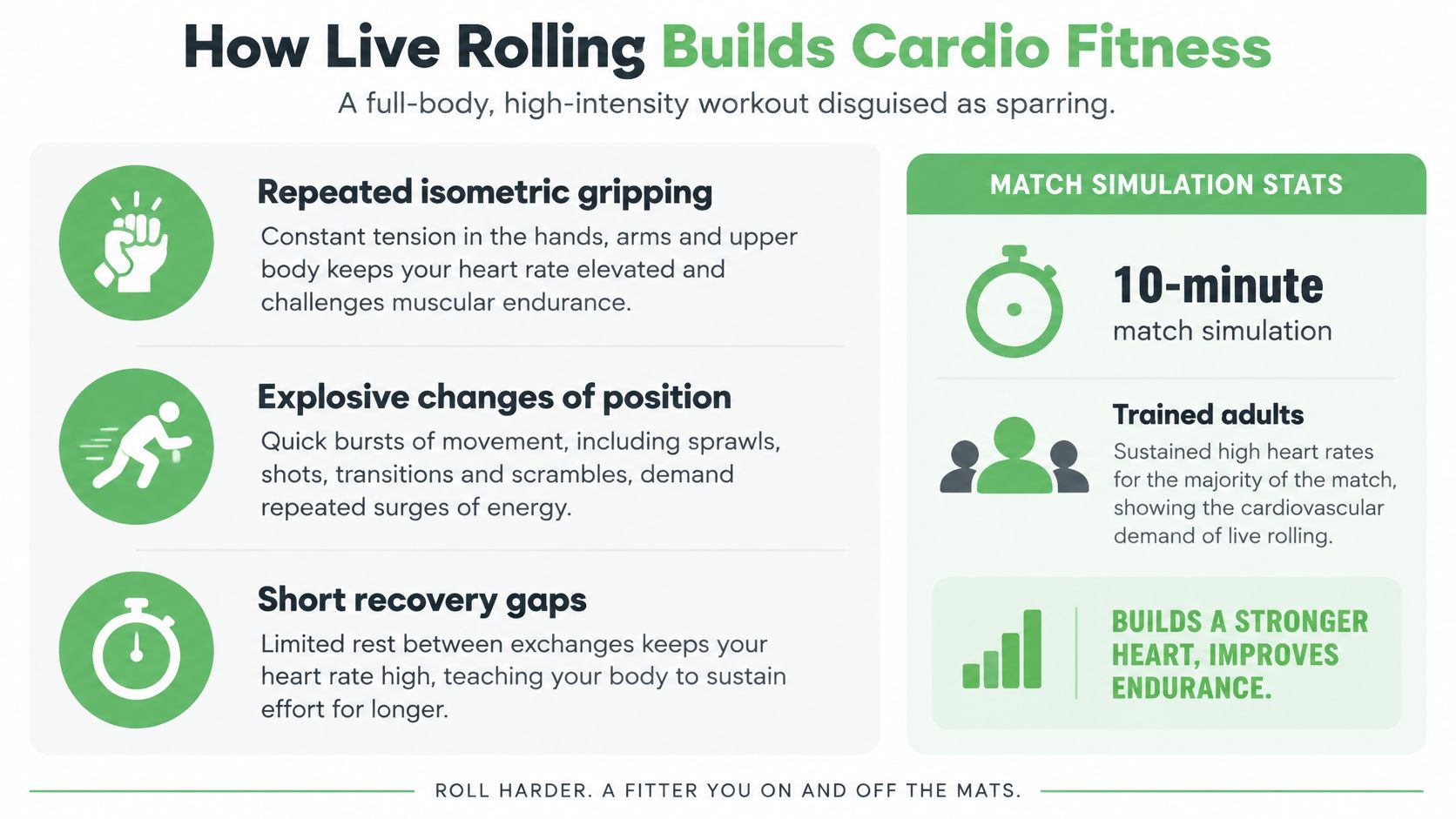
In a controlled 10-minute match simulation involving trained adult BJJ athletes, a study published in Sport Sciences for Health found significant increases from pre-match values in heart rate, blood lactate, perceived exertion and maximal isometric handgrip strength. That demonstrates a substantial immediate training demand, not a promise that a beginner's technical class produces the same response.
Different formats create different workloads
The descriptions below are useful starting expectations, not fixed intensity ratings. A coach can make positional work gentler or harder by changing the resistance, starting position and recovery.
Cardio demand by BJJ session type
Session type | Typical intensity | Cardio effect | Best suited to |
|---|---|---|---|
Technical drilling | Low to moderate, with frequent pauses | Modest and intermittent | Beginners learning positions and escapes |
Positional sparring | Moderate and controlled | Steady and sustained when movement continues | Beginners building fitness with less fatigue |
Live rolling | High, with bursts and rest gaps | High and intermittent | Trained students who can sustain effort safely |
A hard round isn't the same as steady aerobic exercise. During cycling, you can maintain a fairly even workload; during grappling, you might alternate between a demanding escape and a relatively quiet holding position.
Technical efficiency matters too. A newcomer may use unnecessary tension and feel exhausted, while an experienced partner completes the same exchange with calmer breathing. Feeling overwhelmed doesn't automatically mean you've accumulated more useful cardio.
After training, record your active rolling minutes, a perceived-effort rating out of ten, and whether you spent most rounds breathing hard. Use that rating to compare your own sessions, not to compete with someone else's workload.
When you're breathing hard through most exchanges, those active periods can contribute towards vigorous activity. If you mainly watched demonstrations, drilled slowly or rested, add other cardio rather than counting the whole class as vigorous exercise.
Strength, Flexibility and Coordination Gains
BJJ develops strength through resisting another person, rather than moving a predictable weight along a fixed path. Your partner changes direction, shifts their weight and challenges your position, so you have to keep adjusting.
Ground grappling makes these whole-body demands easier to recognise.
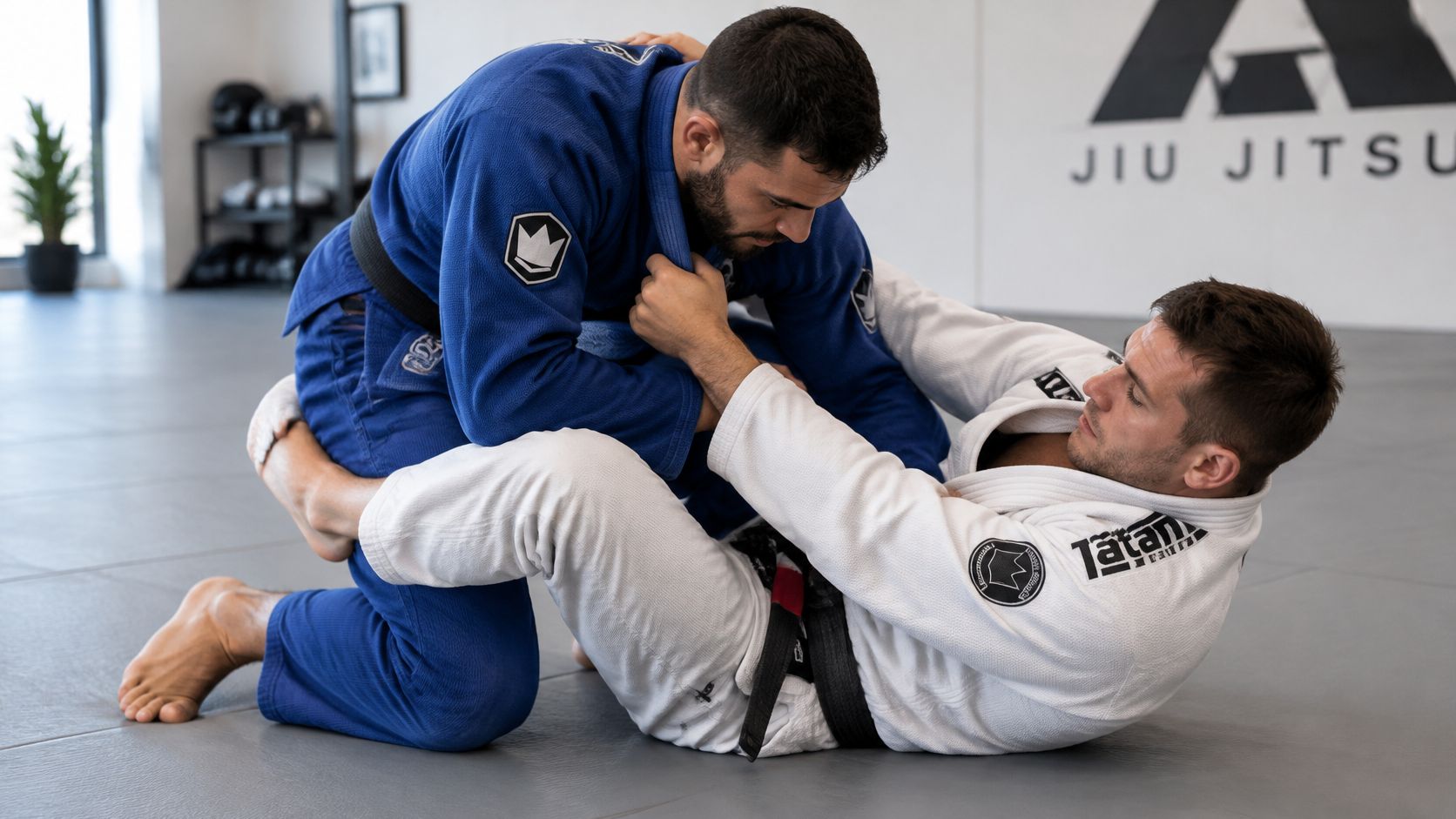
Your trunk braces while you maintain posture. Your hips and legs drive a bridge or help you stand, while your shoulders and forearms support frames and grips. Gi training involves holding fabric; no-gi training still requires grip and hand control through wrist control, clinches and connections around the body.
Match each quality to a movement
Strength and muscular endurance: Holding posture, resisting a pass and repeatedly escaping require you to produce and sustain force.
Mobility and flexibility: Guard movements, hip escapes and controlled bridging ask you to move through usable ranges.
Coordination and balance: Sweeps and transitions require you to place your limbs accurately while responding to someone else's movement.
These demands address a real gap in Australian activity habits. The Australian Institute of Health and Welfare reports that only 22.4% of Australian adults aged 18–64 met the full physical-activity guidelines in 2022, while ABS figures show 56.4% of adults completed at least 30 minutes of activity on five or more days, but only 26.6% performed strength or toning activities on two or more days.
The distinction matters: being active doesn't necessarily mean doing regular strength work. BJJ can introduce resistance-based movement into a routine that otherwise consists mainly of walking or sitting.
This video provides another way to consider movement and technique.
Know what needs separate training
BJJ isn't a replacement for a structured lifting programme if your priority is maximal strength. Partner resistance is difficult to measure and progress precisely, whereas weights let you deliberately adjust the load. Our guide to Jiu Jitsu strength training explores how separate strength work can support mat training.
Flexibility is usually a supporting benefit rather than the lesson's main purpose. Don't force a joint further because a technique appears to require it; improve positioning and add comfortable stretching where needed.
Judge progress across several weeks using more than appearance. Note resting heart rate under similar conditions, how comfortably you finish rounds, whether your grip holds up, and how well you recover before the next session. Better performance with less unnecessary tension is progress too.
How Children and Beginners Should Start
Children's classes use guided drills to develop coordination, focus, discipline and teamwork. Learning to listen, follow a movement sequence and work with a partner matters alongside physical effort, while self-defence skills develop progressively.
Our Jiu Jitsu for Kids program introduces children in a fun, safe and engaging environment, developing discipline, focus, coordination and self-defence skills. Our Beginners program builds fundamental techniques and concepts for people of all ages, genders and fitness levels, with no previous experience needed.
The learning process should be gradual and supervised.
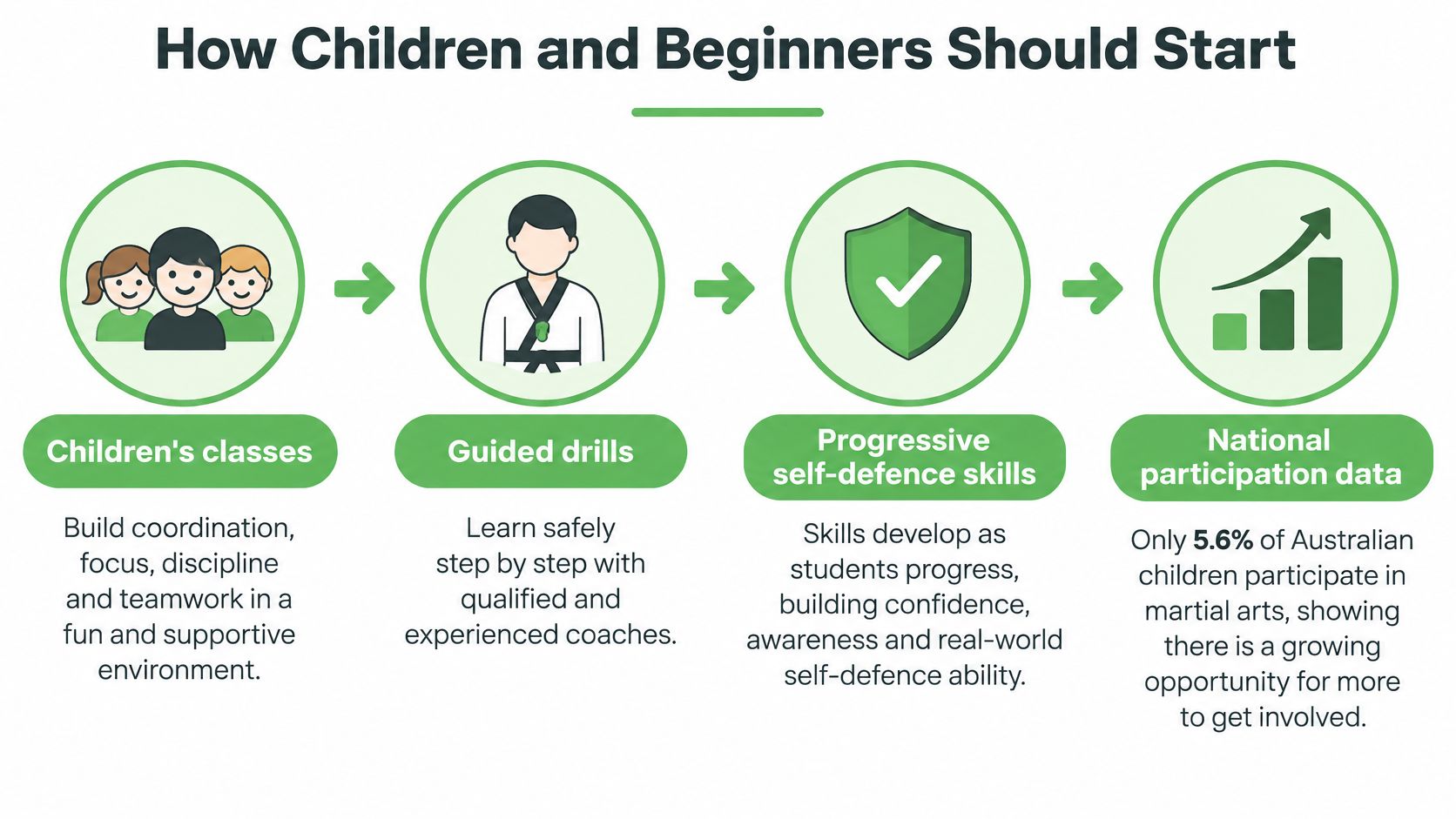
Australian movement guidance recommends at least 60 minutes of moderate-to-vigorous activity daily for children and adolescents, while the ABS figures accompanying this Australian Government physical-activity guidance show that in 2022, only 5.6% of young people aged 15–17 met the applicable guidelines, and 80% didn't complete enough muscle-strengthening activity.
A weekly class is therefore one contribution, not the whole activity plan. Keep outdoor play, school activity and other enjoyable movement in the week, and use our kids' BJJ class guide to understand the learning environment.
A measured progression for adult beginners
Start with technical classes and learn falling and positional skills. Knowing how to move, land and recognise positions gives you something useful to practise before resistance increases.
Use controlled, light rounds before unrestricted live sparring. Starting from a defined position lets you solve a smaller problem without rushing through unfamiliar situations.
Tell the coach about injuries, health conditions and fitness goals. That conversation helps establish appropriate boundaries and identifies when medical advice is needed.
Add sessions only once technique and recovery feel stable. More attendance isn't helpful if fatigue prevents you from moving with control.
Track weekly volume and rest days. Record drilling, sparring and other exercise so you can recognise a sudden increase in workload.
Early skill-focused training will usually feel less intense than a hard round, and that's appropriate. Learn to tap promptly, release immediately when a partner taps, and stop when you need clarification.
You don't need to prove your fitness before you've learned how to practise the movement.
What BJJ Cannot Do Alone for Fitness
Harder rolling doesn't always build better fitness. A session that leaves you unable to train comfortably afterwards may be less useful than a manageable session you can repeat consistently.
Sustainable participation usually beats occasional exhausting efforts. Add rounds and intensity gradually, rather than treating fatigue as the only sign that training worked.
Separate useful goals from unrealistic promises
The available evidence doesn't establish a BJJ-specific Australian injury rate, so it doesn't justify calling the sport risk-free or dangerous. Grappling involves resistance and joint-loading situations, which makes controlled practice, communication and appropriate progression important.
Coordination, confidence and consistency can improve before you notice changes in body composition. If you judge everything by weight loss, you may overlook becoming more comfortable moving on the floor, returning regularly and recovering better between sessions.
Body composition: Training doesn't remove the need to consider nutrition, overall activity and individual circumstances.
Balanced conditioning: Grappling may leave gaps that targeted strength work, mobility practice or steady cardio can address.
Recovery: More training isn't automatically useful when you're sleeping poorly or carrying unresolved pain.
The Australian Sports Commission's physical-activity evidence summary links regular activity with improved fitness, heart and metabolic health, stronger bones, better sleep and mental health, and reduced risk of cardiovascular disease, high blood pressure and type 2 diabetes. These are population-level associations, not proof that BJJ alone prevents disease.
Your results depend on total activity, recovery, nutrition and medical circumstances. Enjoying grappling can make regular movement more appealing, but it doesn't cancel out those other factors.
Choose a workload you can recover from, not the hardest workload you can survive.
If you have a medical condition or a recent injury, speak with a doctor before starting or increasing training intensity.
Build a Weekly Plan and Book a Trial Class
Choose a starting routine that fits your current capacity and calendar. These are example schedules, not automatic proof that you've met the activity guidelines.
Weekly routines and how they fit the adult benchmarks
Routine | BJJ classes each week | Strength work | Extra cardio |
|---|---|---|---|
Beginner routine | 2 | Bodyweight strength on 2 days | Brisk walking on other days |
Fitness-focused routine | 3 | Weights or bodyweight on 2 days | Cycling or running for extra vigorous minutes |
Time-limited routine | 1 | Bodyweight strength on 2 days | Track total weekly minutes and add activity to close the gap |
The beginner option leaves room to learn without making every day demanding. The fitness-focused option gives you more opportunities for active rounds, but still needs enough recovery to keep movement controlled.
The time-limited routine doesn't meet the aerobic benchmark on its own. Keep the class for learning and enjoyment, then deliberately schedule enough extra activity to close the gap rather than assuming attendance covers it.
Run a weekly check
Add active minutes: Separate moderate and vigorous activity from demonstrations, pauses and rest.
Count hard rounds and strength days: Record what you completed, including exercise away from BJJ.
Check movement practice: Include mobility, balance and coordination across your training and non-training days.
Fill the missing component first: Add walking if aerobic volume is short, or a manageable strength session if resistance work is missing.
Keep the routine when you're meeting your targets and recovering comfortably. Use our guide to sleep and recovery for athletes to help plan the time between demanding sessions.
We run classes for all ages and fitness levels from morning till night, close to Beaconsfield, in a friendly and supportive environment. Check the current timetable, choose a realistic first session, and start your activity log that same week.
Locals Jiu Jitsu Alexandria offers a free trial class so you can experience BJJ's movement, technique and fitness demands before planning your routine. Visit Locals Jiu Jitsu Alexandria to check the timetable and book your first session, then build your weekly activity plan around what you do on the mat.
Comments