
Jiu Jitsu for Self Defense: Jiu Jitsu for Self-Defence
If you can hold someone down but can't get away safely, have you really defended yourself? That question matters more than whether you can win a round on the mat.
Jiu jitsu for self defense is most useful when you treat it as a way to protect your body, regain control and leave. For adults and parents considering training, the important distinction is between learning a skill in class and being able to use it during an unpredictable encounter.
Table of Contents
What Jiu Jitsu Can and Cannot Do for Self-Defence - Core jiu jitsu concepts and their self-defence role - Training and real encounters have different boundaries
The Decision Sequence Before Any Grappling - Choose the least entangling option - Why ground control comes last
How Leverage, Positioning and Control Work Together - Control connects the mechanics - A wrist-grab practice scenario
Core Skills to Practise First - Beginner skill benchmarks - Check the route back to standing
Legal Limits of Self-Defence in NSW - Belief and reasonable response both matter - What that means during training
Realistic Progress for Beginners and Children - Beginner training stages - Children need development, not fear
Where Jiu Jitsu Falls Short Against Family Violence and Weapons - A wider safety framework
Book a Free Trial at Locals Jiu Jitsu Alexandria - Questions to bring to your trial
What Jiu Jitsu Can and Cannot Do for Self-Defence
Jiu jitsu can build balance, body control and escape options in a close, one-on-one encounter. It can't guarantee safety, and grappling alone doesn't adequately cover strikes, weapons or several attackers.
Think of it as learning to recover your footing on a slippery path. Better balance helps when something goes wrong, but it doesn't remove the hazards around you. A useful technique gives you an option, not a promise.
Core jiu jitsu concepts and their self-defence role
Concept | What It Does | Where It Helps | Where It Fails |
|---|---|---|---|
Leverage | Multiplies force through joints and angles | Breaking a grip or moving a larger person, such as shifting your hips to free a pinned arm | Fails with poor angles or against strong resistance |
Positioning | Controls hips, base and body alignment | Staying balanced and avoiding being pinned, such as moving a foot behind you when pushed | Hard to hold during a sudden attack |
Control | Limits an opponent's movement without striking | Creating space to disengage, such as briefly restricting a grabbing arm | Needs time and practised skill |
Distance | Keeps the threat outside striking range when space is available | Preventing someone from reaching you by moving beyond their reach | Easily lost on the ground or in tight spaces |
Escape | Frees limbs and body from a held or pinned position | Getting up and leaving after freeing a trapped leg or arm | Does not stop weapons or multiple attackers |
The final column is the most useful starting point. A cooperative partner lets you find the right angle and finish the movement. During a frightening encounter, surprise, panic and hurried decisions can interrupt that process.
Size still matters. So do fitness, experience, available space, and the other person's intent. Technique doesn't cancel those factors, and a movement that succeeds for one person may fail for another.
Practical rule: Judge a technique by whether it helps you reach safety, not by how impressive it looks.
Training and real encounters have different boundaries
In sport training, partners agree to rules and stop signals. Outside training, you can't assume the other person will avoid striking, release a hold or remain alone.
That doesn't make grappling useless. It means these concepts belong inside a wider personal-safety plan. Practise them under controlled resistance before relying on them, and pay particular attention to the moment when an escape stops working.
The Decision Sequence Before Any Grappling
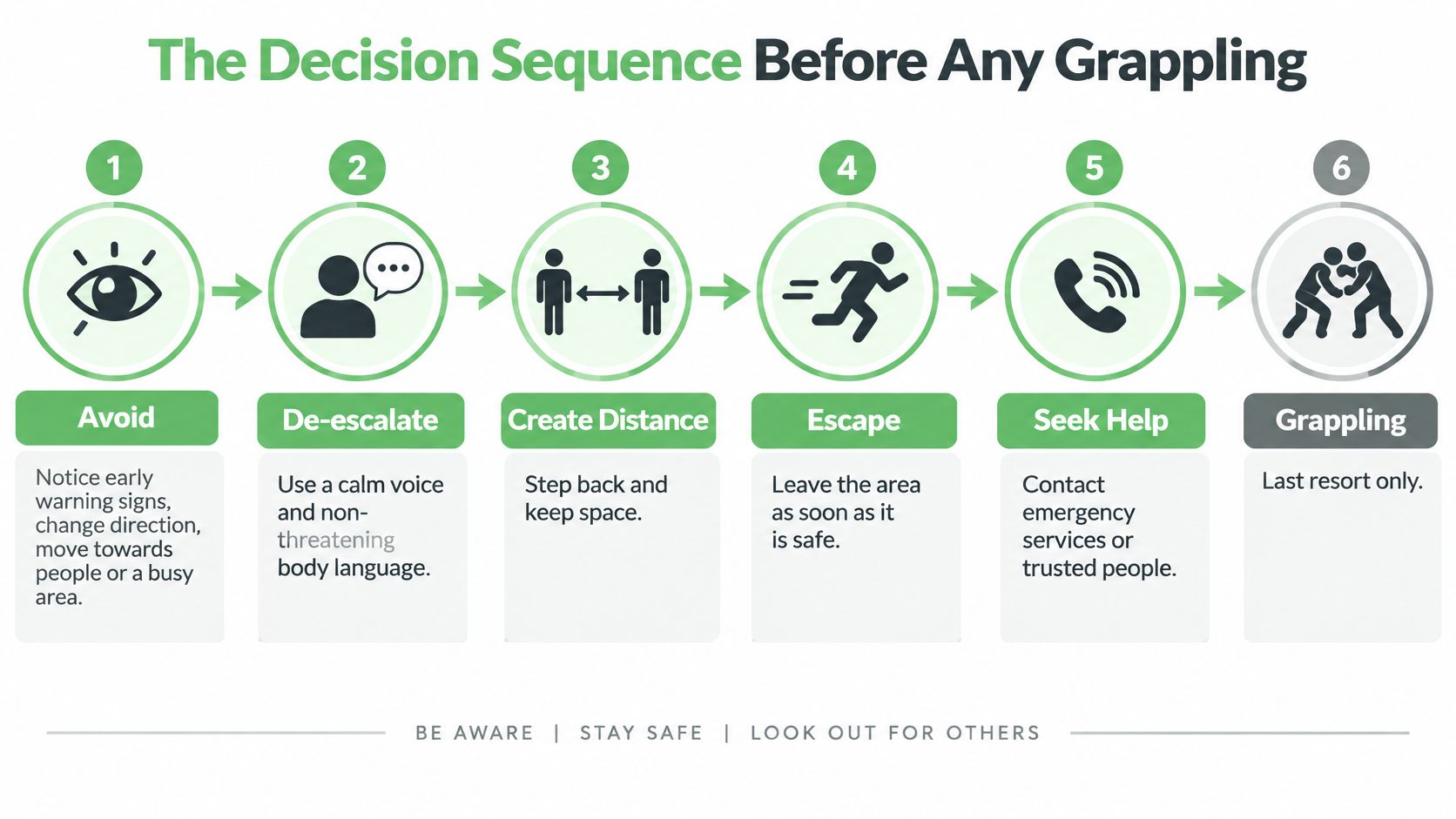
Avoid, de-escalate, create distance, escape and seek help. Grappling belongs behind those options, as a last resort when you can't safely leave without physical contact.
This isn't a test of courage. Staying upright and leaving early can preserve choices that disappear once someone grabs you or takes you to the ground.
Choose the least entangling option
Avoid. Notice escalating behaviour, blocked exits or someone following your movements. Change direction, leave, or move towards people and a busy, well-lit area.
De-escalate. Speak calmly and firmly. A short boundary such as Stop, back off is easier to deliver than a long argument. Keep your body language non-threatening.
Create distance. Step away without blindly backing into obstacles. Keep your hands raised in an open, protective position, but don't assume that alone will prevent a grab.
Escape. If contact has happened and you can release it, move through the opening towards an exit. Don't stay to prove that the technique worked.
Seek help. Shout for assistance and address a particular bystander rather than the crowd generally. Contact emergency services when there's immediate danger.
The sequence is a guide to priorities, not a requirement to complete every step before acting. You may need to seek help immediately or escape without speaking.
Why ground control comes last
Holding someone close takes time and attention. On the ground, you may struggle to see another person approaching or reach an exit quickly.
Think of ground control as an emergency brake, not your preferred route home. It may interrupt an immediate threat, but staying entangled creates its own problems.
Practise decisions as well as movements. A supervised drill can include a spoken boundary, light resistance and a visible exit, with success measured by leaving rather than keeping the partner pinned.
How Leverage, Positioning and Control Work Together
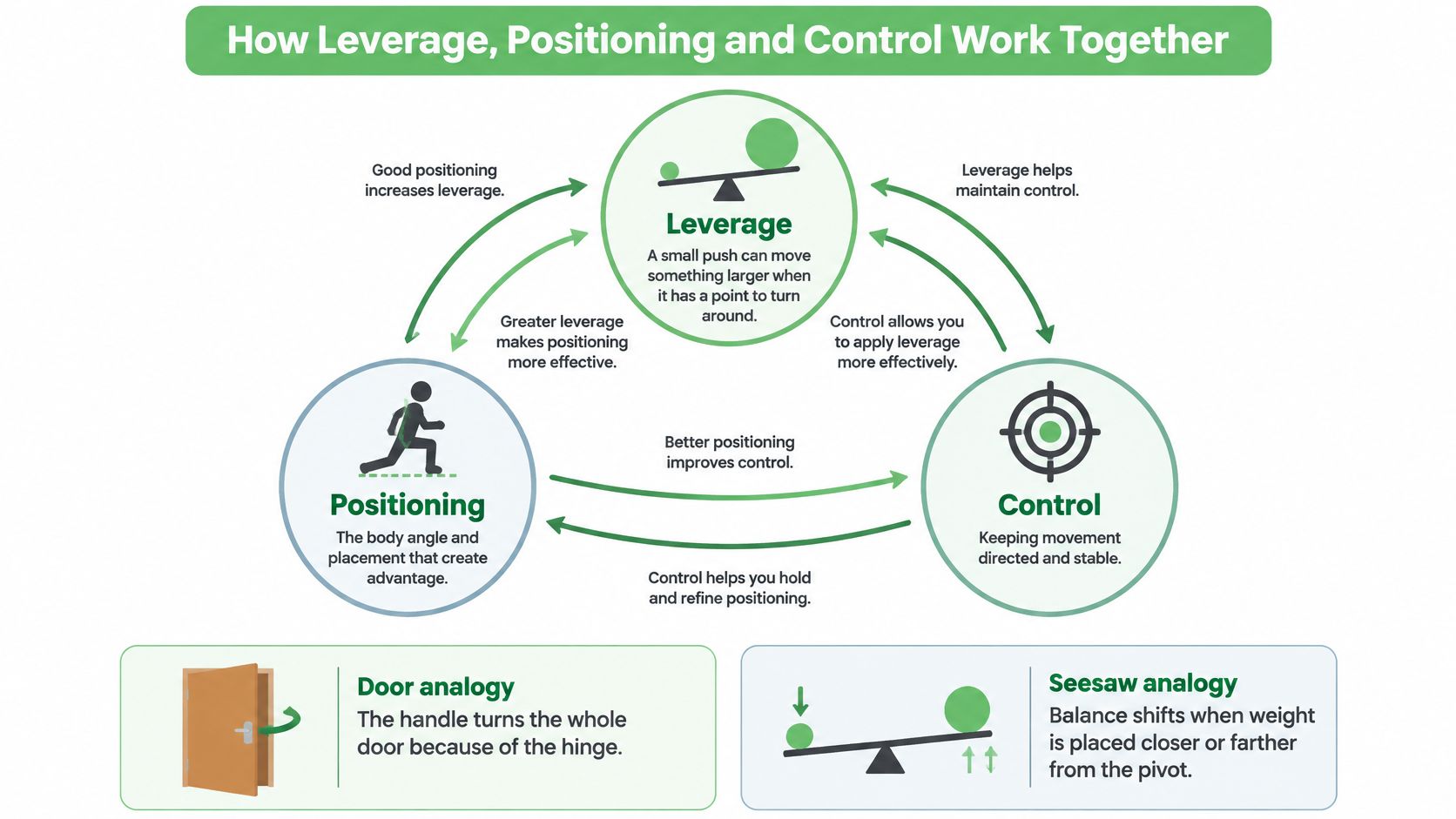
A door helps explain the concept. Pushing near the handle turns the door more easily than pushing close to the hinge because you're applying force farther from its turning point.
Positioning is more like a table. A table with its legs supported is steady; lift a leg and it becomes easier to tip. Your feet, knees and body angle create a base that can support movement or leave you wobbling.
Control connects the mechanics
Control means directing or limiting movement long enough to do something useful. Keeping a partner's hands and hips occupied may briefly prevent them from rebuilding a grip or following you.
These ideas work together rather than taking turns in isolation. Power without balance can pull you over, while a stable stance achieves little if you're pulling against the strongest part of a grip.
A wrist-grab practice scenario
Say a partner holds your wrist from the front during a coached drill. Don't begin by yanking harder. Work through the movement slowly enough to understand what each adjustment changes.
Make room. Step back if space allows, keeping your balance rather than stretching your arm behind you.
Find the opening. Turn your wrist towards the gap around the partner's thumb. This is usually a more useful direction than pulling into their closed fingers.
Support the movement. Lower your hips slightly and establish a comfortable base. Don't squat so low that you can't move.
Release and leave. Draw your wrist through the opening while moving your body, then continue towards open space.
This is a learning example, not a reliable answer to every wrist grab. A second hand, a sudden pull or a strike changes the problem immediately.
Our guide to fundamental BJJ and ground control gives further context for understanding how body placement affects a partner's movement. BJJ is short for Brazilian jiu jitsu.
For this drill, each later action relies on the earlier preparation. If stepping back destroys your balance, fix that before adding speed or resistance.
Core Skills to Practise First
Skills that protect your body come before attacks. A beginner needs ways to land, maintain a workable position and stand again before focusing on submissions, which are holds that prompt a training partner to signal surrender.
A coach should assess what happens under manageable pressure, not just whether you can copy a demonstration. The following are practice benchmarks, not guarantees of protection outside class.
Beginner skill benchmarks
Skill | Beginner Benchmark | Why It Matters |
|---|---|---|
Safe breakfall | On a mat, tuck the chin and use the coached landing shape and arm slap without posting on a straight wrist | Helps manage impact and protect the head and wrists |
Posture | Maintain an appropriate head position, low hips and elbows close under pressure | Makes it harder for a partner to fold or pin you |
Guard retention | Recover a protected position promptly when a partner moves around your legs | Helps prevent an exposed, flattened position |
Technical stand-up | Stand without turning your back to the partner | Returns you to your feet while keeping the partner in view |
Disengage | Release contact and create distance when an opening appears | Lets you leave instead of extending the encounter |
A breakfall is a practised way of managing a fall. Learn it close to the mat before adding height, and don't interpret landing flat as dropping rigidly onto your spine. The coach should check chin position, controlled impact and the absence of an outstretched wrist trying to catch your weight.
Posture isn't keeping your head upright at all costs. It means maintaining body alignment that protects your head and neck while letting you move. Guard retention means keeping or recovering your legs between you and a partner; it may happen while your back is on the mat, so it doesn't mean staying off your back entirely.
Check the route back to standing
A technical stand-up uses a supported position to rise while facing the partner. The coach checks balance, protected head position and whether your supporting hand and foot are placed safely.
Disengagement needs its own practice. Beginners often free themselves and then remain within reach because the drill has taught them to stop moving.
A useful beginner test is whether you can protect your posture, identify an exit, stand safely and disengage under moderate resistance.
Training should include controlled variations in space, clothing and spoken boundaries, rather than assuming every encounter starts with a ready partner.
Stop immediately if concussion is suspected: remove the person from training, arrange medical assessment and allow no same-day return, consistent with the RACGP's sport-related concussion guidance. A fall can cause concussion even without a direct strike to the head; returning requires an appropriate graduated process and clearance.
Legal Limits of Self-Defence in NSW
Knowing a technique doesn't give you permission to use it whenever you feel angry or challenged. This is general information, not legal advice, and the legal assessment depends on the circumstances of the incident.
In NSW, self-defence is governed by sections 418 and 419 of the Crimes Act 1900, as explained in the NSW Judicial Commission's self-defence guidance. The central statutory questions concern whether the person believed their conduct was necessary and whether it was a reasonable response in the circumstances as they perceived them.
Belief and reasonable response both matter
For practical understanding, separate these questions:
Necessity. Did you believe you needed to act to defend yourself or another person?
Grounds for that belief. What was happening that informed your perception of danger?
The response. Was the force reasonably proportionate to the danger you perceived?
The NSW Public Defenders' explanation of self-defence discusses belief, reasonable grounds and proportionality, including the serious consequences of excessive force in relevant cases, potentially involving manslaughter or murder. Those consequences aren't an automatic result of every excessive response; the facts and applicable offence matter.
A threatening situation isn't a blank cheque. The danger may change while you're responding, and what began as protective conduct can become difficult to justify if you continue after the need has passed.
What that means during training
Say someone releases your wrist and stops advancing. Continuing to pin them or applying a painful hold to teach them a lesson may cross the line, depending on the circumstances.
This is why a useful training habit is to reassess rather than finish a memorised sequence regardless of what the partner does. Practise recognising when an opening exists, releasing unnecessary pressure and moving away.
Our explanation of whether self-defence is legal in Australia offers broader context, but it can't decide an individual case. Seek personal legal advice about your own situation, especially after an incident involving injury or police.
Realistic Progress for Beginners and Children
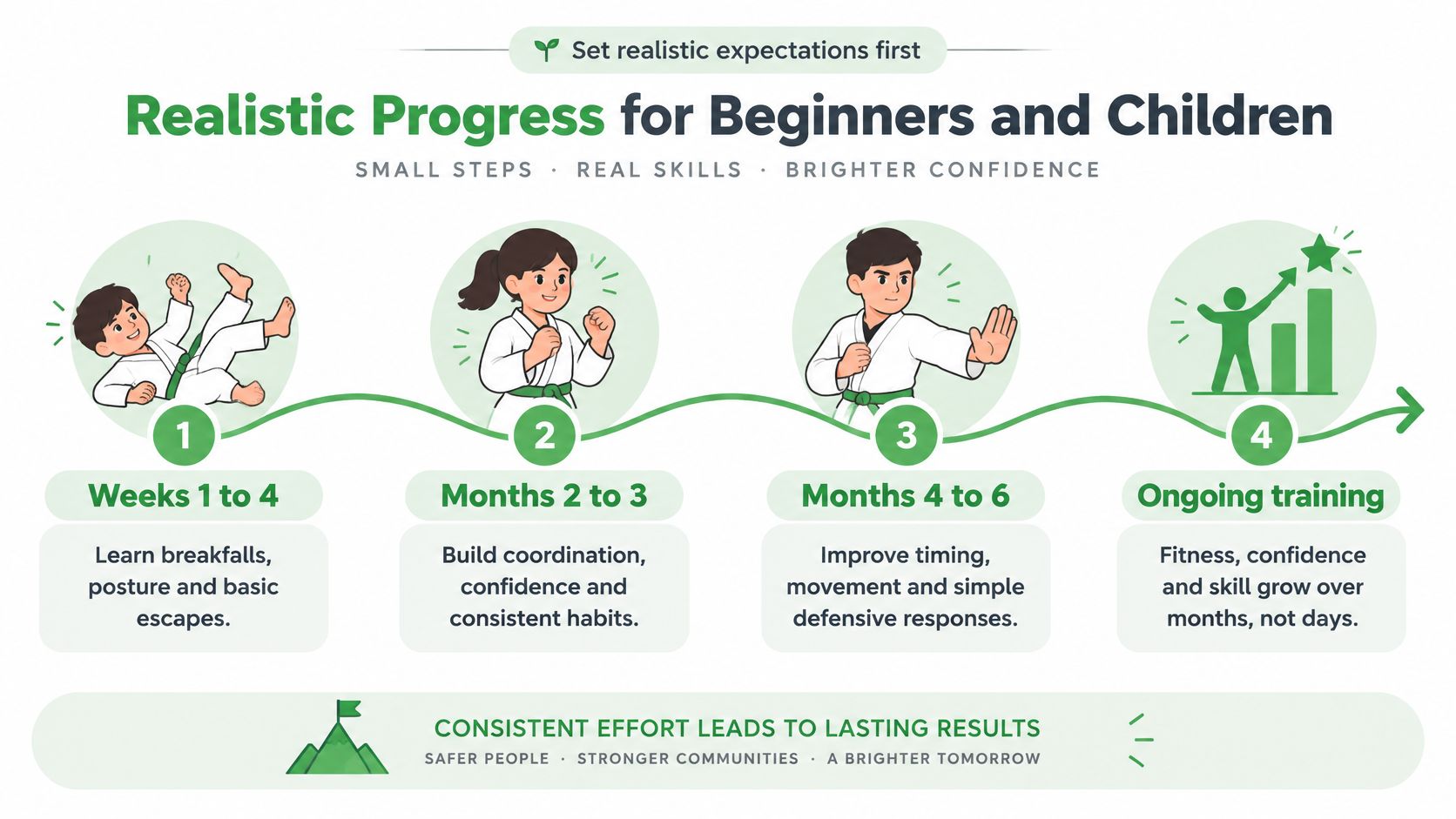
Regular training can develop fitness, confidence and skill over months, not days. There's no honest date when a beginner becomes ready for every real-world threat.
The need for sustainable activity is clear: NSW Health reported that only about 39% of children aged 5–17 achieved at least seven hours of physical activity per week in 2024–2025. A worthwhile program should therefore be something a child can enjoy and continue, not a short course built around frightening promises.
Beginner training stages
The schedule below is an illustrative planning example, not a validated timetable for competence. Adjust attendance and progression to health, recovery, age and coaching advice.
Stage | Focus | Attendance |
|---|---|---|
Weeks 1 to 4 | Breakfalls, posture and basic escapes | Aim for at least twice a week if appropriate and manageable |
Months 2 to 6 | Controlled drills against light resistance and recognition of common positions | Maintain a regular, recoverable schedule |
Months 6 to 12 | Skills under moderate resistance and conditioning through a full class | Continue consistently, adjusting for fatigue or injury |
Early progress may mean remembering how to stop safely or staying calm when a partner applies light pressure. Later progress might mean selecting an escape without being told which movement to use.
Children need development, not fear
Children should practise boundaries, asking trusted adults for help and responding to stop signals. Coordination and controlled behaviour matter more than whether they can overpower another child.
Australian guidance recommends at least 60 minutes of moderate-to-vigorous physical activity daily for young people aged 5–17, according to the Australian Government's movement recommendations. Jiu jitsu can contribute, but it belongs alongside other movement, recovery and sleep.
Parents can use our guide to self-defence for kids to think through age-appropriate priorities. For smaller adults, older beginners and people with low fitness, adjusted resistance and a sustainable pace matter more than belt colour.
Confidence should grow from tasks you can repeat safely, not from promises about what you could do to an attacker.
A class can improve your options. It doesn't replace a plan for safety beyond the mat.
Where Jiu Jitsu Falls Short Against Family Violence and Weapons
Can grappling skills make someone safe from an abusive partner or an armed attacker? No. Jiu jitsu may help a person control or escape a physical encounter, but it cannot address coercive control, repeated abuse, threats to children, or an abuser's control over money, transport and support.
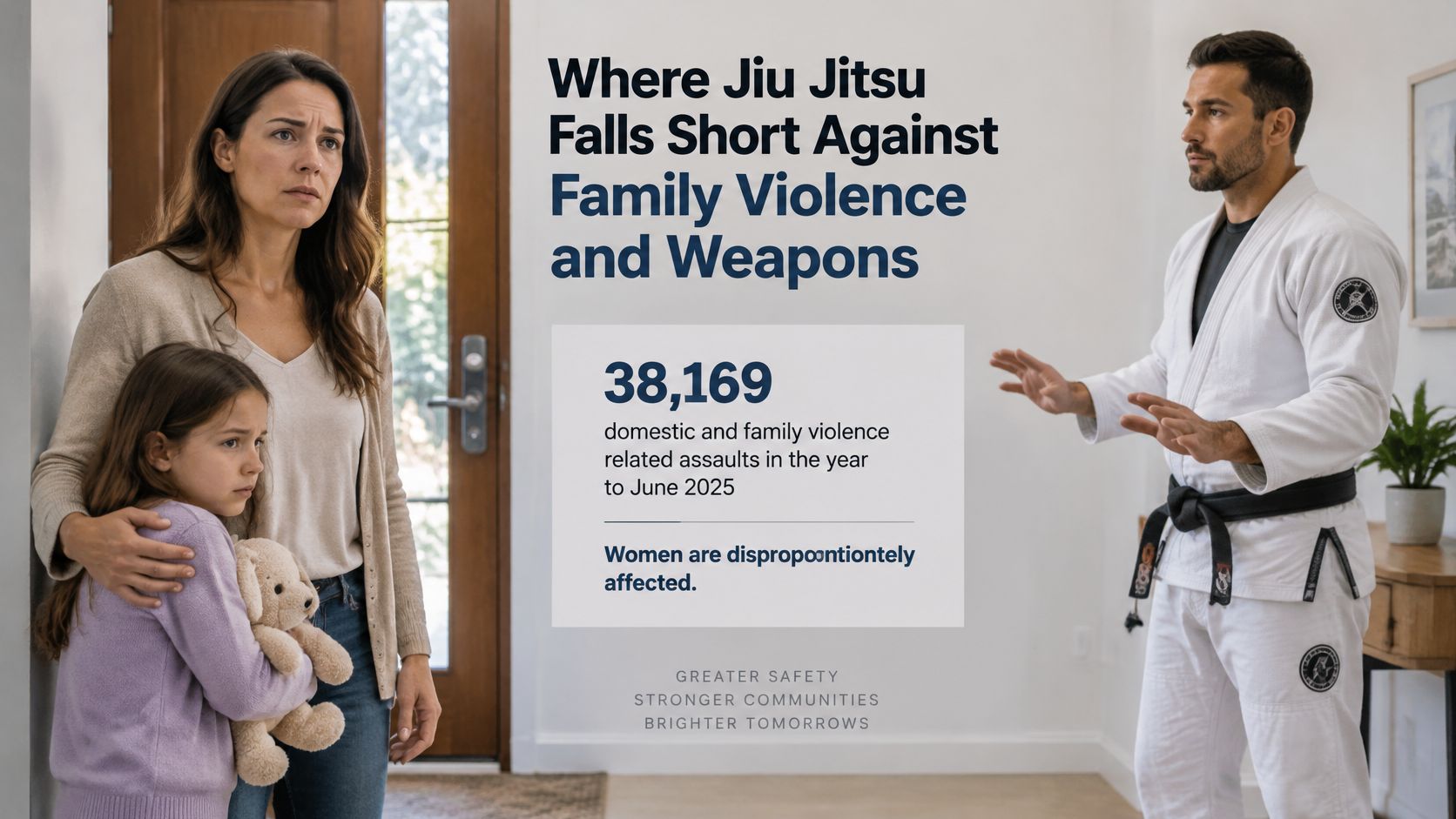
NSW recorded 38,169 domestic- and family-violence-related assaults in the year to June 2025, and women represented 67% of recorded DFV assault victims, according to the NSW strategy on responding to the use of domestic and family violence. The strategy also notes that Aboriginal women can be misidentified as primary aggressors when using self-defence or retaliatory violence.
A wider safety framework
A safety plan may involve specialist family violence services, trusted people, bystander assistance, emergency services and a plan for leaving. Communication and de-escalation techniques for security guards illustrate skills that can complement physical training, but boundary-setting may not be safe with an abusive person. Leaving may also require careful planning and specialist support.
Weapons, multiple attackers and confined spaces can make physical engagement especially dangerous. A grip escape may help in a particular moment, much as a seat belt can reduce risk in a crash. Neither makes a dangerous situation safe. Empty-hand training cannot promise reliable protection against a weapon.
No student should be told that surviving violence depends on training harder or performing a technique correctly. Physical skills have limits, and responsibility for an abuser's actions never rests with the person targeted.
Instruction should be culturally informed and respectful, with those limits made clear before physical practice begins.
Book a Free Trial at Locals Jiu Jitsu Alexandria
A practical next step is to book a free trial class at Locals Jiu Jitsu Alexandria, our jiu jitsu and martial arts academy in Alexandria, Sydney. We offer trials for all levels, so your first visit can help you assess the teaching and environment without treating it as a commitment.
Our beginners program accommodates people without previous experience across ages, genders and fitness levels. We also offer children's training and No-Gi grappling, which uses no traditional uniform. Before booking, confirm the appropriate age range, experience requirements and current schedule directly with us.
Questions to bring to your trial
Foundations. How will I learn breakfalls and protective posture?
Resistance. How will the difficulty increase safely?
Head knocks. What happens if concussion is suspected?
Progress. What will show that I'm ready for a harder drill?
The same observation-first approach applies when evaluating a 24/7 gym before joining, as discussed by Empire Athletics: use a trial to assess fit rather than rushing into a decision. For grappling, pay particular attention to supervision and partner behaviour.
Check the timetable on our website, call 0414752412 or email team@localsalexandria.com.au to arrange your visit. Treat the first class as a supervised introduction, not a test you have to pass.
Locals Jiu Jitsu Alexandria offers a free trial class for all levels, giving you a chance to explore control, positioning and escape under supervision. Visit Locals Jiu Jitsu Alexandria to check the timetable and book a first class that fits your experience and goals.
Comments