
Martial Arts Classes: How to Choose the Right Format
Are you choosing martial arts classes by the style on the sign, or by what will happen when you or your child steps onto the mat? A familiar name doesn't tell you how much contact is involved, how beginners are supported or what the full enrolment cost will be.
The right choice combines suitable instruction, manageable contact and a routine you can maintain. Comparing those details before paying makes the first month less confusing, especially if you're unsure about fitness, belt levels or training with a partner.
Table of Contents
Martial Arts Class Formats Compared - What a first visit can look like
Choosing a Class by Age and Experience - Match the starting point to the student
What Regular Classes Build Over Time - Notice useful progress, not just promotions
Weekly Activity Guidelines Your Classes Can Support - Count movement, not just booking time
What Classes Really Cost Beyond Tuition - Request the complete cost schedule
Safety Questions to Ask Before Enrolling - Take these questions to the trial
How to Trial a Class and Decide - Follow a practical trial routine
Confirm Your Class Fit Before You Enrol - Make the final decision deliberately
Martial Arts Class Formats Compared
Common class formats and who they suit
Format | Typical students | Experience needed | Main focus | Contact level |
|---|---|---|---|---|
Kids classes | Children, grouped by age | None | Coordination, focus, respect and basic self-defence | Guided drills and supervised contact |
Beginners program | Adults and teens of all fitness levels | None | Fundamental positions, movements and submissions | Light, controlled practice |
Advanced classes | Students at blue belt and above | Blue belt or higher | Deeper technique, strategy and concepts | Live rolling at higher intensity |
No-Gi and grappling | Grapplers and competitors | Some grappling experience helpful | Grips, wrestling techniques and No-Gi submissions | Live rolling at a faster pace |
Fitness or self-defence classes | Adults seeking fitness or confidence | None | Conditioning and practical defence drills | Ask whether drills are noncontact, cooperative or live |
These are useful starting descriptions, not guarantees about every session. Contact means more than striking: holding a partner, practising an escape and wrestling for position all involve contact, but with different demands.
What a first visit can look like
Kids classes suit children who benefit from clear routines and guided activities. A first visit should introduce the instructor, mat rules and simple movements before supervised partner drills, with teamwork built into taking turns and helping partners practise.
A beginners program gives newcomers time to understand unfamiliar positions. Expect a demonstration, repeated practice with a cooperative partner and explanations of how to stop safely, rather than an assumption that you already know the terminology.
Advanced classes suit students who can apply established fundamentals while making technical decisions. On a first visit, an experienced student should confirm entry requirements and the expectations for live rolling, which means practising against a resisting partner.
No-Gi and grappling replace grips on the traditional gi uniform with body controls, such as wrist grips and underhooks. Our comparison of No-Gi and gi training explains the distinction; a first visit should also clarify clothing requirements and permitted submissions.
Fitness or self-defence classes suit adults whose immediate priority is conditioning or practical confidence rather than belt progression. Ask whether the session includes pad work, rehearsed escapes or resistance from a partner, because the class name alone doesn't establish its contact level.
Choosing a Class by Age and Experience
Matching age and experience to a starting class
Age or experience | Starting format | What to check first | Realistic first step |
|---|---|---|---|
Children aged 5-8 | Kids class | Age grouping and class length | One weekly class, then add more if they enjoy it |
Children aged 9-14 | Kids class | Instructor supervision and group size | One or two classes a week |
Teens aged 15-17 | Beginners program | Whether mixed-age groups are used | One or two classes a week |
Adult complete beginner | Beginners program | How mixed fitness levels are handled | One or two classes a week |
Adult with prior training | Beginners program or trial | Current level and belt rank | Trial class to confirm level |
Blue belt and above | Advanced class | Entry requirements | Regular advanced sessions |
Grappler preparing for competition | No-Gi program | Competition preparation support | No-Gi class alongside advanced training |
Treat these attendance suggestions as possible starting plans, not age-based requirements. Readiness includes listening, comfort with partners and recovery between sessions, not just physical fitness.
Look for an instructor who makes the class expectations understandable before practice begins.
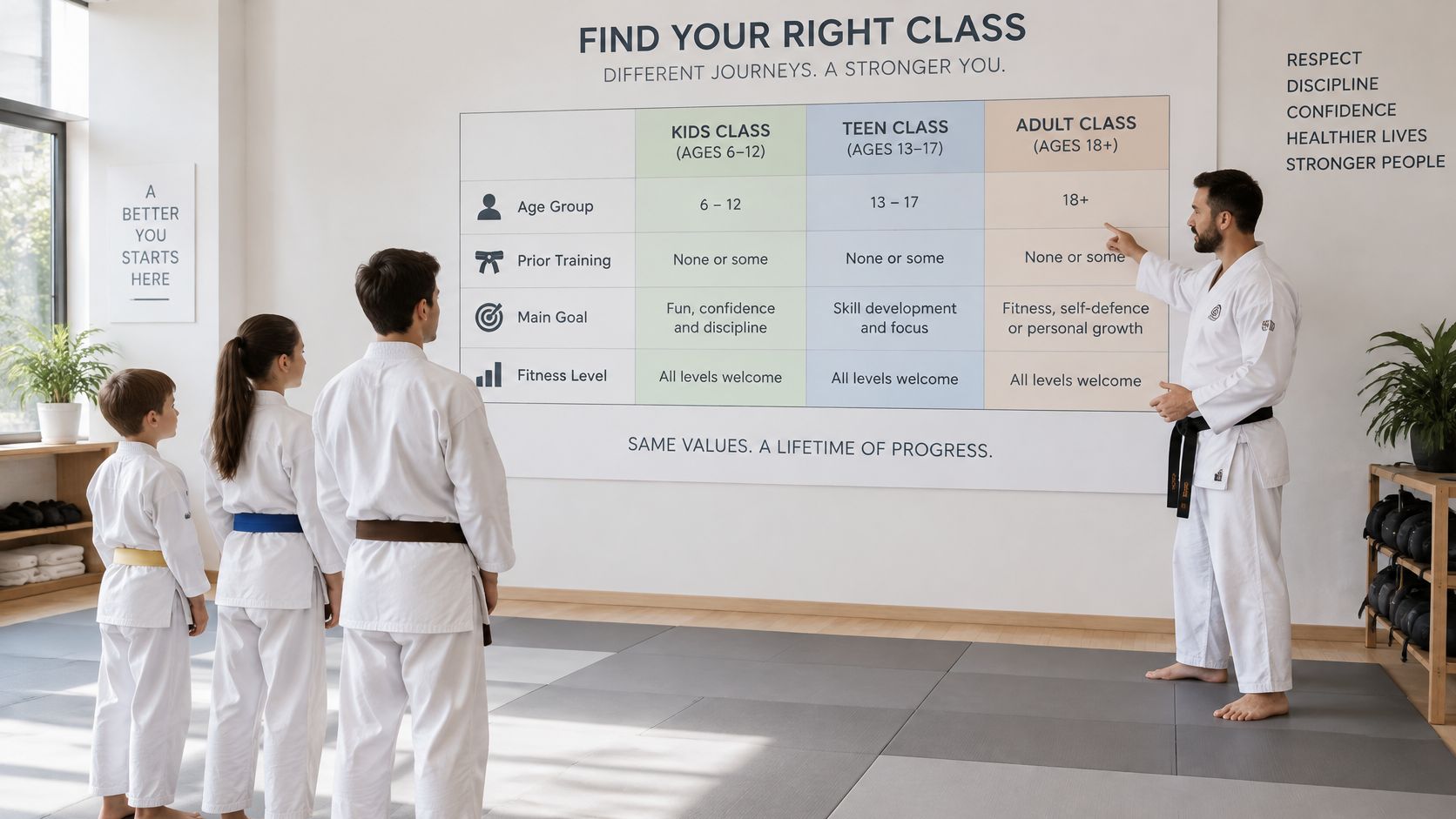
Match the starting point to the student
For younger children, begin with enjoyment and the ability to follow a simple routine. Our guide to martial arts classes for kids can help parents think through that starting decision.
Older children may welcome more detailed partner work, but parents should still ask how many students each instructor supervises. A confident child shouldn't automatically be placed in a harder-contact group.
Teens moving into beginners training need suitable partners and clear boundaries in mixed-age sessions. Ask how the instructor handles differences in size and maturity, rather than assuming everyone in an adult-labelled class trains identically.
For adult newcomers, low fitness isn't a reason to choose advanced conditioning before learning technique. Ask how exercises can be adjusted and whether you can pause without disrupting a partner.
Use the video as another introduction before discussing your starting point with a coach.
Returning adults should explain their previous style, rank and time away. Blue belts can discuss advanced entry, while competition-minded grapplers should clarify how No-Gi practice supports their intended ruleset.
At Locals Jiu Jitsu Alexandria, we run classes catering for all ages and fitness levels from morning till night. A trial class is the simplest way to confirm that the proposed group suits the student.
What Regular Classes Build Over Time
The Australian Sports Commission's AusPlay martial arts report estimates that 85% of adult martial-arts participation in Australia was organised during January 2016 to December 2018, making scheduled classes a mainstream way to train.
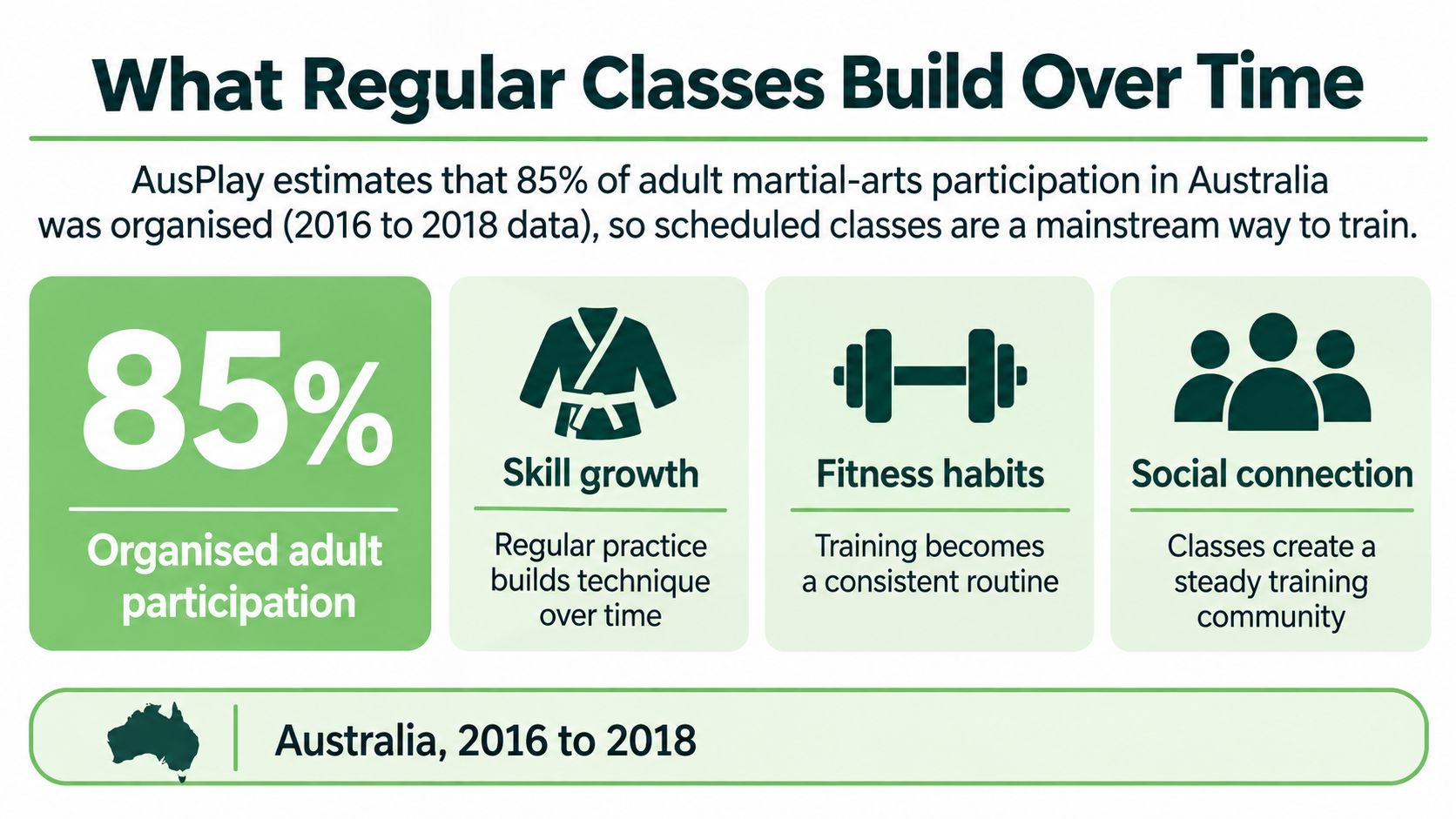
Regular attendance creates opportunities to develop several abilities together:
Fitness and coordination: Repeating movements helps students practise balance, controlled effort and changing direction.
Focus and discipline: Listening, practising and responding to feedback become part of a familiar routine.
Confidence with unfamiliar tasks: Students can learn to ask questions and attempt movements without needing immediate success.
Practical self-defence skills: Positioning, escapes and decisions under resistance develop over months rather than weeks, without guaranteeing real-world outcomes.
Notice useful progress, not just promotions
A child attending weekly might first learn to fall safely and follow the class routine, then move towards cooperative partner drills and positional control. An adult might notice better stamina and balance within a few months, although neither change has a fixed deadline.
Belt ranks mark stages of learning, not a promise of fitness, confidence or protection. During the first month, recognising a position or remembering when to stop can be more meaningful than performing a technique quickly.
Practical rule: Choose the class you can keep attending, not the most ambitious timetable you can imagine completing.
Consistency still needs an appropriate activity mix and sensible safety boundaries. A sustainable commute matters because instruction only helps when the student can return regularly.
Weekly Activity Guidelines Your Classes Can Support
Australian activity guidelines by age group
Age group | Guideline | How classes contribute |
|---|---|---|
Children aged 5-17 | 60 minutes of moderate-to-vigorous activity every day | Drills and controlled grappling add movement to the daily total |
Children aged 5-17 | Vigorous activity and muscle and bone strengthening on at least 3 days a week | Stance work, bodyweight exercises and grappling can address these components |
Adults aged 18-64 | 150-300 minutes of moderate or 75-150 minutes of vigorous activity a week, or an equivalent combination | Regular classes can count towards the weekly total |
Adults aged 18-64 | Muscle-strengthening on at least 2 days a week | Grappling and bodyweight work complement separate strength training |
For children aged 5-17, the Australian Government's activity recommendations specify 60 minutes daily, which can be split into shorter sessions, with vigorous activity and muscle and bone strengthening on at least three days weekly. For adults aged 18-64, WorkSafe Tasmania's physical activity guidance sets 150-300 moderate-intensity minutes or 75-150 vigorous-intensity minutes weekly, or an equivalent combination, plus strengthening on at least two days.
Count movement, not just booking time
A class includes listening, demonstrations and partner changes as well as exercise. The Australian Bureau of Statistics activity methodology distinguishes intensity when counting activity, so don't automatically label an entire grappling session vigorous.
Say an adult attends two one-hour classes each week. Those hypothetical sessions might cover the aerobic target if enough time is vigorous, but not if much of the session involves instruction or light practice.
That adult could add a separate strength session, while checking whether class-based resistance work supplies another strengthening day. Walking, cycling and other enjoyable activity can fill remaining gaps.
A class contributes to an active week. It doesn't automatically complete one.
Choose attendance you can recover from and sustain, then assess the rest of the week rather than expecting a single class format to provide everything.
What Classes Really Cost Beyond Tuition
Cost, transport and competing priorities are common barriers to children's participation identified by the Australian Sports Commission's life-course evidence. A tuition figure alone won't tell a family whether ongoing training is affordable.
Historical national participation spending isn't a current academy quote. Build your budget from the actual charges for the class you're considering, using our guide to Jiu Jitsu costs to prepare your questions.
Request the complete cost schedule
Tuition: Confirm weekly or term charges, included attendance and any family or multi-class rates.
Uniform: Ask whether a gi is compulsory immediately and whether the first uniform is included.
Equipment: Confirm required mouthguards, gloves or shin guards for the chosen format, and whether suitable loan equipment is available for trials.
Additional fees: Ask about registration, grading and belt-test charges.
Travel: Include fuel, parking and the time needed to get there and home.
Enrolment terms: Establish whether a trial leads to an enrolment fee, recurring payments or a fixed contract.
For a hypothetical comparison, add three months of tuition, the commute cost and first-month equipment for each option. Use the attendance frequency you intend to maintain, not the maximum sessions advertised.
A lower tuition price may be less practical if the journey requires paid parking or an awkward school pickup. Request the full schedule in writing before paying, including cancellation and pause conditions, so you can compare the commitment rather than just the headline price.
Safety Questions to Ask Before Enrolling
An Australian peer-reviewed study discusses national injury surveillance linking combative sports with hospitalised facial fractures, shoulder dislocations and cervical-spine injuries, while noting that school-based martial arts are generally foundational and noncompetitive. That distinction matters: a cooperative lesson and unrestricted competitive practice aren't equivalent experiences.
A demanding class isn't automatically a well-taught class. Children should practise cooperative drills, controlled positional games and supervised contact before competition becomes a priority. Adult instruction should distinguish learning a technique from applying it in live rounds.
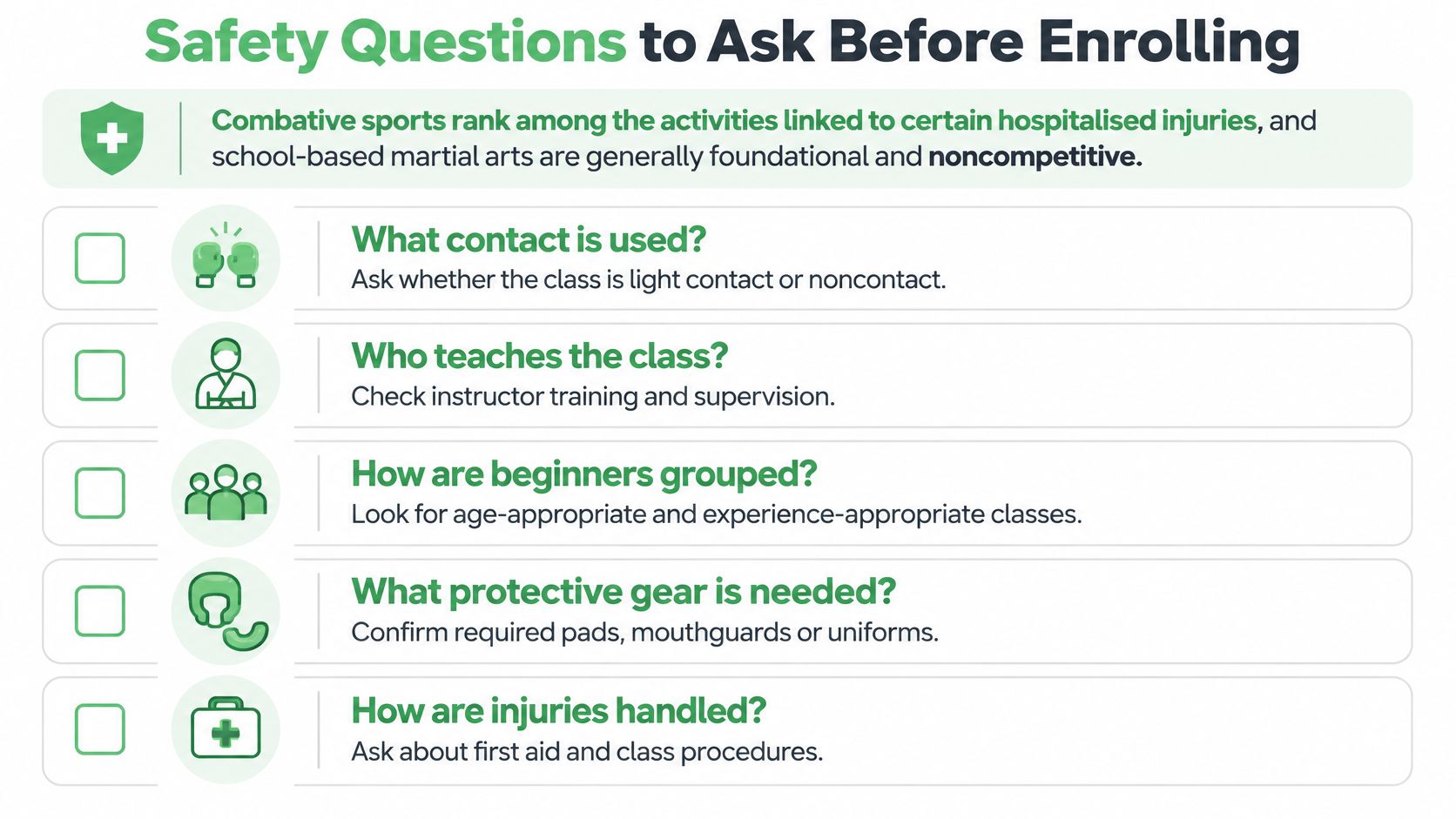
Take these questions to the trial
Partner matching: How does the instructor account for size, experience, confidence and agreed intensity?
Tap-out rules: Are students taught to stop immediately for a physical tap or verbal stop? Can they stop before discomfort becomes pain?
Takedowns: When are standing techniques introduced, and how are falling skills and landing space managed?
Supervision: Who watches partner practice, and what happens when an instructor needs to help an individual student?
Injury disclosure: How should students report previous injuries, current limitations or a new problem during class? Who records an incident and arranges first aid?
Hygiene: How are mats cleaned, what clothing standards apply, and when should a student stay away because of illness or a suspected skin infection?
Protective equipment: What is required for this particular session, and how should it fit?
At Locals Jiu Jitsu Alexandria, our experienced coaches prioritise safety and progression. Experienced coaches should be able to explain how their teaching decisions support both, rather than offering reassurance without practical details.
Tell the coach about relevant limitations before partner work begins. If you have a disability, previous surgery or restrictions from a treating clinician, discuss suitable adjustments rather than assuming every drill must be completed unchanged.
Being able to stop, ask for help or decline a drill is part of learning responsibly.
Tired muscles and ordinary exertion are different from persistent pain, dizziness or a new injury. Stop training when warning signs appear and seek medical advice before continuing; don't treat pressure to push through as evidence of commitment.
How to Trial a Class and Decide
At Locals Jiu Jitsu Alexandria, we offer a free trial class for all levels, and prospective students can check the timetable and book a session. Use that visit to assess the teaching and practical commitment, not to prove how tough you are.
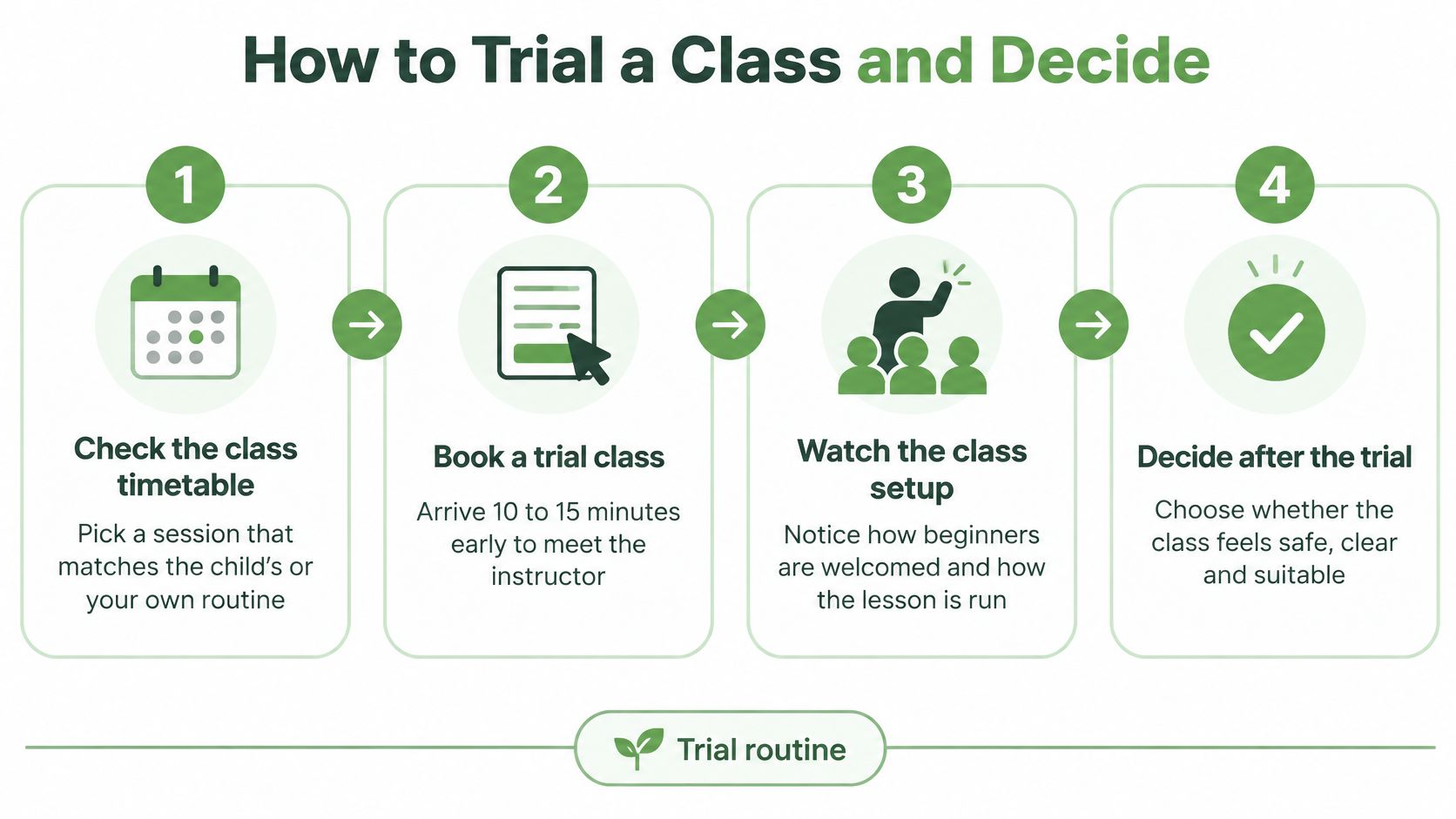
Follow a practical trial routine
Choose a realistic session. Check the timetable against school, work and family routines. Don't trial a convenient holiday session if you couldn't attend it during an ordinary week.
Book and arrive early. Aim to arrive 10 to 15 minutes early so you can meet the instructor and clarify what to wear. Rushing straight onto the mat leaves little room to explain your needs.
Explain your starting point. Share age, experience, fitness, previous injuries and worries about contact. Don't hide a limitation because you think the coach expects everyone to keep up.
Observe the lesson structure. Notice whether beginners receive clear instructions and suitable partners, with time to practise before resistance increases. Don't judge the entire program by one fast-paced round involving experienced students.
Test the safety answers. Ask about supervision, tapping, takedowns and hygiene, then notice whether class behaviour matches the explanation. A friendly welcome matters, but it doesn't replace clear procedures.
Check travel and the full commitment. Test the journey at the actual class time, including parking and the trip home, and request written tuition, uniform, equipment, registration and enrolment terms. Don't ignore a difficult commute just because the lesson itself was enjoyable.
Decide from learning and comfort. If you attend further sessions, ask whether the student understands more, feels comfortable and wants to return. Don't mistake initial awkwardness for failure, or assume a trial permits ongoing attendance without confirming arrangements.
For the first month, bring the agreed clothing, water and any required personal equipment. A nervous child may need a clear explanation of the opening activity; an adult may need reassurance about when partner practice begins.
Measure the early experience by understanding and participation, not submissions won.
Confirm Your Class Fit Before You Enrol
A suitable class should pass three checks: the format matches the student's age and experience, the weekly routine supports their age-appropriate activity needs, and the coach gives clear answers about safety. None of those checks requires the student to be naturally athletic or confident on arrival.
Shortlist a couple of suitable formats and compare their practical demands. Include total cost and the actual commute, especially if you're travelling from Waterloo, Zetland, Rosebery, Beaconsfield, Green Square, Kensington or Erskineville.
Make the final decision deliberately
Enrol after a trial if the student is learning, feels comfortable and can maintain the commitment.
Pause the decision if the coach can't explain contact boundaries or injury procedures clearly.
Review after about a month to assess enjoyment, recovery, affordability and whether the chosen group still fits.
Check the timetable, location and trial terms on our website, then confirm the details directly before attending. Ask whether kids training, beginners instruction or No-Gi is the appropriate starting point, and bring your safety questions to the coach.
We're one of the Locals academies in Sydney, with additional locations in Marrickville and Maroubra, so confirm that your booking is for Alexandria. We promise to get back to enquiries ASAP, but don't assume a session is confirmed until you've received the booking details.
You don't need certainty about long-term goals before beginning. You need a clear starting arrangement, permission to learn gradually and enough information to make the next decision without pressure.
Locals Jiu Jitsu Alexandria offers beginner-friendly classes, kids programs and progressive training, with a free trial to help you assess the fit. Visit Locals Jiu Jitsu Alexandria to check the timetable and book a suitable session, then bring your questions about contact, costs and starting level.
Comments