
Martial Arts for Adults: How to Start and What to Expect
You've finished work, sorted dinner and finally found a quiet moment to look at a class timetable. You'd like to feel fitter and learn something useful, but walking into a room full of people who already know what they're doing feels uncomfortable.
Showing up consistently is the first skill to learn. Martial arts for adult beginners should make room for limited time, uneven energy and plenty of questions. You don't need to prove yourself in your first session. You need a manageable introduction and a reason to return.
Table of Contents
What an Adult Beginner Class Looks Like - What controlled practice means
Choosing a Martial Art That Fits Your Goals - Match the practice to your preferences - Test the room, not just the style
Fitness and Confidence Benefits to Expect - Look for practical changes - Track more than sweat
Common Worries Adults Have and How to Handle Them - Turn each worry into an action
Fitting Training Into a Busy Adult Week - Choose a workable starting pattern - Adjust around real commitments
What an Adult Beginner Class Looks Like
Say you're a 35-year-old with no martial arts experience. You arrive unsure where to stand, whether your clothes are suitable or what happens when someone asks you to practise with them.
In a well-run beginner class, the coach explains where to go and introduces the movements before expecting you to use them. The following is an illustrative grappling session, not a fixed timetable for every martial art.
Typical structure of an adult beginner class
Stage | Typical length | What you do | Why it matters |
|---|---|---|---|
Warm-up | 10 minutes | Movement drills, hip escapes and bridging | Prepares joints and builds a stable base |
Technique demonstration | 10 to 15 minutes | Coach shows one or two positions or movements | Gives a clear goal for the drills that follow |
Partner drilling | 20 to 25 minutes | Repeat the technique slowly with rotating partners | Builds muscle memory without pressure |
Positional or light rolling | 10 to 15 minutes | Controlled practice at light intensity | Applies the technique under mild resistance |
Cool-down and reflection | 5 minutes | Stretching and a short wrap-up with the coach | Aids recovery and gives a clear finish |
These example stages add up to 55 to 70 minutes, so allow roughly 60 to 70 minutes for a session built around this structure. A timetable might reserve a 60 to 75 minute slot to allow for introductions, questions and transitions.
What controlled practice means
During drilling, your partner helps you learn rather than trying to defeat you. For example, you might practise moving your hips away from pressure while your partner holds a steady position.
Positional practice adds a small challenge from a defined starting point. Rolling is more open-ended grappling, but beginners shouldn't be expected to spar hard on day one. The coach sets the intensity, checks in between drills and can lengthen live rounds over the following weeks as control develops.
Partners should be matched thoughtfully, including similar size and experience where practical. You can tap, ask to pause or step off the mat whenever needed. A tap means release immediately, not finish the movement first.
A healthy first class leaves you with tired legs, a few movements remembered, some questions answered and a clear focus for next time. Exhaustion isn't the test.
Choosing a Martial Art That Fits Your Goals
Start with your reason for training. Is it fitness, self-defence, a social group, a difficult skill to work on or a break from daily stress?
Styles differ mainly in what you practise and how contact is introduced. These broad comparisons describe training formats, not guarantees about any particular class.
Common adult beginner styles compared
Style | Main focus | Contact level | Suits adults who want |
|---|---|---|---|
Brazilian Jiu-Jitsu | Ground grappling, positions and submissions | Low to moderate, controlled | Technical problem solving and a close community |
Muay Thai | Strikes with fists, elbows, knees and shins | High, with padded sparring | Intense conditioning and striking skills |
Boxing | Punching, footwork and defence | Moderate, with optional sparring | Fitness with a simple, structured skill set |
Karate | Stand-up striking, forms and kata | Low to moderate | Traditional structure and gradual progression |
Taekwondo | Kicking, forms and sparring | Moderate | Flexibility and dynamic kicking |
Match the practice to your preferences
Brazilian Jiu-Jitsu suits people who enjoy working through physical puzzles. You learn how position, balance and technique affect an escape or submission. Strength still matters, but learning better timing gives you something more useful than trying harder.
Muay Thai and boxing offer striking-based practice through footwork, bags, pads and partner exercises. They can suit adults who enjoy sustained conditioning, although padded sparring still involves contact and isn't automatically appropriate for a newcomer.
Karate and taekwondo often appeal to people who enjoy formal structure and gradual progression. Forms, known as kata in karate, let you rehearse movements without an opponent actively resisting.
Test the room, not just the style
Watch how the coach introduces contact. Notice whether students can ask questions, whether partners adjust their pace and whether the session makes you want to return.
Our guide to choosing which martial art to do offers more detail on matching training to your preferences. You're not making a permanent decision: adults can change styles after a few months, and trying a class in each shortlisted option can make the choice clearer.
How to Start Your First Month
Treat your first month as a practical experiment, not a fitness transformation. You're finding out whether you can attend regularly, follow the coaching and recover well enough to return.
Use these starting points to keep the process simple.
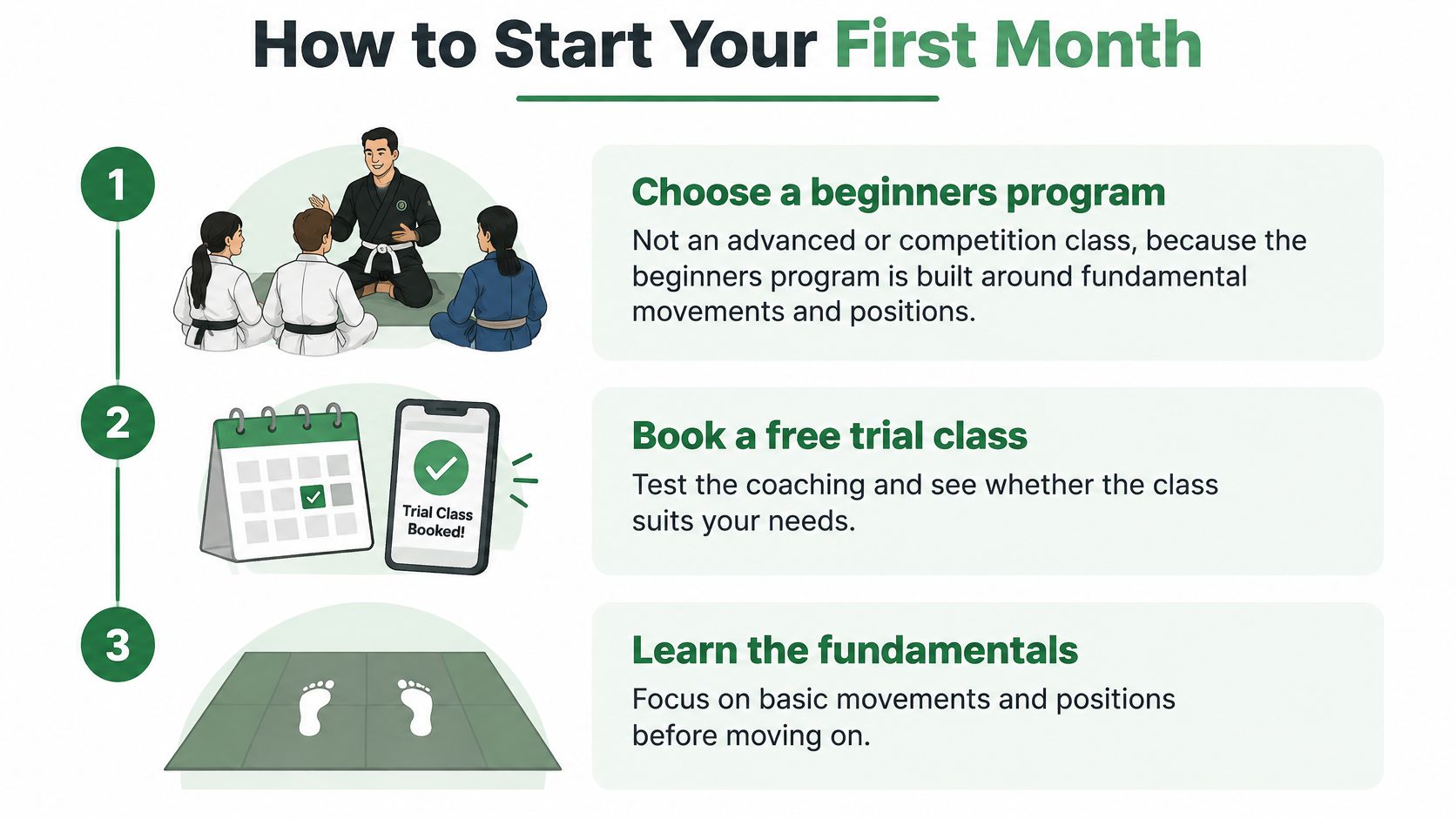
Build a repeatable routine
Choose a beginners program. Fundamental movements and positions need patient explanation, which an advanced or competition session may not provide. Don't mistake a harder class for a better starting point.
Book a free trial class where one is offered. Test the coaching style, room atmosphere and how you feel afterwards rather than committing on enthusiasm alone. Before booking, confirm whether the trial is free and ask about ongoing fees, contract length and cancellation terms.
Reserve two fixed sessions a week as a starting plan. Choose times you can realistically protect around work and family. A common slip is filling the calendar in the first week, then discovering the schedule is impossible to maintain.
Keep your kit basic. Start with comfortable training clothes without zips or exposed hardware, a rash guard for grappling and a water bottle, and confirm any uniform requirements before buying. If you progress to striking contact, get the required mouthguard before participating, not afterwards.
Arrive ten minutes early. Introduce yourself and mention injuries, medical conditions or recent surgery so the coach can discuss suitable adjustments. Don't leave this conversation until a drill causes discomfort; seek medical advice beforehand if you're unsure about readiness.
Use eight sessions as an initial review point, not a deadline for competence. Pick a weekly focus, such as posture, an escape or a guard position. Changing your target every session makes it harder to recognise improvement.
The video below offers another way to get familiar with the training before attending.
A solid first month means you attended most planned sessions, can repeat some movements and feel more comfortable meeting a new partner. Technical confidence develops over months of practice, not according to a guaranteed calendar.
Fitness and Confidence Benefits to Expect
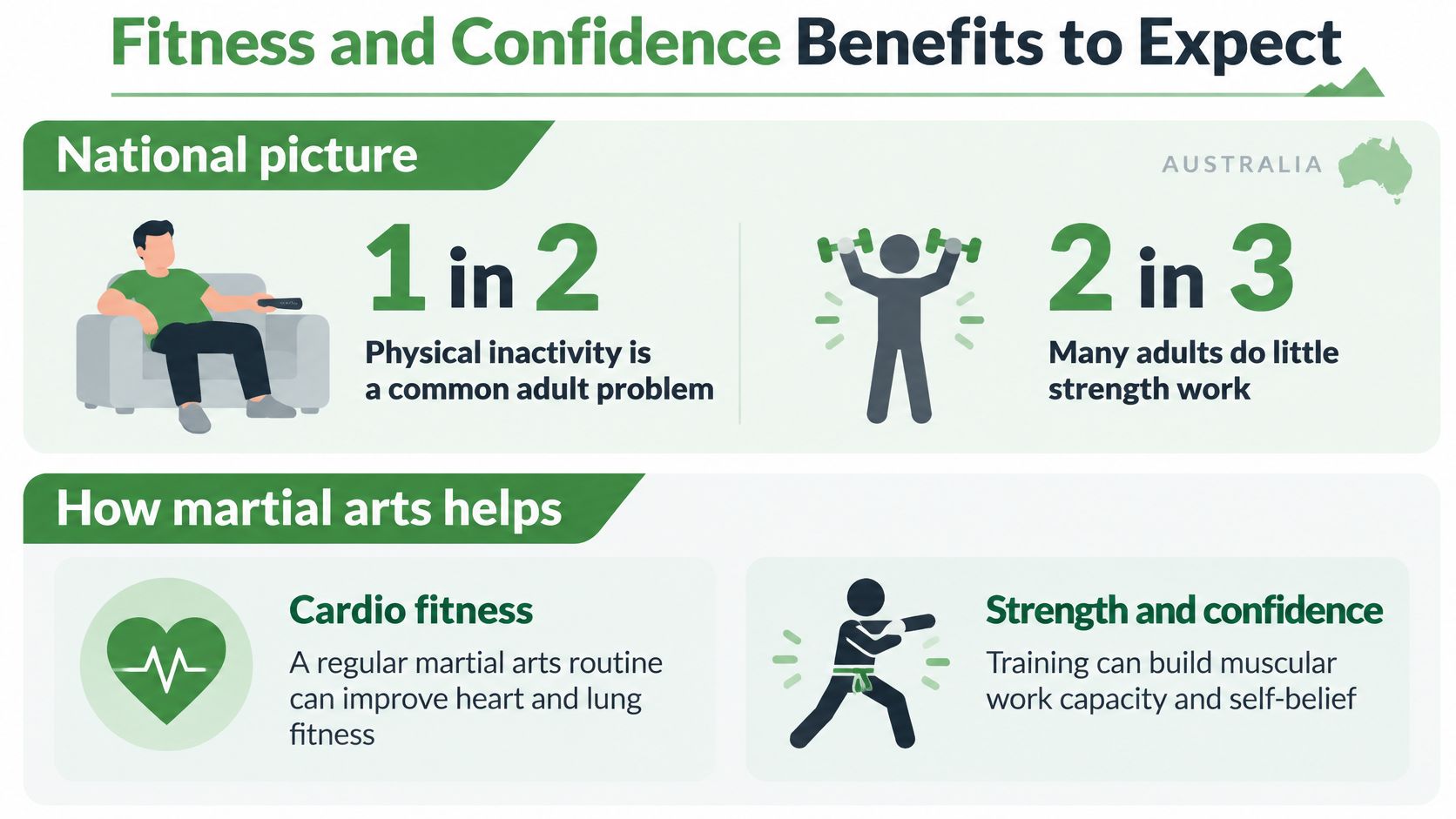
The latest figures in the AIHW's cited historical report are from 2014–15, not current rates: 52% of Australian adults aged 18–64 didn't reach the recommended moderate or vigorous activity across five or more weekly sessions, about 70% of adults did no strength-based activity, and only 19% achieved both recommendations.
A martial arts routine can include aerobic effort and resistance work through movement drills, partner pressure and sustained rounds. Those opportunities become useful through regular practice over months, rather than a single demanding workout.
The main benefits involve both physical capacity and confidence.
Look for practical changes
Stamina: You may complete a controlled round with fewer pauses and steadier breathing.
Balance and coordination: Recovering your base becomes less awkward when a partner changes direction.
Grip and trunk strength: Holding position and resisting movement can build work capacity.
Flexibility: Repeated, comfortable movement can make positions more accessible without forcing stretches.
Calm and confidence: Practising a safe fall, grip escape or way to create distance gives you a specific skill rather than imagined reassurance.
Confidence in class isn't a guarantee of safety outside it. Avoidance, awareness and leaving a dangerous situation remain important.
For more detail, explore how BJJ can contribute to fitness. If you track aerobic effort, Wallaby Wellness lets you calculate your target heart rate zones; treat estimates as guidance, not targets to chase during every technical drill.
Track more than sweat
Record sessions attended, rounds completed, next-morning comfort and a skill that feels easier. Results depend on attendance, intensity, recovery and your wider activity plan, so compare similar sessions rather than judging yourself by how exhausted you feel.
Common Worries Adults Have and How to Handle Them
You don't need to pass a fitness test before you're allowed to learn. A suitable beginner session starts from what you can currently do, with adjustments where needed.
Australian guidance also recognises different needs across adulthood: recommendations for older adults include fitness, strength, balance and flexibility, according to AIHW's guidance on physical inactivity. That supports adapting the activity, not assuming everyone should train identically.
Turn each worry into an action
I'm not fit enough. You can learn a movement without completing every repetition at full pace. Tell the coach your current activity level and ask how to scale the drills.
I'm too old or too late. Being an adult beginner isn't a contradiction, although mobility, health and recovery needs differ. Discuss suitable movements and contact levels before joining.
I'm not flexible. Starting positions can be adjusted while you develop comfortable movement. Ask for a smaller range rather than forcing yourself into a shape; splits aren't an entry requirement.
I'll get hurt. Injury is possible, and no coach can remove all risk. Declare existing injuries, tap before pain and choose controlled partners.
I won't fit in. You don't have to be outgoing to participate. Ask how newcomers are introduced and paired so you know what to expect.
I'll be the worst in class. Experienced students have practised skills you haven't learned yet. Measure your own ability to follow instructions and repeat a movement instead.
A useful boundary: You should be able to say that something feels uncomfortable without being pressured to continue.
Our guide to finding a good Jiu Jitsu gym explains coaching and training-environment checks. Pay particular attention to how a coach responds when someone needs a slower pace.
Fitting Training Into a Busy Adult Week
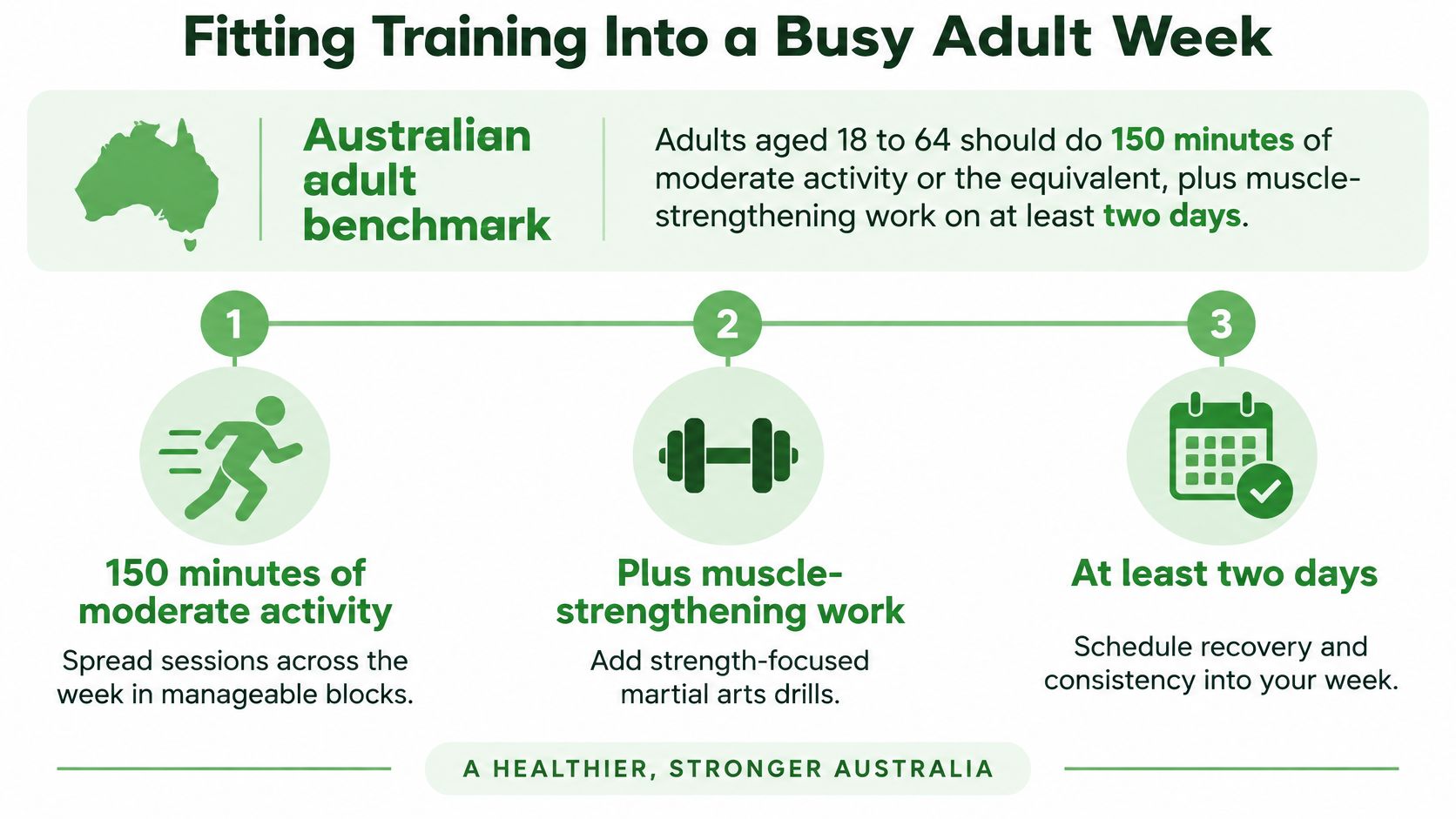
For adults aged 18–64, Australian physical activity guidance uses 150 minutes of moderate-to-vigorous activity across five or more days per week as its activity threshold and separately recommends muscle-strengthening work on at least two days.
A single class can contribute, but it won't meet that frequency benchmark alone. Also, the time spent listening to a demonstration isn't the same as time spent moving at moderate or vigorous intensity.
The weekly pattern matters as much as the class booking.
Choose a workable starting pattern
These are example schedules, not calculated guarantees of meeting every recommendation. Add up your actual active time and strength work rather than assuming a row automatically covers everything.
Example weekly plans for adult beginners
Sessions per week | Example pattern | Extra activity to add | What it covers |
|---|---|---|---|
1 session | One beginner class on Tuesday evening | Two 30-minute walks and one short strength session | Skill practice once a week, with walking and strength helping fill the gap |
2 sessions | Tuesday and Saturday classes | Two 20-minute strength sessions at home and daily walks | Regular technique work and two planned strength days |
3 sessions | Monday, Wednesday and Saturday classes | Two short walks and one mobility session | Frequent practice with built-in recovery days |
The lightest schedule may still need more aerobic activity and another strength day. The busiest schedule also needs checking: technical classes don't automatically provide enough strengthening work just because you attended.
Adjust around real commitments
Protect fixed training days, then fit walking into lunch breaks or after dinner. For home strength work, use movements you can control, such as chair squats, wall push-ups and resistance-band rows, with appropriate progression.
For shift workers, anchor training to the roster rather than insisting on the same weekday. Parents can choose a primary session and a backup slot instead of treating a disrupted evening as a lost week.
Increase attendance or round length in small steps, rather than increasing both together. If sleep, mood or soreness worsens, reduce the workload and discuss persistent symptoms with an appropriate health professional.
Each Sunday, check your active minutes, strength days, and recovery. Decide whether the coming week needs more movement, less intensity, or the same manageable routine.
Book a Free Trial Class to Start
Book a free trial class and use it to judge whether the training suits you. You don't need to make a long-term decision before you've experienced the coaching and practised alongside a partner.
Before booking, get clear answers about ongoing fees, contract length and cancellation terms. Knowing the commitment helps you decide calmly, without feeling rushed after the session.
Make the trial useful
Locals Jiu Jitsu Alexandria in Alexandria, Sydney, is one option to consider. Our Beginners program builds a strong foundation of fundamental techniques and concepts for individuals of all ages, genders and fitness levels, and we offer a free trial class for all levels.
Use the style and first-month decisions already made to keep your next step straightforward. Check our website's timetable, identify two fixed sessions that could suit your week and book the trial.
Take this checklist with you:
Notice the aftermath: Did you feel interested and appropriately challenged, or overwhelmed and reluctant to return?
Discuss the first month: Ask what you'll practise initially and how the coach will help you develop the fundamentals.
Check partner grouping: Find out how size, experience and comfort are considered.
Confirm your boundaries: Make sure you can pause, stop or decline a practice when needed.
You don't need to leave feeling talented. A useful trial gives you a clearer understanding of the class, confidence in asking questions and enough information to decide whether to return.
After attending, use your first-month plan rather than adding a demanding new schedule. The next success is keeping a realistic booking, not proving how much training you can tolerate.
Locals Jiu Jitsu Alexandria offers foundational beginner training and a free trial class for all levels, giving you a practical way to start martial arts without needing previous experience. Visit Locals Jiu Jitsu Alexandria to check the timetable and book your free trial.
Comments