
Martial Arts for Females: What Beginners Need to Know
You've had the class page open for a week. You close it because you don't know what happens if you're the only new person, who you'll be paired with, or whether you'll look out of place. That hesitation is reasonable. Martial arts for females is less about finding the toughest style and more about a room that treats a complete beginner as welcome.
The useful questions are practical. How much contact will you face? What do you wear? What hurts is normal, and what means stop? What can training change about your safety, and what can it never promise?
Table of Contents
Which Martial Arts Styles Suit Women Best - How much contact you want
What Happens in Your First Class - A simple first-session order
What to Wear and How to Handle Injuries - Soreness versus a real warning
Fitness Gains and How Training Fits Your Week - A week that actually fits
Confidence and Self-Defence Skills You Build - What early classes actually drill
Self-Defence Limits and What Training Can Realistically Do - Questions people skip
Which Martial Arts Styles Suit Women Best
A woman who wants fitness and steady technical progress may prefer a different class from someone drawn to competition or striking. Start by asking what you want to practise, then check how contact is introduced. The class format matters more than the style's reputation.
Style | Main focus | Contact level | Best fit for |
|---|---|---|---|
Brazilian Jiu-Jitsu | Ground grappling, leverage and positional control | Controlled partner drills, with pressure adjusted to experience | Women who enjoy problem-solving and technique |
Judo | Throws, grips and safe falls | Partner practice includes throws and ground work | Women interested in throwing and falling skills |
Taekwondo | Kicks, footwork and flexibility | Drills, with sparring depending on the class | Women interested in kicking and a structured grading path |
Boxing | Punching, footwork and pad work | Pad work and conditioning; sparring varies by class | Women interested in striking and cardio conditioning |
Karate | Striking techniques, forms and kata | Often focused on drills and forms; contact varies | Women who prefer structure and forms |
Muay Thai | Clinch, kicks, knees and elbows | Pad work and partner drills; sparring varies | Women seeking striking practice and conditioning |
Women train in styles such as judo and taekwondo, but a style name alone cannot tell you whether a class will suit you. Ask how beginners are taught, how partner work is matched, and whether you can observe or pause when needed.
How much contact you want
Karate and taekwondo classes may focus on forms, kicks and fitness, with sparring depending on the school. Ask what a typical beginner session involves before deciding.
Brazilian Jiu-Jitsu and judo involve partner practice, grips and close contact. In Brazilian Jiu-Jitsu, students work through ground positions; judo includes throws and falling practice. A beginner-friendly class explains each drill and builds pressure gradually, rather than expecting newcomers to keep up without guidance.
Boxing and Muay Thai focus on striking. Pad work lets you practise punches or kicks against a target, while sparring involves practising with a partner. Find out when sparring is introduced and whether it is optional for beginners.
Practical rule: Choose a class whose teaching style and contact level feel manageable. Give yourself time to decide whether you enjoy the training.
For a broader comparison, read this guide to choosing a martial art. Then consider which kind of practice you would look forward to attending regularly.
What Happens in Your First Class
Most beginners worry they'll be judged, that they'll be the only newcomer, or that they won't belong. Those worries match barriers the Australian Sports Commission names for women aged 15 and over: fear of judgment, low confidence, worries about appearance and competence, a male-dominated culture, harassment, awkward times, cost, and feeling unsafe. For girls, being watched, feeling inadequate, menstruation, and travelling home on dark winter evenings sit among the leading barriers, and 62% of girls want to be more active but face obstacles.
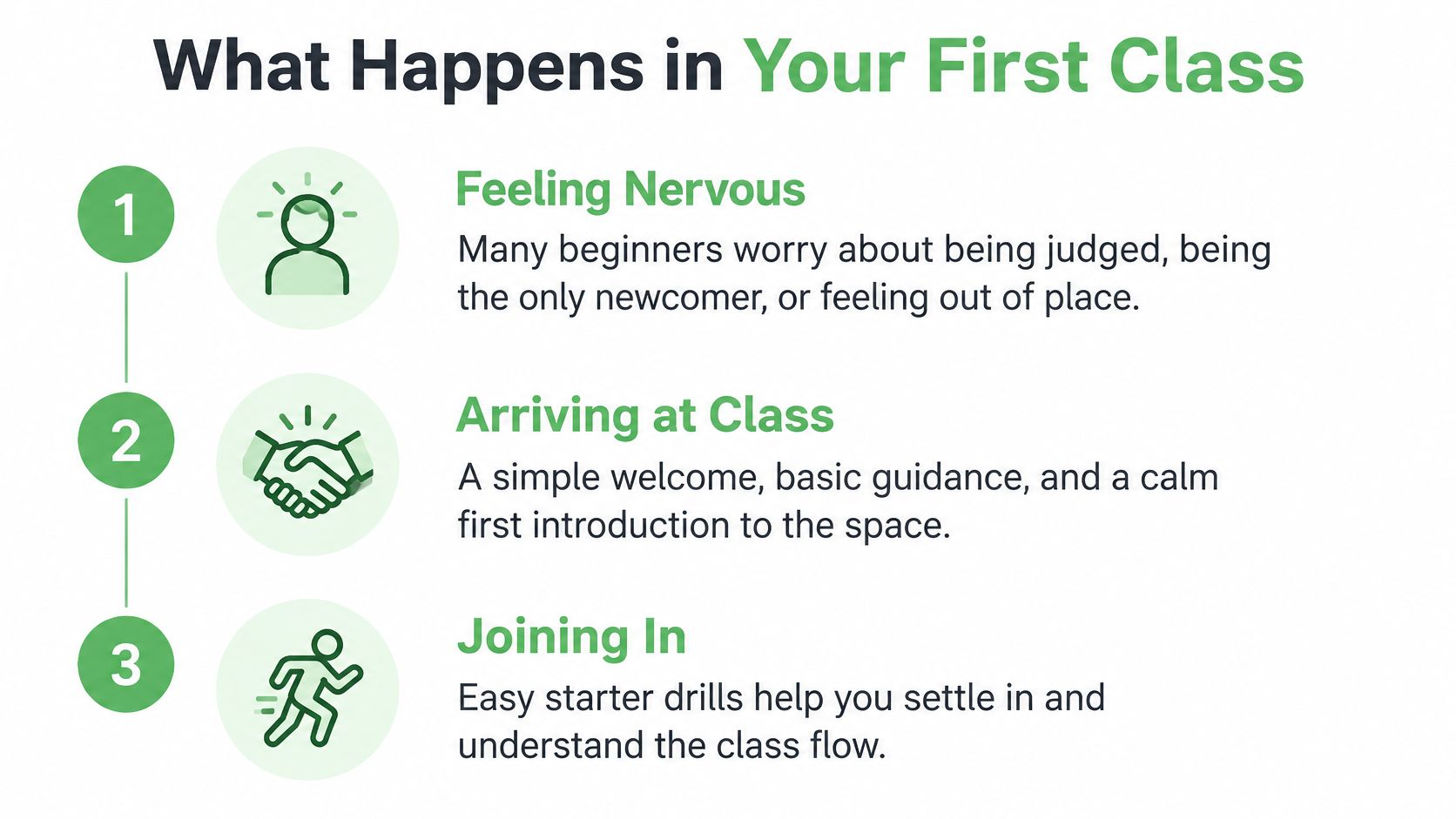
A clear first hour takes the guesswork out. At Locals Jiu Jitsu Alexandria, the room is family-friendly and set up for anyone who wants to train, including people with no experience. Our coaches put safety and progression ahead of looking tough.
A simple first-session order
Arrive early. Come 10 to 15 minutes before the start and tell the coach you're new, so they can plan your round instead of dropping you into the middle.
Warm up first. Movement drills come before any partner work. You learn how the class moves without anyone grabbing you yet.
Learn the basics slowly. Falls, stances and simple steps are enough. There is no sparring on day one.
Take the partner you're given. The coach should match size and experience. Say so if the pairing feels wrong.
You can stop a drill. A clear signal should make the coach pause. You don't have to push through fear to be polite.
Cool down and check in. A short chat covers what you practised and when the next beginner session runs.
You don't need to perform. You need to leave knowing what you did, what felt safe, and when you can come back.
What to Wear and How to Handle Injuries
Wear a well-fitted high-support sports bra or a protective compression layer, plus a rashguard that stays put when you invert. Clothing should let you breathe. Loose tops twist, ride up, and rub.
An Australian-led study of 182 female athletes found that 36% reported breast injuries, and 21% of those affected said the injury hurt their performance. Contact and combat athletes reported contact injuries more often, with higher risk also tied to larger breasts and a higher body-mass index. In grappling, the usual causes are a knee or elbow, chest compression in a pin, friction from a gi or rashguard, and repeated impact in takedowns.
On your period, use products you can change in the bathroom without a rush, and plan lighter drilling on heavier days. Tell the coach if you need a break. You don't owe anyone the details.
Soreness versus a real warning
Symptom | Likely cause | Action |
|---|---|---|
Normal muscle soreness | Unaccustomed training load | Continue at lower intensity and monitor |
Focal pain or tenderness | Direct knee, elbow or pin pressure | Stop the drill, see a doctor and reduce load |
Bruising or swelling | Takedown or joint contact | Rest, get a medical assessment and avoid contact |
Persistent tenderness | Repeated compression or impact | Medical assessment and temporary load reduction |
Breast discomfort during training | Poor support or a shifting top | Refit the sports bra or layer and tell the coach |
General muscle ache the next day is common. Focal pain, bruising, swelling, or tenderness that doesn't settle means stop, get a medical check, and cut the load. While you recover, stay technical with lower-intensity positional sparring and controlled movement drills instead of full contact. More on that sits in how to prevent injuries in BJJ.
Fitness Gains and How Training Fits Your Week
Fitness claims only make sense next to a benchmark. For children and young people aged 5 to 17, ABS guidance on the national physical-activity guidelines sets at least 60 minutes of moderate-to-vigorous activity every day, including muscle- and bone-strengthening work on at least three days. The same guidance notes that only 44% of adults aged 18 and over met the national physical-activity guideline.
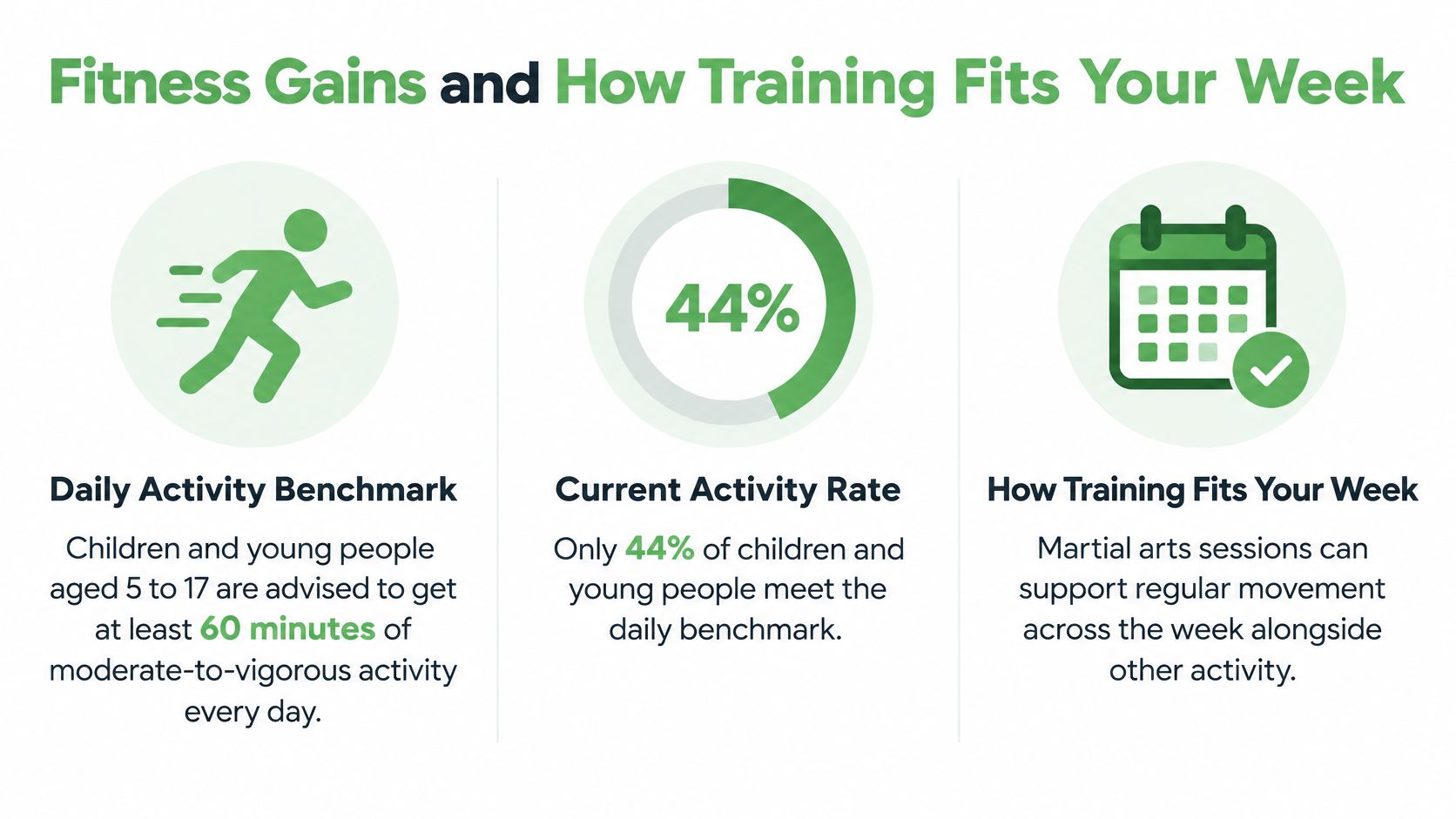
A class adds pieces of that week, not the whole target. Warm-ups raise how much you move. Technical drills ask for whole-body coordination. Positional sparring loads strength and balance. Controlled rounds lift the intensity. At Locals Jiu Jitsu Alexandria, training is built around technique, fitness, self-defence, and personal growth, which is a different job from chasing a single daily minute count.
The Australian Sports Commission physical activity evidence reports that an estimated 5,522,000 Australian women aged 15 and over, 49% of that population, took part in physical activity at least three times a week. A set class can sit inside a habit you already half have.
A week that actually fits
Say you train Tuesday and Thursday, walk most other days, and add a short strength session on Saturday. Off the mats, build strength with beginner workouts if you want simple lifting to support grips and posture. Two or three classes plus walking is plenty for a new starter. Martial arts complements the weekly guideline. It doesn't replace it, and one class won't make every student meet the target. Whether grappling is a sensible fitness choice is covered in is BJJ good for fitness.
Over eight weeks, track four things: energy, sleep, strength in simple movements, and how often you attend.
Confidence and Self-Defence Skills You Build
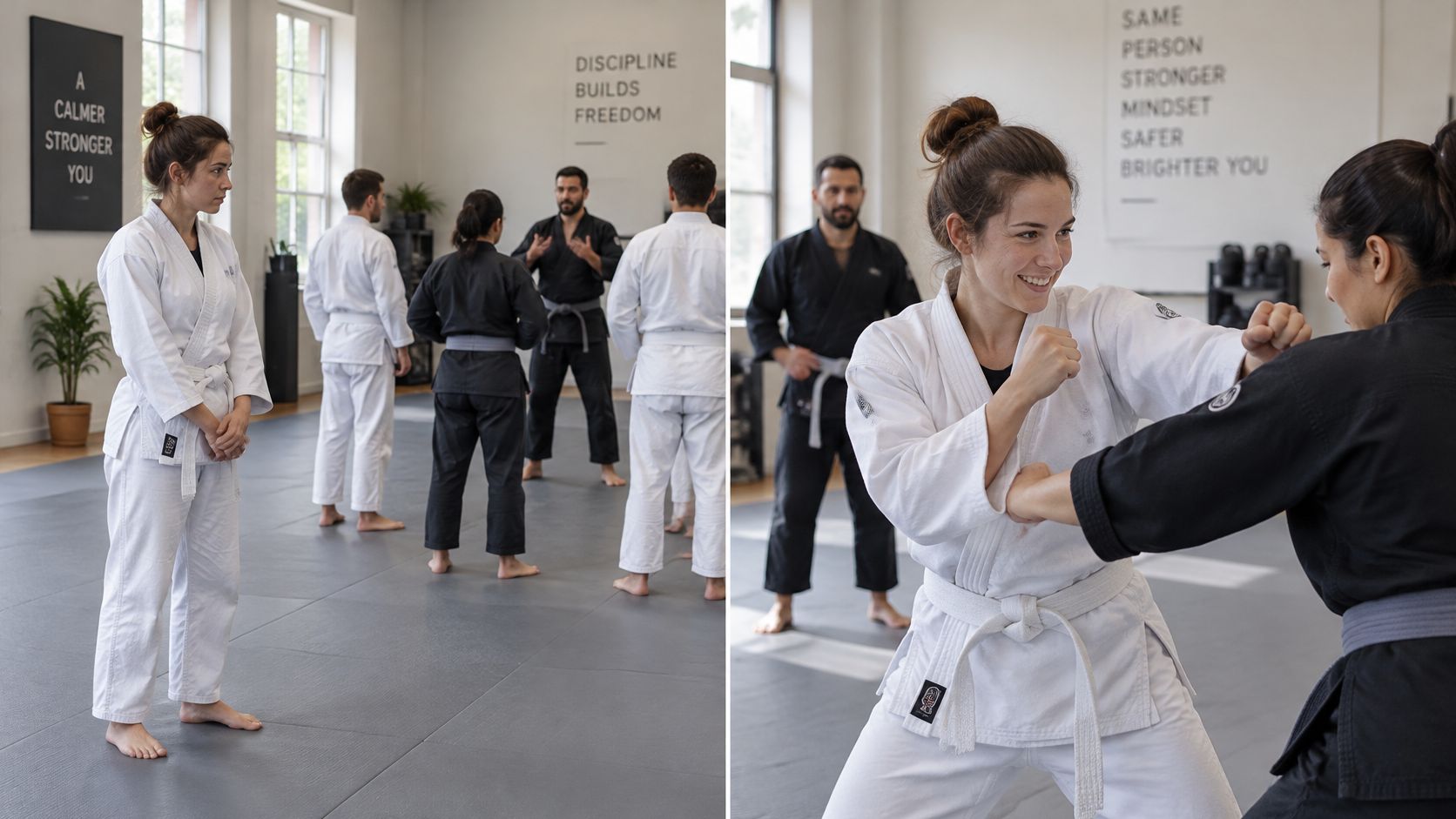
Say you've had a hard year and you walk in convinced you'll be the only beginner. The first rounds feel clumsy. A few weeks later the same drills feel familiar, because you've repeated them, not because you became a different person overnight.
What changes is specific. You get better at threat recognition, saying a clear boundary, moving with intent, and acting while your heart rate is up. In a survey of more than 400 Australian women who practised martial arts, Women's Agenda reported that 95% described moderate-to-high improvements in mental health and confidence or self-esteem, 93% felt safer and more secure day to day, and 78% believed training would lower their risk of harm in a physical confrontation. Those figures are self-reported. They describe how women felt. They don't prove that classes prevent violence.
What early classes actually drill
A women's beginners block should favour positional escapes, grip-fighting, balance disruption and controlled resistance. Isolated submissions can wait. In the first months you can expect three jobs:
Escape a clinch. Create space, turn your hips, and step out instead of shoving harder.
Break a wrist grip. Use angle and two hands on one, then move your feet.
Leave a pinned position. Frame, shrimp your hips, and recover a safer shape before you try anything fancy.
This short clip shows the kind of calm, repeatable movement those drills are built on.
Progress looks ordinary from the outside. You stay calmer when a partner adds pressure, and you speak up when a round needs to slow down.
Self-Defence Limits and What Training Can Realistically Do
No class can guarantee your safety or stop an assault. Training belongs inside a wider plan: notice what's around you, de-escalate, ask for help, and leave when you can. Women are often harmed by people they know, so a gym skill doesn't replace those steps.
Sport and self-defence are different jobs. A referee, a bell, and a set starting position don't show up on a street or in a home. What transfers is positional control, putting escape first, setting a boundary, and reading the space. What doesn't transfer is waiting for a restart, accepting a bad position because the rules say so, or assuming a partner will stop when you tap if the other person isn't there to train.
The Australian Sports Commission safeguarding guidance describes harmful sporting environments that can include psychological abuse, bullying, gender-based harassment and sexual harassment. Risk rises with power imbalances, hypermasculine norms, weak reporting and little accountability. A class that ignores that isn't teaching safety.
Questions people skip
A smaller or less athletic woman can still benefit. The point is technique, frames and escapes, not out-muscling someone.
Against a larger person, force is the wrong bet. Frames, angles and getting out matter more than winning a strength contest.
Competition-style sparring is a poor fit for beginners, for anyone injured, and for badly matched partners. Progressive intensity and consent-based drilling let you test a skill without pretending it's a real attack.
The right question isn't whether martial arts makes you safe. It's what it realistically adds to the safety habits you already use.
Choosing an Inclusive Women's Training Environment
An inclusive class is an operations job, not a slogan. Look for beginner-only rounds, private changing space, a plan for periods, a finish time that doesn't leave you walking home in the dark alone, coaching that fits different bodies, and a written way to report bad behaviour. Gender-neutral wording on a website doesn't create any of that.
Turn those details into questions before you pay for a month.
How are partners matched? Ask how size and experience decide the pairing, and whether you can decline a partner.
Who takes a complaint? Ask whether safeguarding and harassment rules are written down, and who you speak to if a coach is the problem.
Is there a beginner or women's session? A separate round lets you learn falls and frames before a mixed class.
How does partner rotation work? Nobody should be stuck with the same person every round.
Who watches the mats? Ask who supervises sparring and how an injury stops the round.
Shoulder niggles show up early from grips and posts. A plain Thermo Recovery Wear shoulder brace guide is worth reading if you want support while you keep technical rounds, not as a substitute for a clinician.
Respect in the room beats any single technique. If you can't see how partners, complaints and injuries are handled, you don't have enough information yet.
Book a Free Trial Class to Test the Fit
Pick one style from the comparison, then check a timetable and book a free trial class at Locals Jiu Jitsu Alexandria. Trials are open to all levels, and you can book from the timetable rather than guessing which session is for newcomers.
Bring comfortable training clothes, a fitted support layer, a water bottle, and the questions above. You aren't auditioning. You're collecting evidence.
Judge the hour on four points. Did the coach explain the movement in plain words? Did the partner work feel safe? Did people treat you with respect when you were slow? Do you want to come back? If one answer is no, that is useful information.
Give it two or three beginner classes across four weeks before you lock in a longer plan. One nervous night isn't a fair test, and neither is signing up because you felt you should. The right room is one where you feel respected, stretched, and able to keep showing up. That call is yours after the trial, not before it.
Locals Jiu Jitsu Alexandria runs structured Jiu Jitsu for beginners and families in Alexandria, with coaching aimed at technique, fitness, self-defence and steady progression. If you want to see whether the room feels right, book a free trial and judge it for yourself. Visit Locals Jiu Jitsu Alexandria to check the timetable and reserve a session.
Comments