
No Gi Jiu Jitsu Clothing: What to Wear
You're packing your bag the night before your first class, looking between a gym T-shirt, beach shorts and a rash guard online. You don't need a branded wardrobe to get started. You need no gi Jiu Jitsu clothing that stays put, has no snag points and suits the session you're attending. Everyday training and competition are different jobs, so choose your class kit for safe movement and your competition kit against the organiser's written rules.
Table of Contents
What to Wear for No Gi Jiu Jitsu - Start with the wearable basics - Leave everyday gym clothing behind
Why No Gi Clothes Cannot Be Loose - Follow the fabric through a scramble - Keep relaxed fits off the mat
How to Choose a Rash Guard That Lasts - Ask what the fabric actually does - Use a movement test - Check UV protection for outdoor use
Example Kits for Class Heat and Kids - An adult starting this month - A hot evening around Alexandria or Green Square - A parent buying for a child
Class Clothes Versus Competition Rules - Check the event you actually entered - Run a pre-weigh-in clothing check
Wash Rotate and Replace Your Kit - Make washing part of the routine - Mend sound clothing and retire failed fabric
Pack Your Kit and Try a No Gi Class - Let movement settle the choice - Arrange your first visit
What to Wear for No Gi Jiu Jitsu
For a normal session, start with a compression rash guard and grappling or fight shorts. No-gi means grappling without the traditional jacket and pants, so your clothing needs to sit close to your body rather than provide fabric for someone to hold.
No-gi class clothing at a glance
Item | Bring it? | Fit or rule for class | Why it matters |
|---|---|---|---|
Rash guard, short or long sleeve | Yes | Tight compression, flat seams, no zipper | Helps limit mat burn and loose grips |
Grappling or fight shorts | Yes | No pockets, buttons, snaps or metal | Covers the thigh without a handle |
Spats or compression tights | Optional | Worn under shorts, no loose cuffs | Extra cover in scrambles |
Mouthguard | Yes for sparring | Boil-and-bite or fitted | Helps protect teeth in live rounds |
Cotton T-shirt or singlet | No | Loose and absorbent | Grips, stretches and stays wet |
Board shorts or sport shorts | No | Avoid pockets, hardware and baggy legs | Can snag and fail event checks |
Shoes or thongs | Off the mat only | Clean feet on the mat | Keeps street dirt off the surface |
Start with the wearable basics
Short-sleeve and long-sleeve rash guards both suit class when they hug your torso and arms. Tight means secure, not so restrictive that you can't breathe comfortably or reach overhead.
Choose shorts that cover a solid share of the thigh and let you squat without pulling across the seat. Check the actual garment, not just its description: a product labelled fight shorts can still have an exposed cord or closure you need to inspect.
Spats provide extra leg coverage underneath shorts without adding loose fabric. A mouthguard belongs in your bag once live rounds begin; choose a boil-and-bite or fitted model that stays seated without constant clenching.
Leave everyday gym clothing behind
A cotton T-shirt, baggy singlet or familiar pair of beach shorts might feel comfortable standing up, but that's not the test. During grappling, clothing presses against your partner, stretches across bent joints and moves against the mat.
An Australian grappling FAQ recommends rash guards and grappling shorts, or other tight-fitting athletic clothing, excludes zippers and pockets, and explains that no-gi training is barefoot. It also advises keeping feet clean and wearing shoes or thongs away from the mat so contaminants aren't carried back onto the training surface.
Check for metal or plastic hardware, including small decorative pieces. Keep your thongs beside the mat for trips to the bathroom, change room or outside.
Pack tonight: a clean rash guard, clean grappling shorts, mouthguard, water and thongs. That's a useful starting kit, without buying accessories you haven't yet found a reason to use.
Why No Gi Clothes Cannot Be Loose
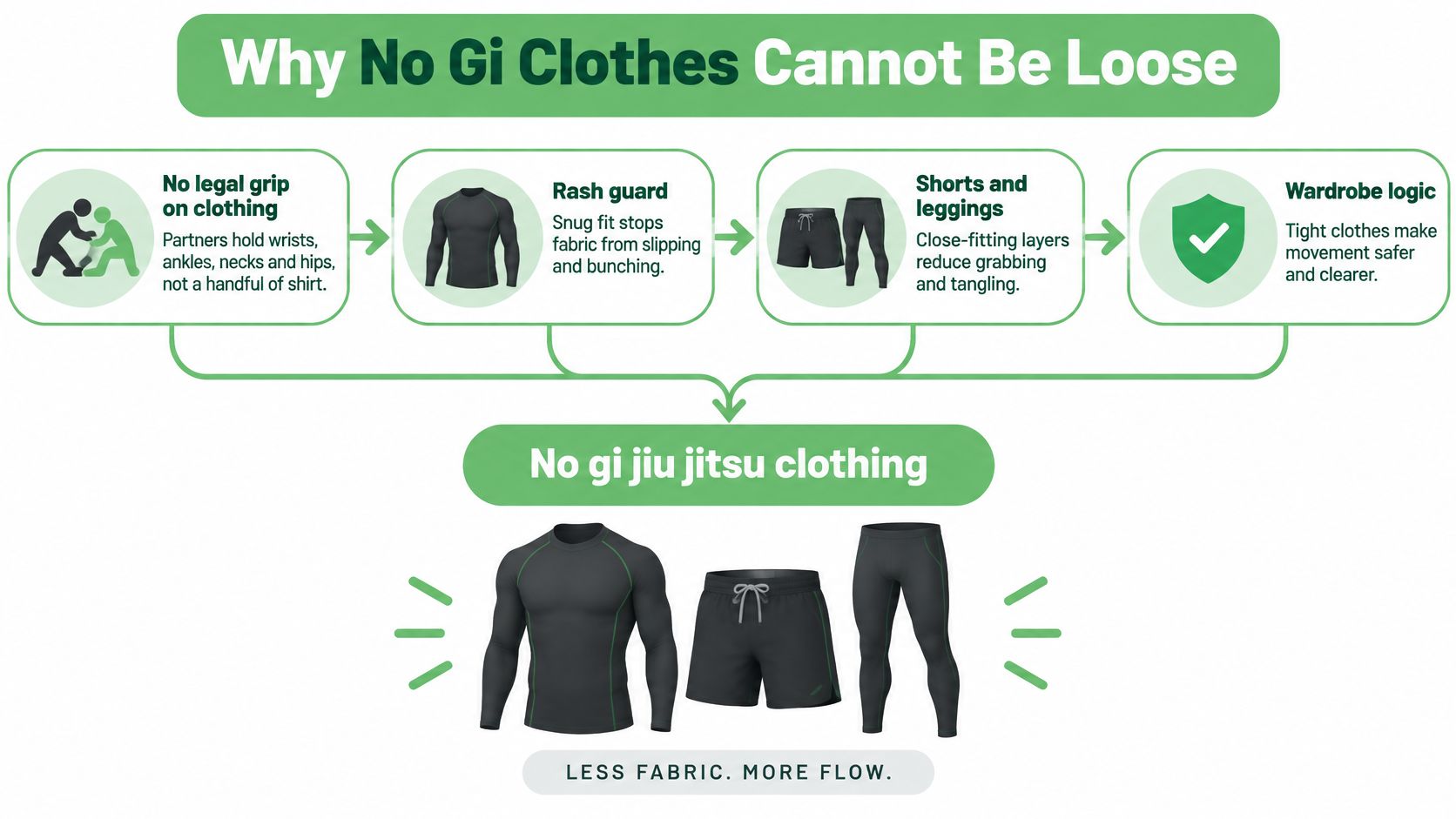
Think of a rash guard as a second skin and a loose T-shirt as a handle someone isn't supposed to have. No-gi partners work with grips around wrists, ankles, necks and hips, rather than taking a handful of shirt.
The published no-gi event rules on Smoothcomp prohibit grabbing clothing and allow body grips instead. Those rules also specify weighing in without the gi and restrict heel hooks and knee reaping to brown- and black-belt divisions, showing why both clothing checks and technique permissions depend on the ruleset.
The relationship between those rules and clothing design is straightforward.
Follow the fabric through a scramble
Say you take a wrestling shot. Your top should stay against your shoulders while your shorts let your hips drop, without the waistband opening or the legs pulling tight.
Then you invert from guard. A loose shirt can slide towards your face, while excess material around your hips bunches under your partner's weight. From tight side control, that same fabric can become trapped beneath you when you're trying to turn and recover position.
Hard components create a different problem. A zipper tooth, snap or plastic drawstring tip can press into skin or scrape across the mat, while a pocket opening gives a finger or toe somewhere to catch.
Practical rule: A legal grip doesn't become safer just because the clothing caught in it was grabbed accidentally.
Keep relaxed fits off the mat
Loose clothing has a place outside training. ClothME's guide on how to style relaxed clothing is useful for everyday outfits, but the extra room that works casually is exactly what you're trying to remove from grappling kit.
A weigh-in without the gi doesn't automatically mean an organiser excludes every item of clothing from your measured weight. Follow the event's weighing procedure rather than assuming a soaked cotton layer won't count.
Likewise, don't copy an advanced competitor's outfit or leg attacks from a highlight reel. Their division may permit something yours doesn't.
Before relying on a new top in rounds, perform a deep squat and raise your arms overhead. If the hem lifts, the collar pulls or fabric collects around your waist, reconsider the size or cut.
How to Choose a Rash Guard That Lasts
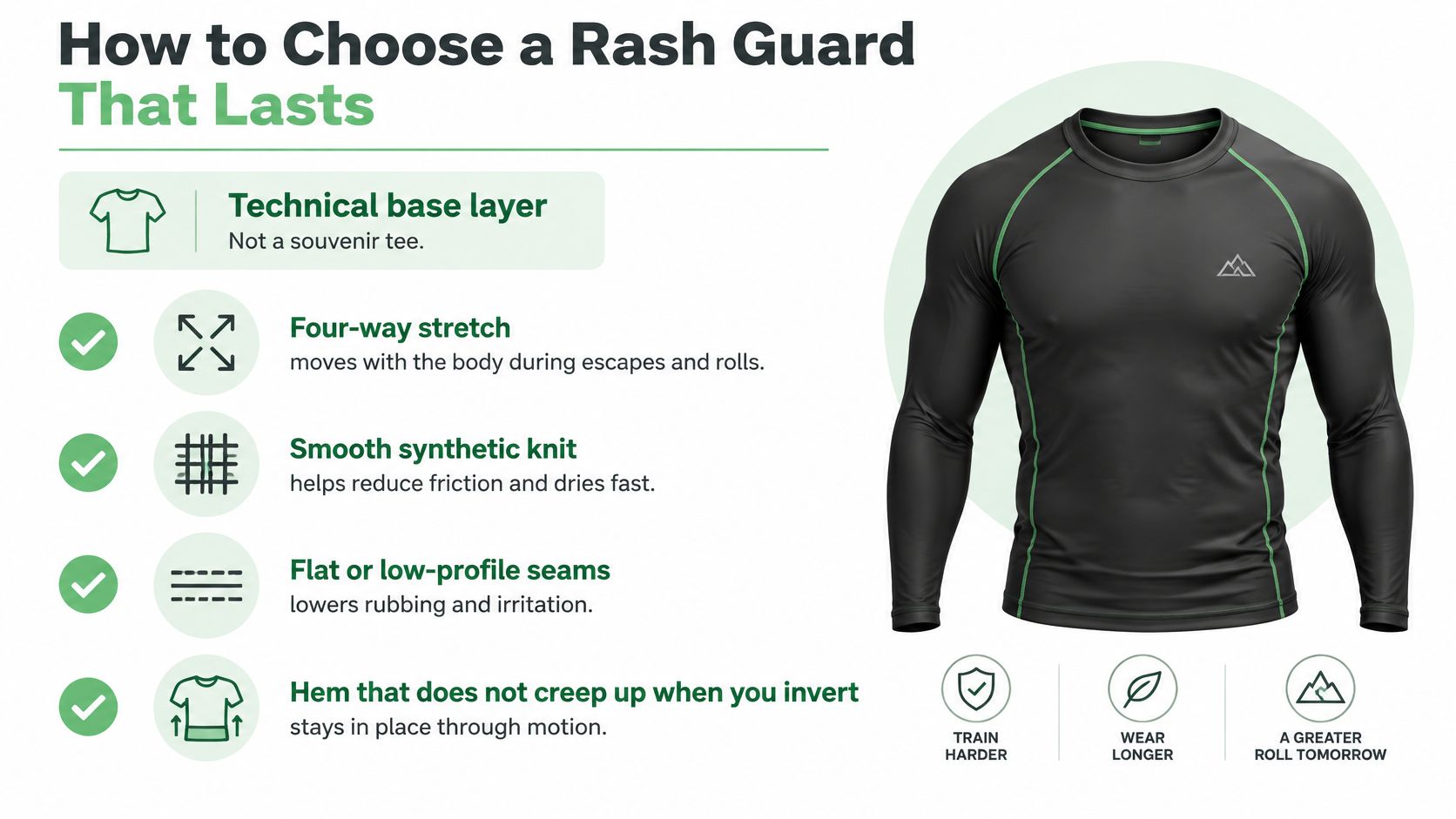
A rash guard can look sharp on a hanger and still distract you through every round. Choose it as a training layer: check how it stretches, how its seams feel, and whether the fabric suits where you'll wear it. A stylish print cannot make a poor fit or a rule-breaking outfit suitable.
Look for four-way stretch, a smooth synthetic knit and flat or low-profile seams. The collar and cuffs should sit against your skin without digging in, and the fabric should return to shape after stretching.
These details matter more than the artwork.
Ask what the fabric actually does
In Sydney's warm conditions, a top that holds sweat can feel heavy. Prioritise moisture management and drying performance rather than judging quality by how thick the fabric feels.
SGS Australia's comfort and performance wear testing covers attributes such as breathability, moisture management, UV protection and durability. Treat “quick-dry” and “antimicrobial” as claims to check, not automatic properties of polyester.
Check the inside seams, especially around the armpits and neck. A raised seam that feels rough on your fingertip may rub when pressed against your skin during training.
Use a movement test
Check the dry fit. Look for bagging at the lower back. The fabric should follow your torso without hanging away from it.
Reach and rotate. Raise your arms, circle your shoulders and reach forward as if framing against a partner. Your sleeves shouldn't restrict the movement.
Fold forward. Bend at the hips and check whether the hem stays over your waistband. If it keeps creeping up, try a different cut or size.
Review the first session. Check your ribs, neck and armpits for seam rubbing. Notice whether you spent rounds adjusting the top.
Long sleeves provide more coverage against mat friction, while short sleeves may feel cooler. For details on coverage and construction, see this guide to long-sleeve rash guards for BJJ.
Check UV protection for outdoor use
For outdoor warm-ups or camps, look for a UPF rating tested to AS/NZS 4399 under ARPANSA's fabric testing guidance. Higher UPF numbers indicate greater sun protection. Don't assume dark or thick fabric provides adequate protection.
Stretch, wetness and wear can affect how fabric performs. Cover exposed skin with suitable clothing, seek shade and use sunscreen on uncovered areas. For indoor training, prioritise fit and resistance to grappling wear.
Wash the rash guard after training, and don't train with an active skin lesion. Choose a size that passes the movement test, not one that only looks fitted when you stand still.
Example Kits for Class Heat and Kids
The easiest way to choose a wardrobe is to match it to your next training session, not every session you might attend someday. An adult beginner, a commuter training on a hot evening and a child can use the same basic principles without buying identical outfits.
Keep the shopping practical, whether you're buying for yourself or your family.
An adult starting this month
Start with a dark rash guard and plain grappling shorts. Black is an easy class choice, but a colourful print is just as practical when the garment fits correctly and has no problematic attachments.
Don't pay extra for a competition-colour outfit before choosing an event. Your first purchase needs to get you through class comfortably, not satisfy an unknown tournament's requirements.
A single clean outfit can cover your first visit if you can wash and dry it before returning. Once training becomes regular, a spare top and shorts make laundry less likely to disrupt your plans.
A hot evening around Alexandria or Green Square
Keep the compression cut rather than switching to a loose singlet. Choose a fabric that doesn't remain heavy when wet, and use sleeve length to balance your comfort with the amount of mat coverage you prefer.
Long sleeves can still be reasonable in warm weather when the fabric manages moisture well. If you're travelling home by train or walking to your car, pack a dry change of clothing as well as your thongs.
Watch movement when judging an outfit, not just how it looks while someone stands upright.
A parent buying for a child
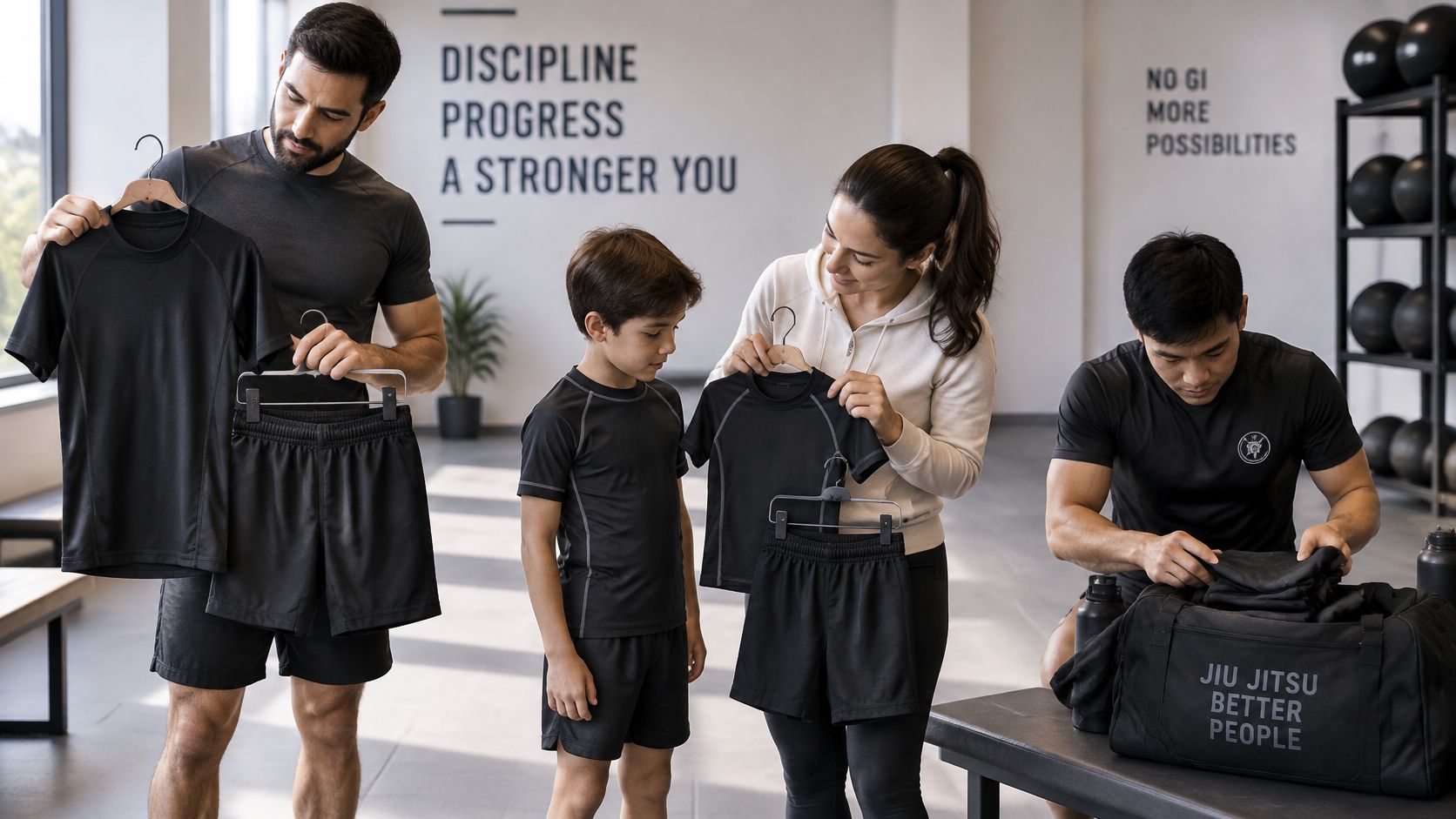
Scale the same rules down rather than buying a costume version of adult kit. Choose a close-fitting rash guard, pocket-free shorts and a practical spare set before spending on logos.
Avoid sizing up so far that the sleeves fold over the hands or the torso hangs loose. Growing room is useful in everyday clothing, but it shouldn't interfere with a child's ability to move safely during contact training.
Spats can help when shorts are cut high or a child wants more coverage during knee-on-mat movement. Check that the waistband stays comfortable when they crouch and that the cuffs don't gather around their feet.
For all these situations, leave the board shorts for the beach. A sensible upgrade path is class kit first, a spare clean set second, event colours last.
Class Clothes Versus Competition Rules
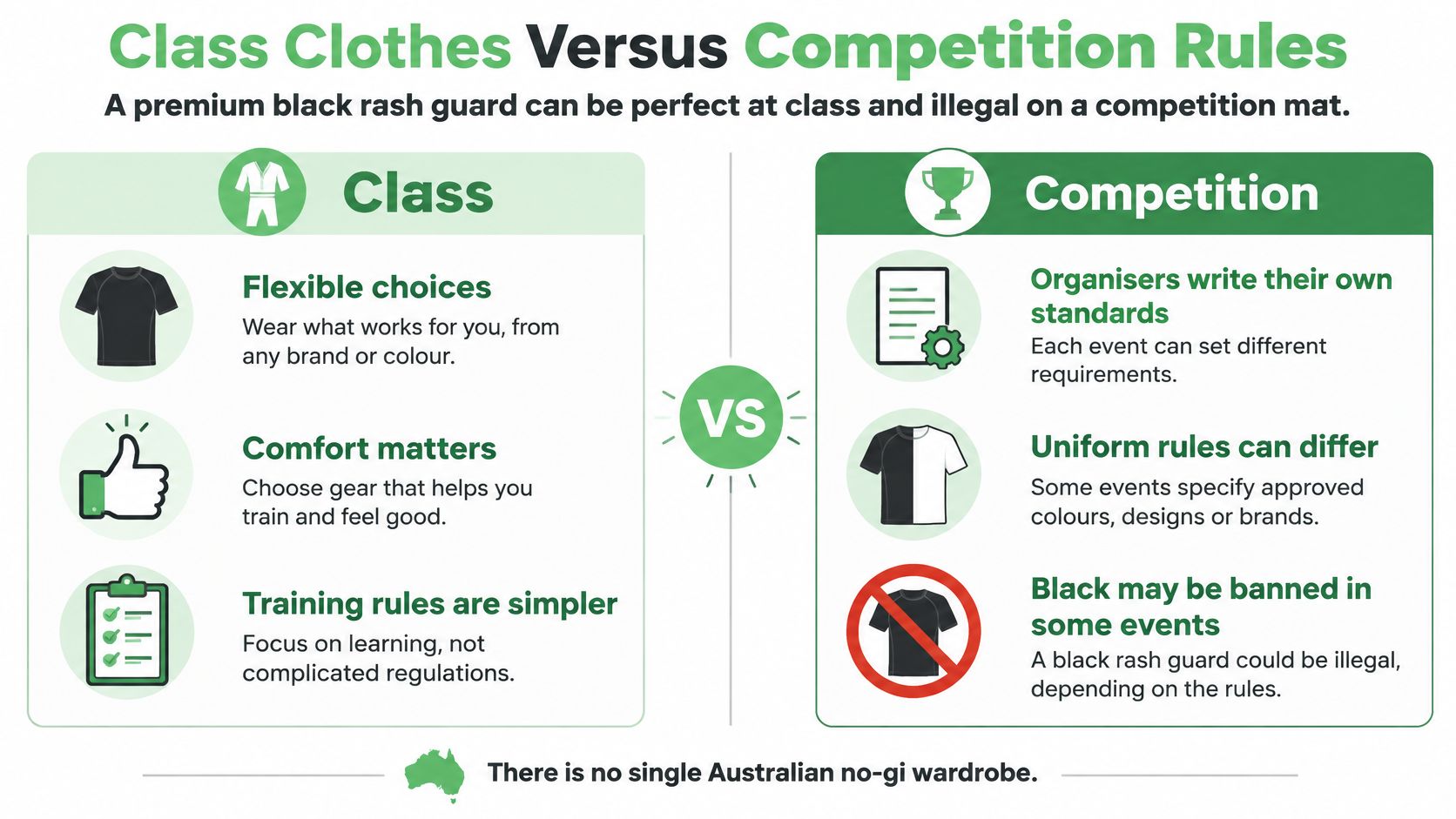
A rash guard that works for an ordinary class may not pass a competition uniform check. Class clothing is chosen for safe movement and comfort; competition clothing must also meet the specific organiser's rules. Brand and price do not determine eligibility.
Class kit versus competition checks
Check | Regular class | Rules may specify | What to confirm for your event |
|---|---|---|---|
Rash guard colour | Follow your academy's requirements | Assigned colours may apply | Which colours are accepted and how much of the garment must show them |
Shirt or rash guard | Choose close-fitting training clothing | Garment style may be restricted | Whether shirts must be rash guards and whether loose clothing is allowed |
Shorts | Grappling or fight shorts without hard parts | Cut and coverage may be specified | Accepted styles and minimum thigh coverage |
Pockets, buttons, snaps | Leave them off | May be prohibited | Whether any pockets or fastenings are allowed |
Zippers, metal, plastic | Avoid hard or snagging parts | May be prohibited | Which materials or attachments are restricted |
Board shorts or sport shorts | Check with your academy | May not meet the required design | Whether these styles are permitted |
Underwear or extra layer | Follow class requirements | Underlayers may be specified | What must be worn beneath the uniform |
Assigned colours and minimum thigh coverage vary by organiser, so check the event's uniform section rather than relying on a general grappling guide. A Sydney Grappling Championship event listing is one example of an event listing that describes clothing rules. Treat it as an example, not a standard for other competitions.
The same shorts can be fine for class and unsuitable for an event. Read the current rulebook for the competition you entered, because requirements can differ even between events using similar formats.
Check the event you actually entered
Some formats, including IBJJF-style events, have ranked-colour and garment-design rules. A red or blue top accepted at one event may not satisfy another event's requirements. Use the organiser's current rulebook, not the clothing shown in a poster.
For background, read this guide to no-gi Jiu Jitsu rules, then confirm the details with your event organiser. Check the uniform section and the weigh-in procedure so you know what to wear and when clothing inspection takes place.
Run a pre-weigh-in clothing check
Confirm the assigned colour. Check which colours are accepted and how the organiser identifies them.
Check sleeve requirements. Match the garment design to the rulebook.
Check shorts coverage. Wear the shorts normally and compare their cut with the event's stated requirements.
Inspect attachments. Look for pockets, cords, zippers and hard parts. If anything is unsuitable, choose another pair rather than trying a last-minute alteration.
Check underlayers. Confirm whether underwear or compression layers are required, and whether spats need shorts over them.
Review the current rulebook. Recheck the organiser's published rules during event week for any updates.
A familiar brand is no guarantee of approval. The written rules decide.
If you already own a compliant spare, pack it. Otherwise, resolve any uncertainty before travelling so the uniform check does not become a last-minute problem.
Wash Rotate and Replace Your Kit
Wash your rash guard, shorts and spats after every session. Australian grappling hygiene guidance recommends laundering training clothing after each use and showering before and after training because damp, sweat-soaked equipment can support bacterial growth.
Remove used kit from your bag when you get home. Don't leave it bundled in a car boot or treat a top that has dried overnight as clean enough to wear again.
Make washing part of the routine
Use detergent suitable for the fabric, avoid fabric softener, and check the care label before selecting the wash temperature. Hang dry where permitted rather than exposing compression fabric to unnecessary heat that can degrade its stretch.
For a hypothetical week with a couple of sessions, rotate a pair of rash guards and keep spare shorts available. The useful number is whatever lets you bring fully clean, dry clothing without rushing a damp outfit back into service.
After training: Empty the bag and put used garments into the laundry.
Before packing: Check seams, waistband recovery and lingering odour.
Before leaving: Confirm that the set in your bag is clean and dry, not just the least damp option.
Mend sound clothing and retire failed fabric
A split seam in otherwise sound shorts may be worth repairing. A rash guard with holes, a bagging hem or fabric that no longer recovers its shape has stopped doing its job, even if the print looks new.
Persistent odour warrants checking your washing process and cleaning the garment properly. If it remains after appropriate laundering, or the fabric is degrading, replace the item rather than covering the smell.
Judge value by cost per training session, calculated by dividing the purchase cost by the sessions you wear the garment. A well-cut set that keeps its shape can offer better value than cheap tops you repeatedly replace.
Australia's 2024–25 national waste reporting estimates 840 kilotonnes of textile, leather and rubber waste, about 31 kilograms per person, and 442 kilotonnes of discarded clothing, of which 52% went to Australian landfill and 2% was recycled domestically. Check whether a textile collection service accepts worn synthetic sportswear before placing retired kit in general waste; don't assume a donation bin accepts damaged garments.
Clean clothing doesn't eliminate every infection risk or replace mat cleaning. Don't train over an active skin lesion, and don't pass a holed rash guard to someone else as usable contact-training kit.
Keep the weekly habit simple: a clean set packed, used kit in the wash, nothing damp left in the car.
Pack Your Kit and Try a No Gi Class
Choose the outfit you can wear comfortably to your next session, rather than buying for an imagined competition season. Use the pack-tonight list near the beginning, leave event colours until an organiser assigns them, and add a spare clean top when your training week needs it.
A trial session is the practical fit test a product photograph can't provide. Drilling lets you notice whether your shoulders move freely, your waistband stays secure and your clothing remains comfortable against the mat.
Let movement settle the choice
At Locals Jiu Jitsu Academy in Alexandria, our No-Gi / Grappling program covers the fast-paced, dynamic style of Jiu Jitsu without the traditional gi, incorporating wrestling techniques, grips and submissions relevant to the format. We offer a free trial class, and beginners don't need previous experience or a branded wardrobe to start.
For people living or working near Green Square and surrounding suburbs, it's a practical way to try the format before buying more equipment. Use the session to assess fit during the movements your coach introduces, rather than assuming your first visit needs to include hard sparring.
Our BJJ gym bag guide can help you organise the rest of your belongings without adding unnecessary gear. Keep your dry change separate from used training clothes so getting home is straightforward.
Arrange your first visit
Call 0414752412 or email team@localsalexandria.com.au to enquire about starting. We aim to reply as soon as we can.
Wash the kit, pack it the night before, and use the trial to check fit during training rather than guessing from a product photo.
Locals Jiu Jitsu Alexandria offers a free trial class where you can try No-Gi / Grappling and assess your kit through real training movements. Visit Locals Jiu Jitsu Alexandria to arrange your first class, bring your clean rash guard and grappling shorts, and start with clothing that lets you focus on learning.
Comments