
Fighting Gym Near Me: How to Choose the Right One
What if the closest result for fighting gym near me is the wrong gym for you? Distance tells you nothing about coaching, contact safety or whether a beginner can sit out live rounds. Judge a gym by its first-class experience, sparring rules and safety process first. A short trip to a poorly run room isn't convenient if you get hurt, feel intimidated or sign a contract you can't leave.
Table of Contents
Checklist for Judging Any Nearby Fighting Gym - Why These Checks Matter - Ask for Names and Specifics
Which Fighting Style Matches Your Goal - Use Three Questions to Shortlist Two Styles
Your First Visit and Trial Class Checklist - Run the Trial Step by Step
Fitness Value and Contact Safety - Class Time Isn't the Same as Exertion - How Contact Should Progress
Kids Classes and What Parents Should Check - What to Watch in the Room
Comparing Costs, Contracts and Free Trials - Do the Cost Per Class Maths
Checklist for Judging Any Nearby Fighting Gym
Run these seven checks before you pay anything. Don't rely on photos, trial offers or a polished sales pitch. Ask direct questions and write down the answers.
Check | What good looks like | Red flag |
|---|---|---|
Coach credentials | Named head coach with rank and years of teaching | Vague claims such as trained by champions with no names |
Class structure | Separate beginner, kids and advanced classes | One mixed class for every level |
Sparring policy | Controlled rounds graded by rank and partner, optional at first | Everyone rolls hard from the first class |
Hygiene | Mats cleaned daily, clear rules for gear and showers | Visibly dirty mats or no stated cleaning routine |
Contracts | Weekly price stated upfront, no sign-up fee, no lock-in | Long lock-in terms or fees that appear only at sign-up |
Trial process | Free trial with clear booking and no pressure to buy | Pressure to pay on the spot |
Injury handling | Written process and staff trained in first aid | No stated policy for injuries |
Why These Checks Matter
An unclear sparring policy is how beginners get hurt. You need to know who chooses partners, how hard rounds are and whether you can stop. Vague contracts are how people keep paying for classes they no longer attend.
Ask for Names and Specifics
Ask the coach for their name, rank and teaching experience. A good answer is plain and specific. A vague answer about training with champions, with no names or dates, doesn't help you judge who's teaching you.
Ask who's taking the class you'll attend. The named head coach may not teach every session, and that's fine if the gym explains who does and how they're supervised.
Coach: Can they name who teaches beginners and how corrections are given?
Class structure: Are complete novices separated from advanced students for basic instruction?
Hygiene: Are mats cleaned daily, and are shoes banned on the mat?
Scoring rule: A gym that answers clearly on most checks is worth a trial. Remove any gym that won't explain its sparring or contract terms.
Visit at least two gyms and compare answers side by side. First impressions can mislead you. A friendly reception doesn't prove that partner matching, first aid or cleaning routines are sound.
Which Fighting Style Matches Your Goal
Start with the goal, because the style shapes every class. This comparison gives you the main options at a glance.
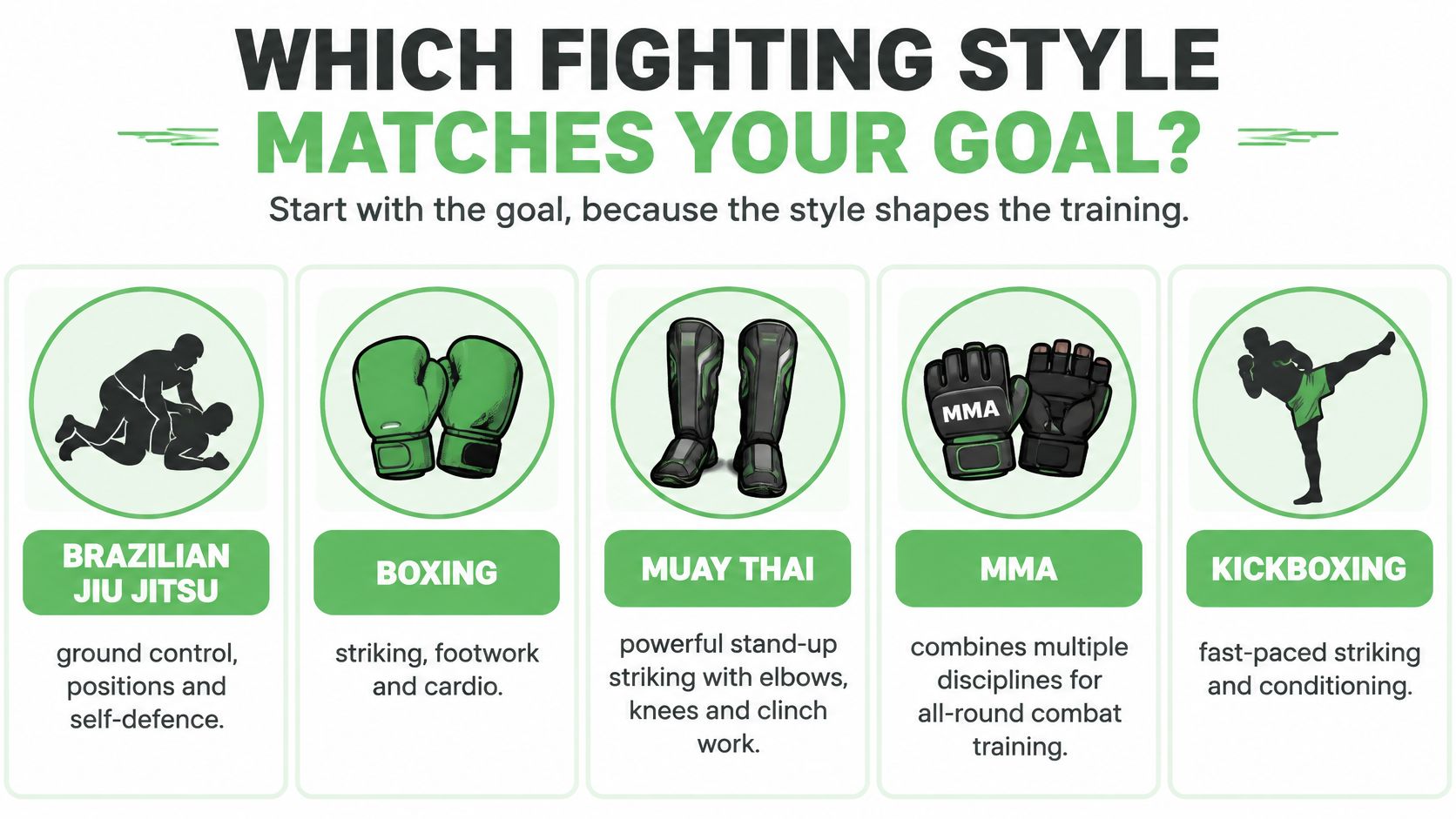
Style | Main skills | Typical contact | Best for |
|---|---|---|---|
Brazilian Jiu Jitsu | Grappling, positions, submissions | Medium, controlled rolling | Self-defence on the ground, fitness, community |
Boxing | Striking, footwork, combinations | Light to medium sparring | Cardio, striking and coordination |
Muay Thai | Clinch, kicks, knees, elbows | Medium to high | Full-body conditioning and striking |
Wrestling | Takedowns, control, scrambles | High in live rounds | Competition and strength |
Mixed martial arts | Striking plus grappling | High | Experienced competitors |
Choosing a style is like choosing a vehicle. A ute and a sports car both get you somewhere, but they do very different jobs. Picking the wrong one doesn't make it bad, it just makes it wrong for your purpose.
Watch how training differs in practice before you decide from descriptions alone.
Use Three Questions to Shortlist Two Styles
What do I want from training? Ground control and positions point to Brazilian Jiu Jitsu. Footwork and combinations point to boxing. Kicks, knees, elbows and clinch work point to Muay Thai.
How much contact can I handle this year? Be honest about old injuries, confidence and recovery. Wrestling and mixed martial arts usually involve harder live rounds.
Do I want competition, or fitness and self-defence? Competition needs regular live practice against resisting partners. Fitness and self-defence still need resistance, but the pace can be controlled.
Many gyms teach more than one style, so check that the timetable matches your shortlist. Our guide to choosing which martial art suits your goal can help you narrow the choice further.
For Jiu Jitsu, Gi classes use a fitted uniform, and you grip the jacket. No-Gi classes remove the jacket, so grips go on skin or clothing and the pace is often faster. Check whether a plan includes both formats before you pay for one.
Your First Visit and Trial Class Checklist
Closest isn't always most accessible. The Australian Sports Commission AusPlay reporting notes that only 28% of adults use a gym, fitness club, sports or leisure centre, while informal exercise is more popular than organised activity. That means many beginners are stepping into an unfamiliar, high-commitment setting, so a clear first-class process matters more than a short drive.
Use this sequence during your trial.
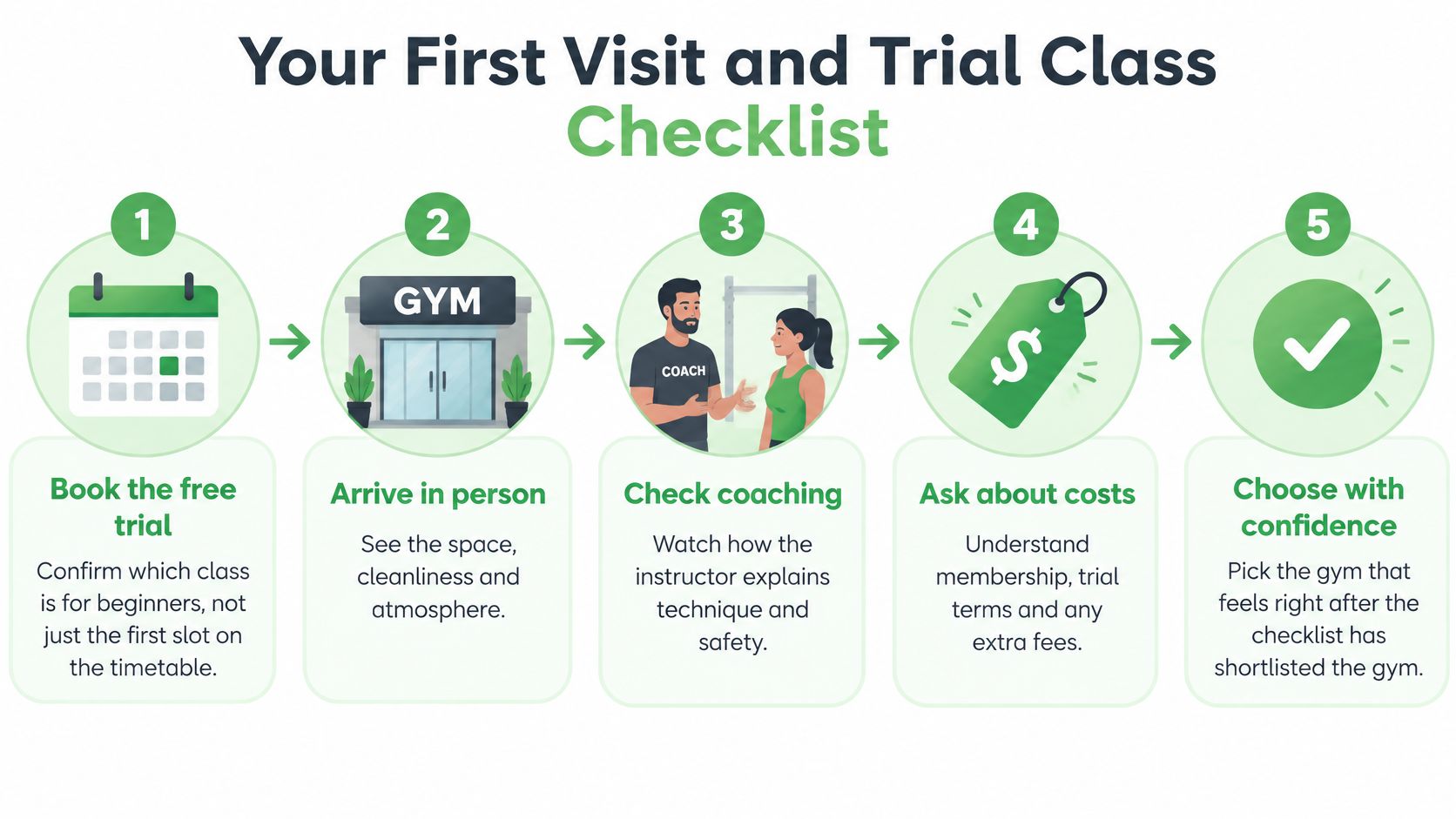
Run the Trial Step by Step
Book the right class. We offer a free trial class for all levels, and you can check our timetable and book a session. Confirm it's a beginner class, not just the first empty slot.
Ask what to wear. Check whether you need a rash guard, shorts without pockets or a mouthguard for striking. Don't buy a full kit until you know you'll continue.
Arrive 10 to 15 minutes early. Meet the coach, give your name and hear how the warm-up works. A coach who learns your name and explains movements is paying attention.
Ask how partners are matched. Size, experience and fitness should matter. A novice shouldn't be sent into hard rolling with a much larger or senior partner.
Check whether contact is optional. Drilling should be separate from sparring at first. Controlled drilling teaches position and timing without forcing you to survive live rounds.
Ask what happens if you're nervous or hurt. Staff should explain how to stop, rest or get first aid. You shouldn't need to apologise for sitting out.
Leave with one clear next step. Decide whether you'll return, visit another gym or ask a follow-up question. Don't let a same-day discount make the decision for you.
We promise to get back to enquiries ASAP, so use that contact to confirm gear, class level and partner rules before you arrive. After class, recover with food, water and sleep, and if you're curious about basics you can find beginner-friendly gym supplements explained without turning supplements into a condition for starting.
A good gym expects beginner questions. It doesn't push you into live rounds or a payment on day one.
Fitness Value and Contact Safety
A timetable only has value if it helps you train consistently at the right intensity. The NSW physical activity guidelines for adults recommend 150 to 300 minutes of moderate-intensity activity or 75 to 150 minutes of vigorous activity weekly, plus muscle-strengthening work on at least two days.
Measure | Guideline | Timetable check |
|---|---|---|
Adults moderate activity | 150 to 300 minutes per week | Three 60-minute sessions give about 180 minutes of class time, if intensity is sustained |
Adults vigorous activity | 75 to 150 minutes per week | Counts only if live rounds keep heart rate high |
Adults muscle strengthening | At least two days per week | Look for dedicated strength work on the timetable |
Children 5 to 17 daily | At least 60 minutes moderate to vigorous per day | One 45 to 60 minute class covers part of the day, so active play is still needed |
Children vigorous and strength | At least three days per week | Count class days against this target |
Class Time Isn't the Same as Exertion
Three 60-minute sessions give about 180 minutes of class time. That sounds like enough, but warm-ups, demonstrations, partner changes and rest reduce actual exertion. Count the hard work, not just your time inside the building.
Ask three questions. How much of each class is live rounds? Can beginners scale intensity without being singled out? Does the programme include strength work, or do you need to add it elsewhere?
How Contact Should Progress
Sparring should be graded by rank, size and partner. Start with positional drilling, move to light rounds with clear limits, then increase resistance as control improves. A tap in grappling, or a clear stop signal in striking, must end the exchange every time.
Ask when headgear, shin guards, gloves or other padding are expected for that style. Equipment rules should be stated before sparring, not invented after someone gets clipped. Hygiene supports safety too, and this guide to choosing disinfectants for gym mats shows what a serious cleaning routine should consider.
A gym that can show how a beginner moves from drilling to light sparring over six to eight weeks has a real progression. If staff can only point to a class list, keep looking.
Kids Classes and What Parents Should Check
Parents, judge a children's class by active time and supervision, not by how tough it looks. Australian guidance cited by Better Health Channel sports and physical activity guidance recommends children aged 5 to 17 accumulate at least 60 minutes of moderate-to-vigorous physical activity every day, with vigorous and muscle- or bone-strengthening activities on at least three days per week.
A 45 to 60 minute class can provide a large share of vigorous activity for that day. It won't automatically cover the full recommendation, especially if children spend time waiting for turns. Keep active play and other sport in the week.
What to Watch in the Room
Age and development split: A small six-year-old shouldn't learn or partner the same way as an older, stronger child.
Short queues: Children should move often through games, crawling, bridging, takedown entries and positional drills.
Partner rotation: Coaches should change partners deliberately and watch size or confidence mismatches.
Controlled falling and escapes: Teach children how to fall, protect themselves and escape before harder grappling.
Supervised contact: Short sparring rounds need clear start and stop signals, with coaches close enough to intervene.
Our Jiu Jitsu for Kids programme at Locals Jiu Jitsu Alexandria introduces children in a fun, safe and engaging environment, developing discipline, focus, coordination and self-defence skills. Guided drills and movement games come before any harder contact, and difficulty should rise gradually as control improves.
You can read more in our overview of Brazilian Jiu Jitsu for kids and how classes are structured, then watch a class with the checklist in hand.
Ask how progress is measured. A clear answer names skills, behaviour and readiness, not just time served or buying the next uniform.
Finally, ask how children move from kids classes into beginner classes. The transition should depend on maturity, control and technical readiness. Your child shouldn't be moved up just because a birthday has passed.
Comparing Costs, Contracts and Free Trials
Compare the cost per attended class, not the headline weekly price alone. Our current weekly plans are below.
Plan | Price per week | Sign-up fee and contract | Trial and extras |
|---|---|---|---|
Kids | from $35 | No sign-up fee, no lock-in contract | 1-day free trial, family discounts apply |
Adults | $55 | No sign-up fee, no lock-in contract | 1-day free trial, family discounts apply |
Emergency Services | $50 | No sign-up fee, no lock-in contract | 1-day free trial, unlimited Gi and unlimited No-Gi |
Kids start from $35 per week and adults pay $55 per week. Emergency Services is $50 per week with unlimited Gi and unlimited No-Gi. Each is subscription-based, with no sign-up fee, no lock-in contract and a 1-day free trial, and family discounts apply to kids and adults.
Do the Cost Per Class Maths
Divide the weekly fee by the sessions you will attend. For example, $55 for three classes is roughly $18 per class. If you'll only attend once a week, that's $55 per class, so your real attendance matters more than unlimited access on paper.
Check whether the plan includes both Gi and No-Gi, because paying extra for the format you prefer changes the comparison. Then ask what happens when you pause or cancel. No lock-in means you can leave without a penalty, which is the safer setup when you're testing a new gym.
Our breakdown of how much Jiu Jitsu costs and what to compare gives you more detail before you commit.
Ask every gym one final question. Is the price all-in, including uniform and equipment hire? If fees appear only at sign-up, the advertised price isn't the actual price.
Book a Free Trial Class Near You
Book a trial at a gym that passes your checks, not the first result for fighting gym near me. We're at Suite 2, 540 Botany Road, Alexandria NSW 2015, in Sydney's inner south. We serve students from nearby Waterloo, Kensington and Zetland.
Book in the Right Order
Check the timetable. Pick a time you can repeat each week, not a one-off slot that suits only today.
Match the class to your goal and fitness. Beginners should start with fundamentals. Children should join the kids programme, and experienced grapplers can choose the level that fits.
Book the free trial. Confirm what to wear, where to enter and who'll meet you.
Bring your first-visit questions. Ask about partner matching, optional contact, injury handling and contract terms while you're there.
You can reach us by phone on 0414752412 or by email at team@localsalexandria.com.au. Confirm class times directly before you travel, because timetables can change.
Pay attention to the reply itself. A good gym answers enquiries promptly and explains contact and contract terms clearly. A slow, vague or pushy reply is useful information before you step on the mat.
Use this final test. If the checklist answers are clear and the trial feels safe, commit to at least four weeks before judging progress. Skills, timing and fitness take repeated sessions to show, and one hard class doesn't predict how you'll feel after a month of consistent training.
Book your free trial with Locals Jiu Jitsu Alexandria and judge the coaching, partner matching and class structure in person before you pay. Choose the beginner, kids, advanced or No-Gi session that matches your goal, bring your checklist, and train only at a contact level you're ready for.
Comments