
Self Defence Class Near Me: What to Look for in 2026
You typed "Self Defense Class Near Me" into your phone after the same thought kept returning. Maybe it was a walk home from the station that felt different last week. Maybe it was your ten year old mentioning a kid at school, a doctor's comment about your blood pressure, or the dawning sense that your only exercise is the walk to the car.
You're not looking for a fight. You want a room where someone competent teaches you or your child what to do if a situation turns physical, and does it without theatre.
The useful question isn't which class makes the biggest promise. It's which class supervises contact properly, states its rules out loud, and lets you watch before you pay. What follows is how to judge that in an afternoon rather than a fortnight of guesswork.
Table of Contents
What to Check in a Local Self-Defence Class
Six criteria do most of the filtering work. Apply them to every option you find, whether it's a gym two streets away or a club near your office.
Criterion | What good looks like | Red flag |
|---|---|---|
Separate programs | Kids, beginners and advanced students train in separate classes | One mixed class for every age and level |
Coach supervision | Coaches watch every partner drill and stop unsafe moves | Students drill with no coach nearby |
Contact rules | Written rules on tapping, neck cranks and live speed | No stated rules for live training |
Trial class | A free trial lets you watch a session before paying | Pressure to sign up on the first visit |
Progression | Students move up by technical skill | Rank depends on size or aggression |
Timetable | Published class times that fit your week | No timetable or unclear class times |
Most of the six come down to one question: does an adult who knows what they're doing have their eyes on the room? Separate programs exist because a nine year old and a 45 year old beginner need different instructions, pacing and mat rules, and a single mixed class forces the coach to compromise both. Supervision is that same idea in real time.
Contact rules matter because grappling means someone holds you and you hold them back. Written rules on tapping, neck cranks and live speed tell you the academy has thought about the difference between controlled practice and a scramble. A free trial matters for the reason test drives do: fifteen minutes of watching shows more than an hour of sales conversation.
Practical rule: Judge the room, not the brochure. If you can't watch a session before paying, that's your answer.
Three checks you can run this afternoon:
Call or email about injuries. Ask how the coach handles a tweaked shoulder, a bad knee or a nervous first-timer. A vague answer tells you plenty.
Read the timetable against your actual week. A 6am class you'll never attend costs the same as one you will.
Ask to watch one session. Sit at the back, time a few rounds, note how often a coach intervenes.
If evening sessions mean walking home after dark, the campus walking safety advice from 3rd-i covers route planning, lighting and phone habits worth reading before your first night.
Treat all six as a screen rather than a scorecard. Passing them gets a class onto your shortlist; it doesn't tell you whether the training behind the front desk is worth your Tuesday nights.
How Jiu Jitsu Builds Practical Defence Skills
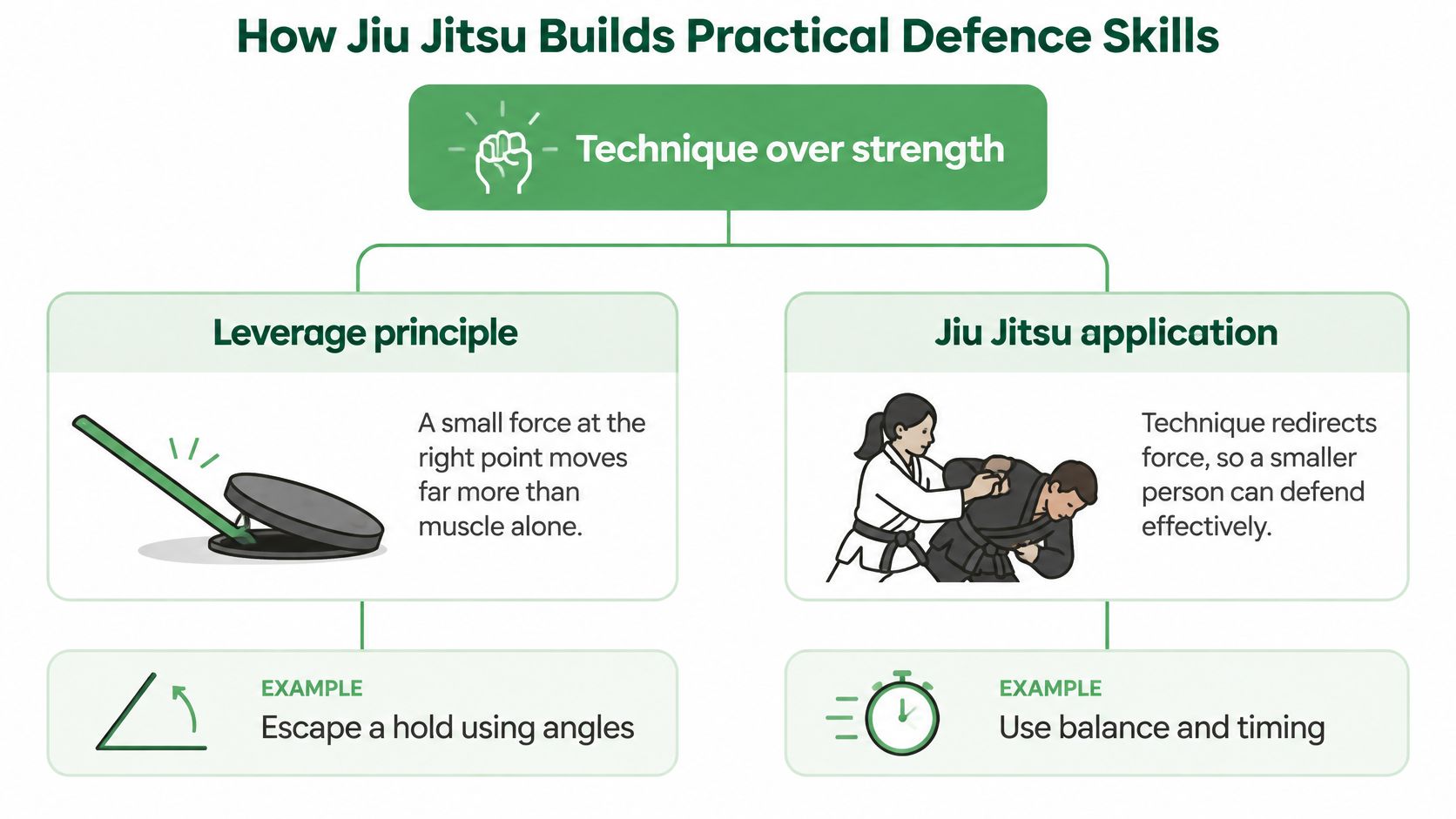
Slide a crowbar under a heavy lid and the lid lifts with almost no effort. Your strength hasn't changed. The point where the force lands has. Jiu Jitsu is built on that same observation about the human body, which is why a 60 kilogram training partner can move a 95 kilogram one without a wrestling background.
Most confrontations don't stay at arm's length. They close, they get heavy, and someone ends up on top. A class that teaches you to work from underneath, to frame, to shift weight and to stand back up is preparing you for the shape a real situation tends to take.
Four skills you're actually building
Mechanical advantage. A grip near the wrist plus a turn of the hips moves a whole arm. Small inputs, large outputs, repeatable under pressure.
Positioning. Where your hips and shoulders sit relative to someone else's decides whether they can strike, grab or pin you. Position first, technique second.
Escape. Getting out of a hold, off your back and back to your feet. This is the skill most beginners want first, and it's the one worth drilling most.
Fitness. Every drill is resistance work against another person, which builds strength and stamina at the same time as skill.
Weight against a resisting partner isn't a gym machine. It's whole-body work, and it counts. Australian adults aged 18 to 64 are advised to accumulate 150 to 300 minutes of moderate activity or 75 to 150 minutes of vigorous activity each week, plus muscle-strengthening work on at least two days and mobility, balance and coordination work on at least three, according to the national physical activity and exercise guidelines. Only 22.4% of adults in that age group met the guidelines in 2022.
Repetition is what turns any of this into a reflex. Ten clean reps of an escape on Monday, again on Wednesday, again next week, and your body starts finding the angle before your thinking brain catches up. That's the entire mechanism. Not a secret technique, just structured repetition against someone who isn't cooperating.
Live rounds at reduced intensity come after the basics hold, never before. Submissions stop the moment a partner taps, and tapping is treated as a normal part of training rather than a defeat.
Technique buys you time and options. It doesn't make a size gap, a weapon or a second attacker disappear. Leaving is still the best outcome, and an instructor who says otherwise is selling rather than teaching.
Locals Jiu Jitsu Alexandria builds its sessions around technique, fitness, self-defence and personal growth, so those threads run through the same class rather than sitting in separate courses. If you want the mechanics in more detail, our breakdown of Jiu Jitsu for self defence walks through positioning and body mechanics step by step.
Matching the Class to Your Age and Goals
Most of the confusion about where to start disappears once you match the person to the program.
Program | Who it suits | Focus |
|---|---|---|
Jiu Jitsu for Kids | Children learning in a fun, safe setting | Coordination, focus, discipline, respect and teamwork |
Beginners program | Adults and teens with no experience, any fitness level | Fundamental movements, positions, submissions, leverage and balance |
Advanced program | Students who have reached blue belt | In-depth technique on the path to black belt |
No-Gi and grappling | Grapplers and competitors | Grips, wrestling techniques and No-Gi submissions |
Picking your row
You're a parent: start with the kids program. Our Jiu Jitsu for Kids classes introduce children to the art in a fun, safe and engaging environment, building discipline, focus, coordination and self-defence skills.
You've never trained: start with the beginners program. It builds a strong foundation of fundamental techniques and concepts and is open to all ages, genders and fitness levels, with no prior experience needed.
You're a blue belt chasing black belt or competition: go to the advanced program, which explores Jiu Jitsu in more depth, or add No-Gi sessions for grips and wrestling entries.
Organised activity is already a normal part of childhood. The Australian Institute of Health and Welfare reported that 67% of Australian children aged 0 to 14 took part in organised physical activities outside school hours at least once a fortnight in 2018. The question for a parent isn't whether to join that pattern, but which program earns the weekly slot.
That's why these groups run separately rather than as one rolling class. A first-timer isn't asked to keep pace with someone three years in, and a competitor isn't slowed to a beginner's tempo. Everyone trains with peers at a similar stage, which is also how coaching stays specific.
Safety Questions for Children's Classes
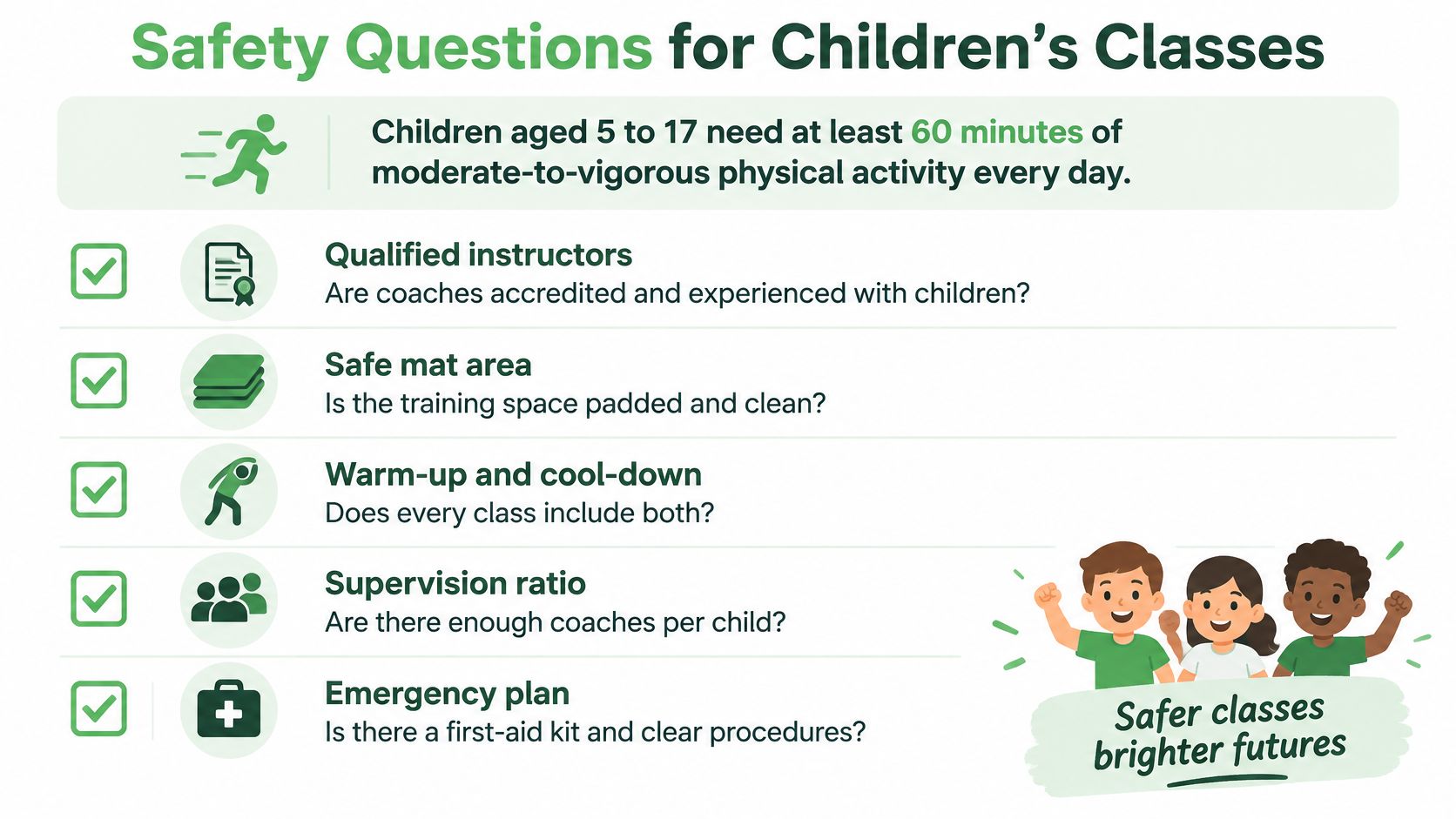
A child's first grappling class should look more like a structured playground session than a fight. The benchmark for judging it comes from national guidance, not an academy's marketing. Australia's 24-hour movement guidelines for children and young people recommend at least 60 minutes of moderate-to-vigorous physical activity every day for ages 5 to 17, with vigorous activity and muscle- and bone-strengthening exercise on at least three days each week. Those minutes can be gathered in shorter blocks, so one or two classes a week sit comfortably alongside lunchtime play, walking to school and weekend sport.
A grappling class contributes through games, crawling patterns, balance challenges, controlled bridging and light partner resistance. None of that requires a child to be athletic beforehand, and none of it should involve hard sparring in the first month. If a trial throws new children into full-contact rounds, that answers the supervision question before you ask it.
Four questions are worth asking, and each one protects a specific training skill:
How are children paired, and what does the first session contain? You want same-size partners and a first night that's mostly drills. Size-matched pairing lets a small child learn effective techniques instead of being outweighed.
Is a coach watching every pairing? Ask directly who stops a drill when something looks wrong. Supervision is what turns tapping early into a habit rather than a gamble.
What happens after an injury or a knock to the head? Sport was involved in 62% of concussion hospitalisations among 13 to 15 year olds, and sports and recreation accounted for 18,700 injury hospitalisations among children and adolescents in 2021 to 2022, per the Australian Institute of Health and Welfare. Ask how concussion signs are recognised, reported and cleared before a child returns.
How does the coach handle a shy or nervous child? Non-punitive teaching is the answer you want. A child who isn't shamed for a wrong move keeps trying, and repeated trying is where coordination and confidence come from.
Our coaches are experienced and put safety and progression first. For how ranks and curriculum work, our guide to Brazilian Jiu Jitsu for kids covers it in detail.
From the parent's chair, a good first class looks calm. The coach demonstrates, pairs children carefully and keeps eyes moving across the room. Your child leaves tired and cheerful rather than subdued. If you watch a session and can't tell who is supervising, nothing else about the class matters.
Realistic Expectations for Adult Beginners
The myth worth retiring first is that a course makes you safe. It doesn't. What a beginners program builds over weeks of regular attendance is a small set of usable fundamentals: how to stand, how to break a grip, how to get back to your feet, how to stay calm while someone heavier leans on you.
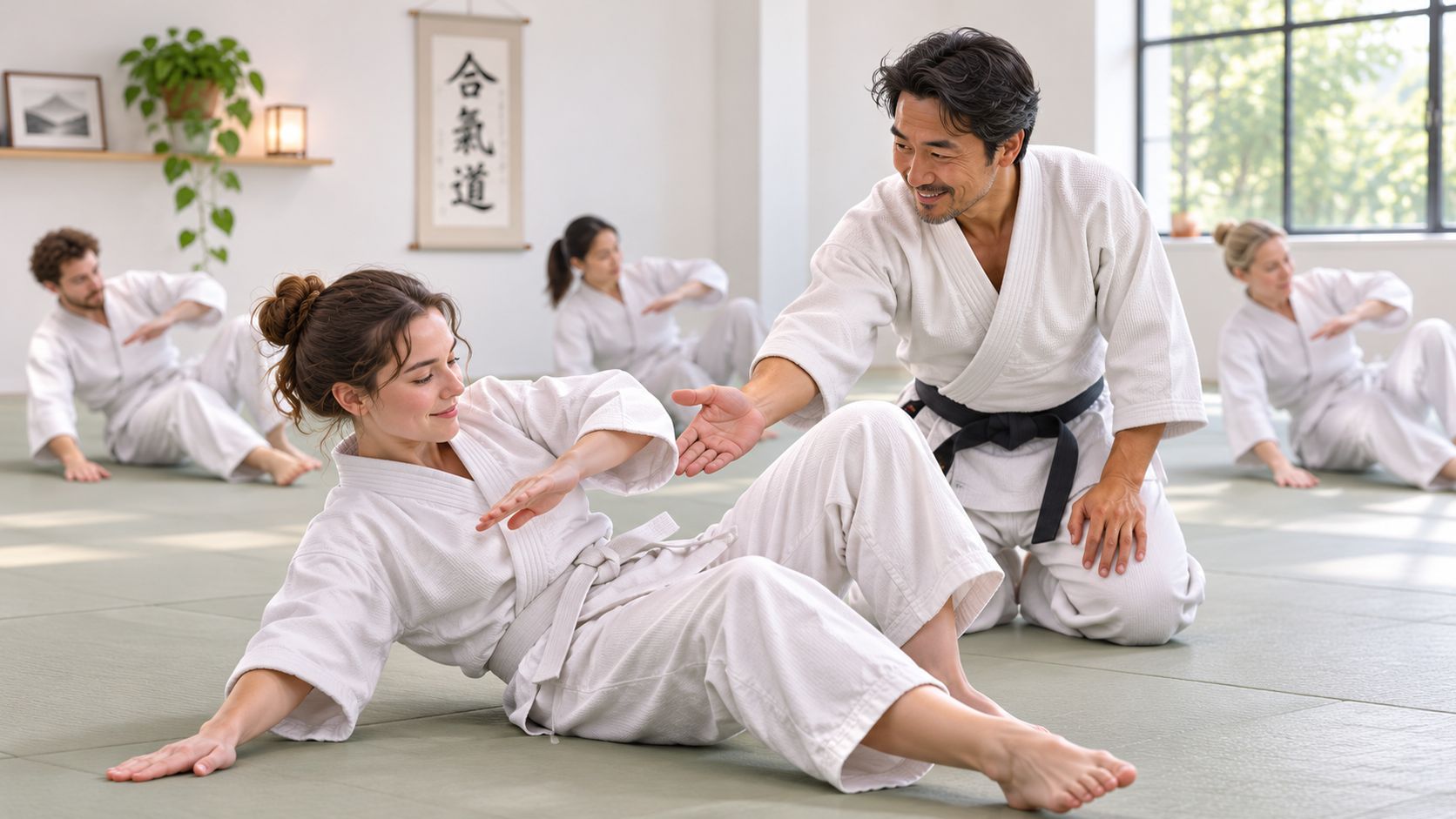
Expect soreness in the first fortnight. Hips and shoulders stiffen from framing and bridging, forearms collect a few tender spots, and there's usually one night where nothing you learned works on anybody.
First month, honestly: stiffness, some bruising, and a session or two where your body refuses to cooperate. That's the normal curve, not evidence you're unsuitable.
Compare that with practising on a friend in the backyard or the local park. A coach stops an unsafe move before it lands, sets the pace, and corrects the grip that would otherwise become a habit. Informal sparring between untrained people tends to do the opposite: it hardens errors and raises the chance of a strain that keeps you out for a month.
Plenty of adults come for the fitness as much as the self-defence. In 2022, 73% of Australian adults aged 18 to 64 did not do enough muscle-strengthening activity, according to AIHW reporting on physical activity. A class that includes resistance work against a partner closes part of that gap by default.
If you have an injury, a health condition or a disability, say so before the first class rather than during it. Our beginner-friendly classes and progressive training for all levels give coaches room to adjust a drill instead of asking you to sit out.
After a month of steady attendance, most beginners notice balance first. Then a calmer response when someone reaches for their arm. Then a clearer sense of when to step away instead of engage, which is the most practical skill of the lot.
Compare Class Costs Before You Pay
Martial arts pricing is usually quoted weekly, so the first job is turning a weekly figure into a real number.
Plan | Weekly price | Key terms |
|---|---|---|
Kids Starting Price | $35 per week | Subscription, no sign-up fee, no lock-in contract, family discounts, 1-day free trial |
Adults | $55 per week | Subscription, no sign-up fee, no lock-in contract, family discounts, 1-day free trial |
Student / 1st Responders | $50 per week | Subscription, no sign-up fee, no lock-in contract, student card required, unlimited Gi and No-Gi, 1-day free trial |
Emergency Services | $50 per week | Subscription, no sign-up fee, no lock-in contract, unlimited Gi and No-Gi, 1-day free trial |
Every plan runs the same way: subscription based, no sign-up fee, no lock-in contract, and a one-day free trial included. Family discounts apply to the kids and adults plans, and the student rate requires a student card at sign-up.
Do the multiplication before you compare anything. An adult on the $55 plan training for 12 weeks pays $660 before any family discount. A student on the $50 plan pays $600 over the same stretch and gets unlimited Gi and No-Gi access, which matters if you want to try both formats before settling on one.
Two more things to check while you're doing the sums. First, whether the plan covers both Gi and No-Gi if you intend to use both, since a cheaper weekly rate that excludes half the timetable isn't cheaper. Second, whether a one-day free trial is included, because a trial you pay for isn't a trial.
Our guide to how much Jiu Jitsu costs breaks down the extras beyond the weekly fee, including uniforms and gear.
Cheap and expensive both miss the point. What you're buying is supervised hours on a mat with someone correcting your technique, and the price per session is the number that compares.
Book a Free Trial and Confirm the Right Class
Six steps take you from shortlist to first session.
Choose the program. Match your age and goal to a row in the program table, whether that's kids, beginners, advanced or No-Gi.
Check the timetable on the Locals Jiu Jitsu Alexandria website for a session that fits your week.
Book a free trial class. Sessions run for all levels, so you don't need experience to walk in.
Judge the room while you're in it. Watch whether each move is explained, how beginners are paired, and whether the class feels controlled and respectful.
Ask about plan price and terms before you commit, including family discounts and the student card requirement where it applies.
Pick the plan and start. Consistency beats intensity, and two sessions a week is a realistic beginning.

Locals Jiu Jitsu Alexandria sits in Alexandria, an inner southern suburb of Sydney, and serves students from Waterloo, Kensington, Zetland, Rosebery, Erskineville, Beaconsfield and Green Square. Work out your travel time against your route before you book, because the best class is the one you'll still attend in March.
We answer enquiries as quickly as we can, so a question about class times or the trial doesn't sit unanswered for days.
If you're hesitating, the numbers put you in ordinary company. The Australian Sports Commission reports that around 65% of Australians were involved in sport in some way in 2024 to 2025.
Make one decision this week. Book a single trial, watch how the coach runs the room, and let that hour choose the program for you.
Locals Jiu Jitsu Alexandria runs beginner-friendly Jiu Jitsu, kids classes, advanced training and No-Gi sessions in Sydney's inner south, with experienced coaches who put safety and steady progression first. If this guide gave you a checklist, bring it to a free trial and judge the room for yourself. Visit Locals Jiu Jitsu Alexandria to see the timetable and book your first session.
Comments