
Full Guard Jiu Jitsu: Controls, Moves and Safety Basics
You're on your back, your training partner is kneeling between your legs, and you're squeezing hard enough that your thighs are tiring. They still seem comfortable. You remember a sweep from the demonstration, but you can't find the opening.
That's a common starting point in full guard jiu jitsu. The missing piece usually isn't another move. It's learning what to control, what your partner's reaction tells you, and when getting off the ground is a better result than chasing a submission.
Table of Contents
The Three Controls That Keep the Position Working - Control posture without wrestling the head - Stay connected without becoming rigid
Common Actions From Full Guard and What Each One Needs - Match the action to the opening
Safety Rules for Full Guard Rounds - Rules both partners should follow - Make safety part of the task
How to Sequence Your Choices During a Round - Run the sequence without rushing - Measure decisions rather than activity
When Standing Up Beats Staying in Guard - Separate sport from self-defence
Full Guard Examples for Kids, Beginners and Self-Defence - A child's success looks different - Look beyond taps and stillness
Try Full Guard at Locals Jiu Jitsu Alexandria - Prepare for learning, not winning
What Full Guard Is and Why Beginners Learn It First
Full guard is a position where the bottom player uses their legs to control an opponent positioned between them. The bottom player lies on their back and wraps both legs around the top player's body, so the legs work as both a barrier and a steering tool.
Coaches use the term in two ways. Many mean closed guard, where the ankles cross behind the opponent's back. Others use it more broadly for any surrounding leg position. Check which meaning your coach intends before you start drilling.
The training position looks like this:
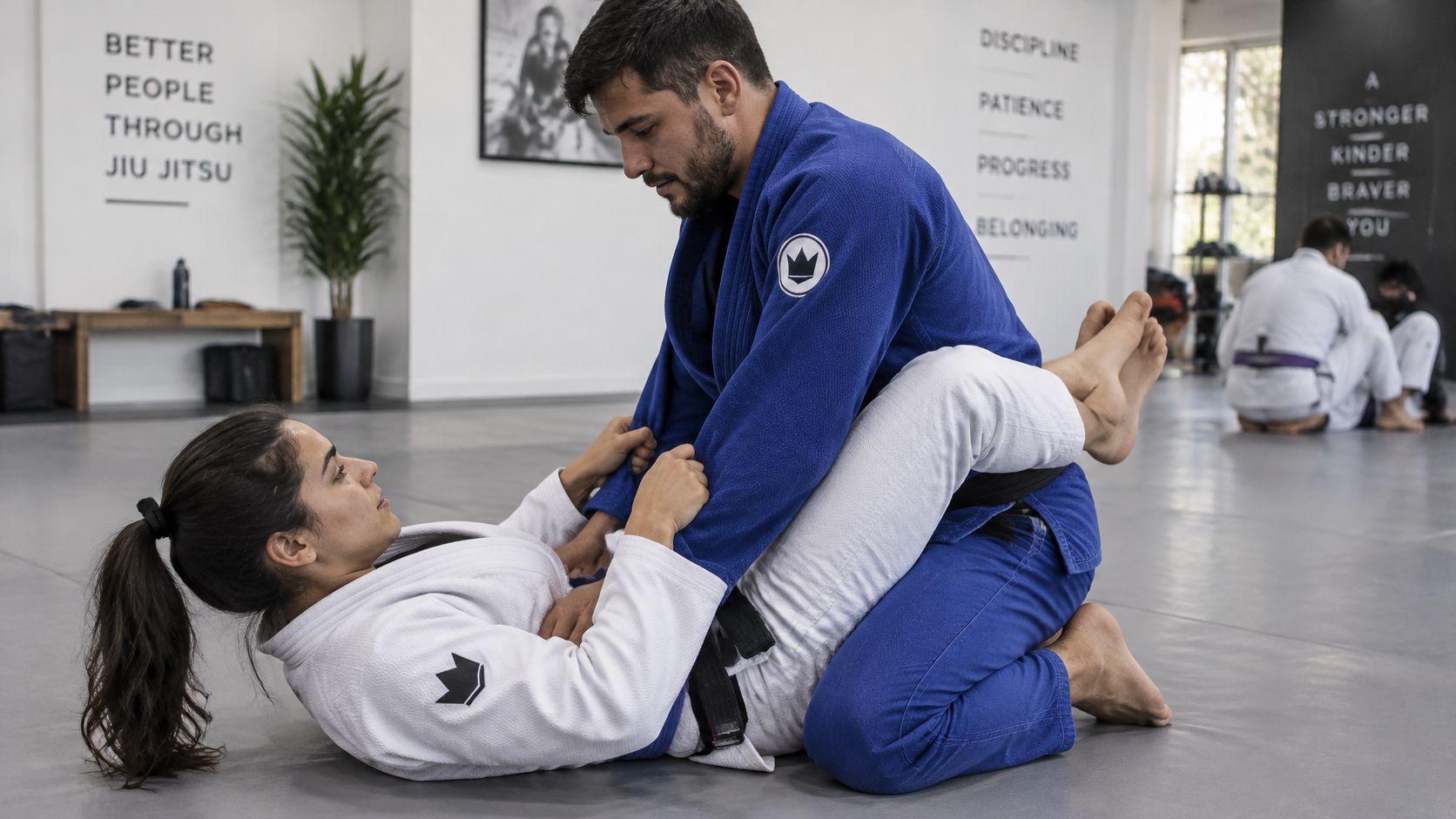
Beginners meet this position first because it rewards decisions over strength. Your hips work like a lever's pivot: a small change underneath shifts the balance of the person above. A heavier partner still carries a weight advantage, yet a lighter student can slow them down by choosing what to control and by reading what the partner does next.
Each grip, hip shift and leg adjustment answers a question the top player is asking. That is why full guard teaches you to read a round rather than memorise a list of moves, and why the position keeps working even when attacks stall. When the exchange dries up, standing up remains a valid result.
Spotting check: Look for wrapped legs, connected hips and controlled distance. Your partner may be within arm's reach, but you shouldn't hold them away with rigid, straight arms.
The Three Controls That Keep the Position Working
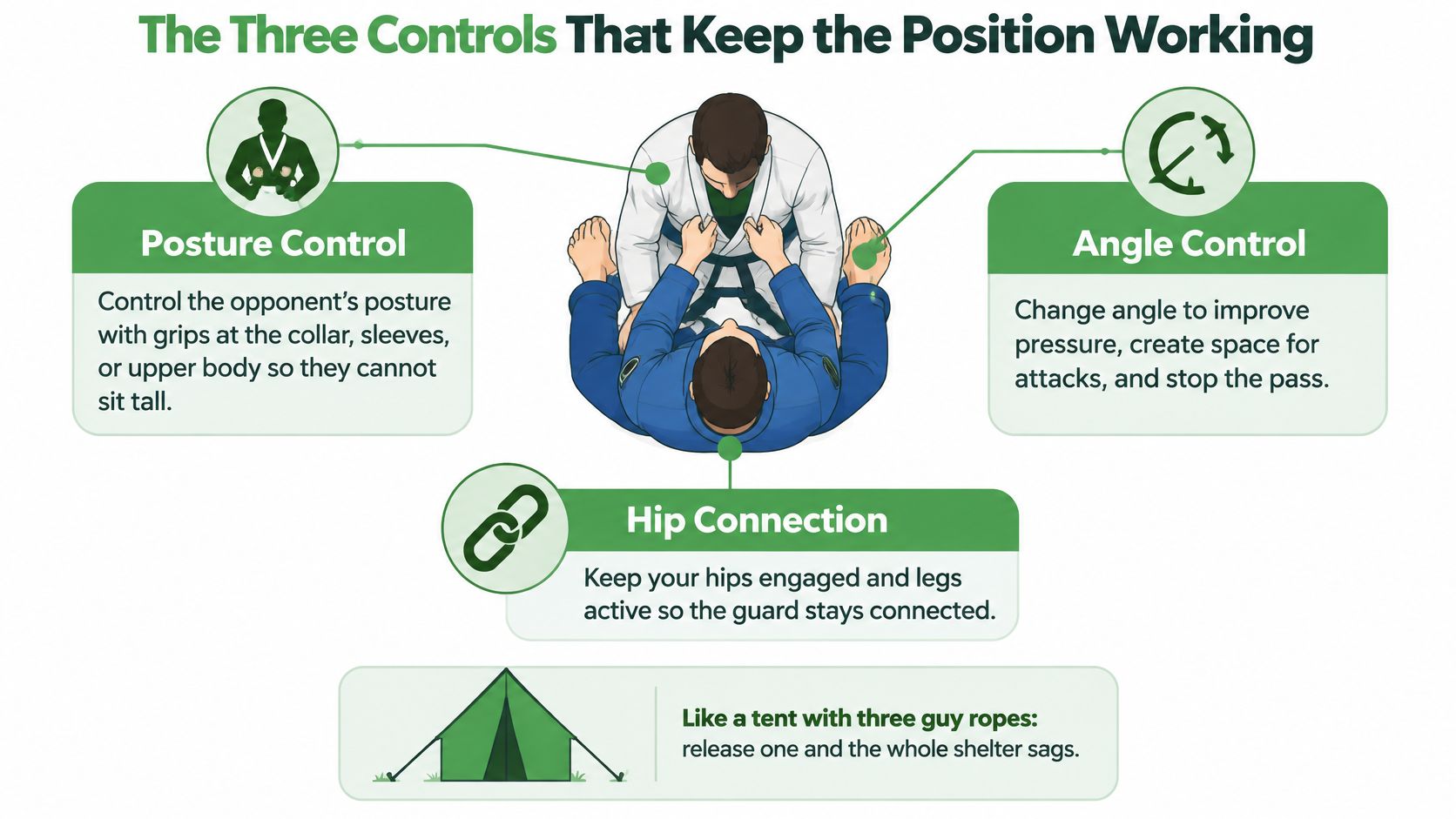
Full guard works like a tent with three guy ropes. Release one and the whole shelter sags. Those ropes are posture control, hip connection and angle control, with your legs helping maintain the connection and direction.
The diagram shows how these controls fit together:
Control posture without wrestling the head
Posture means how your partner organises their head, spine and hips. If they can sit tall with a stable base, they can begin opening your guard. Your job isn't to yank their head down, but to interrupt that alignment through coordinated grips, legs and hip movement.
In the gi, collar and sleeve grips provide useful handles. Keep your elbows close rather than reaching with straight arms. Without the gi, controlled wrist ties, upper-arm connections and overhooks replace fabric grips.
A grip alone won't prevent your partner's weight reaching your face. You also need frames, sensible distance and the willingness to adjust before they flatten you.
Core full guard controls and the errors that break them
Control | What It Does | Cue to Use | Common Error |
|---|---|---|---|
Posture control | Stops the opponent sitting up and driving weight forward freely | Hands on collar or sleeve, elbows in | Pulling with the arms only and dropping the head |
Hip connection | Keeps pressure from travelling forward unchecked | Hips close to the opponent's hips | Keeping the hips flat on the mat |
Angle creation | Opens space for sweeps and attacks | Turn the hips and bring the shin across when opening guard | Turning too late and losing the grip |
Leg control | Limits the opponent's stride and distance | Ankles locked in closed guard or feet on the hips in open guard | Crossing the legs too early and losing the lock |
Stay connected without becoming rigid
Hip connection means your pelvis and legs follow your partner's movement rather than letting them move independently inside your guard. It doesn't mean gluing your lower back to the mat or squeezing continuously.
If your partner starts moving backwards, follow enough to preserve useful contact. If they drive forwards, frame and change your hip position rather than accepting their weight on your neck. Connection helps you manage pressure; it doesn't make pressure disappear.
Angle control gives that connection a direction. Move a hip out so you're no longer square underneath their chest. Bringing a shin across is an open-guard transition, so establish your upper-body control before uncrossing your ankles.
Watch for the relationship between grips, hips and legs during the demonstration:
The useful self-check is physical: does your partner's weight shift when you change your hip angle? If your hips move but they remain completely unaffected, reset the connection before attacking.
Common Actions From Full Guard and What Each One Needs
A sweep reverses the position so the bottom player comes on top. It's a useful early objective because it teaches you to recognise balance rather than hunt for a tap.
For a scissor sweep, sleeve control and a suitable knee position help remove your partner's ability to support themselves in the direction you're tipping them. A hand posted forwards can offer a grip, but you must control the relevant support rather than sweep towards a free posting arm.
The hip bump sweep needs room to sit up and bring your hips towards your partner. If their weight is pressing onto your chest, first create space or encourage them to posture back. Trying to sit straight through heavy chest pressure usually turns the movement into a strength contest.
Match the action to the opening
Treat these situations as things to investigate with your coach, not automatic triggers.
Common full guard actions, when they work and when to learn them
Action | Works When | Main Risk | Learn When |
|---|---|---|---|
Scissor sweep | Opponent posts one hand forward and you control the relevant arm and balance | Losing the sleeve grip and falling back | Early in training |
Hip bump sweep | Opponent's weight sits forward on your chest, then shifts back enough for you to sit up | Landing on your head or neck | Early in training |
Triangle choke | Opponent's posture is broken and one arm is trapped inside your legs | Losing the angle and the opponent standing | After the basic sweeps |
Armbar | Opponent's arm is extended and your hips have pivoted | Opponent pulls the arm back and escapes | After the basic sweeps |
Open guard or stand-up | Opponent's pressure is too heavy to break and you can create protected space | Being passed while standing | From the first lessons |
A triangle choke requires a controlled head-and-arm configuration, not crossed ankles around someone's shoulders. An armbar requires control of the arm and shoulder line before you apply finishing pressure. Our guide to Jiu Jitsu submissions provides context for learning attacks alongside positional responsibility.
If moving your hips feels awkward, the Full Circle Function & Fitness mobility resources offer supplementary reading about mobility work. Don't force a joint into position to imitate a demonstration.
Re-gripping, retaining guard and opening safely are legitimate actions too. Without the underlying controls, a submission attempt is a guess rather than a plan.
Safety Rules for Full Guard Rounds
Suspected concussion means stop training. The Australian Institute of Sport's medical guidance calls for removal from sport, medical assessment and no return on the day of injury, with 24–48 hours of relative rest followed by a graduated return when symptoms don't significantly worsen.
Relative rest isn't permission to resume sparring once you feel a little better. Follow medical advice and the applicable return-to-sport pathway. A training partner or coach shouldn't try to clear a suspected concussion beside the mat.
Full guard is ground-based, but it isn't free from head-impact risk. A forceful posture break can bring heads together, and a scramble can carry someone into another pair. Takedown entries and uncontrolled transitions introduce additional risks.
Rules both partners should follow
Tap early and without ego. Tap clearly on your partner or say tap aloud if your hands are trapped. Release immediately when your partner taps.
Never crank the head or neck. Use controlled positioning rather than sharp pulling, twisting or bouncing.
Keep drilling intensity controlled. Agree on the task and resistance before starting. Don't turn a cooperative drill into an unexpected contest.
Stop for symptoms. Headache, dizziness or confusion means the exchange ends immediately, even if nobody noticed an obvious impact.
Report a suspected head knock. Tell the coach straight away rather than waiting until the end of class.
The top player has responsibilities too. Don't lift a partner and drop them to open closed guard, or drive them onto their neck when they attack. If you're unsure how to escape safely, pause and ask for instruction.
Make safety part of the task
Our BJJ rules for beginners guide is useful preparation for understanding training boundaries. For broader reading beyond grappling etiquette, Aspen Falls Wellness discusses evidence-based injury prevention for athletes; general prevention advice doesn't replace an individual medical assessment.
Start positional rounds with enough space around each pair and a clear stopping signal. If an exchange drifts towards a wall or another group, stop and relocate rather than trying to finish the move.
Safety standard: Technical progress is never measured by continuing through a possible concussion.
How to Sequence Your Choices During a Round
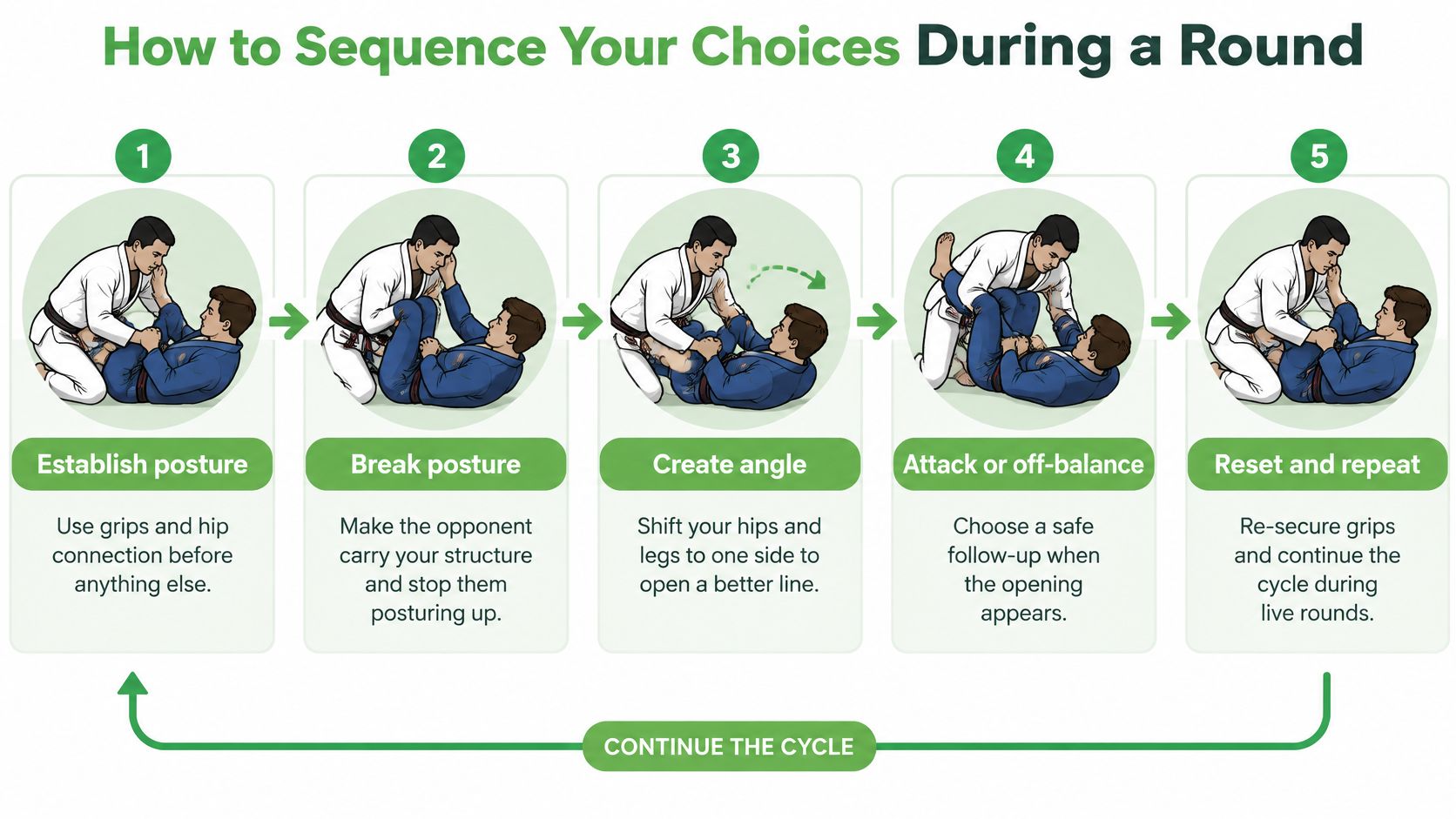
Each choice becomes more reliable when the preceding control is in place. Use a repeatable sequence, but let your partner's response determine the action rather than forcing a memorised finish.
The flow below gives you a practical decision loop:
Run the sequence without rushing
Establish your own posture and connection. Secure useful grips and organise your hips before attacking. Keep your head free to move rather than curling tightly and staring at your hands.
Check their base and disrupt their posture. Notice whether they're leaning forwards, sitting back or preparing to stand. A controlled attempt to disturb their alignment tells you which supports they're relying on.
Create an angle. Shift your hips towards a useful line. Introduce a shin across the body only when you can open your legs without abandoning your defence.
Choose the available action. Sweep towards a compromised support, attack an exposed arm or neck under control, or retain guard as they stand. If pressure makes continued engagement unhelpful, create protected space for disengagement.
Reset when the opening disappears. Recover grips and alignment rather than stretching after an escaping limb. Keep your head and neck clear while you reorganise.
Checking the base matters because leaning forwards doesn't automatically make someone sweepable. They may still have a wide knee position or a free hand ready to post. Your direction must match the support you can remove.
Measure decisions rather than activity
A useful coaching benchmark is whether you can maintain pelvic connection, upper-body control and a purposeful angle together, without excessive pulling on the head or neck. You don't need to hold one frozen shape. You need to preserve those relationships while your partner moves.
Try a positional round where the top player's task is to regain posture and the bottom player's task is to respond deliberately. Once that exchange is controlled, add opportunities to sweep or disengage. This keeps the exercise focused without asking a beginner to solve every problem at once.
You'll recognise improvement through fewer panicked scrambles and more intentional responses. Retaining guard, completing a sweep or disengaging safely can each be a useful outcome. A submission isn't the only evidence that you understood the exchange.
When Standing Up Beats Staying in Guard
Winning from guard doesn't always mean submitting the passer. If you can safely create distance and leave a bad situation, staying underneath someone to prove your technique may be the poorer decision.
Beginners also arrive with different levels of conditioning. The Australian Sports Commission's preventive-health overview notes that nearly half of Australian adults don't meet physical-activity guidelines, a reminder not to assume everyone can sustain the same training demands.
Use the following as decision cues, not guarantees that standing is immediately available.
Standing options when full guard breaks down
Situation | Standing Option | Why It Helps |
|---|---|---|
Opponent is heavier or stronger | Technical stand-up with hands up after establishing support and distance | Keeps the head away from the chest |
Pressure cannot be broken after two attempts in a practice scenario | Step to a safe side once space is available | Changes the angle without forcing a scramble |
Fatigue is building | Disengage into open guard before standing | Avoids forcing a rushed rise while tired |
Space is unsafe | Stand up early and move away when safe | Reduces exposure to head and neck hazards |
Separate sport from self-defence
In sport, you're working on mats against a partner within agreed rules. Outside training, hard surfaces, strikes, other people and restricted exits change the problem. A larger attacker may have dangerous options that a cooperative partner never uses.
A technical stand-up uses a supporting hand, a protective arm and a withdrawn leg to rise without turning your back. Practise the mechanics under supervision, then add controlled resistance.
Don't try to stand through someone who still controls your upper body. Create the opportunity first. The decision is about the situation, not pride.
Full Guard Examples for Kids, Beginners and Self-Defence
Say a 70-kilogram adult beginner is paired with a 95-kilogram partner in a hypothetical training round. The lighter student initially tries to squeeze harder and pull both sleeves towards their chest. Their arms tire, and the larger partner remains balanced.
The coach changes the task: keep the head clear, manage the partner's posture and create a useful angle. The beginner shifts a hip, secures an upper-body connection and makes the partner adjust a hand for balance. There's no submission, but the student has influenced the exchange instead of merely enduring it.
A productive beginner round can end with recognising an opening, even when you haven't yet learnt to finish the move.
A child's success looks different
In a children's class scenario, a young student closes their legs and starts pulling at their partner's neck. The coach stops the exchange and substitutes a movement task: use appropriate frames, move the hips and release safely when asked. The child succeeds by moving with control and listening, not by holding the partner indefinitely.
This is the kind of supervised partner positioning children need to learn:
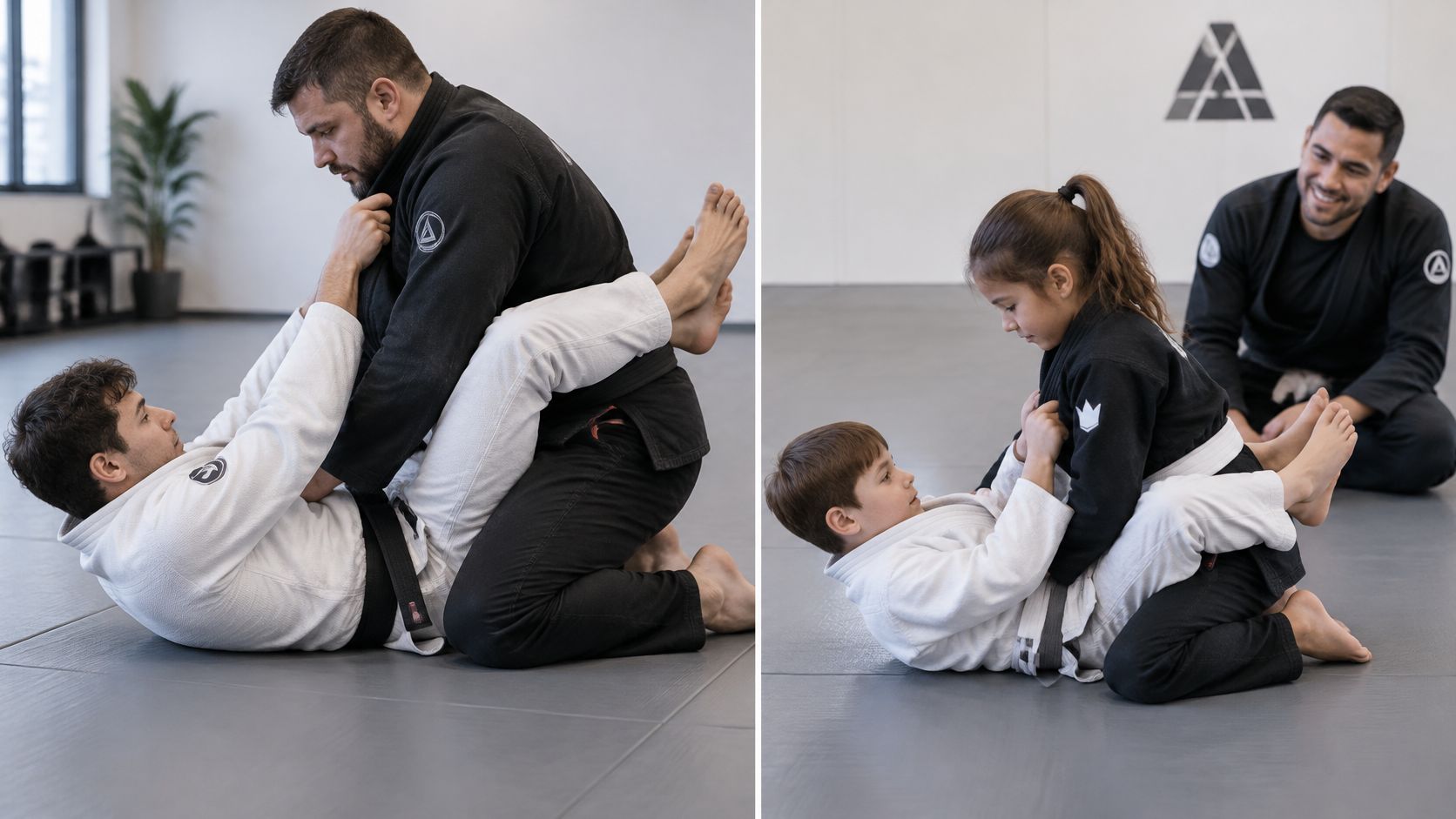
Younger students can begin with body positioning, framing, hip movement, balance and verbal communication. More experienced children can add controlled sweeps and permitted submissions under explicit rules. Readiness matters more than copying the adult version of a drill.
Look beyond taps and stillness
The NSW Health evidence papers report that 38.6% of children aged 5–17 achieved at least seven hours of moderate-to-vigorous activity per week in 2024–25. That supports attention to physical activity, but it doesn't establish that every grappling exercise suits every child.
Parents can look for specific behaviours: does the child stop promptly, communicate discomfort and move without wrenching a partner's joints? A technically secure guard is a poor developmental result if the child learns only to lie flat, stall or overpower someone.
For an adult thinking about Jiu Jitsu for self-defence, the outcome may instead be creating enough space to leave. The same position can serve very different purposes depending on who's practising and why.
Try Full Guard at Locals Jiu Jitsu Alexandria
Reading can help you recognise the position, but a coach can help you feel the difference between gripping tightly and controlling effectively. At Locals Jiu Jitsu Alexandria, our beginners program develops fundamental movements, positions and submissions, including guard basics, with options suited to different ages and fitness levels.
Start by checking our current timetable and booking a suitable session. If you're arranging training for a child, choose the children's pathway rather than assuming an adult beginner class is the right fit. Arrive a little early and tell the coach you're new so they can guide your introduction and partner selection.
Prepare for learning, not winning
Bring comfortable training clothes. Confirm the clothing or uniform requirements for your booked class before attending.
Pack water. Give yourself time to get organised rather than rushing onto the mat.
Name a simple objective. Ask for help recognising posture grips, hip connection and the setup for an introductory sweep.
Expect to be out-positioned at first. Allow several weeks of practising the linked controls before judging whether the position feels natural, rather than treating that as a fixed deadline.
Locals Jiu Jitsu Alexandria offers a free trial class for all levels, so you can begin learning guard fundamentals with coaching rather than trial and error. Visit Locals Jiu Jitsu Alexandria to check the timetable and book a session, then bring your questions about controlling, sweeping and standing safely.
Comments