
BJJ Private Lessons: How They Work and Who Needs Them
Does a private lesson make you better faster, or does it just feel that way because someone is finally watching?
The honest answer sits somewhere less flattering. The format alone doesn't do much. What changes outcomes is whether the hour has a target you can name and a way to check whether it moved, and most private lesson pages skip straight past that part.
So here's a different way to think about BJJ private lessons: as a diagnostic tool and a targeted supplement to group training, not a replacement for it. Booked that way, an hour on the mat answers a specific question. Booked without a plan, it becomes an expensive way to feel productive.
Table of Contents
Private and Group Classes Side by Side
A private lesson and a group class solve different training problems. In a private, the coach can focus on one person's movements and questions. In a group, you practise alongside different partners, which gives you varied reactions to work against.
Private lessons compared with group classes
Feature | Private lesson | Group class |
|---|---|---|
Instructor attention | One coach focused on one student | One coach shared across the class |
Lesson focus | Set around the student's goal | Set around the class curriculum |
Training partners | Coach or assigned partner | Varied partners at mixed levels |
Typical length | 45 to 60 minutes | About 60 minutes |
Best use | Specific technical gaps, injury-aware pacing, focused feedback | Live resistance, routine, variety, community |
Say your guard keeps getting passed on the left. In a private, the coach can watch how your knee, grip and turn work together, then help you adjust one part at a time. A group class may cover the same position, but its focus has to serve everyone attending.
Group training also gives you a range of partners and responses. That variation helps you practise applying techniques against live resistance. Much martial arts training takes place in organised settings such as clubs and academies, and private lessons can add focused coaching to that wider practice.
Use a private to address a specific gap, adapt training around a physical limitation, or prepare for a competition. Choose group classes for regular practice, varied partners and community. The formats can support each other: a private helps identify and work on a problem, while group sessions let you test the adjustment in a changing setting.
If you're comparing class formats, this guide to martial arts classes explains how they differ. Gym owners considering one-on-one coaching can also read this guide to boost gym revenue with boxing privates.
What Happens Inside a Private BJJ Lesson
A private lesson works like a repair job. You arrive with one problem, and you leave with that problem working better than it did an hour earlier. The hour is a diagnostic, not a showcase: the coach finds where the movement breaks, then you test the fix under resistance.
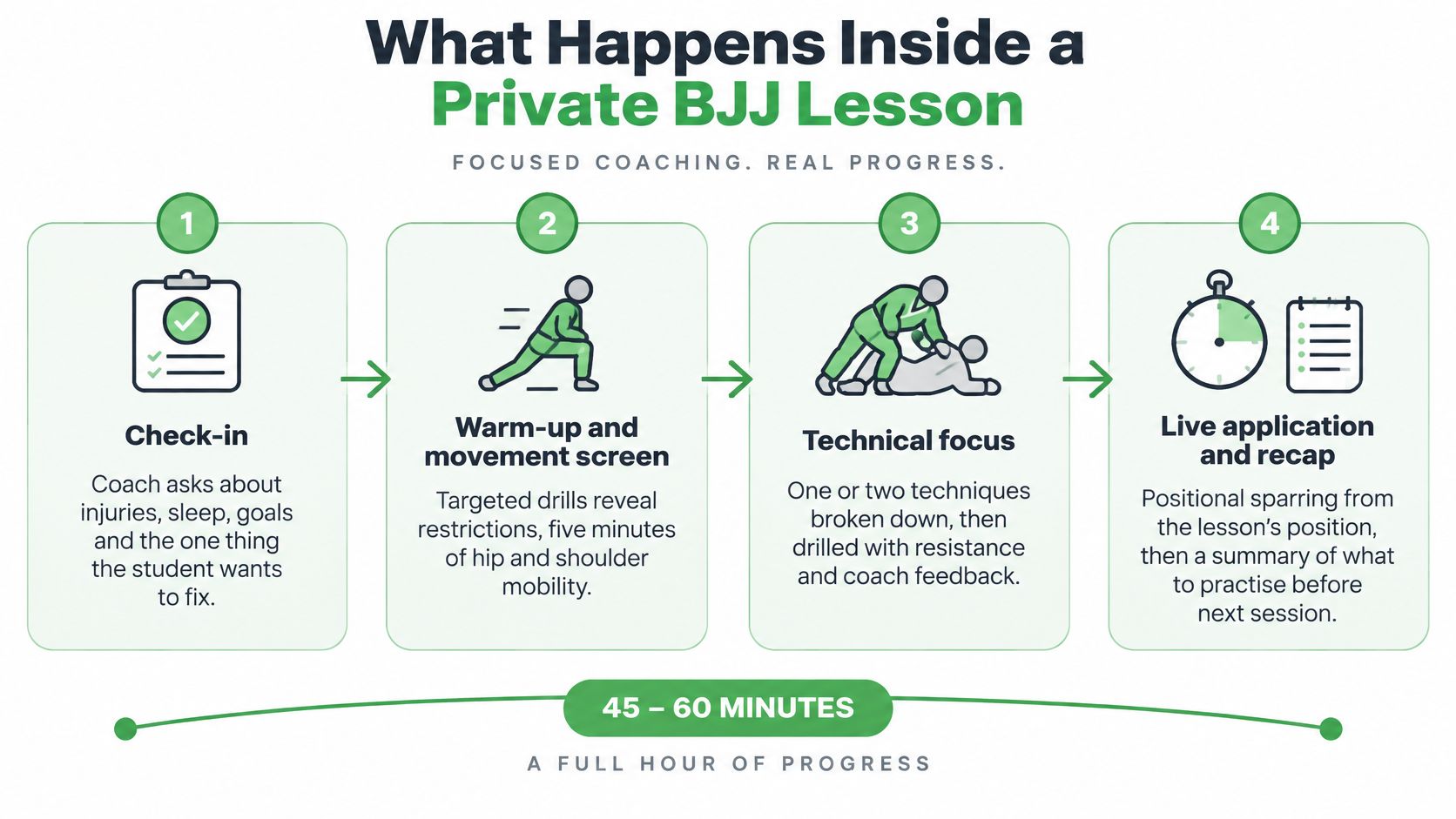
Check-in. The coach asks about injuries, sleep, what has been frustrating you, and the one thing you want fixed. That question sets the objective, so the paid hour stays focused on your problem.
Targeted warm-up. A handful of movements prepare the hips, shoulders and neck for the position you are about to load. Specific preparation readies those joints. Generic cardio does not belong in the middle of a paid technical hour.
One technical problem. A narrow objective, such as recovering guard against a specific pass. The coach demonstrates once, then breaks the movement into steps you can feel. One problem, not five. A technique you half-learn and never revisit is a technique you do not own.
Constrained repetitions. Fixed starting positions, counted attempts, no wandering. Constraints give you many meaningful attempts in a short window, rather than two good ones and a lot of thinking.
Positional sparring. Live rounds start from the same position, so the decisions of live grappling stay inside the drill. If the correction falls apart as soon as someone pushes back, the coach has found the underlying fault.
Immediate feedback. Errors get corrected as they happen. The coach changes pace or resistance based on what they see. A correction mid-repetition sticks. One saved for next week usually does not.
Recap. You leave with one or two points to drill before the next session, so the work continues in group classes. The private supplements the group class. It does not replace it.
That order follows how movement skills are built. The Australian Sports Commission describes skill acquisition as an applied science concerned with developing, performing and retaining movement skills. On the mat that means a narrow objective first, then the same problem kept live under resistance, so the correction has a chance to stick.
A working pace looks like this.
Watching the detail is a skill of its own, which is why the person coaching you matters more than how long the booking runs. At Locals Jiu Jitsu Alexandria, head coach Gian Baratela is a black belt.
Practical rule: if you cannot describe what your last private lesson was about in one sentence, it was too broad to stick.
Four things should be true when you walk out: a clear goal, many attempts at it, quick correction, and one takeaway to drill. A coach can also measure the session instead of guessing. Count meaningful repetitions, successful escapes or entries, and the minutes you spent actively solving the target position. Those counts show whether to change the constraints, the pace or the resistance. They do not call for more techniques. If the counts improve across two or three sessions, the private is doing its job. If they stay flat, the objective was still too wide, or the constraint needs changing.
Who Gets the Most from One-on-One Coaching
A common reason an adult books a private lesson is a recurring sticking point. They may know the steps of an escape but still lose the position when a partner applies pressure. One-on-one coaching can help identify which detail is breaking down, then give the student focused practice on that detail.
Student types, main gains and suggested focus
Student | Main gain from privates | Suggested focus |
|---|---|---|
Adult beginner | Clear foundations and confidence | Positions, safe falls and escapes |
Blue belt aiming for black belt | Targeted fixes to recurring problems | One position or game plan per block |
Self-defence seeker | Tailored scenarios | Leverage, positioning and awareness |
Competitor | Focused match preparation | Specific match scenarios |
No-Gi grappler | Adjusted grips and transitions | Wrestling-based entries |
Parent of a child | Pace and supervision matched to the child | Coordination and focus |
The shared benefit is focused feedback. A coach can notice a recurring error, explain the adjustment and help the student test it against resistance. That makes a private lesson useful as a diagnostic tool: it can clarify what to work on in group classes, rather than replace the variety and partner practice those classes provide.
Parents may wonder whether individual coaching suits a child who is still getting comfortable with Jiu Jitsu. Children and young people aged 5 to 17 are advised to get at least 60 minutes of moderate-to-vigorous activity every day, including vigorous activity and muscle- and bone-strengthening work on at least three days a week, according to the Australian Government's physical activity guidelines for children and young people. A private lesson can give a child more individual attention to coordination and confidence, while group classes offer practice with different partners. Locals Jiu Jitsu Alexandria's Kids program introduces children to Jiu Jitsu in a fun, safe and engaging environment.
For adults, national guidance recommends 150 to 300 minutes of moderate activity or 75 to 150 minutes of vigorous activity each week, plus muscle-strengthening work on at least two days, as set out by the Better Health Channel's physical activity guidance. A beginner does not need to arrive already fit. Consistent training is a practical place to start.
Private coaching may not be the right next step if your main goals are a regular routine, varied partners and a social class after work. Group training supports all three. If you are comparing group-class coaches, this guide to choosing a Jiu Jitsu instructor can help you decide what matters.
Before booking a private, name one recurring problem you want to address. After the lesson, check whether you can explain the correction and reproduce it in practice. If you can, the session has given you a clear target to carry into group training.
Adapting Private Lessons Safely for Kids and Different Needs
Intensity can be dialled down in a private lesson without the session losing its value. That matters for a nervous beginner, a child, an adult returning from injury, and anyone whose body doesn't move the way a general class assumes. Safety isn't a disclaimer here. It's a technical component of the lesson, built in from the first round.
Slowing the ladder down
Australian combat-sport evidence gives a clear reason to plan intensity rather than feel your way through it. A 14-month study followed health problems across 26 MMA and Muay Thai events in Western Australia, recording issues within seven days and following them weekly until they resolved. Those sports aren't BJJ, but the lesson transfers: load and symptoms get managed, not ignored.
A sensible progression runs in three stages:
Cooperative drilling. Your partner offers no resistance, so you can feel the shape of the movement and where your weight sits.
Semi-resistant practice. Resistance arrives gradually, which exposes whether the position holds when someone leans on it.
Short live rounds. Only once the first two stages are clean, and short enough that fatigue doesn't create sloppy mechanics.
Agree the rules before any live work: no uncontrolled takedowns, no twisting submissions, and a full stop at any joint or neck warning sign. Then track what happens afterwards. Delayed pain or swelling is information, and adding resistance before it settles is how a manageable niggle becomes a month off the mat.
The rule that matters most: a joint that complains the next morning is data. Report it and the next session changes.
Private lessons for children
For a child, the coach adjusts drills, pace, supervision and technical complexity to coordination, confidence and stage of development. A six-year-old and an eleven-year-old need different instructions even when the position is identical, and a private session is where that adjustment happens without a room full of distractions. If you're comparing formats for a younger student, this look at Brazilian Jiu Jitsu for kids explains how children's training is structured.
When contact itself is the concern
These are the questions people think about but rarely ask out loud. Can a coach adapt rolling intensity, grips, positions and takedowns? Yes, and a private lesson is the easiest place to do it, because nothing has to be negotiated with a room. What should you disclose before the first session? Anything that changes how your body handles load, and anything that makes contact uncomfortable. Can private training be useful without live sparring? Yes. Drilling, positional work and controlled rounds with a coach who isn't trying to beat you still build real skill.
The participation gap here is worth naming. The Australian Sports Commission estimates 492,000 Australians aged 18 and over with disability, or 14% of that population, took part in a sport-related activity at least weekly in 2024-25, according to its clearinghouse on people with disability and sport. For some of those participants, and for plenty without a disability, the greatest value of a private lesson isn't intensity. It's controlled exposure, confidence and coach-led modification before joining a group class.
What to tell your coach before the first session
Bring a short list and skip the awkwardness:
Goals. The one thing you want working by session four, in plain language.
Injury history. Old injuries that flare, current niggles, and anything that has been scanned or treated.
Concussion history. Any previous concussion, and how recently.
Contact comfort. Where you're happy to be gripped, where you're not, and whether live sparring is on the table at all.
Life context. Pregnancy, medication that affects joints or balance, surgery scheduled, or a physically demanding job.
Boundaries. What "stop" looks like, and whether you want the coach to check in during rounds.
Limited mobility, sensory needs, anxiety about physical contact and return-to-training after injury all belong on that list. Medical clearance questions belong with a qualified health professional, not with a coach, so sort those out before you book and bring the answer with you.
Measuring Progress and Knowing When to Switch
What should change after a private BJJ lesson? Start with one specific position or problem, then check whether you can handle it more reliably during group training. A private lesson works best as a targeted supplement: it helps identify what is going wrong and gives you focused practice, while group classes test that practice against different partners.
At the first session, agree on a starting benchmark with the coach. For example, if you struggle to escape side control, note which part breaks down: framing, hip movement, or timing. Choose a simple measure, such as completing the escape during a drill against moderate resistance. Review that same measure at set intervals. The goal is observable progress, not a promise of rapid results.
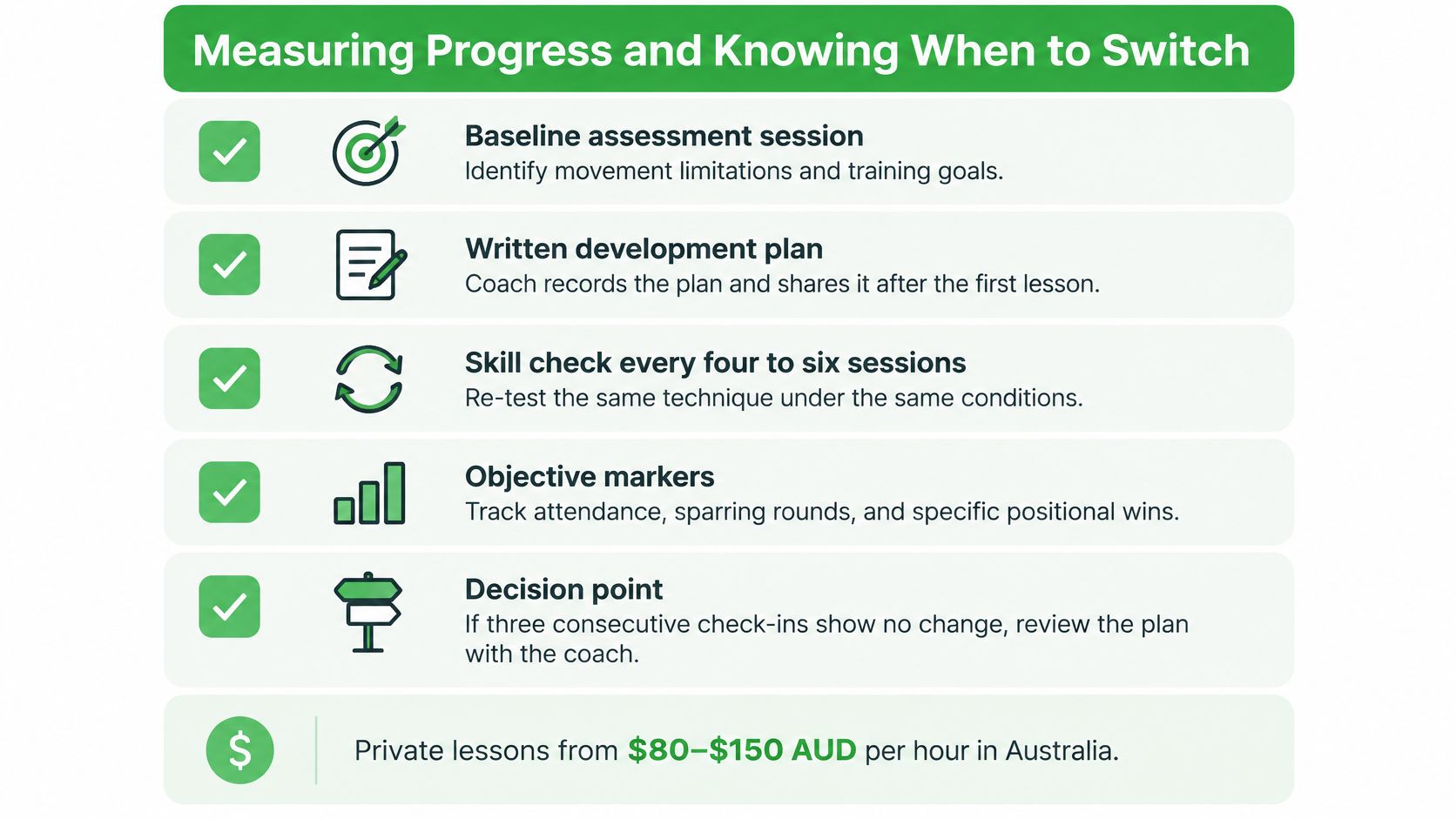
Checkpoint plan and keep-or-switch decisions
Checkpoint | What is reviewed | Keep or switch decision |
|---|---|---|
Assessment (session 1) | Starting benchmark, goals, and the specific technical problem | Agree on a practice plan |
Four sessions | Escape success, attendance, and confidence in the chosen scenario | Continue if the priority still needs work; otherwise choose a new focus |
Eight sessions | Progress on the priority and consistency in group training | Keep, reduce, or pause privates based on what still needs individual attention |
Twelve sessions | Whether the written plan's goals are met | Shift the focus or rely on group classes if the goals are met and the skill is holding up |
Use the checkpoints to make a clear decision, not to chase a fixed number of lessons. After four sessions, look for a more reliable diagnosis and a better starting position. After eight, check whether the skill holds against moderate resistance. By twelve, the agreed goal should be met or the coach should be able to explain what needs to change in the plan.
Book one assessment before committing to a longer block. Practise the lesson's focus in group classes between private sessions, where new partners reveal whether the technique works beyond a familiar drill. If three consecutive check-ins show no change, revisit the goal, drill, or level of resistance with the coach before booking more sessions.
Book a Trial Class Before Your First Private Lesson
Could a group class help you identify what to work on privately? Locals Jiu Jitsu Alexandria offers a free trial class for all levels. Check the timetable and book a session to experience the training and meet the coaches before deciding whether one-on-one instruction fits your needs.
Before a private lesson, ask how the coach will adapt the training to your goals and what you can track to judge progress. For example, if you struggle to escape side control, you might measure whether you can reach a safer position during practice. Share injuries or other needs in advance, and seek guidance from a qualified health professional when appropriate.
Locals Jiu Jitsu Alexandria is in Alexandria, close to Erskineville, Zetland and Rosebery. If you are booking online, compare booking systems with secure checkout to learn what a secure payment flow should include.
Start with the trial, then decide whether a private lesson has a specific job to do.
Locals Jiu Jitsu Alexandria offers structured Jiu Jitsu for children and adults, from the beginners program through advanced and No-Gi training. If you already know which position keeps failing, start with the free trial class and bring that one problem to the mat. Locals Jiu Jitsu Alexandria is a place to begin.
Comments