
Jiu Jitsu Near Me: Alexandria Class Guide
Locals Jiu Jitsu Academy at Suite 2, 540 Botany Road, Alexandria offers a one-day free trial, with classes from morning until night for people in nearby suburbs. But choosing jiu jitsu near me shouldn't mean choosing on distance alone.
Beginner-friendly means you don't need to get fit before starting. For parents, a convenient kids class is worth the trip only when coaches introduce contact carefully, group children appropriately and recognise progress beyond belt colour. The useful question isn't how close the mats are, but whether the class fits the person stepping onto them.
Table of Contents
Jiu Jitsu Near Me in Alexandria - Test the journey you'll actually make
Class Formats and Weekly Prices - Choose the training format separately - Experience and clothing aren't the same category
What the First Adult Class Feels Like - Arrive ready to explain your starting point - Learn the stop signal before resistance
How Parents Can Judge a Kids Class - Watch how coaches introduce contact - Look beyond the belt
A Normal Week on the Mats - A child learning to work with a partner - An adult making sense of the basics - An experienced grappler studying the details
Fitness Gains Without Overstated Promises - Track changes you can observe - Keep self-defence claims realistic
Book the Free Trial Before You Commit - Send an enquiry that helps us place you
Jiu Jitsu Near Me in Alexandria
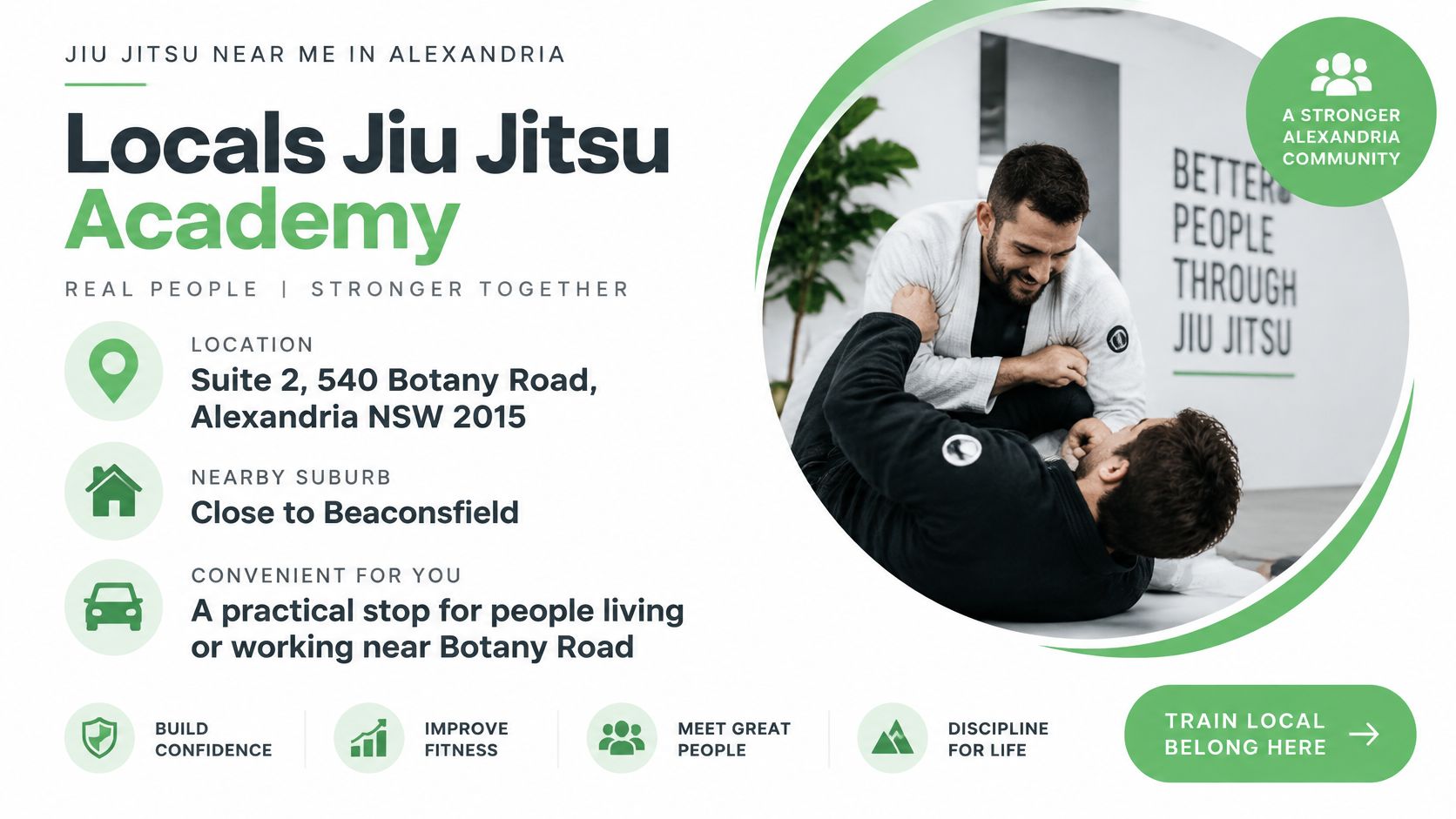
Locals Jiu Jitsu Academy is at Suite 2, 540 Botany Road, Alexandria NSW 2015, close to Beaconsfield and a practical stop for people living or working near Botany Road and Green Square. It's also a local option for Zetland, Rosebery, Erskineville, Waterloo and Kensington.
Say you work near Green Square but live in Waterloo. A class after work might fit more naturally than travelling home, changing and heading out again. For a parent coming from Zetland, the deciding detail might be whether a kids session works between school pickup and dinner.
Test the journey you'll actually make
Classes run from morning until night, so compare the timetable with your real routine rather than an unusually quiet day. Include changing, the journey to Botany Road and getting home afterwards.
From work: Check whether you can leave reliably enough to arrive before instruction starts.
From school: Allow for pickup, a snack and a child who may need time to settle.
From home: Choose a session you can repeat without rearranging the household every week.
In 2022, only 23.9% of Australians aged 15 and over met the physical-activity guidelines, according to the Australian Sports Commission's physical-activity evidence summary, which makes a repeatable local commitment more useful than another workout you have to organise from scratch.
Practical rule: Test your travel time against a class you can attend consistently, not just the closest pin on a map.
Convenience gets you through the door. The membership cost, suitable class format, first-class expectations and parent checks determine whether you'll want to return. Use the free trial to judge those details before making training part of your week.
Class Formats and Weekly Prices
Weekly memberships at Locals Jiu Jitsu Academy
Plan | Weekly price | Sign-up fee | Lock-in | What is stated | Trial |
|---|---|---|---|---|---|
Locals Kids | $35 | None | None | Family discounts apply | 1-day free trial |
Locals Adults | $55 | None | None | Family discounts apply | 1-day free trial |
Locals Emergency Services | $50 | None | None | Unlimited Gi and unlimited No-Gi | 1-day free trial |
These are subscription-based plans. Locals Kids starts at $35 per week, while the adults and emergency-services subscriptions have the weekly prices shown above. Family discounts apply to the kids and adults plans, so a household comparison should account for that rather than adding individual memberships.
You can review the options through our membership pricing plans. Don't assume the unlimited Gi and No-Gi inclusion stated for emergency services automatically describes every other plan. Choose the appropriate membership, then confirm which sessions you intend to attend.
Choose the training format separately
A membership answers the cost question. It doesn't tell you which class suits your current experience.
Format | Who it suits | What the training covers |
|---|---|---|
Kids | Children learning through age-appropriate instruction | Guided drills, technical training, coordination, focus, discipline, respect and teamwork |
Beginners | People with no previous Jiu Jitsu experience | Fundamental movements, positions and submissions, with leverage, balance and strategy |
Advanced | Students at blue belt working towards black belt | Deeper exploration of established techniques and concepts |
No-Gi / Grappling | Grapplers seeking training without the traditional uniform | Wrestling-style techniques, grips and submissions, including preparation for No-Gi competition |
Children develop self-defence skills while progressing through the ranks, but they shouldn't be placed on an adult plan by default. Their instruction has different developmental priorities, including learning to listen, cooperate and control contact.
The beginners program accommodates different ages, genders and fitness levels. You don't need previous martial-arts experience to enter it, and recognising the word submission isn't an entry requirement. A submission is a controlled technique that prompts a partner to signal that they want the action stopped.
Experience and clothing aren't the same category
Advanced describes the level of technical instruction. No-Gi describes training without the traditional jacket and trousers used in Gi practice. They aren't interchangeable labels, and No-Gi doesn't automatically mean beginner or advanced.
A blue belt seeking deeper progression should use the advanced program rather than treating the beginners room as their main development path. Someone interested in jacket-free grappling should check the suitability of the No-Gi session for their experience.
For a supplementary look at how martial-arts practice can be organised, the training formations from Vanta Sports provide a resource to explore alongside coached instruction. They don't replace a coach's decision about suitable partners, resistance or class level.
Pick the membership row that fits your circumstances and the format row that fits your experience. Then check the timetable for a session you can realistically attend.
What the First Adult Class Feels Like
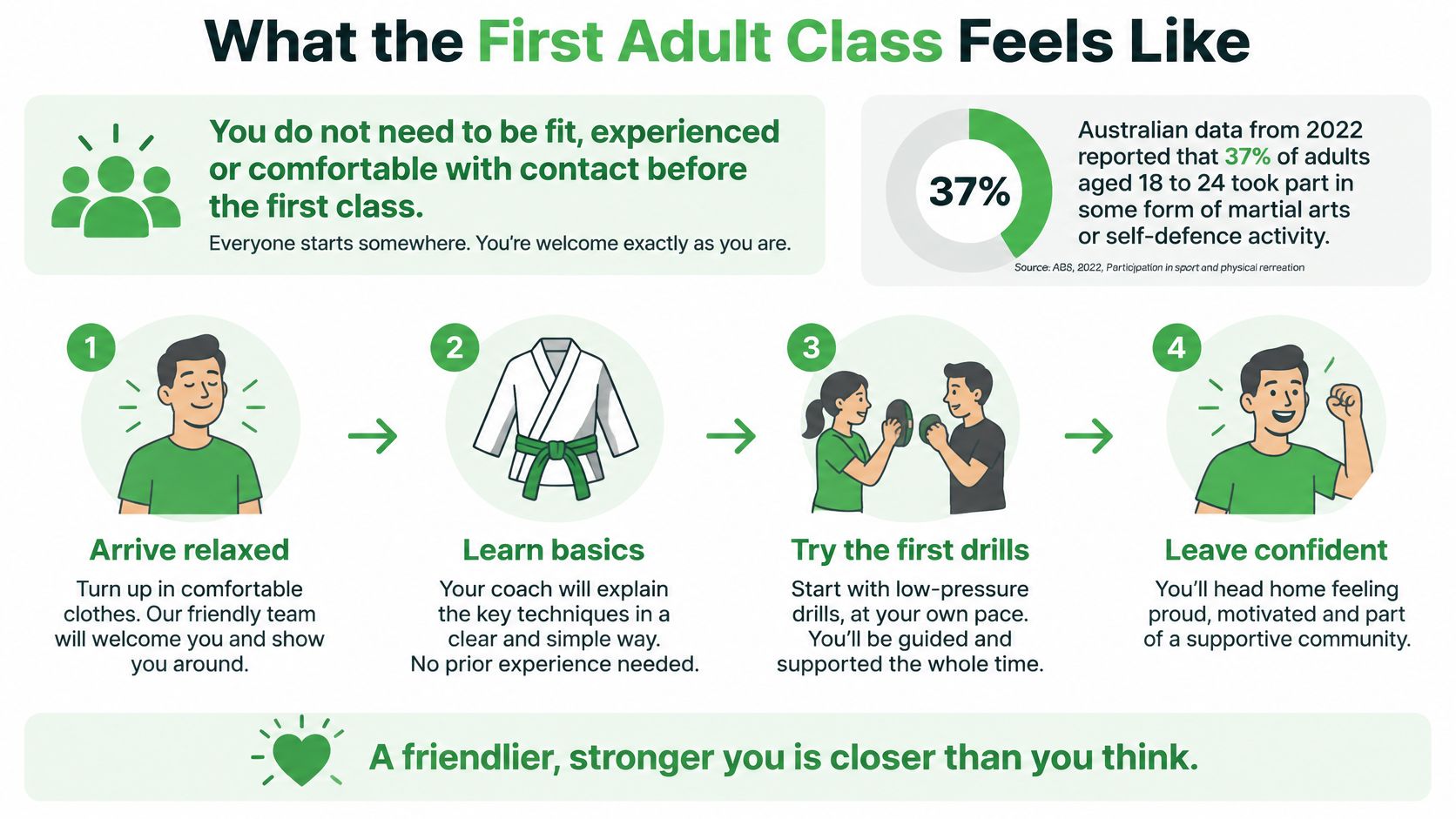
Fitness isn't a prerequisite for your first class. You can arrive without experience or confidence around physical contact, provided you're willing to communicate your limits and learn gradually.
That starting point is normal. The Australian Institute of Health and Welfare reports that in 2022, 37% of adults aged 18–64 did not meet the physical-activity guideline, while 73% did not meet the muscle-strengthening guideline. A useful beginner introduction must make room for people returning to movement, not just people who already train.
Arrive ready to explain your starting point
A comfortable T-shirt and long training pants are enough for an initial trial until you know whether a Gi is appropriate. Choose clothing without exposed zips or hard fittings, arrive with clean feet and trimmed nails, and remove loose jewellery.
Tell the coach before training if you have an old injury, difficulty kneeling or anxiety about close contact. If a health condition makes exercise suitability uncertain, get individual medical advice rather than trying to test it during a class.
Name the limitation: Explain which movement causes difficulty, such as kneeling or putting weight through a wrist.
Ask about the drill: Find out what you'll practise before your partner begins.
Pause when needed: Stop and speak up rather than pushing through pain or confusion.
Our Beginners program focuses on fundamental techniques and concepts across ages, genders and fitness levels. The emphasis is on understanding movement, position and balance, not proving how much discomfort you can tolerate.
Learn the stop signal before resistance
A newcomer should work with a patient partner who can keep the exercise controlled. That's different from being placed into a hard match and expected to work things out.
Tapping is the stop signal. Tap your partner clearly or say “tap” when you need the action to end, and use it early. When your partner taps, release immediately.
You don't have to earn a rest, and you don't have to wait for pain before stopping a technique.
The different kinds of practice can sound confusing at first:
Technical drilling: Partners repeat a movement cooperatively so each person can learn its sequence.
Live sparring: Partners apply resistance and make decisions against each other when they're ready for that practice.
No-Gi: Partners train with different gripping options because there's no traditional jacket to hold. It isn't a harder version of your introductory class.
Expect unfamiliar movements and some effort, not a fitness examination. Muscle soreness can follow new exercise, but sharp pain, joint pain or symptoms that worsen aren't something to train through.
Leave knowing what you practised, how to stop safely and what you want clarified next time. Conditioning develops through regular participation, rather than serving as a ticket you must present before entering.
How Parents Can Judge a Kids Class
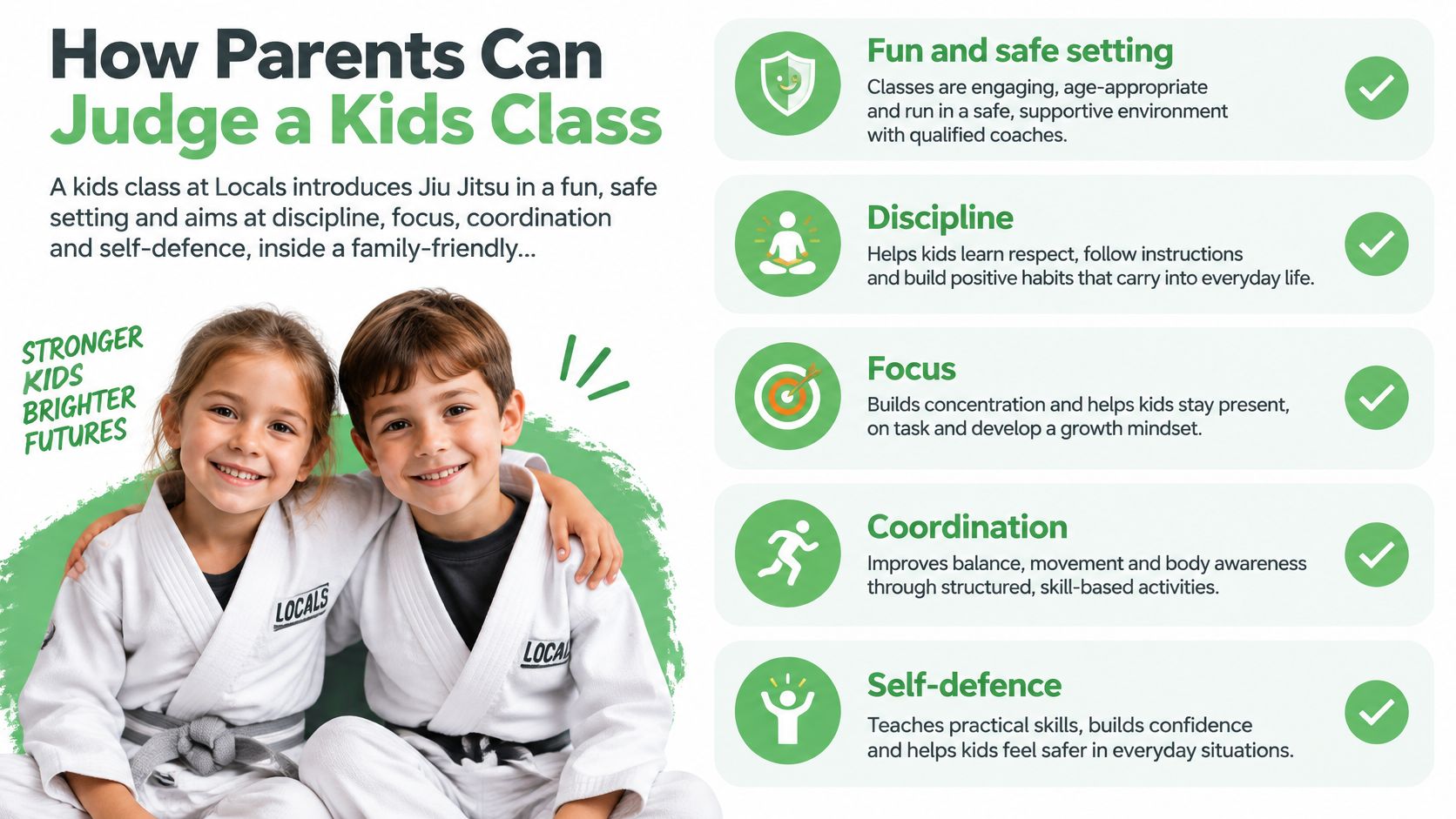
Our kids program introduces Jiu Jitsu in a fun, safe and engaging environment, with attention to discipline, focus, coordination and self-defence. We welcome families, but a welcoming description is only the start of a parent's decision.
Use a visit to assess how the teaching works for your child. A class can look busy and energetic without being developmentally appropriate.
Parent checks for a children's Jiu Jitsu class
Check | A good sign | A reason to pause |
|---|---|---|
Grouping | Children separated by developmental stage | Every age thrown into one general class |
Contact | Safe falling and joint control taught before resistance rises | Unrestricted matches for new students |
Behaviour | Rough play and bullying stopped in the moment | Roughness treated as toughness |
Progress | Focus, coordination and willingness to return | Belt colour as the only measure |
Trial | A parent can observe or book the one-day trial | Payment required before anyone sees the room |
Watch how coaches introduce contact
Ask how the group accounts for age, size, skill and maturity. Similar height alone doesn't mean children are ready for the same instruction or amount of resistance.
Watch whether a coach explains safe falling, grip control and joint safety before asking children to resist each other. A child should understand the task and stop signal, not just copy a faster or more confident partner.
The Australian Government's movement recommendations for children aged 5–17 call for at least 60 minutes of moderate-to-vigorous physical activity every day, including vigorous and muscle- or bone-strengthening activity on at least three days per week.
A grappling session can contribute through stance work, drills, positional games and controlled contact with appropriate rest. Children change levels, crawl, bridge and solve balance problems against a partner, but a class doesn't replace activity throughout the rest of the week.
Look beyond the belt
Useful progress might mean a child follows an instruction more calmly, repeats a movement with better coordination or feels comfortable asking for help. Their willingness to return matters too.
Jiu Jitsu isn't a guaranteed fix for bullying or a shortcut to discipline. Respectful coaching, a willing child and steady attendance matter more than promises about transformation. Ask how coaches respond when a child becomes upset, refuses contact or behaves roughly.
Our guide to Brazilian Jiu Jitsu for kids offers further context for families considering the program. Before booking, confirm the age band for the relevant timetable session; if it isn't shown, include that question in your enquiry.
Match the kids starting price of $35 per week to a school-week routine your household can sustain. Choose on the quality of the child's learning environment, not an adult self-defence pitch.
A Normal Week on the Mats
A full timetable is not the same thing as a good week. These scenes show what practice can look like for different people. Coaches choose the exercises for the group in front of them, so none of this is a fixed lesson plan.
A child learning to work with a partner
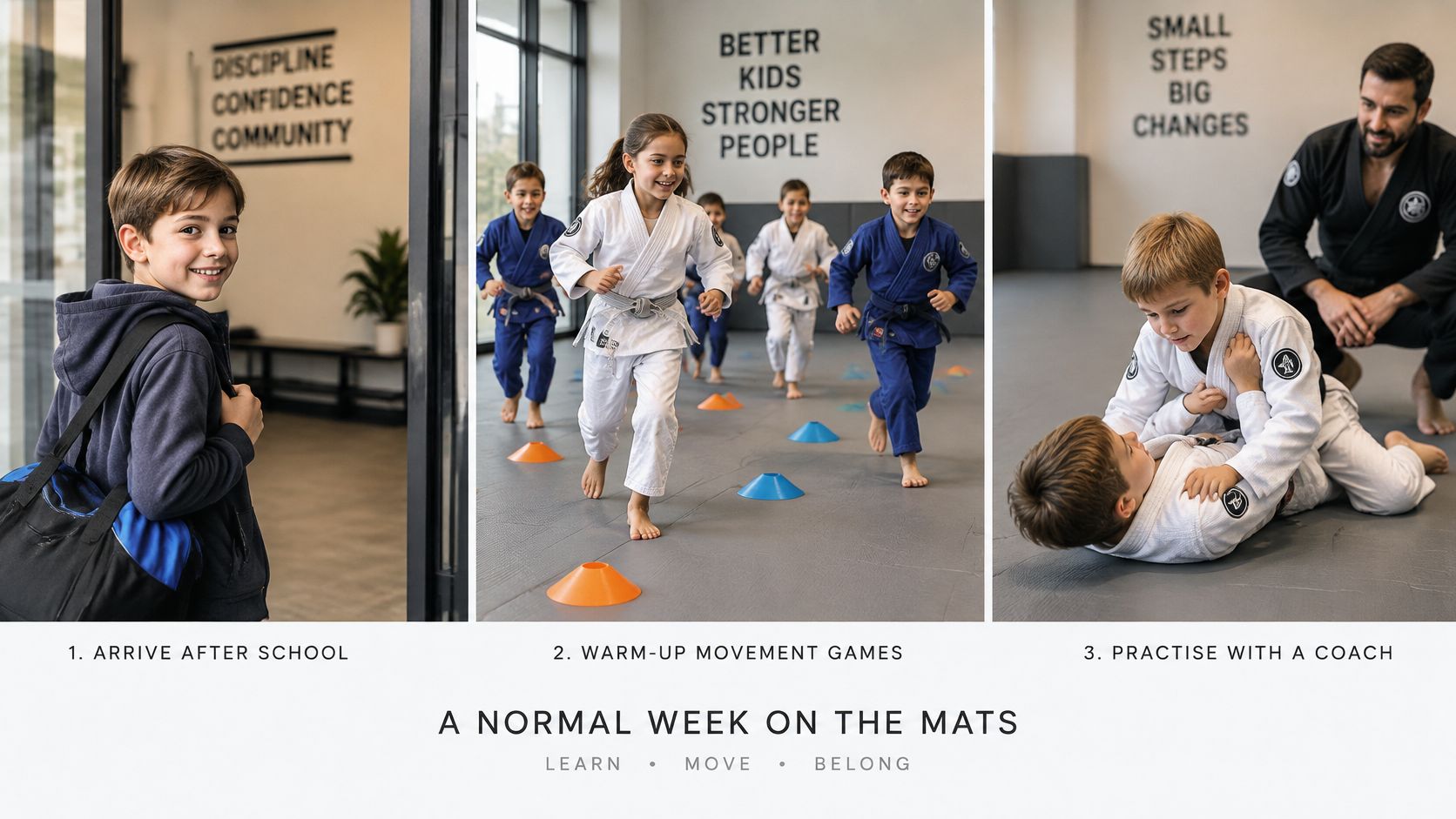
A kids class is worth the trip when contact, grouping and progress match the child, not when the gym is nearby. A child arrives after school and starts with movement games. Then they practise a simple position with a partner at a similar developmental stage. The task might be holding balance, or moving out from underneath a controlled hold.
The coach watches for attention, careful repetition and cooperation. A winner is not the point. A short review of a safe fall or a basic control gives the child one clear thing to remember on the way home. That is progress you can see without treating a belt as the only scorecard.
An adult making sense of the basics
Beginner-friendly means you do not need to be fit first. A new adult might spend the session on stance, hip movement and one position. If kneeling hurts, they pause and ask how to continue. Discomfort is information, not a test of toughness.
Leaving with a usable idea about body mechanics beats grinding through a resisted round you cannot explain. Changing the angle of the hips often moves a partner more easily than pushing straight into their weight. The hips work like a hinge: a small turn can open space that a straight shove only closes.
A productive beginner session leaves you with something you understand, not just evidence that you worked hard.
Packing before work can make attendance simpler. If you need to find a gym bag for commuting, Urban Totes' guide offers practical considerations for carrying training gear; keep clean clothing separate from damp kit and unpack it when you get home.
An experienced grappler studying the details
A more experienced student might use an advanced session to revisit a familiar position and notice how a small change in angle changes control. The aim is clearer technique, built through repetition rather than a pile of unrelated hard rounds.
On another suitable day, that student might train No-Gi. Without the traditional gi, control comes from wrestling-style entries, grips and submissions that belong to jacket-free grappling. It is the same problem, solved with different handles.
Separate kids, beginners, advanced and No-Gi sessions let instruction match the stage and the demand. Classes run for different ages and fitness levels, so a normal week can be one or two sessions you recover from, not every room on the board.
For a developing routine: Pick sessions you can attend again next week.
For technical progression: Stay with the program that fits your stage.
For a new student: Learn one format before sampling every class.
A week you can repeat teaches more than an ambitious timetable you abandon.
Fitness Gains Without Overstated Promises
A tiring class isn't proof that it meets every fitness need. The Australian Government's movement guidance distinguishes aerobic activity, muscle strengthening, functional mobility, balance and coordination, alongside reducing sedentary time.
Grappling can complement those movement qualities. Getting up from the mat involves coordinated movement; maintaining position against a partner challenges balance; learning to move efficiently requires more than using strength.
Track changes you can observe
There's no published fixed conditioning timeline for our program. Instead of expecting an instant transformation, notice practical changes:
Attendance: Record the sessions you complete and whether the routine remains manageable.
Recovery: Notice how your breathing settles between drills.
Movement: Pay attention to whether getting up from the floor or changing position feels easier with consistent practice.
Our explanation of BJJ and fitness provides more context. For broader reading on supporting your fitness goals, Vitamin Planet's exercise guide is a supplementary resource, not a reason to assume you need supplements before training.
Keep self-defence claims realistic
Practising technique, position and a calm response under supervision supports technical learning. It doesn't guarantee a safe outcome in an unpredictable confrontation, and no class should be presented as a scripted answer to every threat.
We view Jiu Jitsu as more than a martial art, with an emphasis on stronger bodies, sharper minds and deeper connections. Those are guiding aims, not guaranteed individual outcomes.
If you're ready, use the trial to experience the training. If you're unsure, choose the format that matches your present ability rather than the one that sounds most demanding.
Book the Free Trial Before You Commit
Book the one-day free trial before committing to ongoing training. It's open to all levels, and our website timetable lists kids, beginners, advanced and No-Gi sessions running from morning until night.
Choose the class before choosing a convenient time. A child belongs in an appropriate kids group, a new adult should start with beginners, and a blue belt seeking deeper technical development should consider advanced instruction. For jacket-free training, look for No-Gi and confirm that the session suits your experience.
Send an enquiry that helps us place you
Include the details that affect your first visit:
Who's attending: Give the child's age or the adult's training background.
Which format interests you: Name kids, beginners, advanced or No-Gi.
What needs discussing: Mention movement limitations, contact concerns or an unclear age band.
When you can attend: Suggest a timetable slot that works with your usual travel.
Call 0414752412 or email team@localsalexandria.com.au. We'll reply as soon as we can.
The membership choices are kids from $35 per week, adults at $55 per week, or emergency services at $50 per week where applicable. Before booking, check the journey from Alexandria, Waterloo, Zetland, Kensington, Beaconsfield, Rosebery, Green Square or Erskineville against the session you intend to repeat.
You don't need to settle your entire training future before visiting. You need a suitable class, a workable journey and a clear way to tell the coach what you need.
Locals Jiu Jitsu Alexandria offers structured kids, beginners, advanced and No-Gi training, with a one-day free trial to help you find the right fit. Visit Locals Jiu Jitsu Alexandria to check the timetable and book a session that suits your experience and weekly routine.
Comments