
Gi vs No Gi BJJ: Which Format Suits You
Is the best BJJ format the one with the techniques you like, or the one your body and weekly routine can comfortably support? Most gi vs no-gi BJJ comparisons stop at clothing, but beginners feel the difference in their hands, breathing, movement and confidence.
You don't need to choose a permanent speciality before stepping onto the mat. Understanding what each format asks of you makes it easier to choose a useful starting point.
Table of Contents
Gi and No-Gi BJJ Side by Side - What each row asks of a beginner
How Clothing and Grips Change the Game - Control without fabric - Competition makes clothing consequential
Technique and Training Pace Compared - What practice can feel like - What transfers between formats
Injury Risk Beginners Should Understand - Control the parts you can influence - Account for exercise outside BJJ
Which Format Suits Your Goal - Match your starting point to your learning needs - Let experience change the recommendation
Choosing Your First Class and Trial - A practical starting sequence - Prepare for the session you booked
Gi and No-Gi BJJ Side by Side
Gi and no-gi are two formats of the same martial art. The difference you feel first is how you control another person, and that choice shows up in your hands, your breathing, and how a normal training week fits your body.
Use the table as your reference. Each row is a trade-off a beginner can test in class, not a score.
Gi and no-gi BJJ compared across key criteria
Criteria | Gi | No-Gi |
|---|---|---|
Clothing | Kimono jacket, trousers and belt | Rash guard and shorts |
Grip style | Collar, sleeve and lapel grips | Underhooks, wrist control and wrestling-style clinch |
Typical pace | Slower, grip-based control | Faster scrambles and transitions |
Common submissions | Collar chokes and sleeve-based submissions | Leg locks and body-control submissions |
Heat and comfort | Thicker fabric, hotter in summer | Lighter and cooler, with more direct skin contact |
Injury focus | Finger and hand loading from grips | Faster scrambles and leg-lock exposure |
Competition structure | Separate IBJJF Gi division with uniform rules | Separate No-Gi division with approved apparel |
These are typical tendencies, not promises about every class. A controlled no-gi lesson can feel calmer than a hard gi sparring round, and many submissions work in both.
What each row asks of a beginner
Clothing is a body and laundry question before it is a style question. A gi adds thick fabric, so summer classes and long rounds run hotter, and the jacket still needs washing after every session. No-gi clothing is lighter and cooler. Close contact stays part of training, and skin friction can replace the heat you were trying to avoid.
Pace follows the grip row. Collar and sleeve holds work like handles on a suitcase: once they are on, the exchange slows and you spend time making or breaking those holds. Without fabric handles, position has to change sooner. Your lungs and feet get tested earlier, which matters if you only have two evenings a week and want to leave class able to train again soon.
Submissions follow the same split. Gi attacks often load the fingers and hands through collar and sleeve grips. No-gi rounds more often involve leg attacks and quicker scrambles, so the sore spots move. A coach should still pick techniques that match your experience. The format does not do that job for you.
Competition is a goal and calendar question. Your uniform belongs to a defined format, not an optional outfit inside one division. Gi and no-gi are separate divisions under IBJJF rules, and Australian events also run them as separate divisions. If a first competition is the goal, train the column that matches the division you enter. If the goal is fitness, self-defence, or steady progress through the week, choose the pace and heat your body can repeat.
Keep the table as a practical reference. Neither column is a ranking.
How Clothing and Grips Change the Game
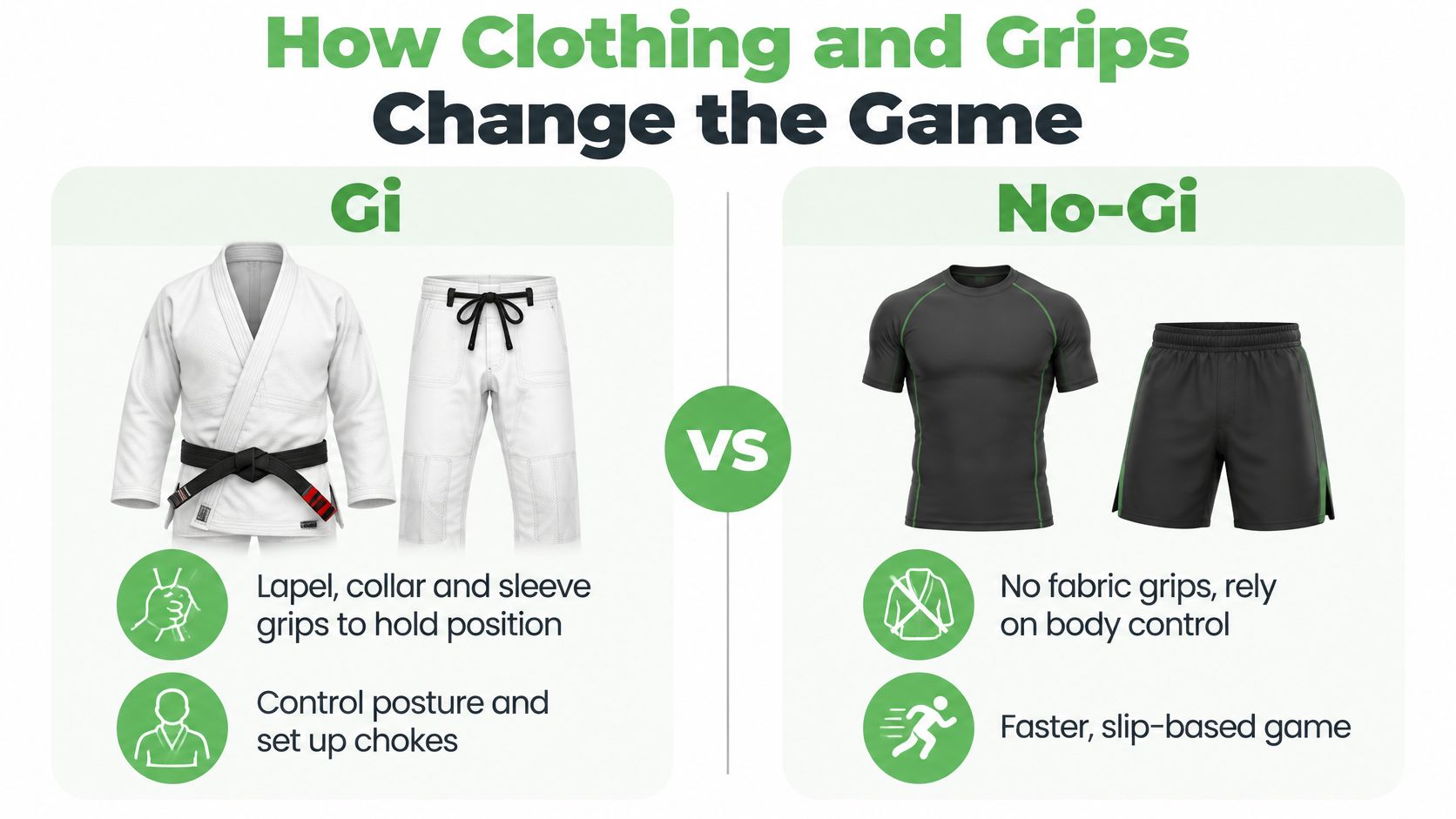
A gi gives your training partner handles. They can hold your sleeve to restrict an arm, grip your collar to affect your posture, or use your lapel, the loose front edge of the jacket, to build control.
That means an escape often begins with dealing with a grip, not moving harder. If someone holds your sleeve while you try to pull away, you'll feel tension through the fabric before you gain much distance.
Control without fabric
In no-gi, you don't grab the rash guard or shorts. Instead, you connect to the person through their limbs and torso.
An underhook means placing your arm underneath your partner's upper arm to help control their body. A clinch is a close standing connection, while a body lock involves wrapping your arms around the torso. Your head and hips also help determine whether your partner can turn, stand or move away.
These examples make the distinction clearer:
Collar choke from closed guard: Closed guard means controlling someone between your legs while your ankles are crossed. A choke using their collar requires a gi.
Wrist-control sweep: A sweep turns a bottom position into a top position. Controlling the wrist can support that movement in either format.
Body-lock takedown: Bringing a standing partner to the mat through torso control is especially useful in no-gi, though it also works in gi.
For equipment preparation, our no-gi clothing guide explains what to consider before class.
Competition makes clothing consequential
The AFBJJ rule book uses the International Brazilian Jiu-Jitsu Federation rule set, with separate adult Gi and No-Gi weight-class structures. Your kimono must meet the relevant requirements, while no-gi divisions require approved grappling apparel.
Both formats start standing, prohibit striking and normally progress to ground fighting; the Australian Jujitsu competition guide describes a six-minute match format, won by submission through a joint lock or strangulation, or by points from throws, takedowns and positional progressions. That duration isn't a universal promise for every age, rank or event.
At some events, athletes weigh in wearing their division uniform, receive one official weight check, and face immediate disqualification if overweight, as shown in these Australian event requirements. Check the event's uniform rules before entering, and check your weight in the correct gear.
Technique and Training Pace Compared
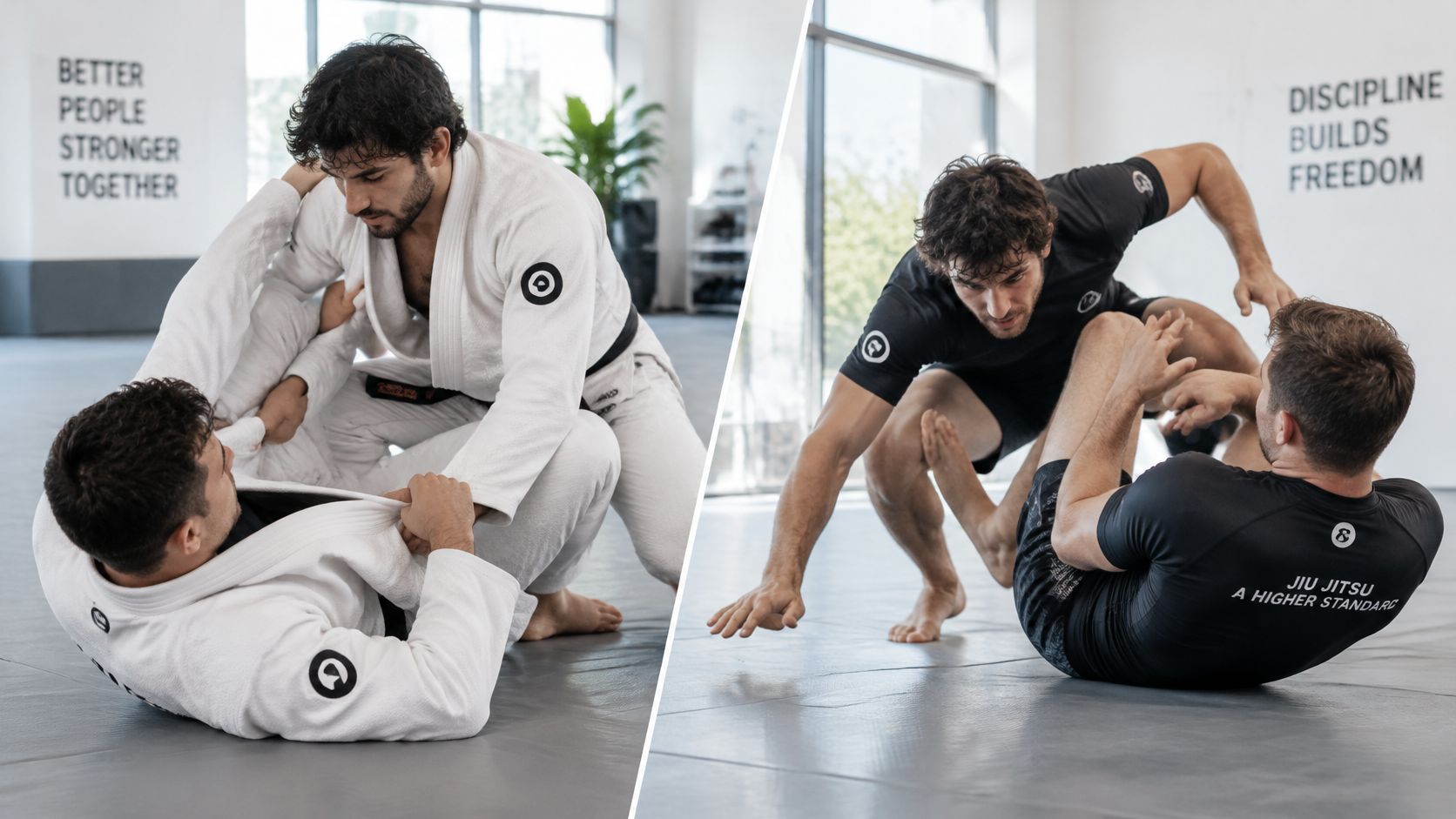
During gi practice, you might feel stuck even when there seems to be room to move. A partner's sleeve grip can prevent you from posting a hand on the mat, while a collar grip keeps your upper body bent forward.
During no-gi practice, the opposite problem often appears: you find a useful position, then your partner slips away before you settle. Neither experience means you're bad at grappling. You're learning to recognise different forms of control.
What practice can feel like
Gi lessons often give beginners time to identify grips, organise their posture and build frames. Frames are structures made with your arms or legs to maintain space, rather than trying to bench-press your partner away.
No-gi lessons often require quicker adjustments between positions. Students learn to reconnect after losing contact and recognise when a safe movement opportunity is disappearing. Leg-lock systems may also appear earlier in a no-gi curriculum, but their introduction should follow the coach's progression, not a beginner's enthusiasm.
Consider these example drills:
Gi grip-fighting drill: For a hypothetical five-minute round, one student works from guard while both practise obtaining collar and sleeve control. The task is to recognise and remove useful grips, not finish a submission.
No-gi movement drill: For a hypothetical five-minute round, partners alternate recovering guard and moving between top and bottom. They pause whenever movement becomes uncontrolled, then restart from a clear position.
Pace isn't effort. You can move quickly without using maximum force, and you can work hard while barely changing position.
What transfers between formats
Guard retention means keeping your legs between yourself and a passing opponent. Base means arranging your weight and contact points so you're harder to tip over. Both matter whether you're wearing a jacket or a rash guard.
Gi practice can make the structure of a position easier to feel because the grips hold people together. No-gi practice asks you to maintain that structure while connections change. Neither removes the need for balance, timing or thoughtful defence.
For an example eight-to-twelve-week learning diary, record whether you held a position deliberately, escaped using the taught movement, or recognised a submission early enough to tap calmly. Don't judge progress by taps alone. A controlled escape against an appropriate partner tells you more than forcing a submission through strength.
Injury Risk Beginners Should Understand
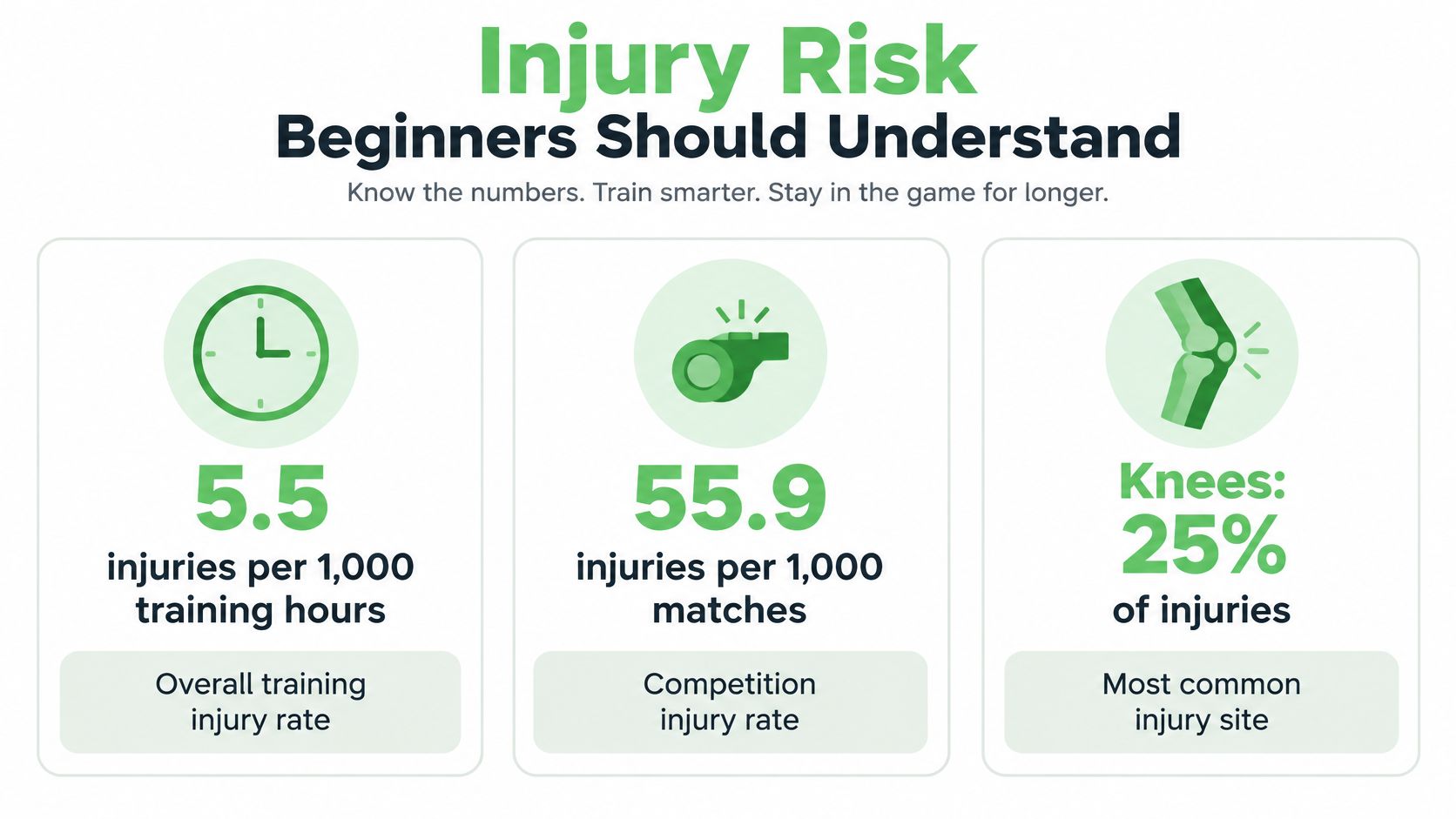
A 2025 study of 881 BJJ practitioners, summarised by Upwell Health, reported 5.5 injuries per 1,000 training hours and 55.9 injuries per 1,000 matches, with knees accounting for 25% of reported injuries and shoulders 13%. These are global figures, not Australian injury rates, and they do not show that either clothing format is safer.
On a beginner's body, the clothing row of the comparison is easy to feel. Gi grips can load fingers and hands the way a heavy bag strains a tired wrist if you keep squeezing. No-gi can feel more like a fast game of chase: people change levels quickly, and legs get tangled. Your coach, your partner, and how hard you resist shape what happens next.
Control the parts you can influence
Locals Jiu Jitsu Alexandria has experienced coaches who prioritise safety and progression. Before class, tell them about previous injuries, movements that cause symptoms, and any limits a treating clinician has already set.
Learn tapping before resisting: Tap your partner clearly with your hand, or say “tap” if your hands are trapped. Release immediately when your partner signals.
Choose controlled resistance: For a first stretch of about four to six weeks, favour clean movement over winning rounds. Move on when the position feels familiar and your coach agrees, not because a date on the calendar has arrived.
Match the task to your experience: Practise unfamiliar positions slowly. Don't spin out of a leg entanglement or pull harder against a joint lock you don't understand.
Stop when something feels wrong: Sharp pain, instability, or symptoms that get worse are stop signs. Seek clinical assessment. Swapping uniforms will not repair a joint that already hurts.
Account for exercise outside BJJ
Running and CrossFit sit on the same weekly bill as class. Count those sessions when you talk with a clinician about total load, especially if knees or shoulders are already working hard. Lake City Physical Therapy's resource on physical therapy for runners and CrossFitters is about those other activities. It is not evidence that one BJJ format prevents injury.
The academy's BJJ injury-prevention guide covers how to prepare for training. A paced start, a partner matched to your level, and speaking up early address avoidable risk more directly than clothing alone.
Which Format Suits Your Goal
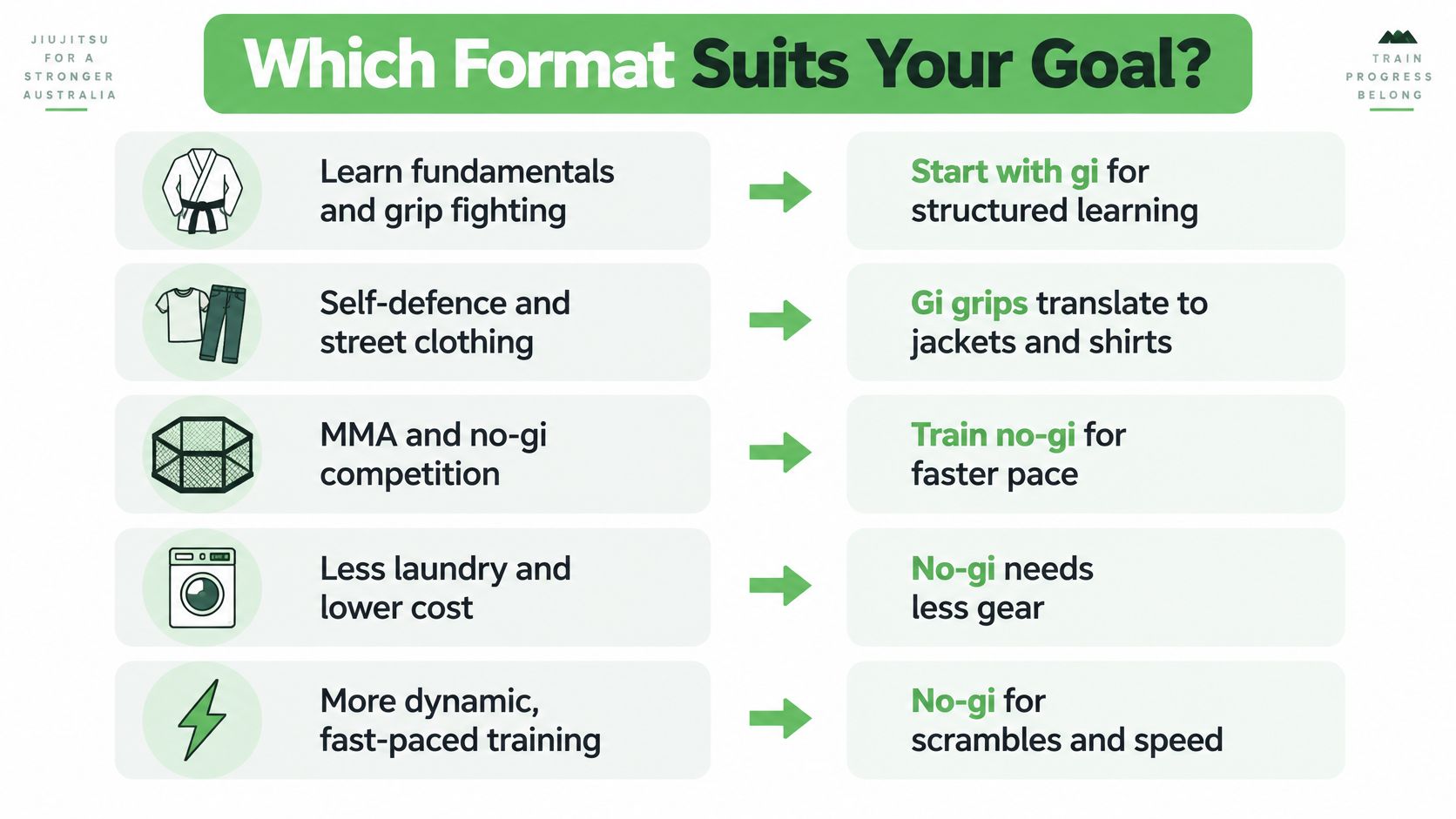
Choose a starting format by what you want to learn and what you can sustain, not by which looks more advanced. Use the following recommendations as starting points, with injury-related decisions subject to individual assessment.
Recommended starting format by goal
Your goal | Best starting format | Why |
|---|---|---|
Learning fundamentals and grip control | Gi first | Grips make positions easier to hold and read |
Fitness and mobility | No-Gi or a mix of both | Faster pace and less restrictive clothing |
Wrestling or scrambling background | No-Gi | Transfers directly to body control and takedowns |
Australian IBJJF competition | Both, planned by division | The uniform sets the division and weigh-in rules |
Recovering from a hand or finger injury | No-Gi, with coach guidance | Less fabric-grip loading on fingers and hands |
Match your starting point to your learning needs
For fundamentals, gi first is a useful option when you want clear reference points for posture and control. It isn't a prerequisite for becoming technical. A well-structured no-gi beginner class can also teach sound foundations.
For fitness and mobility, choose the format you'll attend consistently without turning every round into an exhaustion test. Lighter clothing may feel more comfortable, but you can ask for controlled training in either format.
For a wrestling background, no-gi offers familiar ways to connect standing movement with ground control. You'll still need to learn submission awareness and habits that differ from wrestling, including when staying on your back is a deliberate choice.
Let experience change the recommendation
A competitor needs practice under the conditions of the intended division, not just general fitness. If you plan to enter both formats, allow time to rehearse each format's grips, permitted techniques and equipment requirements.
A recovering hand or finger injury needs more caution than a table can provide. No-gi removes fabric gripping, but posting on the mat, wrist control and accidental contact can still stress the hand. Coach guidance doesn't replace clinical clearance where it's needed.
Choose the format that serves your current goal. You can change the balance as your skills, comfort and priorities develop.
At Locals Jiu Jitsu Alexandria, our Beginners program builds fundamental techniques and concepts for people of all ages, genders and fitness levels, including those with no previous experience. Our No-Gi / Grappling program focuses on dynamic training without the traditional gi, incorporating wrestling techniques, grips and submissions specific to that format.
For students who have reached blue belt, our Advanced program explores Jiu Jitsu in greater depth while supporting progress towards black belt. Experience opens up more technical choices, rather than creating a requirement to abandon one uniform.
Most students benefit from learning both over time. The practical balance should fit your goal, recovery and available class times, rather than an imagined ideal schedule.
Choosing BJJ for Children and Families
Does your child need a formal uniform, or more room to move? Clothing, grip, pace and goal still matter, but each one now shows up in a smaller body, a family timetable and a reason to come back next week.
A child who likes predictable routines may enjoy tying a belt the same way every class. The gi works like a map with handles: collars and sleeves give clear places to hold, so a beginner can feel where a partner is moving. Rough fabric, heat or a tight collar can turn that same map into a heavy coat. No-gi takes the coat off. Movement games, wrestling and controlled scrambling are easier to introduce because there is less cloth in the way. Neither format is better for every child.
Watch the child, not the label on the class.
Comfort: Notice fabric sensitivity, heat and how freely your child moves.
Confidence: Look for a willingness to try again after a mistake, not a perfect first attempt.
Instruction: Age-appropriate explanations, clear boundaries and controlled partner work matter more than adult competition rules.
Routine: Washing, drying and packing clean clothing has to fit the family's week, or the preferred format becomes the one they miss.
Locals Jiu Jitsu Alexandria's Jiu Jitsu for Kids program introduces children to Jiu Jitsu in a fun, safe and engaging environment. Training builds coordination, focus, discipline and self-defence skills, with respect and teamwork as students progress. Competition can wait. A young beginner does not need a gi or no-gi division chosen before they have learned to listen, practise and return.
Our guide to Brazilian Jiu Jitsu for kids walks through that developmental side. Observe a class and talk with the coach about your child's age, sensory preferences and confidence before you pick a starting format.
Choosing Your First Class and Trial
Start with a structured beginner class, then experience both formats before choosing a longer-term preference. You don't need to arrive fit, flexible or familiar with grappling terminology. You need a suitable introduction and permission to learn at a manageable pace.
Your first session is also a chance to check practical fit. Can you reach the class without rushing from work, organise clean training clothing and leave enough room for recovery? A format you can attend regularly is more useful than one that only fits your calendar occasionally.
A practical starting sequence
Choose your main goal. Decide whether your immediate priority is learning foundations, enjoying exercise, developing no-gi skills or preparing for competition. Pick one primary aim so you're not judging every class against different expectations.
Book a free trial class. Our trial is available for all levels and lets you experience the training before committing to membership. When booking, explain that you're deciding between gi and no-gi so we can guide your starting point.
Check the timetable. Look for suitable sessions in both formats, while keeping the beginner pathway central. Don't assume every class is intended for someone with no experience.
Tell the coach about your starting condition. Mention previous injuries, current symptoms and your fitness level. It's also useful to say if close contact or unfamiliar movement makes you nervous.
Build a comfortable routine. For a suggested four-to-six-week introductory period, focus on learning names, recognising positions and communicating with partners. Note whether you leave pleasantly challenged or too depleted to manage your other responsibilities.
Choose your main format and add the other later. You don't have to divide your time equally. Begin with the option that best supports your goal, then broaden your practice when the routine feels manageable.
Prepare for the session you booked
Confirm what clothing is needed before arriving. Bring the correct uniform for the chosen format, clean training clothes, water and a change of clothes for afterwards; don't buy specialised competition equipment before knowing what you need.
Use the free trial to begin comparing how training feels, rather than expecting complete certainty from a single class. It provides an initial experience without paying for that class, but it doesn't mean unlimited free sessions across both formats.
After training, make a short note about comfort, understanding and willingness to return. You're looking for a sustainable learning environment, not proof that you can keep up with an experienced partner.
Locals Jiu Jitsu Alexandria offers Beginners, No-Gi / Grappling, children's and Advanced programs, with a free trial class for all levels. Visit Locals Jiu Jitsu Alexandria to book your trial this week and ask our coach which format best suits your starting goal.
Comments