
Jiu Jitsu Guard Explained: Types, Concepts and Uses
What do closed guard, butterfly guard and spider guard share, once you stop collecting names?
A beginner can rattle off the list: closed, open, butterfly, De La Riva, spider, X, half, rubber. Ask what those positions have in common and the answer usually stalls. That gap causes trouble in a live roll. A partner stands up, strips a grip, or changes stance, and the memorised shape is gone. Without the control underneath the name, there is nothing left to rebuild.
The shared logic is one control at a time. Some guards own the opponent's hips. Some own their legs. Some live on grips, the hands locked onto cloth or a limb. Others live on frames, a stiff arm or shin that keeps the person on top off your torso. Learn which of those four a guard depends on, and an unfamiliar angle still makes sense. Learn only the label, and the position fails the moment the exchange shifts.
In competition, a sweep completed from guard and held in the new position scores. A sweep is the reversal that puts you on top and keeps you there. That score is the clearest evidence the guard is built for attacking, not only for surviving underneath.
Table of Contents
Closed Guard and Its Control Principles - The order of control - Three attacks to learn first - The mistake that gets people passed
Open Guard Variations Including Butterfly, De La Riva and Spider - Butterfly guard - De La Riva guard - Spider guard
Half Guard and Specialist Guards Explained - The knee shield - Specialist guards and when to learn them
How Guard Sweeps Earn Points in Competition - A beginner sweep in five steps
Guard Safety and Training Load - Concussion first - What children learn before submissions - What adults can realistically fit in
What the Jiu Jitsu Guard Is and Why It Matters
The guard is a bottom position in which the grappler on their back uses their legs, hips and arms to keep an opponent controlled. Two roles exist in every exchange. The guard player works from underneath, whether flat on the back, propped on an elbow or seated. The passer works from on top, trying to clear the legs and settle weight into a dominant position.
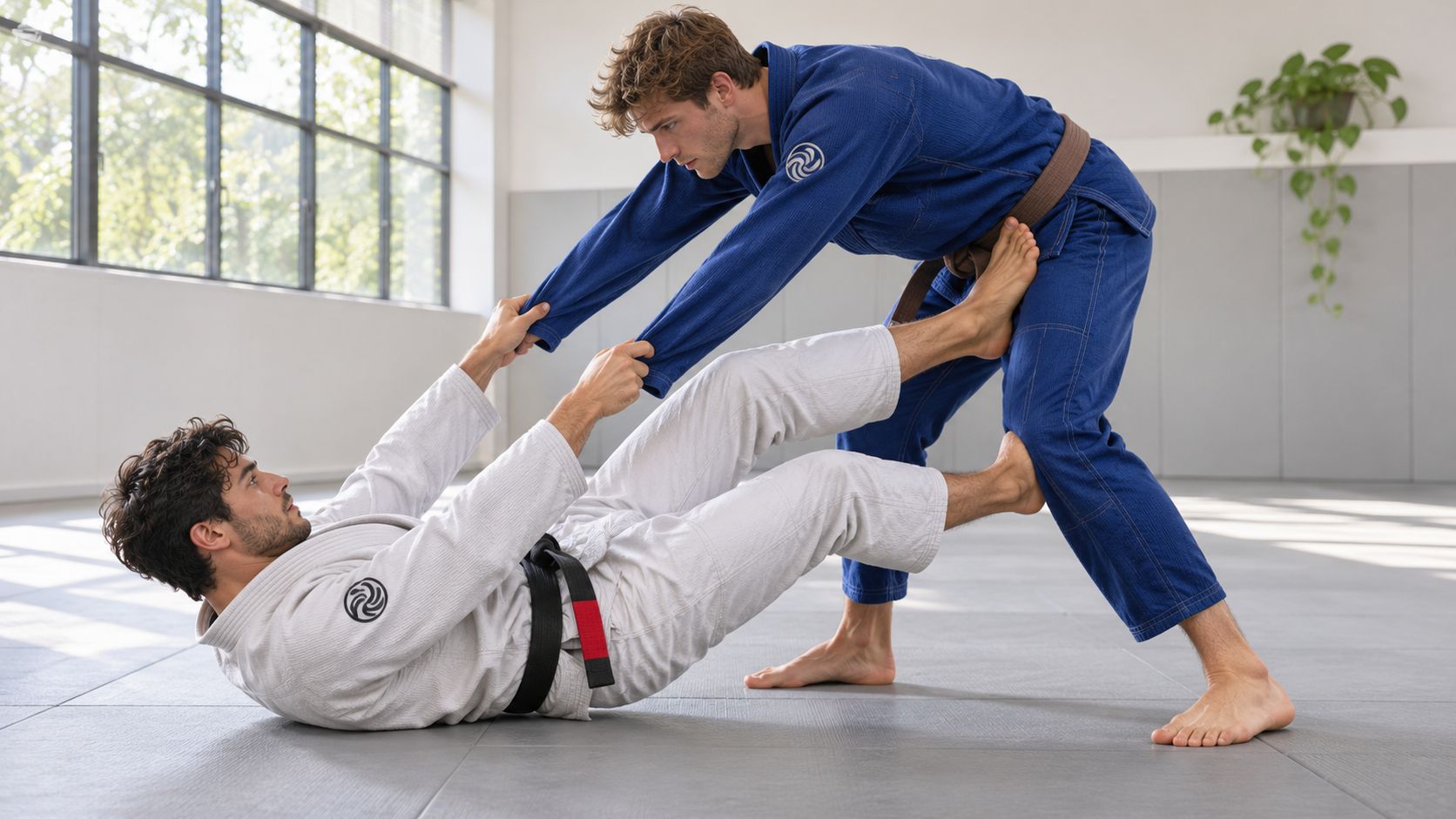
The guard does three jobs, and each one matters on its own.
It's a shell. The legs and hips stop the passer settling heavy weight onto your chest and stomach. Lose that shell and the passer walks around the legs and pins you flat, where breathing gets harder and escape gets slower.
It manages distance. Feet, shins and hands keep the passer far enough away that you can break their posture and decide what happens next. Distance is the guard player's main currency, because it buys time to think.
It launches attacks. From guard you can sweep, which means reversing to the top, or submit with a choke or joint lock. Those two options are why the position isn't purely defensive.
Picture a white belt on their back with legs wrapped around a partner's waist and one hand pulling the collar down. That pull is posture breaking, and it's the difference between a guard that threatens and legs that hang on.
Compare that with side control or mount, where you're underneath with no leg control at all. Escaping those positions is much harder precisely because the legs aren't in play.
Practical rule: In your next drill, name your role out loud before the round starts, guard player or passer. Then decide which one you want to get better at this week.
Guard Types at a Glance
Here is the whole family in one view, sorted by the control each guard depends on.
Guard | Main control | Typical grips or hooks | Common goal |
|---|---|---|---|
Closed guard | Legs locked around the opponent's waist | Collar, sleeve and hip control | Break posture, sweep or submit |
Open guard | Legs free, distance managed with feet and shins | Sleeve and ankle grips | Keep distance and create sweeps |
Butterfly guard | Hooks inside the opponent's thighs | Head and arm control | Sit up, off-balance and sweep |
De La Riva guard | Hook on the outside of the opponent's lead leg | Ankle or sleeve grip | Sweep or take the back |
Spider guard | Feet placed on the opponent's biceps | Sleeve grips | Keep arms pinned and sweep |
X-guard | Player underneath, legs on the opponent's hips | Sleeve and ankle grips | Sweep to the top position |
Half guard | One leg trapped across the opponent's leg | Underhook | Sweep, recover guard or take the back |
Knee shield | Shin or knee frame across the opponent's chest | Frame on the hip or chest | Create space and recover guard |
Rubber guard | Legs and arms bind the opponent's wrist or sleeve | Wrist and leg control | Set up joint locks and chokes |
The grouping logic is simpler than the table looks. Guards fall into three families based on what the legs are doing: locked around the body (closed guard), free and active with hooks or grips (the open guards), or one leg blocking the passer (half guard and its variations).
Many of these positions overlap inside a single exchange. A player might open in De La Riva, switch to X-guard when the passer steps, and end in a knee shield when the sweep doesn't land. The names describe moments, not separate sports.
Read the goal column as what each guard is built to do, not the full menu it offers. Then use the table as a map for the sections that follow.
Core Concepts That Connect Every Guard
Every guard exchange runs on six controls. Once you can name which one a position depends on, the long list of guard names starts to look like variations of the same idea.
A frame is an arm or a leg pressed into the opponent's shoulder, hip, or thigh. It works like a doorstop: the limb holds a gap open so their weight cannot fold you flat. Base is the platform your hips and legs make underneath you. Lose it, and the passer can pin your shoulders to the mat, which knocks every other control out of line.
Grips are the hand holds: collar, sleeve, ankle, or wrist. Distance is the space between the two bodies, set with the feet and shins. Too close, and frames collapse. Too far, and grips slip. Angle is the direction your torso faces relative to theirs. A shove straight into their hips meets their strongest line. The same shove from the side meets a weak edge, and that is what turns a push into a sweep.
Hip movement is the slide that gets your pelvis out from under their weight so an angle can exist at all. Good coaching follows one order. Build frames between the opponent's shoulders and hips, keep the pelvis mobile, manage distance with the feet and shins, align the spine, and only then create an angle.
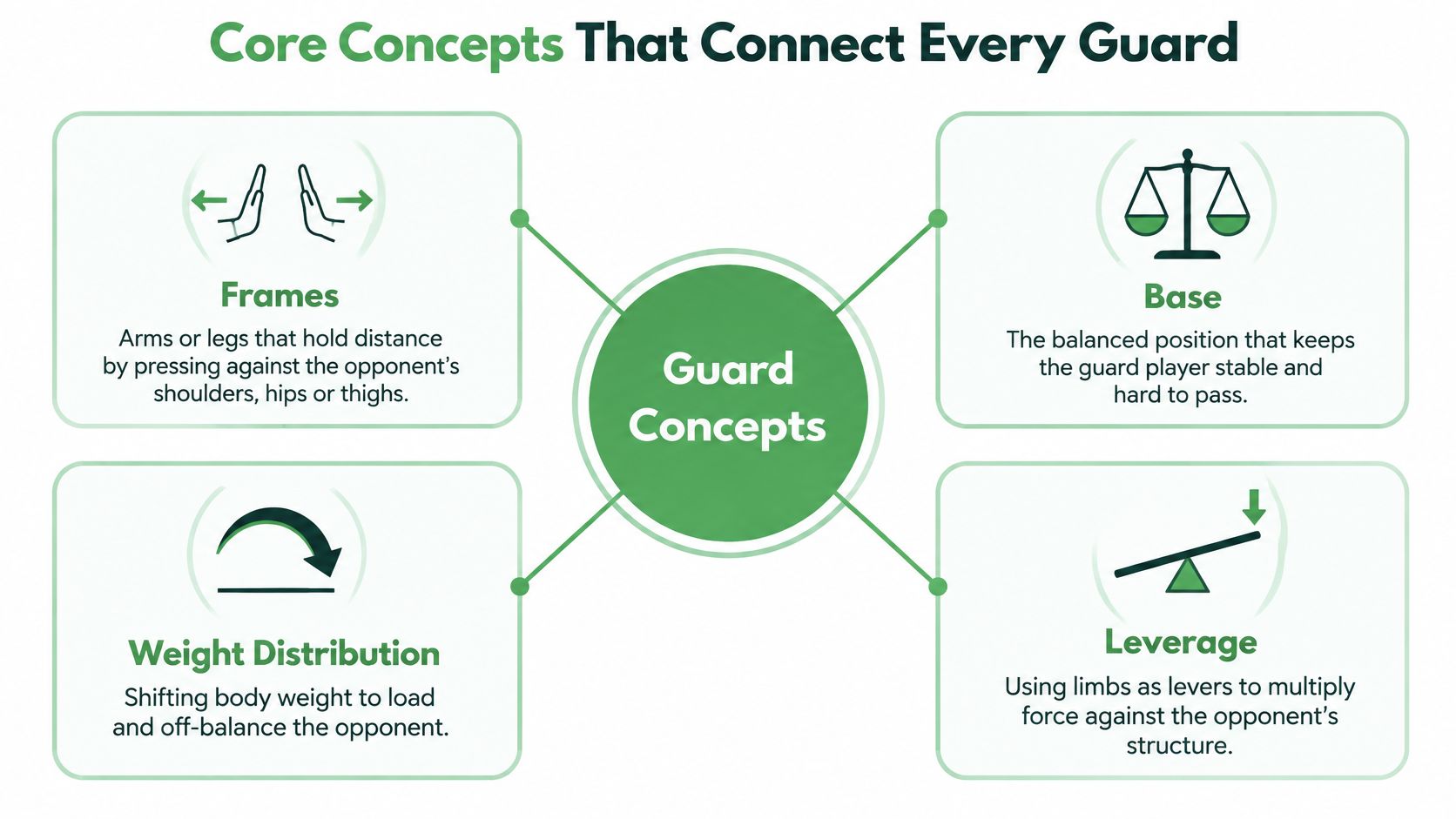
Skip a step and the sweep fails for a simple reason. Without a frame or an angle you are only pushing, and a push into a balanced passer goes nowhere. No-Gi uses the same order. The hand holds change. The frames, hips, and angles stay put.
Here's a walkthrough of the concepts in motion before your next session.
Before every attack, name four things: the frame, your base, the grip, and the angle. If any one is missing, fix that first.
Closed Guard and Its Control Principles
Closed guard is the version where the legs lock around the opponent's waist, with ankles crossed or hooked behind the back. It's the first guard beginners learn, and the one that reveals whether they understand control or are holding on.
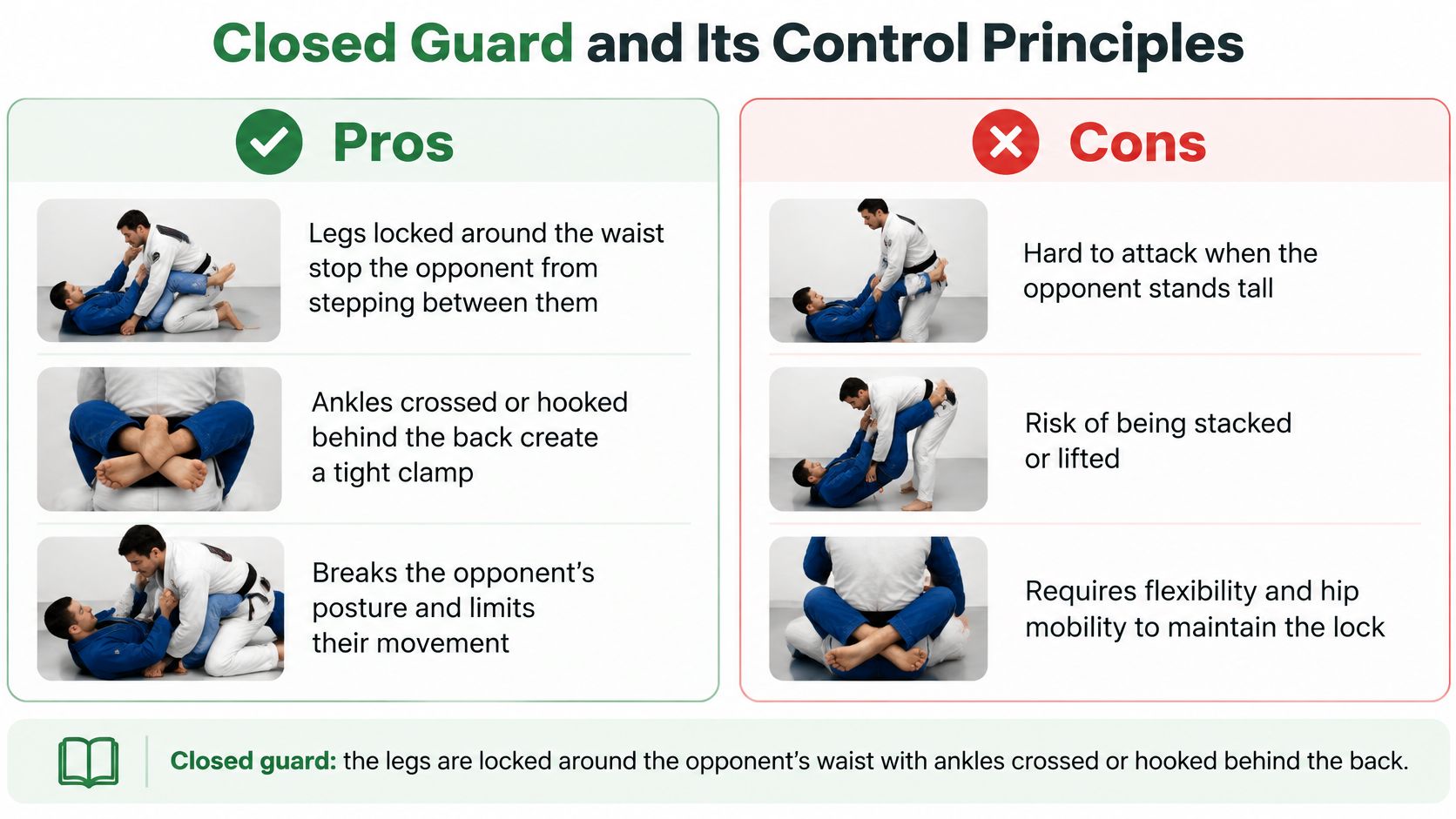
The order of control
Three steps, always in this sequence.
Break posture first. Pull the head down with a collar or sleeve grip and keep your elbows tucked in. A passer standing tall can open your legs and stack you; a passer whose posture is broken can't.
Keep the hips mobile. Shift your angle before you attack. A sweep launched from flat hips is a push, and the passer feels it coming.
Use the legs to steer hips, not just to squeeze. Your legs control the opponent's hip line, which decides whether they can stand, kneel or circle.
Three attacks to learn first
The hip bump sweep starts with a sit-up, using the momentum to roll the passer over one shoulder. The triangle choke uses one arm in, one arm out, with the legs locking around the neck and shoulder. The armbar comes from controlling a wrist and turning your hips to isolate the elbow.
Each one depends on the posture break you did first. Skip it and the attack becomes a scramble.
The mistake that gets people passed
A guard player clamps their legs tight and never touches the opponent's posture. The passer stays upright, opens the guard with a hand on the hip and knee, and the guard player ends up folded underneath with nothing to work from.
Closed guard is strong against a standing passer, but it costs energy. Active hands and mobile hips tire you faster in long rounds, so pace it. Try this drill: break posture, hold it for five seconds, then attack, then reset. Five rounds of that teaches the pattern better than a hundred repetitions of the sweep alone.
Open Guard Variations Including Butterfly, De La Riva and Spider
Open guard is any guard where the legs aren't locked around the opponent. The feet, shins and hooks manage distance instead. Nothing here is passive. The moment your feet stop working, the passer steps through, so open guard rewards constant small adjustments.
Butterfly guard
Both hooks sit inside the opponent's thighs while you sit up rather than lie back. The first sweep to learn is the basic hook sweep: load the opponent's weight onto one hook, lift, and roll them over the other side. The common mistake is leaning back before the hooks are set, which hands the passer a free pass.
De La Riva guard
Your outside hook threads around the opponent's lead leg while you grip their ankle or sleeve. The entry sweep off-balances them over that hooked leg and takes you to the top or to their back. Watch the hook, because letting it slide off the leg converts your attack into their pass.
Spider guard
Your feet press into the opponent's biceps with sleeve grips holding the arms pinned. From there you can sweep or set up triangle and armbar entries. Releasing a sleeve grip too early is the usual error, since the guard depends on both arms staying controlled.
Open guard changes with the opponent's stance and grips. A kneeling passer gives you different entries than a standing one, and a passer who strips your grips forces you to re-establish them before anything else.
Decision rule: choose the open guard that matches the grips you can actually keep, not the one that looks best on video.
Half Guard and Specialist Guards Explained
Half guard is where one of your legs is trapped across the opponent's leg, and you use an underhook to limit their hip movement. It's common because it's easy to reach from a failed sweep, a bad scramble or a near pass, and it gives a reliable base to sweep, recover full guard or take the back.
The underhook is the whole position. Lose it and your own knee becomes a trap, pinned under the passer's weight while they flatten you. Keep it and you can move their hips, which is what every half guard escape depends on.
The knee shield
The knee shield is a shin or knee frame placed across the opponent's chest or hip. Its job is space. It buys enough distance to recover guard, and it only works once that space exists, so build the frame before you try to move away.
Specialist guards and when to learn them
X-guard puts you underneath the opponent with your legs on their hips, loaded to sweep them over. It's powerful, but it demands confidence being underneath a heavy opponent.
Rubber guard binds the opponent's wrist or sleeve with the legs and arms to open up chokes and joint locks. The control has to be accurate, and a loose version leaves your own knee exposed. It's best learnt once closed and open guard feel stable.
Treat all three as situational tools. They reward players who already understand frames and hip movement, and frustrate players still learning them.
How Gi and No-Gi Change Guard Play
What happens to a guard when the cloth you were holding disappears?
The Gi is the traditional jacket and trousers. No-Gi uses sports pants and a shirt, so there is no jacket to grab. A grip is a hand hold on fabric or on a limb. In the Gi, sleeve, collar and trouser grips are the control many guards depend on. Those holds set distance, keep the guard and turn the opponent without much strength. The cloth works like a handle: pull the sleeve and the arm follows.
Take the collar away and that handle is gone. No-Gi control comes from the body: an underhook or overhook, wrist control, head position, a body lock, or the legs. A technique built on a collar grip has nothing left to hold.
The guard keeps its job, but the control changes. Closed guard, legs locked around the waist, often uses a collar and a sleeve. Without the jacket it uses wrist control and hip movement. Spider guard depends on sleeve grips. Without sleeves it becomes a frame, a limb used as a barrier, plus inside control from the feet and hands.
Learn each guard in both formats. For No-Gi, choose the version that stands on frames, hip movement, head position and leg placement. The wider differences are in this guide to Gi vs No-Gi training.
How Guard Sweeps Earn Points in Competition
A sweep is a reversal from the bottom position in which the guard player finishes on top. Some coaches use the Portuguese terms raspagem or raspada for the same action.
Action | Result |
|---|---|
Completed sweep held in the new position | 2 points |
Positional advancement | Points awarded, value set by the event's rules |
Successful choke or joint lock | Immediate win |
Credible unsuccessful attempt to advance or submit | Advantage |
The scoring logic is straightforward. The rules summary published by an Australian jiu-jitsu academy awards 2 points for a completed sweep held in the new position, gives points for positional advancement, and ends the match immediately for a successful choke or joint lock. A credible attempt that doesn't land can still earn an advantage. This reflects the competitive logic of Brazilian jiu jitsu, where the guard controls distance, creates off-balancing force and reverses the match rather than absorbing pressure.
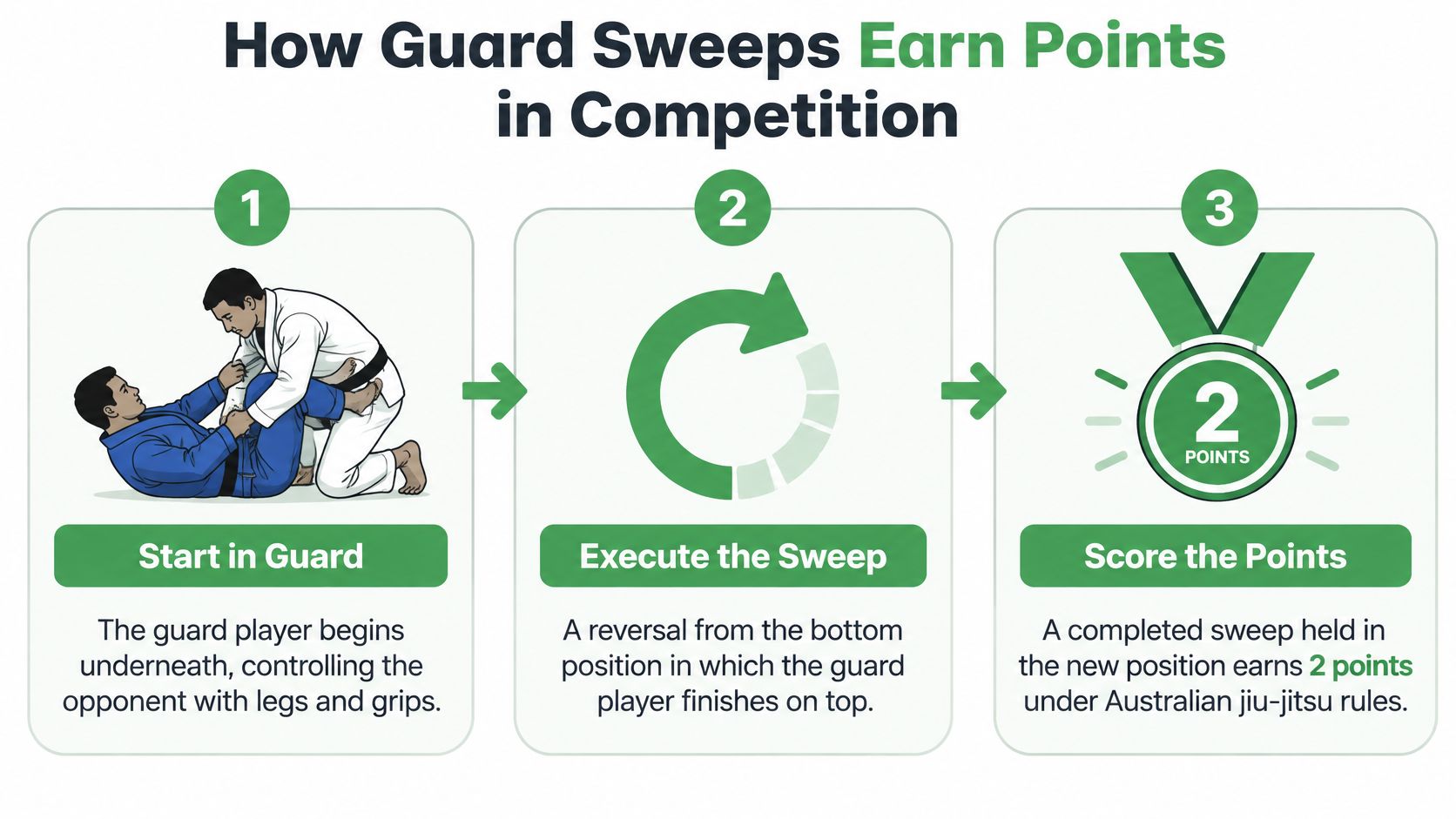
The three stages above are what the scoreboard is measuring.
A beginner sweep in five steps
Establish a stable guard with your hips and legs controlling the opponent.
Manage their grips or frames before they manage yours.
Off-balance them toward one side, so their weight sits over one knee.
Complete the reversal in one movement, with your hips leading.
Stabilise on top and hold it, because the points follow the hold.
Three sweeps do most of the work for beginners. The scissor sweep opens the guard and cuts the legs across. The hip bump uses a sit-up against a broken posture. The pendulum sweep swings the legs to lift and roll a heavier opponent.
Rules decide which sweep is available to you. The Australian Federation of Brazilian Jiu-Jitsu identifies the International Brazilian Jiu-Jitsu Federation rule set as the framework for its competitions, and permitted techniques vary by age, belt and division. Check the current event rules before relying on a particular sweep or grip, and see our BJJ rules for beginners for the wider scoring picture.
Holding guard alone may not score. Aim every exchange at a result the rules recognise.
Guard Safety and Training Load
Two things keep guard training safe: protecting the head and neck, and matching weekly load to the person training. Both have published Australian guidance behind them.
Concussion first
The Australian Sports Commission concussion guidance defines concussion as a brain injury from a head impact, a blow elsewhere on the body that sends force to the head, or a fall. All three appear in guard work: a passer dropping weight, an uncontrolled scramble, a backward fall out of a sweep.
The response is fixed. Stop the session if concussion is suspected, keep the person with a responsible adult, and require medical clearance before returning. The same guidance recommends at least 14 days symptom-free at rest before contact training resumes, and at least 21 days before competitive contact for athletes under 19 and community participants.
Headgear and mouthguards are not a control strategy. That guidance states helmets and similar equipment offer little or no demonstrated protection against concussion, though they do reduce dental injuries and lacerations.
Coaching rule: no neck cranks, no posting on the crown of the head, and a written return-to-training process for any suspected head injury.
What children learn before submissions
The AIHW figures on Australian children's physical activity recommend at least 60 minutes of moderate-to-vigorous activity every day for ages 5 to 17, with vigorous and strengthening activity on at least three days a week and screen time generally capped at two hours a day. Guard sessions contribute to that. Ask what comes before submissions: safe falling, head protection, pressure control and tapping early.
What adults can realistically fit in
The Better Health Channel physical activity guidelines recommend 150 to 300 minutes of moderate activity or 75 to 150 minutes of vigorous activity each week for adults aged 18 to 64, plus muscle strengthening on at least two days. The same guidance notes some activity is better than none, which is why two short, consistent guard sessions beat one long session every few weeks.
Small precautions add up, and SunnyBay's sports injury prevention tips are a useful companion for warm-ups and recovery between sessions. For mat-specific habits, our post on preventing injuries in BJJ covers the details.
Choose Your First Guard and Start Training
Which guard should you learn before the others? Start with closed guard, where your legs lock around a partner's waist, and with the hip escape, the shrimping motion that slides your hips out from under their weight. Closed guard depends on one control: your hips and closed legs holding their posture. The hip escape rebuilds that angle when they start to stand or pass. Later guards borrow both skills.
Once frames, the stiff arms and legs that keep space, and your hip movement feel steady, add one open guard. Butterfly guard depends on hooks, your insteps tucked under their thighs so you can lift and off-balance them. De La Riva depends on one leg wrapped around their lead leg, plus a grip on the ankle or sleeve. Choose butterfly if you like sitting up and elevating. Choose De La Riva if you prefer one long hook and a grip fight. Learn one of them this month, not both.
A workable beginner week stays small. In the first session, stay in closed guard and break posture before any sweep or attack. In the second, drill only the open guard you chose and keep the hooks, or the De La Riva leg and grip, alive for the whole round. On other days, spend five minutes on hip escapes and bridges. When you recover guard after a near pass, slow down and name what broke your control. That habit teaches more than another technique name.
Locals Jiu Jitsu Alexandria runs a Beginners program that builds a strong foundation of fundamental techniques and concepts for all ages, genders and fitness levels, including people with no previous Jiu Jitsu experience. A free trial class is available, and the academy is close to Beaconsfield. Visit Locals Jiu Jitsu Alexandria to check the timetable and book a session. Pick one guard for this month and practise it in that class.
Comments