
Jiu Jitsu Teens: Classes, Skills and Progress Explained
What if the main question about Jiu Jitsu teens classes isn't whether your teen is tough enough, but whether the training is structured, safe and active enough to suit their week? That's the gap many families miss. They picture sparring first, when they should picture coaching, progression and clear safety rules.
The context matters in Australia. The Australian Institute of Health and Welfare physical activity report found that in 2022, an estimated 83% of Australians aged 15 to 17 did not meet the physical-activity component of national guidelines. A regular, coached class won't fix that on its own, but it can give a teen a reason to turn up, move and learn with peers.
Table of Contents
Teen Class Formats at a Glance - Where a New Teen Starts - When Teens Move Beyond Beginners
What Teens Build in Class, Skill by Skill - Leverage, Balance and Strategy - A Worked Example on the Mat
Confidence, Discipline and Friendships on the Mat - The Honest Side
How Much Activity Jiu Jitsu Adds to Your Teen's Week - How a Class Can Count
Concussion Return Steps and In-Class Safety - When a Teen Hides Symptoms - Safety Habits Built Into Class
How Teens Progress Through the Program - From Fundamentals to Blue Belt and Beyond - What a Typical Class Looks Like
Is Jiu Jitsu the Right Fit for Your Teen? - Questions to Ask Before Joining
Teen Class Formats at a Glance
At Locals Jiu Jitsu Alexandria, the right class depends on a teen's experience and the training format they want to learn. The table shows how the programs differ.
Format | Best for | What it focuses on |
|---|---|---|
Beginners program | New to martial arts or Jiu Jitsu | Fundamental movements, positions, submissions, leverage, balance and strategy |
Advanced program | Blue belt students working towards black belt | Techniques and concepts in greater depth |
No-Gi and grappling | Teens interested in grappling without the traditional uniform | Wrestling techniques, grips, submissions and preparation for No-Gi competition |
Children's program | Children in the kids program | Coordination, focus, discipline and self-defence skills |
Where a New Teen Starts
A teen with no Jiu Jitsu experience can start in the beginners program. It covers fundamental movements, positions and submissions, as well as concepts such as balance and strategy. The program accommodates different ages and fitness levels, so a teen does not need to arrive already fit or experienced. They can build fitness as they learn, one movement at a time.
Families comparing martial arts options can read about martial arts classes in Alexandria. For a teen new to Jiu Jitsu, the beginners program provides a structured introduction.
When Teens Move Beyond Beginners
The advanced program is for students who have reached blue belt and want to explore Jiu Jitsu in greater depth as they work towards black belt. A belt level, rather than time spent attending, marks the program's entry point.
No-Gi and grappling classes focus on training without the traditional Gi, incorporating wrestling techniques, grips and submissions specific to this format. They can also prepare students for No-Gi competition. Ask the academy which format is suitable for your teen and what to wear.
Practical guide: Beginners start with foundational training. Blue belt students can explore the advanced program, while No-Gi offers a distinct grappling format.
Locals Jiu Jitsu Alexandria's Jiu Jitsu for Kids program introduces children to training in a fun, safe and engaging environment. It develops coordination, focus, discipline and self-defence skills. For a teen's first visit, bring comfortable clothing that allows full movement and a water bottle. When booking, ask which format your teen will train in and what to wear.
What Teens Build in Class, Skill by Skill
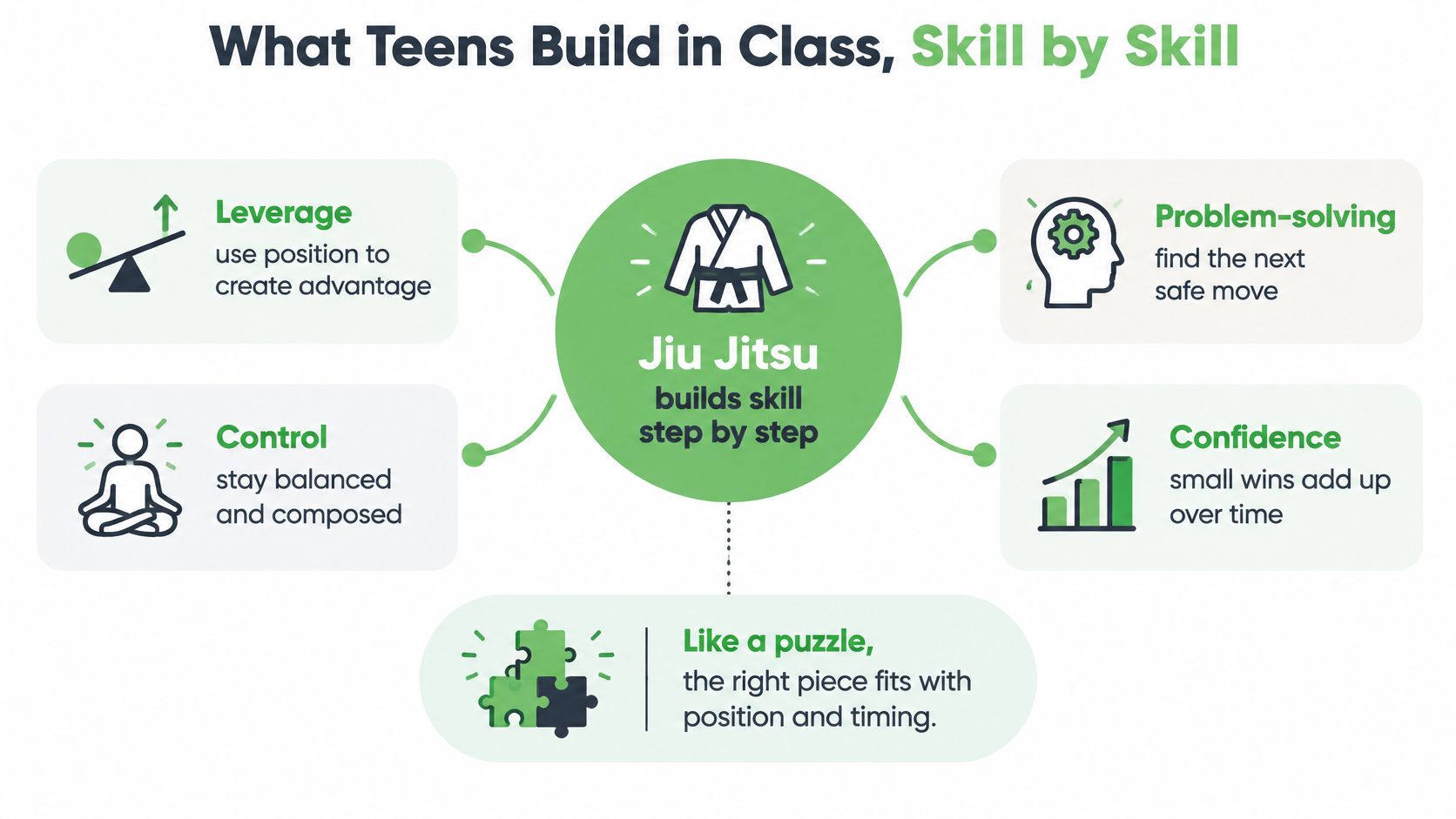
Think of Jiu Jitsu as a puzzle you solve with your body. A smaller person can use technique and position to control a bigger one, a bit like opening a heavy door. Push near the hinge and it's hard work. Push at the right point, with timing, and the same door moves with far less force.
The skills below show how that puzzle comes together in class.
Leverage, Balance and Strategy
Mechanical advantage means using small force at the right angle. In a beginners class, a teen might learn to turn their hips and use a frame with their arms instead of trying to bench press a partner off them. It's slower to learn than pushing hard, but it works when strength runs out.
Balance has two sides. Your teen learns to keep their own base so they don't get tipped over easily, and to notice when a partner's weight shifts so a sweep becomes possible. Coaches drill posture first, because good posture makes almost every later technique safer and clearer.
Strategy means planning ahead. A beginner asks, what do I do now? A more experienced teen asks, if I move here, what will my partner do next, and what does that open up for me? That shift doesn't arrive in one lesson. It grows through repetition.
A Worked Example on the Mat
Say a teen is pinned under a partner's weight. Panicking and pushing straight up usually fails. Instead, they practise a sequence. They turn slightly onto one side, use hip movement to create a pocket of space, place frames to protect that space, then bring a knee through to recover guard, a position where their legs help control the distance.
That one escape teaches several things at once. The teen uses technique rather than raw strength, protects their balance, and follows a plan under pressure. They'll drill it slowly with a cooperative partner before they try it in a live round.
Over months, parents often notice changes in this order:
Posture and body control: Your teen stands, moves and falls with more awareness.
Quicker escapes: Familiar positions stop feeling like dead ends.
Calm problem solving: They breathe, look for space and choose a move instead of freezing.
Clearer position knowledge: They can name where they are and what comes next.
Technique is learned through repetition in drills before live rounds, so early progress can look quiet. That's normal. Like the puzzle, the right piece fits when position and timing line up, not when a teen forces it.
Confidence, Discipline and Friendships on the Mat
Confidence in Jiu Jitsu usually grows from repeated small wins, not from a speech about believing in yourself. A first clean escape counts. So does tapping early and calmly, or showing a new partner a drill you've finally understood.
This photo shows the kind of supervised, peer based setting where those small wins happen.
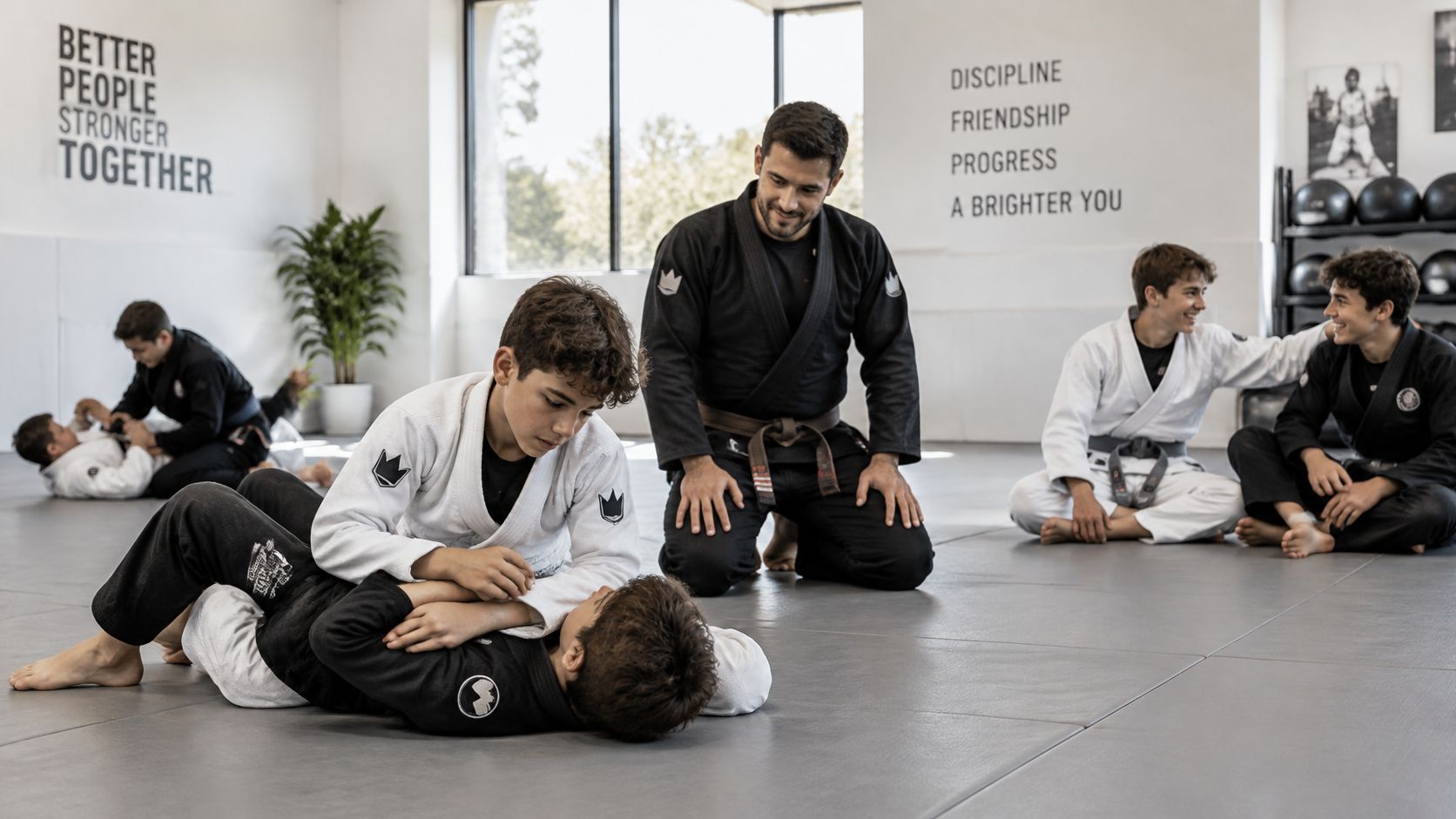
We aim for respectful, controlled training and an inclusive community across age, gender, race, religion and social background, guided by values of wellness, discipline, connection and innovation. For a teen, discipline looks ordinary. They arrive on time, listen to the coach, repeat drills when they'd rather skip to sparring, and look after their training partner.
Friendships tend to form because Jiu Jitsu can't be practised alone. Teens need partners to drill, test escapes and give honest feedback, so they build a regular social circle outside school. That can suit a teen who hasn't clicked with team sports but still wants connection.
The Honest Side
Some teens feel nervous at first, and losing a roll can sting. That's not a sign they've chosen the wrong activity. Coaches teach tapping early so no one gets hurt, and a tap resets the round. The skill is learning to reset your breathing and try again.
Parents also need a wider lens. Training can support routine and connection, but it isn't treatment for mental health concerns. If you're worried about mood changes at home, a parent's guide to adolescent depression can help you recognise signs that need professional support.
The short video below gives a sense of class movement and coaching in practice.
After a month, confidence may look practical rather than dramatic. Your teen might speak up sooner in class, recover faster from a setback at school, or organise their bag and training days without prompting.
How Much Activity Jiu Jitsu Adds to Your Teen's Week
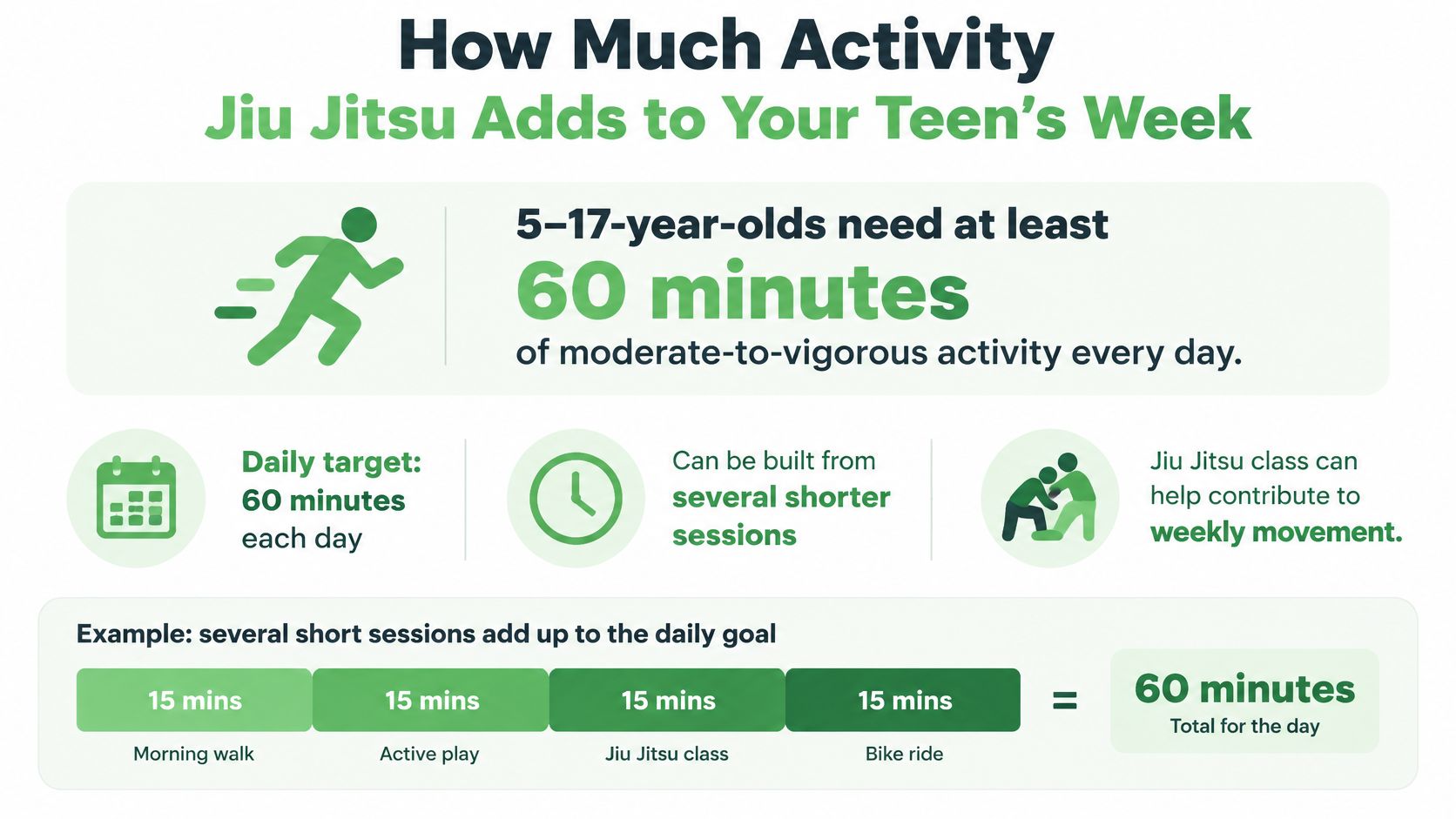
Start with the Australian benchmark, then test a class against it. The Australian Government physical activity recommendations for children and young people aged 5 to 17 years set the target at at least 60 minutes of moderate-to-vigorous physical activity every day, and that total can be accumulated through several shorter sessions. The same guideline recommends vigorous activity and muscle and bone strengthening activities on at least three days each week.
The infographic below puts that daily target in plain terms.
How a Class Can Count
A Jiu Jitsu session usually mixes several types of effort. The warm up and repeated drills raise heart rate. Positional rounds involve resistance, balance and holding posture against a partner. Controlled grappling adds pushing, pulling and bridging, which create strength demands across the body.
That doesn't mean every class automatically covers a full day's target. Intensity depends on duration, pace, rest periods and your teen's effort. Our breakdown of whether BJJ is good for fitness goes deeper on how training load builds over time.
For example, a teen might do a 60 minute class, walk for 20 minutes on another day, and ride a bike on the weekend. The guideline is measured across the whole day, not per session, so class works best as one strong piece of an active week alongside walking, cycling or another sport.
Recovery matters too, especially when a teen adds new training days. Sleep, food and easier days between hard sessions help them adapt, and these practical ideas to improve recovery between workouts can help families build sensible habits at home.
Concussion Return Steps and In-Class Safety
What should you do if your teen takes a knock to the head during Jiu Jitsu? Stop training and arrange a medical assessment. The Australian Sport Australia concussion guidance for youth and community sport says an athlete should be symptom-free at rest for 14 days before returning to contact training, and should not return to competitive contact sport before day 21. A healthcare practitioner should diagnose concussion, so don't try to assess it from the sideline.
Situation | Action | Timing |
|---|---|---|
Suspected concussion | Stop training and get a medical assessment | The same day |
Symptoms at rest | No contact training until symptom-free at rest | At least 14 days |
Return to competitive contact | Get medical clearance before returning | Not before day 21 |
When a Teen Hides Symptoms
Some teens may stay quiet because they feel embarrassed or worry about missing class. Ask calmly whether they hit their head and whether they have a headache, dizziness or trouble concentrating. Reassure them that speaking up is the right choice, then tell the coach.
Reporting symptoms early protects your teen's recovery. Toughing it out after a head knock can make it harder to return safely.
A return to training should be gradual and guided by medical advice. After clearance, a sensible progression is non-contact movement, technical drilling, low-intensity positional work, then higher-intensity live grappling. Coordinate with the school too, since concentration and screen time can affect recovery.
Safety Habits Built Into Class
Safe falling, good neck and spine alignment, controlled movement, and tapping early help reduce risk during training. Tapping tells a partner to release a submission. Teens should practise it without hesitation, before discomfort becomes pain.
A sensible class progression moves from technical drilling to low-intensity positional rounds, then to higher-intensity live grappling. Coaches should adjust training load for factors such as a growth spurt, a previous injury or poor sleep. If a teen twists an ankle, stop training and seek appropriate care. This ankle sprain advice from Adventure Medical Kits offers a home reference while you arrange assessment if pain or swelling persists.
How Teens Progress Through the Program
Progress in Jiu Jitsu follows a sequence, and understanding that sequence helps families avoid a common worry. Slow early progress usually means the plan is working, not that a teen is falling behind.
From Fundamentals to Blue Belt and Beyond
A teen starts in the beginners program, where fundamental movements, positions and submissions are repeated until they feel natural. Once a student reaches blue belt, the advanced program deepens technique and concepts on the path to black belt. If you want the grading picture in full, our guide to the Jiu Jitsu belt system explains how levels connect.
Progress depends on skill and readiness, not age alone. Two teens can start in the same month and move at different speeds because one attends more often, one is growing quickly, or one needs longer to feel calm in live rounds.
For example, a 14 year old who repeats escapes for six weeks before trying live rounds is following the plan. They're building posture, breathing and control first. Rushing that teen into hard rounds would teach survival habits, not good technique.
What a Typical Class Looks Like
Most sessions follow a clear pattern:
Warm up: Movement, mobility and falling practise to prepare the body.
Technique demonstration: The coach shows one idea in steps.
Paired drilling: Partners repeat the technique with light resistance.
Positional rounds: Teens start from a set position and work on a narrow goal.
Live rounds: Only once they're ready, with control as the condition for continuing.
Classes are grouped by age and experience, so a 14 year old beginner trains with peers at a similar level. Our experienced coaches prioritise safety and progression, and they'll adjust a teen's load if control drops.
Attendance matters because the staged plan depends on repetition. Ask the coach two questions. What is my teen's next milestone, and how often should they train each week to reach it steadily? Clear answers make progress easier to judge at home.
Is Jiu Jitsu the Right Fit for Your Teen?
A good fit isn't about being naturally athletic or fearless. It's about whether your teen can enjoy the process of learning something physical, slowly, with other people close by.
Use this checklist as a starting point:
Enjoys physical challenge: They like moving, problem solving or testing themselves.
Can handle being tapped: They can lose a round, reset and try again.
Accepts coaching feedback: They'll listen and adjust, even when it's frustrating.
Will attend regularly: They can commit to a routine most weeks.
A nervous teen can still tick most of that list. Nerves before a first class are common. A poor fit is more likely if a teen strongly dislikes close contact, won't accept partner based learning, or is being pushed into training they don't want.
Questions to Ask Before Joining
Ask how classes are grouped by age and experience, what the injury and concussion policy is, and how the coach handles privacy, changing room arrangements and questions about periods or body image. These aren't awkward extras. They're part of safe participation.
Australian data summarised by the Sport Australia Clearinghouse on gender factors in children and youth sport shows 68% of respondents reported skipping sport because of their period, 90% worried about leaking and 72% felt anxious about their period while playing sport. So ask whether period related concerns can be discussed privately, what changing options exist, and whether training wear can be adjusted for comfort.
After joining, watch for red flags such as persistent pain, sudden reluctance to attend or signs of distress. Talk to your teen and the coach early. A trial class usually answers fit questions faster than reading about them, because your teen can feel the pace, contact and coaching style for themselves.
Book a Free Trial Class to See It First
The clearest next step is to watch a class with your own questions in hand. Locals Jiu Jitsu Alexandria offers a free trial class for all levels, and you can check the timetable and book a session that suits your teen's school week.
During the trial, watch three things. Notice how the coach explains drills and corrects technique. Notice how students treat each other when someone taps or makes a mistake. Above all, notice whether your teen wants to return.
Bring a short list of questions on the day:
Grouping: Which class will my teen join first, and who will they train with?
Safety: How do you handle tapping, injuries and suspected concussion?
Progress: What should my teen focus on in their first month?
Comfort: What should they wear, and where can they change?
You can contact us by phone at 0414752412 or by email at team@localsalexandria.com.au, and we'll get back to you as soon as possible. This week, pick a class time, book the trial, and bring your questions to the first session. One visit will tell you more than another week of guessing.
If your teen needs a structured activity that builds skill, fitness and calm under pressure, Locals Jiu Jitsu Alexandria offers teen suitable beginners, advanced and No-Gi training with experienced coaches who put safety and progression first. Book a free trial, watch a real class in Alexandria, and see whether the mat feels like the right fit. Start by visiting Locals Jiu Jitsu Alexandria to check the timetable and choose your first session.
Comments